
Reading time: ~7 minutes

You’ve rewritten the same three sentences four times. Nobody has read any of them yet. You’re not stuck on the wording. You’re stuck on what happens after you send it.
Analysis paralysis.
Maybe it’s a piece of feedback you haven’t delivered. A decision you haven’t announced. A phone call you’ve rehearsed in your head so many times that you could recite both sides of it, and you still haven’t dialed.
Rumination. Over thinking.
Nothing dangerous is happening. No one in the room is judging you, because there’s no one in the room at all. And your body is responding as if there were.
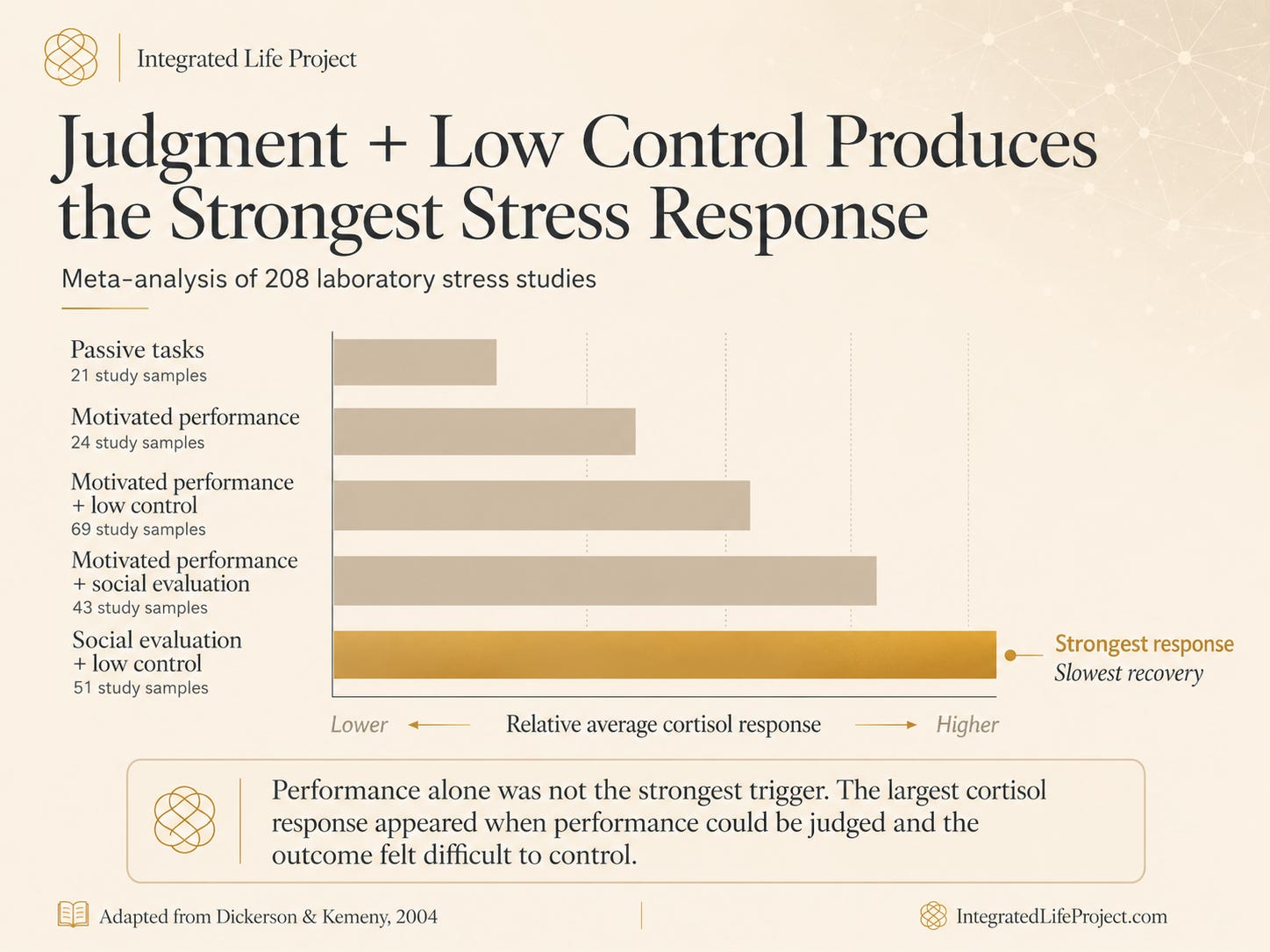
For decades, researchers assumed the body’s stress response was mainly about danger and control: things like pain, unpredictability, or situations you can’t influence. Then in 2004, psychologists Sally Dickerson and Margaret Kemeny reviewed 208 laboratory studies of stress and cortisol, looking for the pattern underneath all of them (Dickerson & Kemeny, 2004).
What they found reordered the picture.
The strongest and most consistent trigger of a cortisol response wasn’t physical threat or even lack of control on its own. It was what they termed social-evaluative threat: a situation in which some part of you could be judged, negatively, by someone else.
Tasks that combined this with a lack of control produced the largest hormonal response and the slowest recovery of anything in the analysis.
Read that again with your own days in mind. A huge amount of what a leader does, delivering hard feedback, making a call your team will judge, presenting a decision to people above you, is exactly this kind of task. Performance, with judgment possible, and a result you don’t fully control.
Here’s a detail that matters more than it seems to. A few years after Dickerson and Kemeny’s review, a follow-up study asked a sharper question: is it being watched that causes the stress response, or is it the possibility of being judged?
Researchers had participants complete a stressful task either alone, in front of someone who was simply present but paying no attention, or in front of an audience actively evaluating their performance. Only the evaluative audience produced a cortisol response. Mere presence, without judgment attached, did nothing (Dickerson, Mycek, & Zaldivar, 2008).
This is worth sitting with. You can be completely alone, at your kitchen table, with no one watching at all, and still trigger this response, because your nervous system is responding to the possibility of judgment, not the literal presence of a judge. The board member who hasn’t responded yet. The direct report who might push back. The peer who’s watching how you handle this. None of them have to be real, present, or even paying attention. The anticipation does the work by itself.
It would be one thing if this only cost you a bad feeling for a few minutes. The research says it goes further than that.
In a follow-up experiment, Dickerson and colleagues found that people who underwent a social-evaluative stressor, a speech and math task performed in front of an actively judging panel, showed a measurable increase in a marker of inflammation in their blood afterward, compared with people who did the same task with no evaluative audience present (Dickerson, Gable, Irwin, Aziz, & Kemeny, 2009).
The body wasn’t only reacting emotionally. It was mounting a biological response more typically associated with fighting off illness.
This doesn't mean one hard conversation is making you sick. It means the cost of chronic, repeated evaluative pressure isn't confined to your mood. If your role regularly puts you in front of real or imagined judgment, and for most people carrying real responsibility, it does, that's not a small thing to shrug off as "just nerves."
You can’t opt out of being evaluated. Leading, or simply performing at a high level, means your calls and your work are regularly in front of people who get to have an opinion about them. But the research points to a few things that specifically change how costly that is.
Name what you actually control. Since the worst responses in Dickerson and Kemeny’s review came from tasks that combined judgment with a lack of control, the more clearly you can separate “what I’m sending” from “how it’s received,” the less your body has to treat the whole situation as unpredictable. You control the quality and the timing of the work. You never controlled the reaction. Naming that split, out loud if it helps, changes what your nervous system is being asked to brace for.
Notice when the audience is imagined. Since an evaluative presence caused the stress response and mere presence did not (Dickerson, Mycek, & Zaldivar, 2008), it’s worth asking, honestly, whether the judgment you’re bracing for is coming from someone real and specified, or from a general, faceless “someone might.” A lot of the second kind evaporates once you try to name exactly who, and what they’d actually say.
Take the recovery seriously, not just the moment. Because this research found the slowest recovery times in situations combining threat and low control, the period right after you hit publish or send matters as much as the moment itself. A short, deliberate pause to let your body come back down is not indulgent. It’s the other half of the stress response finishing its job.
None of this makes the judgment go away. It changes what your body is doing with it, and that’s the part that’s actually costing you.
What's the thing you're circling right now, rewriting instead of sending?
Reply and tell me. I read every one.
This is the third in a five-part series on the physiological patterns that quietly shape a high-performing leader's day. Next: the open loops still sitting in the back of your mind, and why they're costing you even while you're not thinking about them.

Lisa Bollow is a therapist, neuroscience-informed performance strategist, and founder of Integrated Life Project. Her work examines how nervous system regulation, emotional clarity, and cognitive capacity shape leadership, decision-making, well-being, and sustainable performance, integrating clinical insight, neuroscience, and practical strategies for high-functioning individuals and leaders.
Read more on Substack: https://integratedlifeproject.com
Connect on LinkedIn: https://www.linkedin.com/in/lisagoodwinbollow
View my Psychology Today profile: https://www.psychologytoday.com/profile/1572857
References
Dickerson, S. S., Gable, S. L., Irwin, M. R., Aziz, N., & Kemeny, M. E. (2009). Social-evaluative threat and proinflammatory cytokine regulation: An experimental laboratory investigation. Psychological Science, 20(10), 1237–1244.
Dickerson, S. S., & Kemeny, M. E. (2004). Acute stressors and cortisol responses: A theoretical integration and synthesis of laboratory research. Psychological Bulletin, 130(3), 355–391.
Dickerson, S. S., Mycek, P. J., & Zaldivar, F. (2008). Negative social evaluation, but not mere social presence, elicits cortisol responses to a laboratory stressor task. Health Psychology, 27(1), 116–121.
Comments
Nothing yet. Say the first thing.
Sign in to join the conversation.