
Augustus began as Ivy, a merchant-checkout product built on open banking. Over time, integrations with Mollie, Kraken and Circle pulled it towards larger institutional flows, stablecoins and dollar infrastructure. In July 2025, management decided to pursue a US national bank charter.
The logic is clear. A bank beneath the API could hold customer accounts, control its own ledger, access payment systems and rely less on sponsor banks. It could also serve international fintech and digital-asset companies that often struggle to secure reliable dollar banking.

The challenge is execution. Augustus is proposing deposits, lending, correspondent banking, treasury services, tokenised deposits, digital-asset infrastructure and BIN sponsorship, while still building many of the systems required to support them. It has not yet shown that Marble, its proprietary platform, lowers operating costs or that payment volume can be converted into durable bank earnings. Its public position on issuing a stablecoin has also shifted.
For now, Augustus is best understood as a European payments company attempting to become a stablecoin-era wholesale bank. It may eventually build a distinctive clearing platform. It has not yet done so.

Ferdinand Dabitz grew up and went to school in Berlin. The clearest independently verifiable detail from his early years has little to do with banking or technology. It concerns Latin.
In May 2019, Dabitz and Peter Mosebjane Lieck represented the Evangelisches Gymnasium zum Grauen Kloster at the Certamen Ciceronianum Arpinas in Italy. After a five-hour examination, Dabitz finished fourth in a field of roughly 200 students, according to records published by the school and the competition. Lieck took part in the same event. The records confirm that the two were schoolmates by 2019, though they do not establish when they first met.
Augustus’s recruiting materials say Dabitz later studied law at Ludwig Maximilian University of Munich and worked or conducted research at the Bundestag, the Max Planck Institute for Innovation and Competition and McKinsey. We were unable to independently verify the dates, the nature of those roles or whether he completed Germany’s state-examination process. Describing him as either a law-school dropout or a qualified German lawyer would therefore go beyond the available evidence.
His legal background nevertheless offers some insight into the way he presents the company. Dabitz tends to speak in institutional terms, focusing less on software features than on statutes, monetary systems and the boundary between private enterprise and the state. Former regulators recruited by Augustus have said that he approached regulation as part of the product design rather than as a problem to be addressed later.
Greg Quarles, the proposed president of the bank, told Dallas Innovates that advisers had warned the founders that a charter application would require an experienced banker. Augustus subsequently hired him through an executive search.
That hiring decision also points to the central weakness in Dabitz’s profile. He has no disclosed experience managing deposits, liquidity, credit risk or a regulated balance sheet through a period of market stress. Augustus has tried to compensate by separating the group’s strategic leadership from the operational work required to establish the bank and by recruiting executives with direct regulatory and banking experience.
The Augustus name reflects Dabitz’s interest in classical history. He has connected it to the Roman emperor’s consolidation of control over coinage and to Augustus’s rise from underestimated heir to political ruler. As branding for a company moving from payment routing into monetary infrastructure, the reference is understandable. It should not be treated as a serious historical basis for the business. The broader claim sometimes associated with the story, that Augustus invented modern currency, is not supported by the historical record.
Dabitz’s selection for the 2025 Thiel Fellowship added another element to the founder narrative. By then, Ivy had already raised both its seed and Series A rounds. The Thiel Foundation described the company as a “world trade bank”, one of the earliest public signs that management’s ambitions had expanded well beyond merchant checkout.
Fellows receive $200,000 over two years and must be no older than 22 when they apply. The foundation did not explain why it selected the founder of an already well-financed company, and there is no public evidence that the fellowship shaped Augustus’s bank-charter strategy.
The surrounding network may still have been useful. Valar Ventures, co-founded by Peter Thiel, had led Ivy’s Series A, while the fellowship placed Dabitz within a community of founders and investors receptive to unconventional projects operating at the edge of technology and regulation. That may have helped with fundraising, recruitment and access. It says nothing, however, about customer demand, operating performance or the company’s standing with regulators.
Augustus is usually presented as Dabitz’s company, but the original product was built by a broader founding team.
Peter Lieck, who attended the Graues Kloster school with Dabitz, later studied corporate management and economics at Zeppelin University, according to company biographies. He initially oversaw revenue and commercial development and is now described, depending on the source, as either chief revenue officer or chief commercial officer. His role appears to remain focused on partnerships, distribution and institutional relationships.
Joshua Becker, another Zeppelin University graduate, joined as chief product officer before moving into the chief operating officer role. Simon Wimmer studied information systems at the Technical University of Munich and has remained the company’s chief technology officer. Of the four founders, he is the one most closely associated with engineering and the development of Augustus’s banking platform.
There is little public information about how the team came together. The available record does not show when Becker or Wimmer first met Dabitz, whether the founders experimented with earlier products or how ownership and decision-making were divided at the outset. German corporate filings show all four being appointed to the predecessor company in January 2022, which provides the clearest documented starting point for the team.
Their backgrounds made sense for a merchant-payments startup. Between them, they covered sales, product, operations and engineering. What they did not have was experience establishing and running an insured US bank. Augustus’s later hiring decisions reflect the scale of that gap.
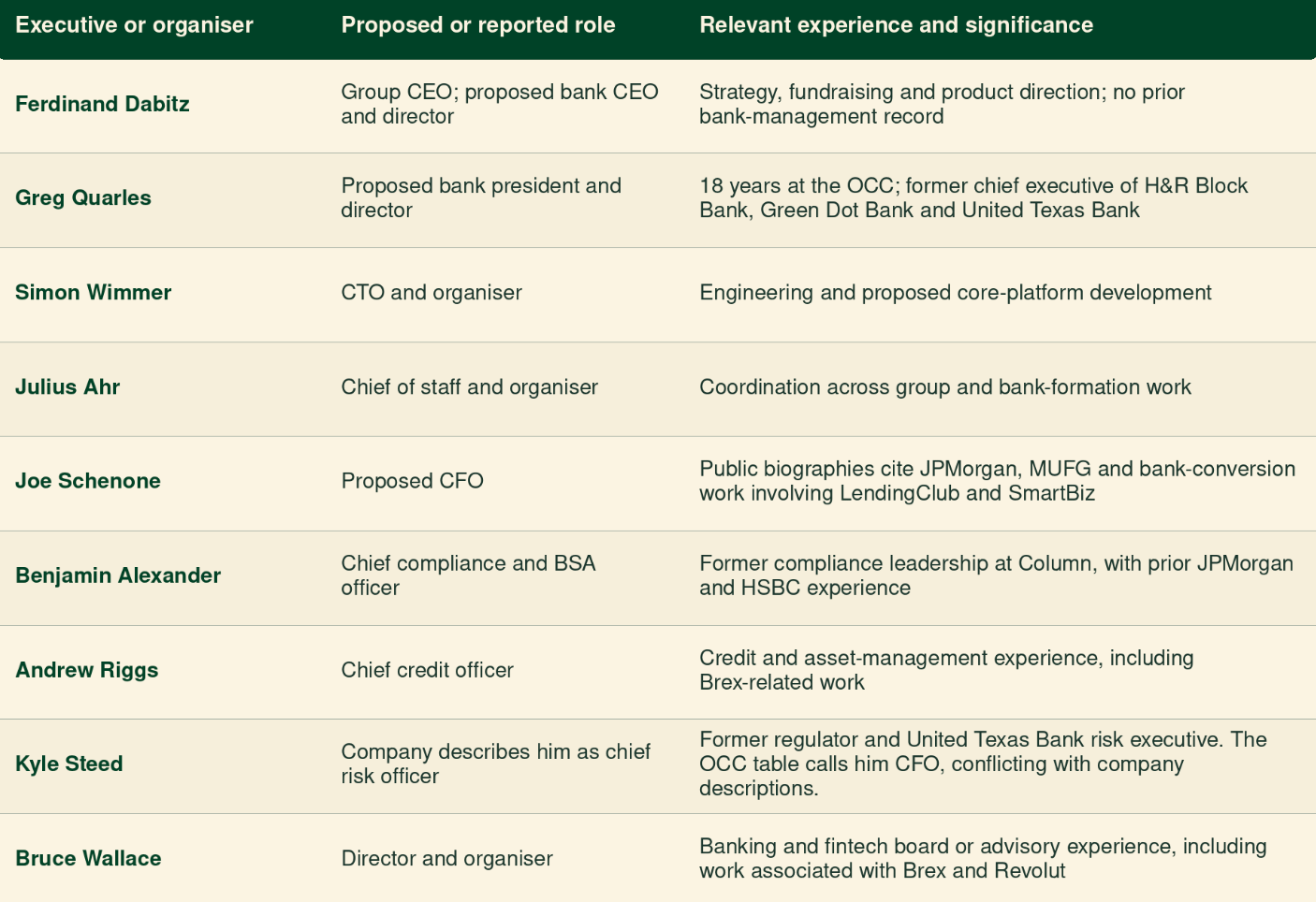
The recruitment of Greg Quarles was particularly significant. A national bank application led entirely by founders in their twenties would inevitably have raised questions about governance, credibility and execution. Quarles brought experience from the OCC, previous bank leadership roles and a working knowledge of what supervisors expect from a new institution. His presence gave the proposed bank a degree of operational weight that the founding team could not provide on its own.
The more difficult question is how authority will work in practice. Dabitz remains the group chief executive, principal strategist and public face of Augustus. Quarles is the proposed bank president and the executive responsible for preparing the institution for its pre-opening examination. That structure will only satisfy regulators if the bank’s management, directors and control functions can operate independently from the parent company and challenge Dabitz when necessary.
Those tests are likely to arise around customer risk, liquidity, growth targets and the timing of new product launches. In a regulated bank, compliance, risk and treasury officers cannot simply advise management. They must have the authority, resources and reporting lines needed to delay or stop activity.
Ivy’s first public product was easier to understand than its current one. At checkout, a consumer selected pay by bank, authenticated with a bank and authorised a transfer directly from an account. Ivy supplied the merchant-facing API, connection and payment logic.
Unlike a card transaction, an account-to-account transfer does not require a card issuer, network and acquirer to approve and settle the payment. It can reduce card fees and chargeback exposure. It also loses some features consumers value, including credit, familiar dispute procedures and universally accepted credentials.
Ivy added smart routing, transaction-risk controls, instant payouts and payment links. “Routing” meant choosing the connection or payment method most likely to complete a bank payment in a particular market. Payment links allowed merchants to initiate the same flow outside a conventional checkout.
The company’s decision to cast Visa and Mastercard as the main incumbents was commercially astute but competitively incomplete. Cards controlled merchant volume and economics, so displacing card payments defined the prize. In daily sales, however, Ivy also faced open-banking providers such as TrueLayer, Trustly, Volt and Tink, as well as local payment methods and PSPs able to aggregate several providers.
In July 2023, Ivy said that its API could reach about 5,000 banks, 50 markets and 500 million accounts. The figures were repeated in TechCrunch’s seed report and its Series A coverage. They were not independently audited. Ivy did not publish an integration list distinguishing direct bank connections from aggregator access, partner coverage or theoretical availability.
Merchants paid volume-tiered fees, according to the Series A reporting. Ivy did not publish rates or margins. Mactrade, a German electronics marketplace, was one of the few named early customers.
The model faced familiar constraints. Open-banking standards differed by country. Bank APIs varied in reliability and authentication design. International payments remained less interoperable than domestic ones. Merchants cared about conversion, not the number of theoretically connected accounts. Consumers often defaulted to cards or wallets. The provider sat above banks whose uptime, data and payment access it could not fully control.
Those weaknesses did not make the product useless. They limited differentiation. A merchant payments API can assemble broad coverage without owning the bank accounts, ledger or settlement layer that determine much of the final experience.
The evidence supports the proposition that Augustus moved upstream, but not the idea that the move was inevitable.
As late as January 2025, Ivy was still explaining itself publicly as an instant bank-payments network and card alternative in an interview with The Paypers. Mollie’s March integration was also framed as Pay by Bank for merchants.
The direction changed as the customer set changed. Kraken required bank funding, euro settlement and crypto-related account infrastructure rather than merely a better retail checkout. Circle added stablecoin conversion and settlement possibilities. The Thiel Foundation’s May 2025 description of Ivy as a world trade bank suggests that management was already recasting the company before its public rebrand.
According to Quarles and Dabitz, customers wanted direct access to US payment rails and more reliable dollar infrastructure. At a July 2025 leadership offsite, management decided to pursue a national charter. It began OCC pre-filing discussions in October and submitted the application on 18 December.
This was both an evolution and a pivot. The common thread is moving money between accounts through software. Almost everything surrounding that function changed:
A bank beneath the API would let Augustus hold customer balances, manage a ledger, control payment prioritisation and retain more economics. It could also reduce dependence on sponsor banks that may withdraw from crypto or international fintech relationships.
The price is that Augustus must now combine several businesses: payment software, deposit-taking, correspondent banking, credit, treasury, financial-crime compliance and digital-asset infrastructure. Each has different failure modes. The charter is not merely a stronger licence for the same product.
The original merchant API has not disappeared. Augustus’s documentation maintains a legacy 2023 API for open-banking payments alongside a 2026 banking API. That makes it a retained product, but the company’s sales language and capital allocation suggest it is no longer the strategic centre.
Augustus’s clearest operating foundation is Ivy Pay Oy, a Finnish payment institution. Company terms identify the entity as the European provider, while the Bank of Lithuania’s passporting register lists payment-account, transfer, payment-initiation and account-information permissions across the European Economic Area. The entity was previously called H3llo Pay Oy.
A payment institution can operate payment accounts, execute transfers and safeguard client money. It is not the equivalent of an insured deposit-taking bank. Customer funds generally must be safeguarded and cannot be used like ordinary bank deposits to fund lending.
Augustus says this entity provides euro clearing and processes billions annually. “Clearing” requires qualification. The public record supports euro payment and settlement services connected to SEPA. It does not establish that Ivy Pay Oy is a bank, a direct Eurosystem settlement participant or a central clearing institution. The company may be clearing in the commercial sense of receiving, routing, reconciling and settling payments through its regulated entity and banking partners.
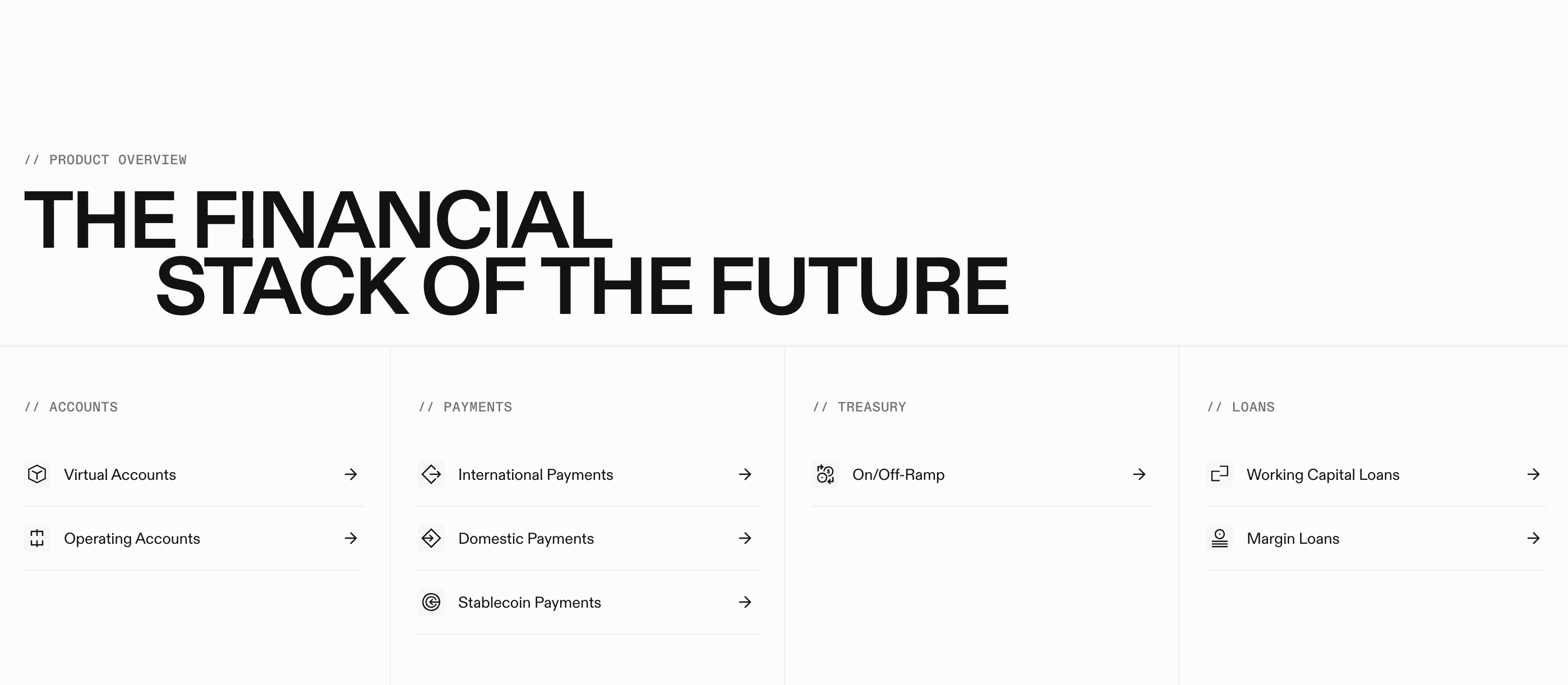
The current documentation is revealing. It preserves the Ivy open-banking API and introduces a newer banking API with operating accounts, FBO accounts, named virtual accounts and digital-asset wallets. Access is invitation-only, sandbox testing precedes production and customers undergo business verification.
Some pages describe virtual US accounts supporting ACH, Fedwire and FedNow but label the feature beta. A worked example contains a September 2026 date, after this report’s cut-off. Other documentation marks several currency conversions as “coming soon”. The pages demonstrate intended API design, not that Augustus National Bank is processing live dollar transactions.
The legal footer names Ivy Pay Oy for euro and sterling payment services. It does not identify the regulated US bank or partner currently supplying any production dollar account. Augustus could be offering partner-bank access in pilot form, but no public disclosure establishes the provider, geography or volume.
OCC Corporate Decision 1374: https://www.occ.gov/topics/charters-and-licensing/interpretations-and-decisions/2026/cd1374.pdf
FDIC Summary of New Deposit Insurance Application Activities: https://www.fdic.gov/bank-examinations/summary-new-deposit-insurance-application-activities
Federal Register: Augustus International Inc: https://www.federalregister.gov/documents/2026/05/27/2026-10497/formations-of-acquisitions-by-and-mergers-of-bank-holding-companies
Augustus Announces $180M Series B at $1B Valuation: https://augustus.com/resource-hub/augustus-announces-180m-series-b-at-1b-valuation

The Cheat with the Ace of Clubs
Georges de La Tour, c. 1620s
insights4.vc and its newsletter provide research and information for educational purposes only and should not be taken as any form of professional advice. We do not advocate for any investment actions, including buying, selling, or holding digital assets.
The content reflects only the writer’s views and not financial advice. Please conduct your own due diligence before engaging with digital assets or related technologies, as they carry high risks and values can fluctuate significantly.
Note: This research paper is not sponsored by any of the mentioned companies.
No posts
Comments
Nothing yet. Say the first thing.
Sign in to join the conversation.