
fomo is trying to answer a question that extends far beyond crypto trading:
“What happens when financial activity becomes social by default?”
The company has built a noncustodial consumer trading application that combines embedded wallets, multichain spot execution, perpetual futures and a public feed of verified trading activity. Instead of asking users to manually publish screenshots, performance claims or market opinions, fomo can turn transactions executed through its platform into persistent social content.
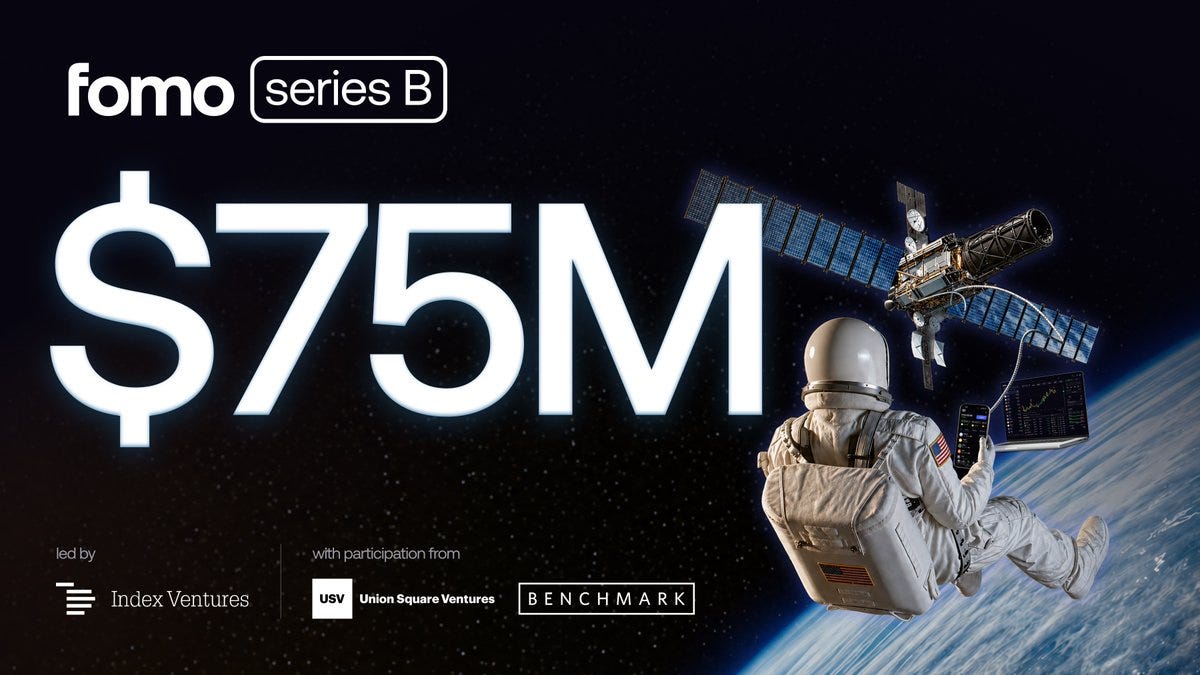
That distinction has attracted significant attention. Since its formation in 2024, fomo has announced approximately $94 million in financing, including a $75 million Series B led by Index Ventures, with Union Square Ventures and Benchmark participating. The round reportedly valued the company at $550 million and placed fomo among the most heavily funded emerging consumer platforms in onchain finance.
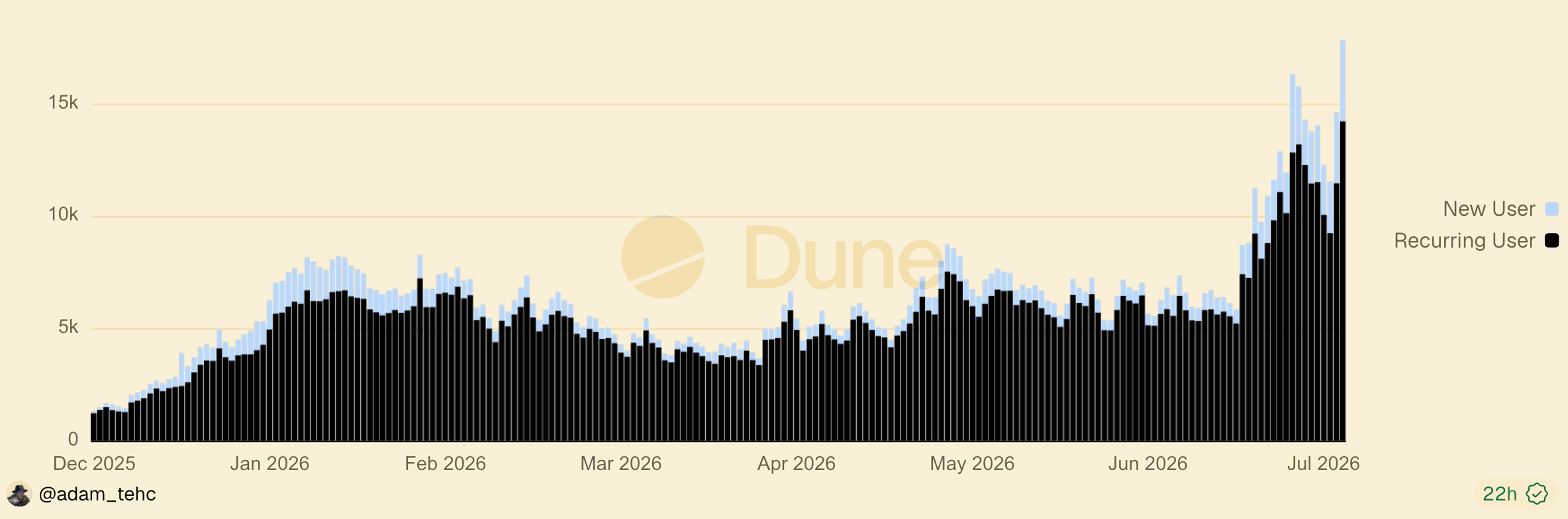
The growth figures are equally striking. By June 2026, fomo reported more than 600,000 users, over $4 billion in cumulative trading volume, 110 million social interactions and 68,000 first-time crypto buyers funded through Apple Pay. Public protocol data also indicates a sharp recent acceleration in both spot and perpetual trading activity.
But the central investment question is not whether fomo can build a fast-growing trading interface. It is whether the company can transform trading activity into a durable financial social graph.
Most of fomo’s execution infrastructure is provided by external partners, including Privy, Coinbase, Hyperliquid, Trade[XYZ], market-data providers and routing infrastructure. Its potential defensibility therefore sits above execution: in the connections between identities, transactions, followers, notifications, written theses, discovery history and reputation.
That moat remains unproven. The company has not publicly disclosed cohort retention, follower concentration, discovery-to-trade conversion or the extent to which users engage with the platform when they are not actively trading. fomo’s chief executive has also acknowledged that the product remains considerably more trading-heavy than social. Meanwhile, Robinhood, Coinbase, Phantom, eToro and other platforms are moving toward increasingly similar combinations of execution, verified activity and social discovery.
This report examines fomo as a company, product, trading platform and emerging financial network. It evaluates the founders, product evolution, user growth, protocol economics, investor base, competitive positioning and regulatory risks. Most importantly, it asks whether fomo is building a genuinely defensible social layer for global finance, or an effective consumer interface operating on increasingly commoditized infrastructure.
fomo’s history is unusually compressed. Public corporate records identify fomo Labs Inc. as a Delaware corporation formed in 2024, with Paul Erlanger and Se Yong Park listed as directors in a later securities filing. The public record reviewed for this report does not establish an exact incorporation date. fomo announced a $2 million pre-seed on February 18, 2025, before the product was public, and a March preview described a forthcoming noncustodial social trading application that would associate visible trades with user identities.
That chronology matters because the social thesis was not merely attached after early memecoin success. Before launch, fomo was already arguing that financial influencers could selectively disclose winners while hiding losses and that verified execution could make reputation more credible. However, the first product was narrower than today’s narrative: a mobile-first, Solana-only application optimized for simple access to long-tail tokens. The public beta launched on May 6, 2025. Its immediate wedge was therefore best described as simplified Solana trading with social primitives, not yet a general financial network.
Product breadth expanded rapidly. Base and a unified multichain balance appeared by September 2025; BNB Chain, richer profit-and-loss displays, comments and average holding time followed in October; Monad and redesigned profiles arrived in November; trade-linked theses and a new Coinbase-native Apple Pay integration were highlighted in January 2026; and messages followed in February.
TradingView charts launched in April, the web application on April 29 and perpetual futures on June 11. A May company article separately named Ethereum, but public materials do not document when or whether all features became available there. The sequence shows an expanding brokerage surface and an increasingly explicit social layer developing together.
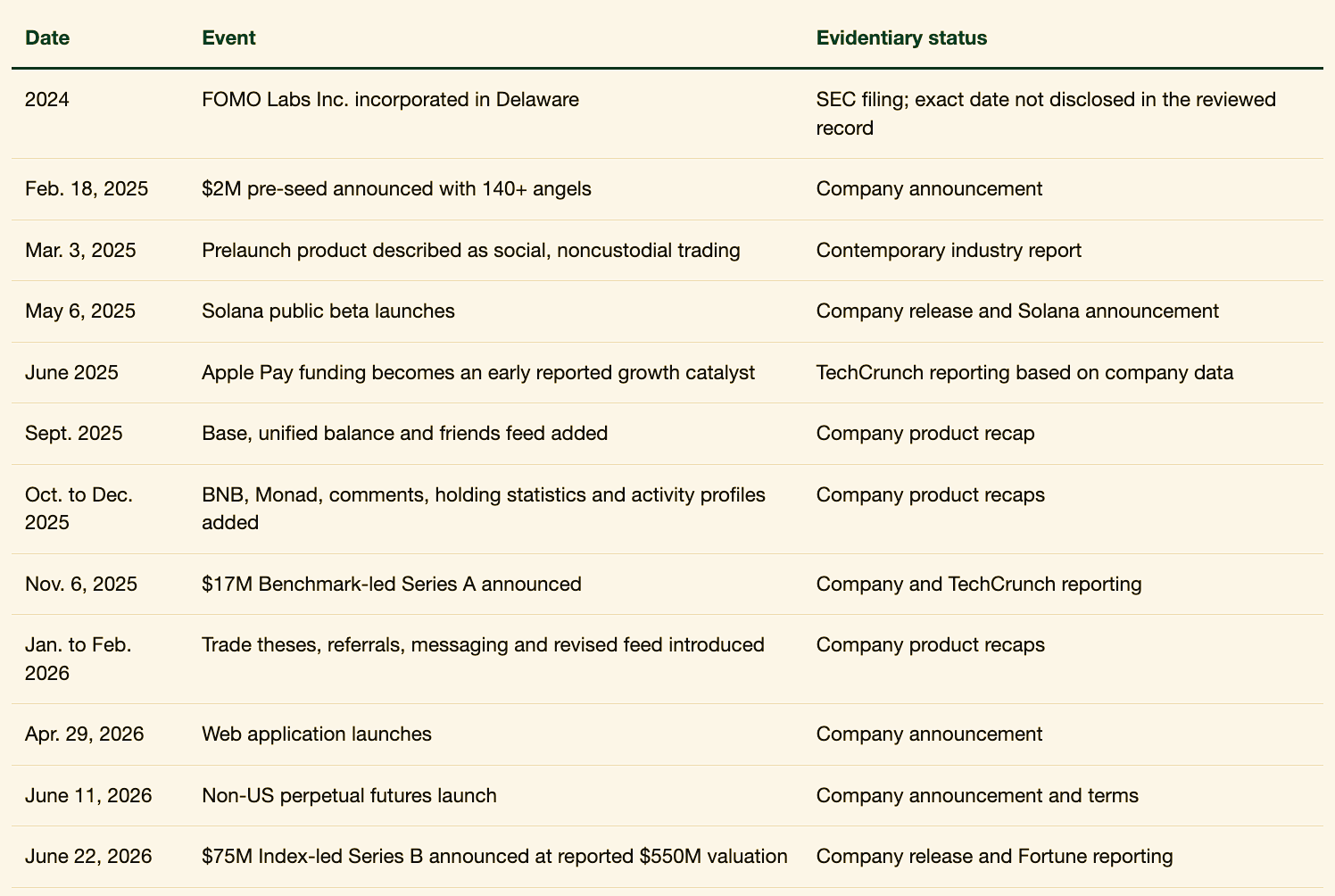
Source: Company announcements, product recaps, SEC filings and contemporary reporting cited throughout Section 1. Evidentiary qualifications are preserved in the final column.
The historical record supports a qualified interpretation of product evolution. fomo began with a memecoin-adjacent access problem: consumers often encountered an asset through a creator but could not navigate wallets, bridges, gas and unfamiliar DEX interfaces. It then generalized that observation into a larger claim about discovery. The social framing was present before launch, but the full “financial social network” ambition became more operationally visible only after feeds, holding statistics, theses, comments, web access and perps accumulated. That distinction prevents a successful trading wedge from being mistaken for proof of the broader network.
fomo was founded by Paul Erlanger, Se Yong Park and Prashan Dharmasena. Their backgrounds combine market structure, business development, ecosystem work and consumer mobile engineering. That mix helps explain why fomo feels less like a protocol console and more like a social consumer application sitting above protocols.
Erlanger’s public profile shows more than three years at dYdX, from July 2021 to October 2024, most recently as head of business development. Before crypto, he worked in private credit at Deutsche Bank and studied at New York University, where his profile notes summa cum laude honors. At dYdX he operated close to decentralized derivatives, partnerships and institutional market structure rather than as a retail product engineer.
Park worked with Erlanger first at Deutsche Bank and later at dYdX, a relationship Index describes as spanning roughly five years. Public biographies associate him with Yale and with ecosystem roles at dYdX and later Eclipse. The exact title and full dates of every dYdX role were not consistently recoverable from primary records, so descriptions such as “about four years” should be treated as rounded founder context rather than exact employment history.
Dharmasena supplies the mobile product and engineering lineage. His public profile lists Android engineering at Square, head of mobile at OpenSea and head of mobile and frontend platform at dYdX in 2024. A Berkeley alumni profile identifies a BA in electrical engineering and computer science. Public sources identify him as fomo’s engineering co-founder, although they do not document individual authorship of the first application build.
fomo’s product embodies a tension between the experienced trader and the consumer who does not know what a wallet or gas fee is. The former demands speed, asset coverage and credible execution; the latter needs a cash-like balance, understandable language and minimal configuration. That tension appears in observable choices: USDC is presented as cash, wallet creation is embedded in account signup, the application sponsors gas, and public flows emphasize a single buy or sell action rather than chain selection and manual execution parameters.
The team remained small at the Series B. Fortune reported 17 employees in June 2026. Public profiles identify finance and operations, growth and user-generated-content leadership alongside a heavily technical hiring plan. In a public interview, Erlanger described the organization as deliberately flat, with an early core team working on equity-heavy terms. No clearly identified in-house compliance or regulatory executive was found in the reviewed public profiles, although absence from public search is not proof that the function is absent.
This team is well suited to rapid product assembly on outsourced infrastructure. It understands perpetual market structure, partner ecosystems and consumer mobile design. The inverse risk is also visible: an engineering and growth-heavy organization can expand faster than its public governance, measurement and regulatory apparatus. fomo’s next stage requires not only product velocity but stronger proof systems around user quality, social integrity and jurisdictional controls.
fomo’s most consequential idea is that consumers should not have to choose to become “crypto users.” Blockchain is treated as a back-end technology offering two properties: globally distributable assets and publicly inspectable activity. On this view, the consumer category is trading or investing, while chains, wallets and bridges are implementation details.
The first property, global distribution, is already useful. A token can become tradable on a permissionless venue before a traditional broker would list it, and an embedded-wallet application can route a consumer to that venue. fomo exploited this with long-tail Solana assets and later added multiple chains. The second property, transparent activity, is strategically more ambitious. If transactions can be attributed to persistent user identities, the application can turn entry, exit, holding behavior and realized performance into a continuous information feed.
The often-invoked comparison to Robinhood, Instagram and X is directionally helpful but incomplete. Robinhood contributes simplified execution, Instagram contributes profile-led visual consumer design, and X contributes a follower-based information graph. Yet fomo does not fully inherit any of their strengths. It lacks Robinhood’s regulated multiasset brokerage, Instagram’s mature creator culture and X’s vast interest graph. Its distinctive contribution is narrower: execution and social identity are joined by default, so a user need not manually publish every trade.
This makes the proposition more precise: Twitter can record a claim about a position, while fomo can record a position opened through fomo. That is stronger evidence, not complete financial truth. A trader may split capital across several fomo accounts, use outside wallets or exchanges, hedge with options, short elsewhere, or display a small visible position while holding a larger offsetting exposure. A pseudonym may also be misattributed, transferred or coordinated with other accounts. Public execution narrows the scope for selective disclosure inside one account but cannot reveal a whole portfolio.
The company therefore should be understood as building an authenticated activity graph, not a comprehensive financial identity system. This distinction is central to assessing both product value and risk. Even partial activity can be useful for discovery if the interface clearly defines its boundaries. It becomes misleading when followers interpret a public account’s history as the trader’s complete wealth, conviction or risk-adjusted record.
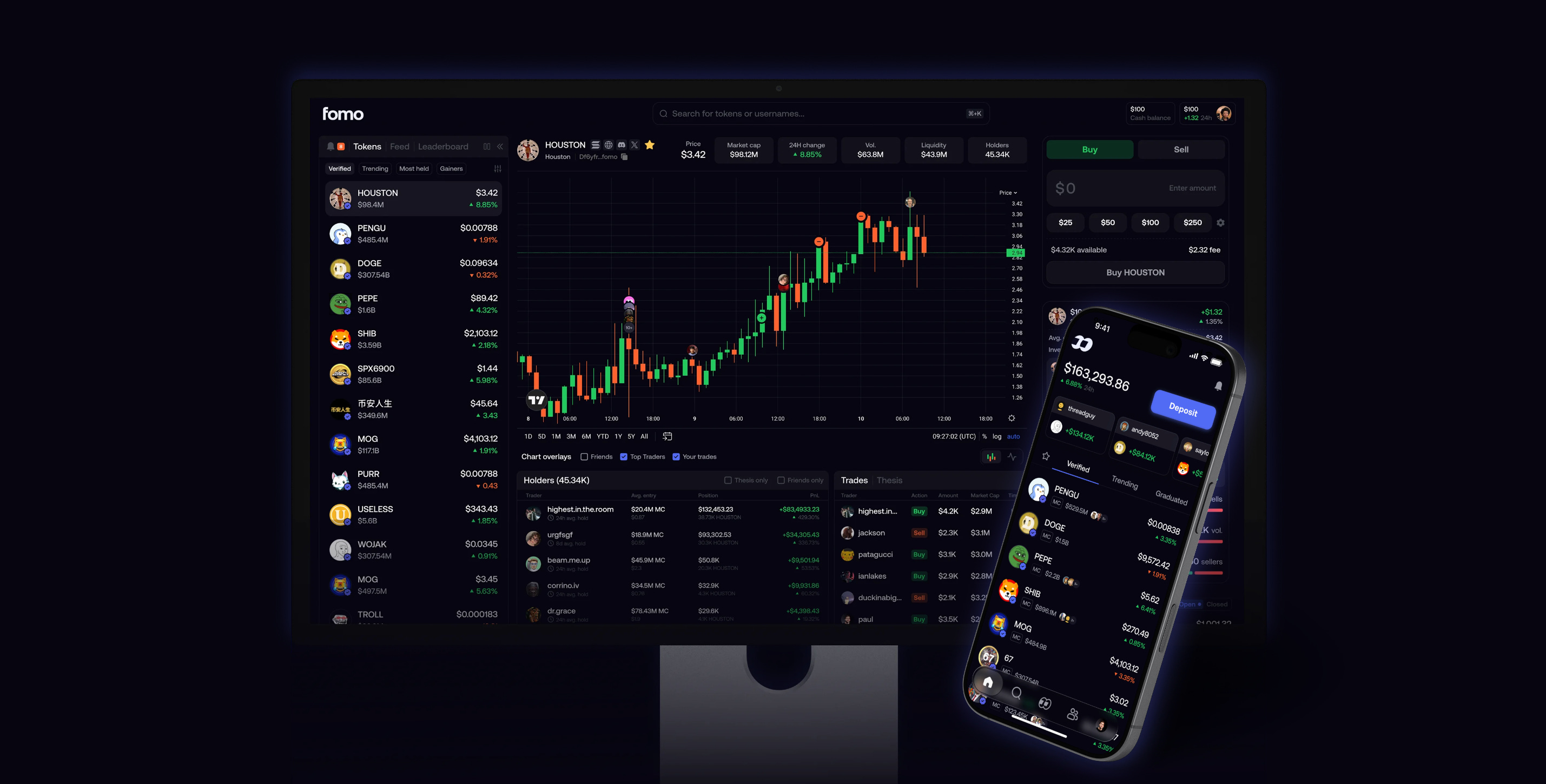
For a new user, fomo’s intended journey resembles a consumer brokerage. The user downloads the iOS or Android application, or opens the web product, signs in with email or an Apple account, and receives an embedded wallet. Funding can occur through Apple Pay or debit card on mobile, subject to availability, or through supported crypto deposits. The application presents a USDC-denominated balance and a cross-chain asset catalog. A user can search for a token, inspect activity and holders, enter an amount and trade without manually selecting a venue or paying gas in a native token.
The account is noncustodial in the technical sense described by fomo and Privy. Privy creates an embedded wallet using key-sharding and secure execution technology; fomo says users can export keys. On EVM networks, the company describes smart-account features such as gas sponsorship. This removes a seed phrase from onboarding but does not remove wallet risk. The terms state that exported private-key material is transmitted by Privy and place responsibility for key security on the user. The architecture is therefore better called embedded self-custody than a traditional custodial brokerage account.
Official product guides consistently identify Solana, Base, BNB Chain and Monad as the core spot networks. A separate May 2026 company article also lists Ethereum, suggesting a recent or limited addition whose feature parity is not publicly documented. The web and mobile applications share accounts, balances and positions. Crypto funding instructions specify USDC deposits on supported networks, while mobile onramps can abstract the conversion. Withdrawals can be made to external crypto addresses, and cash withdrawal availability varies by region.
USDC as the visible cash balance is a meaningful product decision. It prevents a consumer from having to hold SOL or ETH merely to transact and makes profit and loss easier to understand in dollar terms. It does not eliminate stablecoin, issuer, smart-contract or depegging risk, nor does it eliminate exposure created during routing. Gas sponsorship also shifts rather than erases cost: fomo absorbs or bundles network and priority fees, improving conversion but exposing the company to spikes, abuse and thin unit economics on small trades.
The trading surface is intentionally constrained. fomo’s own comparison with Phantom says users receive less granular control over routing and slippage than they would through a direct DEX interface. That reduces cognitive load but transfers responsibility to the application’s routing and protection defaults. Public documentation does not disclose audited execution-quality statistics or a comprehensive policy for favorable price improvement. In illiquid or volatile tokens, users still face price impact, stale quotes, MEV and failed transactions even when the controls are hidden.
fomo’s current terms disclose a spot fee of at least 0.50 percent per buy or sale and a $0.95 minimum, while reserving the possibility of alternative rates. Earlier TechCrunch reporting described the minimum as applying only to Solana, but the later terms use broader language and are the more relevant current source. The minimum creates a sharp small-ticket effect: a $10 order paying $0.95 bears a 9.5 percent explicit fee before price impact. This is the clearest example of blockchain complexity being replaced by consumer simplicity at a potentially high economic price.
The central interface is a token or position sheet. Public guides show price charts, holder and safety information, trending or verified filters, recent social activity and transaction controls. Profiles can display portfolio and transaction history, volume, followers, performance and an equity curve. Feed items can identify a buy, sale or fully closed position, the amount, price movement and realized profit or loss. A user can follow a trader, turn on notifications, inspect the position history and then execute independently.
Perpetuals are a separate, higher-risk experience available outside the United States. fomo connects to Hyperliquid and Trade[XYZ] markets, exposing crypto, pre-IPO, equity, index and commodity-linked perpetual contracts where available. The application displays long or short direction, leverage, notional exposure, margin, take-profit and stop-loss controls. The fee is 0.05 percent in addition to protocol, gas and funding costs. The user-facing abstraction is elegant, but the economic exposure remains a leveraged derivative with liquidation, funding and oracle risk.
fomo is genuinely making onchain execution more understandable. It is also hiding, rather than abolishing, custody, market-impact and protocol risks. The appropriate standard is not whether a user sees the blockchain, but whether fees, execution quality, asset risk and loss mechanics remain intelligible after abstraction. Public app reviews offer anecdotal warnings about delayed orders, inaccurate P&L and login or deposit problems. They do not establish prevalence, but they show where the promise of a seamless brokerage can break.
fomo reports growth through several overlapping definitions. At the Series A in November 2025, it claimed 120,000 users and 35,000 traders, a 29 percent trader-to-user ratio, nearly 15,000 net-new crypto users and $5 million funded through the onramp. By June 2026, company and investor announcements cited more than 600,000 users and $4 billion of cumulative volume; USV used 625,000 users. These figures can be chronologically compatible, but they have not been audited and “user” may mean registration rather than funded or active account.
The public figures support reach but do not establish the composition asserted in fomo’s broader thesis. The November trader-to-user ratio of roughly 29 percent is the only disclosed funnel ratio that can be calculated cleanly, and it reflects one observation point rather than a retained cohort. The 68,000 first-time crypto buyers suggest genuine mainstream onboarding, while six-figure creator audiences suggest a supply of higher-information accounts. fomo has not publicly segmented volume, balances or retention between crypto-native and mainstream users, so the proposed two-sided network remains strategically plausible rather than quantitatively demonstrated.
Public app signals establish reach but not economic quality. Google Play showed more than 100,000 downloads and hundreds of reviews; the US App Store showed roughly 2,500 ratings and a high Finance-category rank at the observation point. These are volatile storefront measures. They do not disclose balances, geography, age, retention or whether one individual uses multiple accounts.
The company has not published a reliable geographic or demographic breakdown. The product is global in distribution, but perpetuals exclude US persons and sanctions restrictions are extensive. The first-time-crypto onramp data supports the claim that fomo has reached beyond crypto-native power users, while the depth and durability of that consumer base remain uncertain.

An Experiment on a Bird in the Air Pump
Joseph Wright, c. 1768
insights4.vc and its newsletter provide research and information for educational purposes only and should not be taken as any form of professional advice. We do not advocate for any investment actions, including buying, selling, or holding digital assets.
The content reflects only the writer’s views and not financial advice. Please conduct your own due diligence before engaging with digital assets or related technologies, as they carry high risks and values can fluctuate significantly.
Note: This research paper is not sponsored by any of the mentioned companies.
No posts
Comments
Nothing yet. Say the first thing.
Sign in to join the conversation.