
Here’s a test. Open the AI tool you use most and ask it to write your homepage headline. Give it a sentence about your company. Take whatever it hands back and read it out loud.
It will sound good. Confident, clean, no typos. And it will be worthless, because it’s a well-written guess built on the two facts you gave it.
Then notice what you do next. You tweak it. You ask for ten variations. You pick the one you like. You ship it. And you never once had to answer the question underneath it, which is: who exactly is this for, what do they want, and why would they believe you.
That’s the pattern. Founders use AI to skip the thinking and produce the artifact. The artifact looks like progress. It isn’t. You now have a headline you can’t defend, on a site you’ll rebuild in six weeks, wondering why conversion is flat.

The best prompts don’t write. They interrogate.
Compare these two.
What most founders send: “Write me a hero headline for my B2B SaaS that helps small businesses manage inventory.”
What actually works: “I want to create a hero message using this format: action verb, ideal customer, what the customer wants, how you help. Ask me as many questions one by one until you understand me better. Then write me the perfect headline.”
Same goal. Completely different mechanism. The second one costs you twenty minutes and asks you eleven uncomfortable questions before it writes a word. Somewhere around question six you realize you can’t name your customer’s job title. That’s not a delay. That’s the actual finding.
The output at the end is almost beside the point. What you’re buying is the interview.
There are five instructions that separate a prompt that thinks with you from a prompt that flatters you. Once you see them, you’ll add them to everything.
One question at a time. If the AI dumps twelve questions in one block, you’ll answer them shallowly, the way you’d fill out a form. One at a time means each answer shapes the next question. That’s a conversation, and it goes places a form never will.
Ban adjectives, demand numbers. “If I give you adjectives, ask for numbers.” Your customer isn’t “frustrated with existing tools.” Your customer spends four hours a month reconciling two systems by hand. One of those is a sentence you can build a business on.
Force narrowing. “If I say small businesses or startups, force me to narrow it.” Every founder overstates their segment, because a big market feels safer to say out loud. A prompt that refuses to accept “startups” and pushes you to “seed-stage B2B SaaS companies with two to ten people and no full-time marketer” has just done more for your go-to-market than a month of positioning debate.
Refuse to produce until there’s specificity. The strongest line in any of these prompts is “do not write the problem statement until you have enough specificity.” It removes your escape hatch. You cannot grab a deliverable and run.
No sugarcoating, explicitly stated. Say it out loud in the prompt: do not flatter me, be direct, challenge weak assumptions. Models are tuned to be agreeable. You have to override that, in writing, every time.
One good prompt gives you a draft. Three in the right order give you a strategy.
Positioning works as a ladder. Hero message first, because it’s the surface. Then the problem formula, because that’s the foundation underneath the surface. Then the investor-grade problem statement, which is the version that has to survive a partner meeting. Each pass forces a layer of specificity the last one let you skip. By the third pass, you either have real clarity or you know precisely which fact you’re missing.
Validation works the same way. Map the search queries your customer would actually type, and score how many show buying intent instead of curiosity. Then extract the complaints people make about the alternatives, including the ones they keep paying for anyway, because a complaint someone pays through is a business and a complaint they walk away from is a hobby. Then feed both into a scoring pass and force a verdict: build, narrow, pivot, or pause.
That third step is the one founders skip, and it’s the whole point. A number and a verdict are harder to rationalize than a vibe.
There’s a line in our validation prompts that I’d tattoo on the inside of every founder’s eyelids: if you need to talk yourself into demand, it isn’t there yet.
Even with a well-built prompt, the model will eventually tell you your positioning is strong or your TAM looks reasonable. When that happens, do not take the win. Invert it.
“That’s strong positioning.” Ask: what would make this positioning weaker?
“Your TAM looks reasonable.” Ask: what assumption in here is most likely wrong, and what would it do to the number?
“This is a compelling problem statement.” Ask: what would a skeptical investor attack first?
The friction is the value. If a session with AI makes you feel good and changes nothing, you didn’t run a diagnostic. You ran a compliment generator.
Two honest limits.
First, these prompts are only as good as your inputs. Ask an AI to simulate what customers complain about, and it will produce a plausible synthesis of patterns, not evidence from your market. Treat that output as a hypothesis list to go verify with real people, not as research you can cite in a deck. A financial model built on assumptions you can’t defend is still fiction, it’s just now fiction with better formatting.
Second, AI is the sparring partner. You are still the founder. The most dangerous version of this is a founder who runs six diagnostics, gets six confident answers, and makes a call they don’t actually understand. Use the prompts to think out loud and stress-test decisions. Use a real customer conversation to settle them.
Pick the decision you’ve been avoiding. Positioning, pricing, whether to pivot, whether the market is real.
Don’t ask AI to write the answer. Take whatever prompt you’d normally send and add one line to the end: “Ask me one question at a time until you fully understand my situation. Do not answer until you do. Do not flatter me.”
Then sit through the interview. If you can’t answer question four, that’s the most useful thing you’ll learn all month.
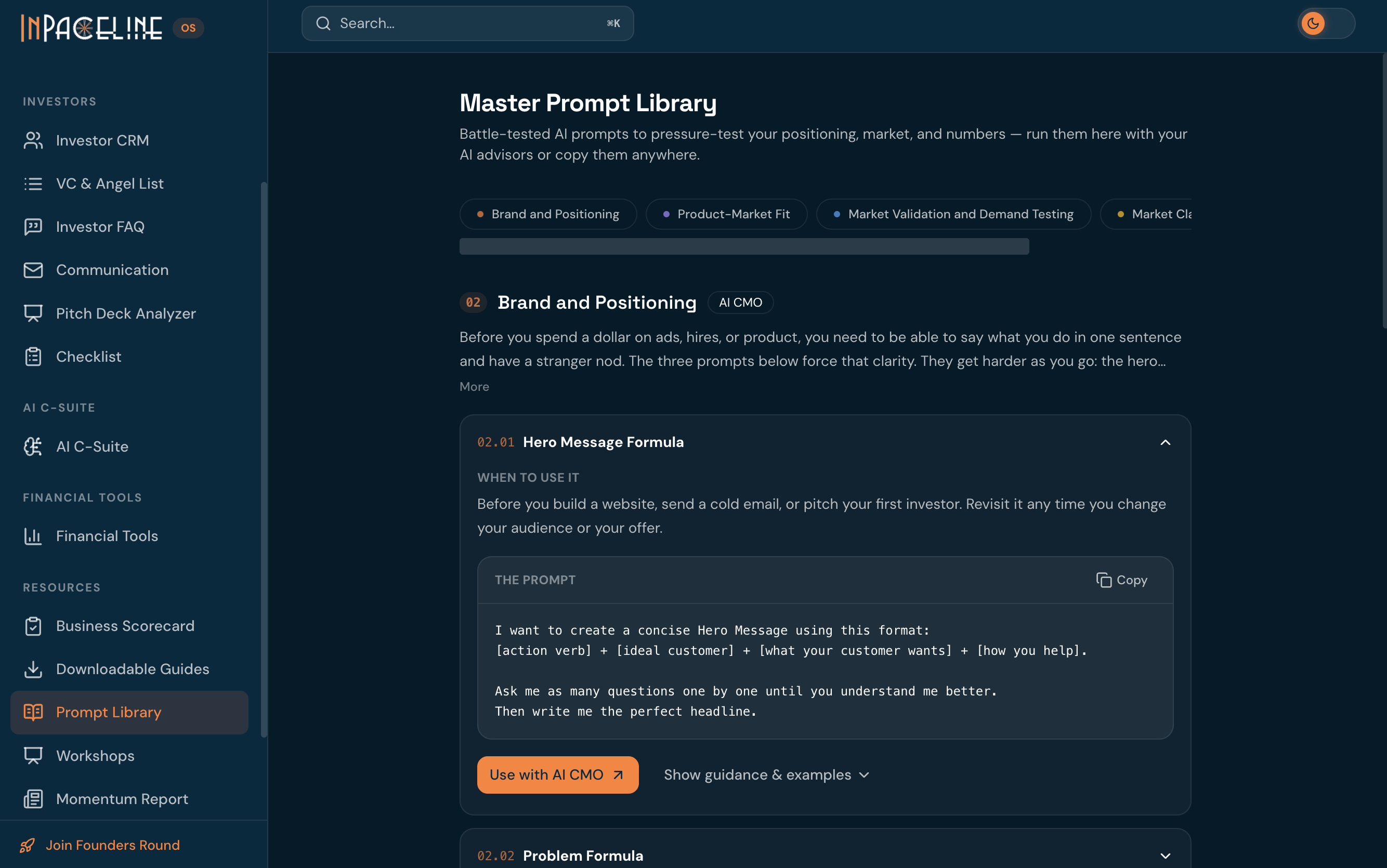
Inside Inpaceline OS, the master prompt library is built entirely this way. Positioning, product-market fit, demand validation, market clarity, and financial modeling, each one an interrogation you run with your AI CMO or AI CFO instead of a template you fill in. Prompts are copy-ready and stack in sequence, so you’re not starting from a blank box every time you need to make a real decision. Open the library at inpaceline.com.
No posts
Comments
Nothing yet. Say the first thing.
Sign in to join the conversation.