
Somebody asked ChatGPT about your product category this morning. It gave them a confident, complete answer with three recommendations. Yours wasn’t one of them. Not because you lost the comparison. Because you were never in it.
This is the quiet shift happening under every early-stage marketing plan right now. AI Overviews show up in roughly 45% of Google searches and cut clicks to websites by as much as 58%. ChatGPT, Perplexity, and Gemini are answering the “what should I use for X” questions your landing page was built to win. The search results page your SEO strategy targets is increasingly a page nobody scrolls past.
Ranking is no longer the game. Getting cited is.
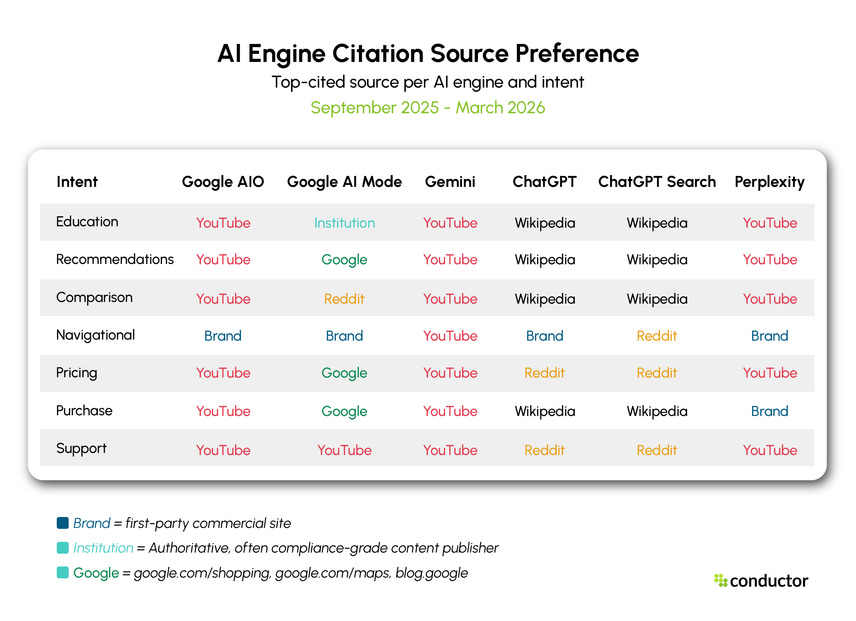
Conductor tracked which sources each AI engine cites most, per query intent, from September 2025 through March 2026. The pattern should change how you spend your next marketing hour.
YouTube dominates. It’s the top-cited source for Google AI Overviews, Gemini, and Perplexity across almost every intent: education, recommendations, comparisons, pricing, even purchase queries. Gemini cites YouTube first for all eight intent categories tracked.
ChatGPT plays differently. It leans on Wikipedia for education, recommendations, and comparison queries, and on Reddit for pricing and support. ChatGPT Search cites Reddit for navigational, pricing, and support intent.
And here’s the part that stings: your own website, the “brand” source, only wins reliably in one category. Navigational queries. People who already know your name and are looking for you. For every discovery-stage intent, the AI engines are citing someone else talking about your category, not you talking about yourself.
Brands are 6.5x more likely to get cited through third-party sources than their own domains. Your blog is competing with YouTube, Wikipedia, and Reddit for the citation, and mostly losing.
You probably don’t have a Wikipedia page, and you shouldn’t try to force one. But the rest of the map is very playable for a small team, arguably more playable than traditional SEO ever was, because AI engines select sources on structure and authority, not just domain age.
Here’s the reallocation I’d make:
1. Treat YouTube as a search channel, not a content channel. You don’t need a production budget. You need videos titled the way people phrase questions: “best [category] for [use case]”, “[your category] pricing explained”, “how to [problem you solve]”. A ten-minute screen recording with a clear answer beats a polished brand video for citation purposes. If Gemini cites YouTube for every single intent, a founder without a channel is invisible to Gemini. Full stop.
2. Show up on Reddit like a human. ChatGPT leans on Reddit for exactly the queries that close deals: pricing and support. Find the three subreddits where your buyers complain, and answer questions with real substance. Don’t astroturf. AI engines surface threads with genuine engagement, and Reddit’s community will torch anything that smells like marketing anyway. One honest, detailed comparison comment from a founder can get cited for months.
3. Restructure your site for extraction, not persuasion. AI systems lift passages, not pages. The Princeton GEO study (KDD 2024) measured what actually moves citation rates: citing sources boosts visibility about 40%, adding statistics about 37%, expert quotes about 30%. Keyword stuffing reduces it by 10%. Practically: lead every page with a direct 40 to 60 word answer, use headings that match how people phrase questions, put pricing in the open (AI engines cite pages with visible pricing), and add FAQ schema. Gated content is invisible content.
4. Check that you’re not blocking the crawlers. Five minutes, real risk. If your robots.txt blocks GPTBot, PerplexityBot, ClaudeBot, or Google-Extended, those engines can’t cite you no matter how good your content is. Plenty of default configs and “block AI” plugins do this silently.
Before you build anything, measure. Pick your 15 most important queries: “what is [category]”, “best [category] for [use case]”, “[you] vs [competitor]”, “[category] pricing”. Run each through ChatGPT, Perplexity, and Google. Log three things in a spreadsheet: did an AI answer appear, were you cited, and who was.
That third column is your content roadmap. If a competitor gets cited through a Reddit thread, that thread is where you show up next. If a random YouTuber owns your comparison query, that’s the video you make. Repeat monthly. Most founders who run this audit for the first time find they’re cited exactly nowhere, which is bad news and a wide-open opportunity in the same breath, because almost none of your competitors are doing this deliberately yet.
The founders who treated Google SEO seriously in 2012 bought traffic at prices that look fake today. AI search is at that moment right now. The engines have to cite someone. Make it annoying for them to avoid you.
Your marketing channels are one more thing competing for your attention span. InPacelineOS gives founders one place to track what’s actually working across all of them, so you can spend your hours where the momentum is.
No posts
Comments
Nothing yet. Say the first thing.
Sign in to join the conversation.