
I have several years of experience working with legacy media companies on content and distribution. First, as an employee at Disney for just shy of a decade and later as a consultant with others. So, I know a thing or two about how media flywheels spin.
When I first heard about Comcast’s decision to spin off NBCUniversal, it felt almost inevitable. IMO, it was a delayed conclusion to a strategic miscalculation that started to manifest the moment Netflix emerged on the scene and figured out how to use the Internet infrastructure as a distribution system.
The media industry, shaped by Disney’s playbook, has always treated content as the engine of the flywheel. Content is indeed that, in terms of strategy and its implementation. But in the hard reality of it, the media flywheel only spins when the underlying technology conditions are right. If the conditions shift, it loses its velocity.
This is particularly true now that every legacy media company has had to become a tech company even as tech companies like Meta and Google have become media companies. Both groups have now converged into being media-tech companies.
You would think that Comcast, which was already a technology company and a media company, was set up well for this evolution. It had most of the ingredients. The content, the distribution technology, and the capital.
What it didn’t have, however, was the right technology layer for the era it ended up competing in. And the right technology layer matters.
What that right technology layer is and how it matters is the focus of this article.
Disney pretty much invented the media flywheel. The Acquired podcast recently released a well-researched episode about the origin of that flywheel and its operation, among other topics. I recommend a listen.
The hosts also linked a Wall Street Journal article published in 1958, which documented Disney’s flywheel strategy. While I won’t reproduce it here to keep the focus on my protagonist, Comcast, take a look at the image in the linked article to get an idea of the model.
A flywheel is a self-reinforcing organizational system in which every part of a business feeds the other part. For Disney, as well as NBCUniversal, films promoted the theme parks. The theme parks sold merchandise based on characters from the films. Merchandise kept characters culturally alive between film releases. TV publicized everything. Round and round it goes!
Every division complements the other and not only generates its own revenue but also makes every other division more valuable in the process.
In this flywheel system, 2+2 is not equal to 4 but equal to a much higher multiple.
That math calculation explains why every media and many non-media companies have tried to replicate this model. Like Amazon. Airbnb and Uber are now trying to build out their own versions of the flywheel in their respective industries.
Comcast started in 1963 as a cable television company. Its founders purchased a 1,200 subscriber cable system in Mississippi to deliver five television channels to local homes via coaxial cable for a monthly fee.
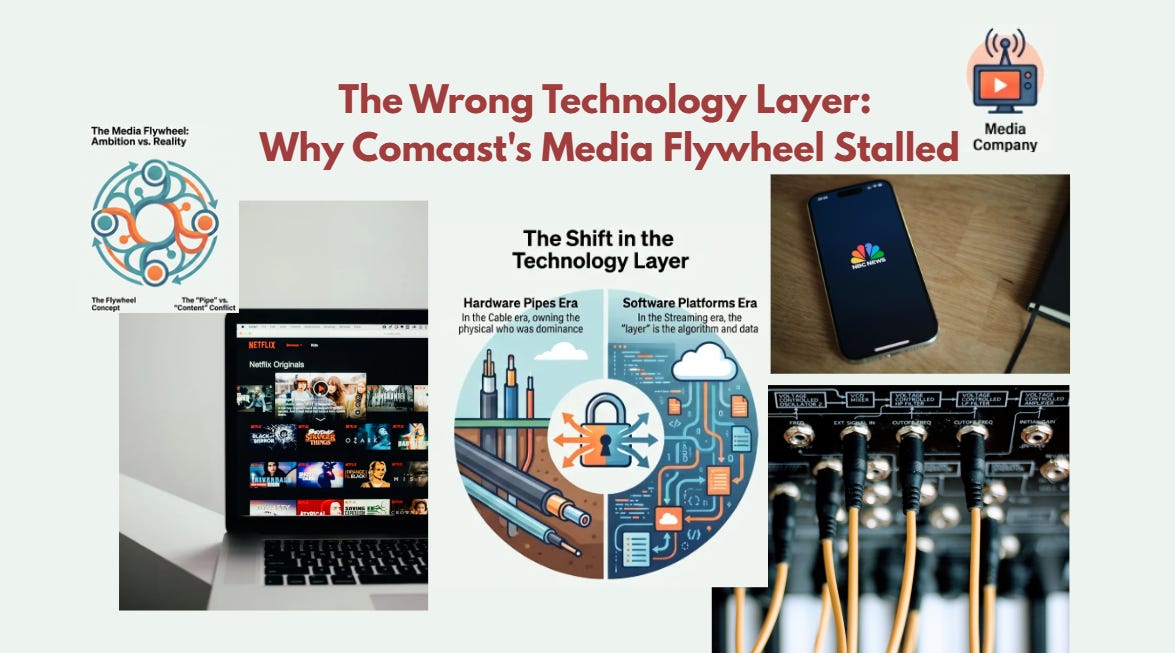
Over the years, it built and maintained the physical layer that other things run on, becoming more of an infrastructure or utility company rather than a technology company in the modern sense, which builds software platforms, data systems, and so on. But during that era, the cable pipe was in fact the dominant content distribution technology layer. And it remained so for several years after.
That is why when Comcast acquired NBCUniversal in 2011, it already had a distribution network in place. And through the acquisition, it got access to a substantial media portfolio that included NBC, CNBC, Bravo, USA Network, Universal Studios, and theme parks, among other entities.
Post-acquisition then, it had content + distribution + consumer experience. What else does a media company need, after all to reach for the stars!?
But having that flywheel architecture of content plus distribution is only the framework for the flywheel. For Comcast, it never really spun the way it did for Disney, its biggest legacy media competitor.
And then along came Netflix with its shiny new content distribution model, which did not help matters.
The Wall Street Journal described the upcoming spinoff as "a death knell for a long-held belief among media executives that putting content and the pipes that delivered it under one roof would create riches for all."
That summarizes what went wrong. But it doesn't explain why. Two problems that Comcast faced do.
The cable television model was a closed bundle system. The content and the distribution pipe were inseparable. If you owned that pipe through vertical integration, it gave you control of it. That is actually a pro for making a flywheel spin.
Comcast designed the package and you, the consumer, paid for it. Its own NBC, CNBC, Bravo, and USA Network were in your package whether you actively wanted them or not. And Comcast's own content got guaranteed eyeballs just by being in the bundle.
But here is what then changed both below and above the surface for Comcast…. Broadband became a thing and the next technology layer between content and consumer.
With broadband, the consumer can build their own bundle. You choose Netflix. You choose Disney+. You decide whether or not to add Peacock.
And most devastatingly, you can cut the cable cord!! Which means owning distribution stopped being an advantage for your own content the moment broadband became the dominant delivery mechanism.
Look at the numbers that tell you a lot about how that shift affected who wins in media. Netflix (~$327 billion) today trades at nearly four times Comcast's market capitalization (~$84 billion), in spite of Comcast generating more than twice as much annual revenue (~$123 billion vs Netflix ~$45 billion).
Netflix built that dominance without owning TV channels or any physical infrastructure. It went up the media ranks by owning the right technology layer platform for its time rather than the pipe.
Now it is changing again as satellite internet, like Starlink, starts to become more commonplace. Wireless carriers are offering home internet service over the air. No more pipes in or above the ground. That means the OG Comcast infrastructure company, the version that will be left after the media spin-off is going to have its work cut out for it.
When the FCC approved the NBC Universal acquisition, that approval came with certain conditions. The first required Comcast to offer NBCUniversal content to competing distributors on fair and non-discriminatory terms so that it couldn’t deprive rivals of content and funnel subscribers toward its own service.
Second, it was required to offer NBCUniversal content to online video distributors like Netflix on fair terms as well. So, it couldn’t withhold content from streaming platforms to slow the adoption of streaming and protect its cable bundle.
Clever FCC!
The question that naturally arises from this is - then why do it? Why acquire NBCUniversal in 2011 in the first place? Surely Comcast knew that those FCC regulatory policies would come in and prevent it from full flywheel integration.
The answer to that is where it gets interesting. By most public accounts, the acquisition was primarily driven by a fear of losing leverage with content owners as a distributor. Almost like a defensive deal rather than an offensive one that would have been driven by a more concrete vision of how content and distribution would create the compounding flywheel effect.
Whether that is on point or not, the net effect was that Comcast content sat mostly parallel to its distribution business rather than feeding each other. It was structurally conflicted from birth and never fully resolved that tension. In reality, it became more of a vertical integration on paper rather than in its actual functioning as a business esp. once the technological milieu changed.
Hindsight is 20/20. It is easy to look back and see that it should have seen the streaming ‘movement’ coming. It should have disrupted itself before the market did it.
The signals were there. Netflix had already launched streaming by the time Comcast acquired NBCUniversal. But to be fair, at the time none of the legacy media companies, including Disney, took Netflix quite as seriously as they did a decade later when each of them launched their own competing platforms.
By the time Comcast launched its streaming platform Peacock in 2020, 13 years after Netflix launched streaming, those investment dollars to build out that platform took away any dollar that Comcast put into its infrastructure business. Opportunity cost!
And that is when it also started disrupting itself. Launching Peacock raised the threat that a cord-cutter would replace its cable TV subscription with a Peacock one. A classic case of cannibalization from itself.
NBCUniversal’s content, while valuable, never generated the kind of multi-generational emotional attachment that makes a flywheel self-reinforcing as it did for the House of Mouse. Disney’s brand and intellectual property developed over a century (the company is 100+ years old) is built on memories, nostalgia and storytelling. But that’s a content conversation for another day. This is a technology story.
Ironically, the fact that Disney never owned the distribution pipe like Comcast turned out to be hugely in its favor. The closest it has come to owning a distribution system is Disney+. But that is viewed more as an application running over the internet or a software product rather than a hardware pipe.
In that way, Disney has consistently used or owned the right technology layer. While Comcast was anchored to the layer regulators were watching most closely, Disney built on the layer regulators were largely ignoring. In spite of Disney’s massive library of IP, that is not a content advantage. It is a technology advantage, whether intentionally designed or not.
This is a really important question for companies that don’t naturally fall under the technology sector by birth. Like the legacy media companies.
For most of them, adopting technology to remain competitive has become non-negotiable. And being able to identify the right technology layer is crucial as we learned with Comcast.
The Comcast story actually offers a practical framework for thinking through this. The right technology layer is the one that sits between the consumer and what they want and controls the terms of that relationship.
But here is the important caveat. What is right at one point in the evolution of an industry may no longer be right later on. The layer that makes you dominant in one era can become the weight that holds you back in the next.
In the cable era, for example, the right layer was the pipe in the ground.
In the streaming era it is the platform, the algorithm, and the data relationship with the consumer.
In the AI era it could possibly be something entirely different, such as personalized content recommendation or another interface layer that makes every other layer beneath it invisible. At this point we don’t quite know.
The signal that you are on the right layer is nuanced. It is not only that consumers cannot route around you (although that is one part of it). Because a layer that traps consumers without giving them flexibility and choice will eventually push them to seek alternatives the moment a better option appears. That is exactly what happened with the cable bundle.
The right layer is one where consumers don't want to route around you because the experience of choice and flexibility it offers is rich enough that seeking an alternative doesn't feel worth it. Netflix doesn't feel like a lock-in even though functionally it is one. The cable bundle felt like a lock-in and delivered no flexibility.
As we’ve established, the companies that correctly identify which technology layer needs to be between the content and the consumer and keep iterating and building towards that layer, as the world turns, are the ones most likely to win.
Comcast identified the right layer for one era and rode it well while the timing was right. What it could not do was make the transition to the next layer cleanly. This was probably partly because the old layer was still generating too much cash to abandon; partly because the new layer put it in direct conflict with its own existing business; and partly because regulators had constrained the integration that might have bought it time.
The spinoff is the final acknowledgment of what the market had already concluded (Comcast’s stock jumped up once the spin-off announcement became public) that a pipe company and a media company sharing a balance sheet does not make either one stronger. To maximize the value of each they need to be separated out.
The lesson for any company navigating a technology transition is that the layer that made you dominant is rarely the layer that keeps you dominant. And the longer you wait to make the shift, the more expensive the transition becomes.
For the remaining Comcast, the infrastructure company, the road ahead is harder than the spinoff announcement suggests. Wireless carriers and satellite internet are already starting to disrupt its core broadband business. Recognizing this looming threat some of its competitors like Charter and Cox are merging to build the scale needed to compete in this new environment. But is scale enough when the underlying technology itself that distributes content is changing?
The Wall Street Journal noted that Comcast has been working to stem broadband and cable TV subscriber losses while expanding its Xfinity Mobile wireless business. That tells you where management sees the next challenge. Hopefully they can cross the line to converge on the connectivity platform before the window closes.
Still, that is more predictable than the fate of solo NBCUniversal. NBCU benefited greatly from the deep pockets of Comcast’s connectivity business ever since it was acquired. Soon that checkbook will go away.
If it doesn’t get acquired by a competitor before the spin-off formalizes in the next year, as Wall Street guesses it will, it enters the market as a stand-alone media company. It hasn’t been single in a while :) And given the content and streaming wars, it needs to quickly come up with a viable plan.
The next question is which technology layer matters most in the upcoming era of media? This spin-off alone doesn’t address that for Comcast or NBCUniversal. But this way, each one gets to solve its own problem without the other one weighing it down.
Comments
Nothing yet. Say the first thing.
Sign in to join the conversation.