
In the Netflix documentary ‘Rafa’, centered on the sports life of tennis legend Rafael Nadal, the protagonist says, “I am not a winner. I am a competitor”. He follows it up with “Victory lasts only so long; it's momentary.” Profound.
He and team members admitted elsewhere in the docuseries that he loved to win. Who doesn’t?
But what if someone or something that is used to always winning has to contend with the possibility of being a mere competitor?
Like Netflix……Maybe.
When Netflix launched, first with DVDs without late fees, and later streaming, it was not only the tech startup that disrupted incumbent media business models but also the digital pioneer that gave us the ability to turn our living rooms into on-demand, affordable movie theaters.
Set up surround sound, mood lighting, comfy cushions, your beverage of choice, microwaved popcorn and Bam! - Home Cinemas Inc.
That was around 20 years ago when it launched subscription streaming video-on-demand.
Today, as a mature company facing competitive headwinds and investor pressure, everyone, including Netflix, is wondering what’s next for Netflix?
I wasn’t planning to write another article about a player in the media industry just a week after the previous one.
But when I came across multiple articles about Netflix possibly launching Live TV and bundling other “subscription-based streaming services, including NBCUniversal’s Peacock, into its offering. It would sell those subscriptions through its main app as rivals such as Amazon.com and Apple have long done”, (let’s call this Model 1) I took it as a sign from the Universe that I needed to write this follow-on piece.
Netflix has also been a boss of a player in the media industry for years now, the OG disruptor that no one saw coming. So, the thought that going down this road (Model 1) might shake up its current business model (and, in my opinion - IMO - create room for a challenger, maybe even another tech startup, to come in and take a piece of the pie the same way Netflix once did to the incumbents) was too tempting to pass.
Or, Netflix could decide to stay exactly what it's always been (let’s call its current business model, Model 0) - a curator-style aggregator, still looking for its next Warner-like acquisition (it lost the bid to Paramount) or content deal to keep feeding the beast in order to keep its audience and shareholders happy, without ever trying to become a neutral ‘storefront’ for anyone else's content.
There are potentially other paths that it could take. In this article I’m going to focus only on these two because they’re already on the table.
Also this article is a thought exercise. Netflix has not yet confirmed the rumors (or denied them).
The pressure to win and why Netflix does need a plan
Model 1: The aggregator of aggregators
Is the timing right for a challenger, perhaps a new media tech startup, to enter the industry?
Model 0: Same curator model, continued
Winning or competing?
The reasons Netflix would consider moves like Live TV and bundling are easy to guess.
Although its revenue and profits are up and it is able to retain viewers (cancellation rate was 2.11% for June) better than some of its competitors (~5% monthly average for the video streaming industry), subscriber engagement, i.e. how long people watch its content, is declining. Subscriber engagement is a key indicator of success in media.
I’m sure that’s disconcerting for the leadership of a company that aced subscriber engagement for the longest time by using audience data and personalization algorithms to shape content decisions and retain audiences.
During yesterday’s quarterly earnings discussion, the company said that it expects slower revenue and profit gains in the next quarter. Tougher times seem to be ahead.
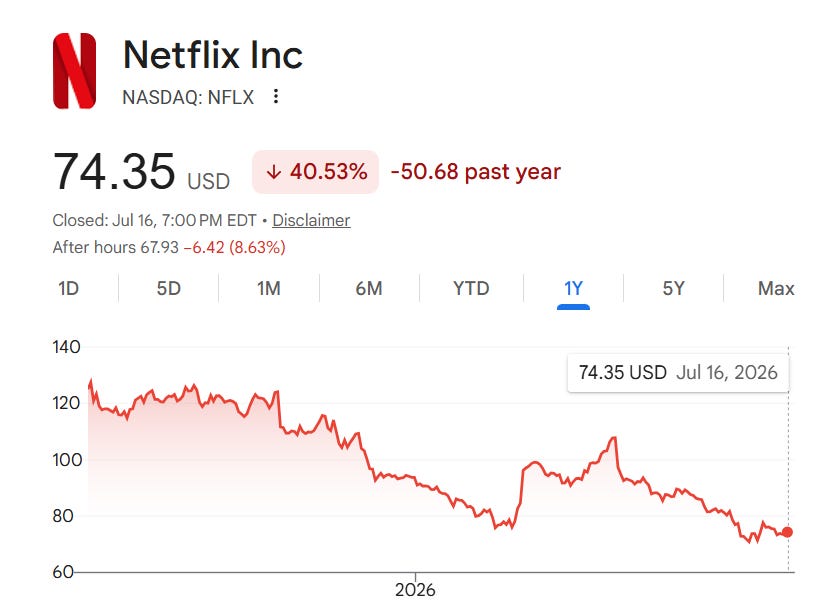
Meanwhile, the stock market is revealing its own belief system about the company as indicated by a significant drop in its share price in the past few months.
Here are some of the pressures that are creating fault lines in the video media industry. They aren’t specific to Netflix but they explain, to some degree, why Netflix is considering its options as it moves into the future.
The costs of viewing content keep increasing for consumers every year (apparently there is a new word for this - Streamflation!)
Cutely merged words aside, if we’re paying more, we better be getting more value out of any subscription streaming service, right? Otherwise users will defect.
So Netflix and its media frenemies are under constant pressure to continue to deliver ‘value’ as the bar (and prices) keep getting higher.
While it was able to capitalize on its data and tech background to compete successfully against the legacy media companies, it is now facing increased competition from social media tech companies that also carry its data and tech advantages.
A Deloitte’s Fall 2025 Digital Media Trends survey showed that some consumers consider watching videos both on social media and on streaming services to be “watching TV.”
Add to that Gen AI which has lowered the cost of content creation and the world of content is now crowded with its density increasing every day.
Media companies, regardless of their video format focus, whether long-form, short-form, TV shows or itty bitty addictive reels are all competing with each other for eyeballs. To make matters worse, the market is wondering whether engagement has reached its peak.
Given this plethora of shiny content objects spread across platforms, users are no longer committing to one platform. They keep switching between platforms and formats. Fragmented audiences follow content around, platform-hopping to keep up with their beloved franchises, artists, influencers and characters.
Although pretty much every media company out there is looking to launch more content or higher quality content, as a way to retain viewers, the reality is that the scarce resource is not content. It’s attention and keeping it aka ‘engagement’.
It makes sense then why Netflix might be considering adding Live TV and bundles to improve engagement. Being one destination among dozens is no longer enough to hold attention on its own.
Netflix disrupted by unbundling cable content once the technology layer shifted. Others followed suit. And for a while that worked. It gave customers more flexibility, more choices. They could pick content a la carte and pay only for what they wanted to watch.
Now once again, bundles might be coming back. Because the conditions that initially led to them have also come back and media companies might be compelled to respond in similar ways.
Ben Thompson’s widely cited Aggregation Theory and formal economic models of multiproducer bundling point to a few recurring conditions that make a market prone to this kind of bundle-unbundle-rebundle cycle.
Many differentiated suppliers (channels incl. social media/studios)
Stable aggregate demand for ‘some good content’ but nobody wants all of it
High consumer search/decision cost in picking and paying for each one separately
Suppliers preferring predictable, pooled revenue over unpredictable hit driven revenue
Combining these, here’s the cycle - new distribution tech or something else lowers the cost of unbundling → unbundling wins for a while → fragmentation costs (search, subscription fatigue) rise faster than the savings from buying a la carte → someone rebundles at a new cost structure.
The conditions seem to be ripe again as the prices of individual platforms go up and there is an ever increasing crowd of differentiated content in the market.
In the next section, I’ll evaluate the two paths in front of Netflix as it navigates the future.
Model 1: Aggregator of content with Live TV and bundles
Model 0: Continue to invest in its own content and neutral content like live sports
Although Netflix has not yet confirmed that it is launching live TV and bundling other streaming services on its platform, the popular media seems to have gobbled up that news. For the purpose of this thought exercise let’s assume that is indeed what is going to happen.
While we don’t know how it would design and implement this, we can make some educated guesses based on how others have done it.
Presumably, Netflix becomes an app where you can find and pay for most of what you’d want to watch. And that the design plan, drawing from media reports, is
“streaming bundles, which would appear like tiles on the streamer’s home page”.
It might also add “live channels that would continuously stream certain programs, or shows and films from a certain genre”
In the short term, this would probably work. Engagement would go up because there are more reasons to open the app and hang out with more content.
Investors would like it because Netflix is not spending outrageous amounts to add to its own content library. Its library increases because it includes content from partners like NBCUniversal, for instance. Netflix would be taking a cut.
As detailed in last week’s article, when regulators approved Comcast’s acquisition of NBCUniversal in 2011, they set some conditions. Comcast had to offer NBCUniversal’s content to competing distributors, including online players like Netflix, on fair and non-discriminatory terms. In other words Comcast, as the owner and distributor of content, its own and that of other competitors, had to maintain neutrality.
If Netflix were to add competitor content on to its platform, the implicit promise to the audience is that it’s a fair place to watch whatever they want, including Netflix’s own content.
The challenge though, in keeping that promise, is that Netflix needs its own originals to keep performing, keep driving engagement, keep justifying the spend. So it would be attempting both at once; being ‘neutral’ while also investing in its own success. At some point regulators usually crack down on these kind of practices.
So, if Netflix leans into aggregation (Model 1), it’s stepping, for the first time, onto ground where the neutrality test actually applies to it, implicitly or explicitly.
Netflix started its life as an aggregator of sorts (or more precisely a curator-style aggregator). Back in the day, it didn’t make its own content. It licensed the rights to other studios’ content and folded it into one unified catalog, presented on one platform for one price, under one Netflix identity.
Later on, it evolved to a more hybrid model in which some content is made by its own studios or by other studios exclusively for Netflix or licensed content from others which stays on Netflix for a contracted period of time.
What is might now be attempting is something different.
Netflix would be selling Peacock’s own subscription as its own distinct product with its own billing, inside Netflix’s app, the way that Amazon resells Paramount or Apple resells MGM.
That’s not curation of content Netflix has licensed and assembled under its own catalog. It’s Netflix acting as a ‘storefront’ for a competitor’s separate, self-branded business.
So, how would neutrality work?
Since it needs its own originals to perform, and it will continue to invest in its own content, how does it become the fair place to find whatever you want to watch? How will it decide which titles get the best placement and the loudest promotion? Its own or someone else’s? Who decides? Its leadership or an algorithm?
Even today, its algorithm pushes its own originals pretty hard. But, as a curator-aggregator, that is the implicit deal with its audience with Netflix saying trust our taste in curating our library and our ability to match your content preferences with recommendations.
However, if it moves to the proposed storefront model, by definition, there is an expectation of equal opportunity or even-handedness that a curated catalog doesn’t convey.
If not, at some point it could face accusations of anti-competitive behavior. Either from content owners on its own platform like Peacock or then the regulators who’ve seen this particular movie before. These concerns don’t usually emerge right off the bat. They come up somewhere along the journey when stakeholder/s notice that their expectations aren’t being met.
Wellll……….
Amazon’s Prime Video channels service is probably the closest to what Model 1 describes for Netflix. Through the Amazon app, you can subscribe to Paramount, MGM, Starz, and a bunch of others. Amazon handles billing and also pushes its own originals….hard!
But there is a fundamental difference here. Prime Video is bundled in with Prime. I don’t know anybody who signed up for Amazon Prime because of its video curation. Usually, it is because customers want free shipping of retail products. Prime Video with ads just comes along for the ride.
On that note, Amazon’s primary identity is retail. In retail, the FTC has indeed gone after Amazon for copying and underpricing seller products to promote its own.
So its diversification into multiple businesses and operation as a conglomerate has somewhat insulated its video business from the kind of attention that could get it into trouble.
That being said, it did get into trouble with customers who felt tricked into paying for some content through Prime Video. The users didn’t realize that the non-Amazon content was an add-on charge. Amazon had to redesign that part of the site and make that clear.
Its media partners have also complained from time to time about their content being buried. But Amazon has 220 million Prime members. Especially for the smaller partners, they can tolerate some of Amazon’s tactics if that means being discoverable by millions on its platform.
Amazon fixes some complaints if the din gets too loud. But, it certainly hasn’t perfected the art of including competitor content on its platform in the eyes of the partners or customers.
Apple also has a version of Model 1 albeit with a cleaner looking interface than Amazon’s. And Apple’s primary business is devices - iphones, ipads, watches, Macs, etc. It has a massive customer base for those. Its content partners also tolerate its lack of neutrality for access to its users.
Netflix is a pure media player. Content is not a side or sibling business like it is for Amazon and Apple. In spite of Netflix’s 325 million subscribers and access to those for any content partners, it is also a direct competitor.
If Netflix switches to a storefront model and pushes its own content ahead of partners, partners are less likely to tolerate that behavior because that would mean handing some of their business over to the very company trying to put them out of business. Especially true for some of the largest media companies like Disney or NBCUniversal which have the resources to battle it out, if needed.
To quote Ben Thompson, “the most important factor determining success is the user experience”.
This was definitely Netflix’s experience for the last few years as it dominated the streaming media market. But here is why I think that adopting Model 1 will actually dilute the experience for users.
Decision Fatigue - curators succeed by removing the ‘what to watch’ burden. Personally, I’ve always thought that the Netflix recommendation engine is not that great although it has improved in the last year or so. In spite of that, it has removed some of that decision burden even for me. If it becomes a portal or a hub that hosts standalone apps, the onus of decision making and content navigation will be back in our laps. Ugh. There might be a way around this through some unified catalog but doing so would entail a delicate balancing act.
Data Dilemma - in most cases, if users get pushed out of the native Netflix recommendation engine into separate Peacock or other apps. Netflix would lose valuable engagement data. And since the use of data to deliver content has been one of their critical differentiators, keeping access to that data is really important to offer a good user experience.
Here as well, there may be a way to get the other content providers to integrate their metadata with Netflix. Presumably that negotiation with partners too would go much better if Netflix did anything else besides content like Amazon or Apple. Right now every other media company sees it as a direct threat to their business.
There is a counter-argument here. Consumers are frustrated by navigating across scattered apps even if they do it all the time. Fully aggregating that experience would reduce friction for users. But that might be a smaller benefit compared to the Model 1 implementation costs to Netflix.
Perhaps not automatically. But, Netflix is more exposed than Amazon or Apple by virtue of being a pure-play content curator with a differentiated product. If the user experience erodes in value, audiences will have no reason to stay subscribed, unlike in Amazon or Apple’s case. That’s what could turn Model 1 from a theoretical risk into a real opening for anyone who’s watching and is motivated (and financially endowed).
Add to that the state of the media industry right now……..
As I described in my Stord/Amazon article, “History shows that dominant platforms unintentionally create the conditions for challengers to emerge from beside them when they become too powerful, too expensive, or too indifferent to customer interests.”
The media industry is certainly not indifferent to customer interests. Far from it. Although Netflix dominates the streaming video market, it isn’t too powerful in the same way as Amazon is in retail.
But the condition that does apply here is that unbundled services have indeed become too expensive for consumers. No single platform pulls all the content together and different platforms and payments added up are becoming unaffordable for many.
This was the exact point in Comcast’s journey where Netflix was able to use technology to unbundle the bundle and win its top position in the industry. The cable bundles had gotten expensive and then startup Netflix showed up as a neutral aggregator.
Maybe. If someone can combine the two parts that have so far existed separately; i.e. a distribution channel people already trust (which Verizon, Comcast, Roku, or Apple all already have), and cross-catalog discovery (which smaller companies like Reelgood and JustWatch tried but weren’t able to scale).
Three things would make whoever pulls it off formidable.
Structural trust. When Netflix first came on the scene as a DVD by mail company with no content of its own, it had nothing to gain by favoring one studio's movies over another's. The trust came free and was built into its business model. Whoever builds this next needs the same structural neutrality. Even if it changes its model later on, as Netflix did when it started creating its own content to get a foot in the industry door, initial image of neutrality to earn that trust is important.
Discovery as the actual product. The thing that wins the audience attention war in a crowded market is no longer more content. If the challenger nails discovery by pointing people to the right content across the entire or most of the industry’s catalog, faster and more transparently than an aggregator with skin in the game, it could potentially capture the opening in the market. There were some startups that attempted this but none of them cracked personalization across platforms or recommendations.
Data and transparency. As Deloitte’s research suggests “without a unified view of customers (their preferences, interactions, transactions, service histories), media companies could struggle to move from discovery and engagement to conversion, monetization, and long-term value.” To make point 2 work, a discovery layer needs to see your viewing habits across every platform you use, not just one. That's a lot of sensitive behavioral data sitting in one place. The company that gets this right will need to be explicit and give users control over their data to be able to pull it off.
Interestingly, Netflix already has two of these three ingredients - the trust, and the data. Perhaps Netflix could be the company that builds cross-platform discovery without turning it into the Model 1 storefront. If it doesn’t, it’s leaving the exact opening it once used against Blockbuster sitting open for a telecom, a device maker, or someone who hasn’t shown up yet. Wouldn’t that be ironic?!
None of this has happened yet. The WSJ reporting says Netflix is exploring live TV and bundling. Companies explore ideas they never ship all the time.
That being said, the nature of what’s being explored is revealing. It suggests a major change in the business model that Netflix has so far operated and succeeded on.
Adopting the marketplace or storefront model does not make the outcome I hypothesized inevitable. A storefront can, in theory, be run with restraint through balanced shelf space and no algorithmic nudge toward Netflix originals over the tile sitting next to them. But what’s possible in theory might not be likely in practice if the external pressures don’t abate.
IMO, if Netflix goes down this path, the endgame could look a lot like Comcast’s. Not immediately. But maybe in 5-7 years. Because one company usually can’t run a neutral marketplace and a competing content studio at the same time for too long without scrutiny. The bigger the company, the greater the scrutiny. And once the scrutiny becomes constant, so does the struggle.
In this scenario, the basic business model does not change. Netflix skips Model 1. It keeps doing what it has always done, possibly with more live sports, which is something it has been testing already. That means no third-party relationships to manage and no major violations of neutrality.
Although the Warner acquisition didn’t work out, it was more consistent with its current business model, which is to own the studio and the library outright and fold it into its own catalog under its own identity.
But, the challenges of competing in the media landscape remain. Streamflation causing stress to users is not going to go away. Fragmented attention is not going to go away. In fact it might get worse, if that’s even possible.
With this model continuing, Netflix is going to have to keep winning attention the hard way - by standing out with desirable content and being the platform that people choose to stay on.
In the short term it might feel like a schlep. But in the long term this might actually be the better plan, in my opinion. Netflix has a global presence with local content production, like pretty much no other company out there. That in and of itself is unique because it has been very difficult for the legacy media companies to capture international markets.
It has a phenomenal data moat that it has built over 20 years. With AI capabilities it only makes the moat stronger. Doubling down on these strengths could set it up for success in the future.
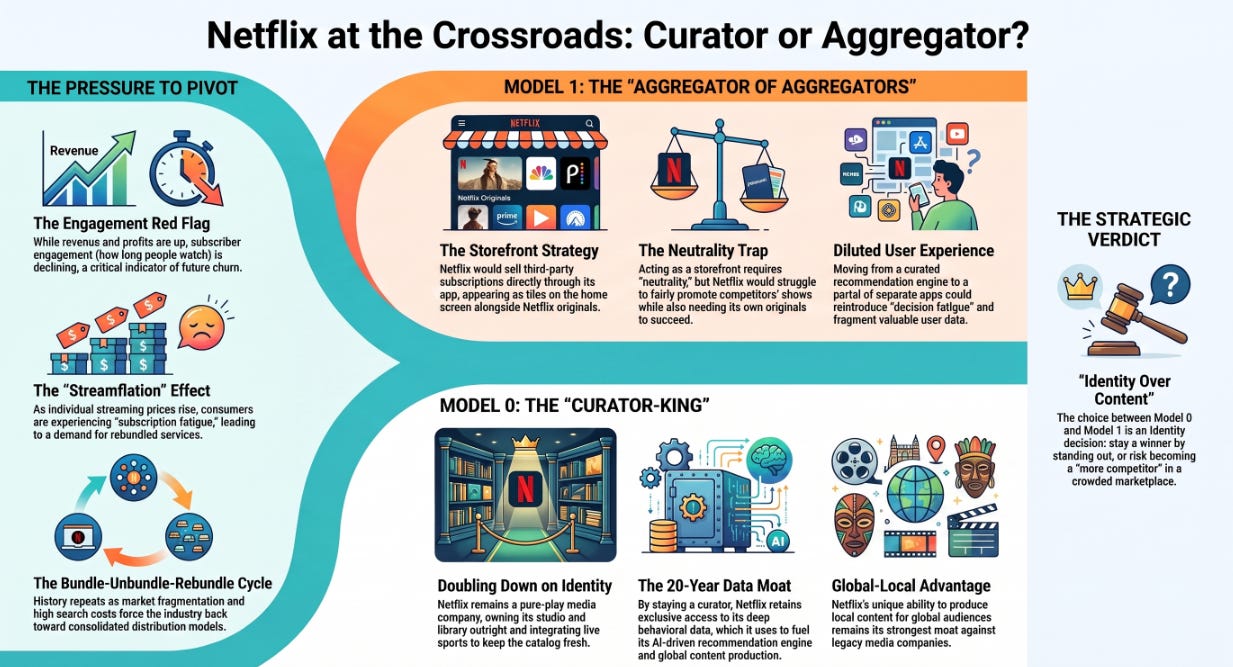
What this piece has argued is that Netflix’s next move is more of an identity decision than a content decision. It’s about what kind of company it is willing to be.
The design of your business model matters. The distinction between being a curator and an aggregator might appear minor. But in its execution, including the storytelling around that model and its actual functioning, the differences are more major.
For now, Netflix is still ‘winning’. The most recent quarterly revenues, reported just yesterday, were $12.56 billion, up 13% from the same period last year and net income was $3.4 billion, up 9%. It has set expectations that the next quarter might not look as sunny and acknowledged the immediate need to improve subscriber engagement.
In my view, Model 1 is high-risk and could put the company in ‘competitor’ territory in the long run. Model 0 with some neutral content extensions and other adjustments might be the winning bet.
As always, only time will tell.
Comments
Nothing yet. Say the first thing.
Sign in to join the conversation.