
The United States of America celebrates its 250th birthday in a couple of days. I’m feeling warm and fuzzy about it.
One of the many great things about this country is its unwavering support of entrepreneurship and technological development. Interestingly, the most impactful innovations, such as the Internet and GPS, did not originate in founder garages or venture-backed startups.
They were incubated in government laboratories, funded by you, i.e. public money (if you pay taxes in the United States), sustained over years, often with no predictable result in sight, and handed over to the private sector only after the hardest and least commercially viable work was done.
And while venture capital gets celebrated for risk-taking and funding innovative technologies (as it should for the commercialization of many ideas), the entities which absorbed the highest risk for foundational technologies that moved the economy forward, have been the National Labs.
This network of 17 National Laboratories operated under the Department of Energy and sister agencies like Defense Advanced Research Projects Agency (DARPA), which is housed under the Department of Defense is, these days, the less talked about story in American innovation.
The Labs were set up after World War II and inspired by the success of the Manhattan Project, the top secret U.S. government program that developed the world’s first atomic bomb. I highly recommend watching the movie Oppenheimer, if you haven’t already, for a dramatized version of how the project unfolded. Either way, the Labs’ origin story should tell you a lot about why they were set up, viz. to drive advanced research not only in defense tech but also other science and technology areas.
The Labs often fly below the radar today mostly because they contribute to the invisible first act of innovation of path breaking technologies and let the private sector take it to the finish line. And in the narrative of American progress, whoever crosses the finish line of commercialization has got most of the credit in the media.
We can trace most of the defining foundational technologies to these Labs. But the one that recently bucked that pattern is….….AI! Or rather a type of AI that includes the large language models and the infrastructure that became ChatGPT and its competitors.
Foundational technologies are those that become embedded infrastructure and something so broadly adopted that it underlies entire industries. Like the Internet.
AI is what many believe will become ‘the’ (preferably pronounced theeeee) foundational technology of our times. Possibly on the scale of the Internet. It’s had a super duper start but whether it earns that designation fully is still tbd. Anyway, Big Tech and venture capital stepped in to fund most of AI development themselves.
As you may know, none of these AI companies are profitable yet as standalone businesses. Not OpenAI, not Anthropic. But pretty much everybody in the world and their furry pet believes that they will eventually become profitable. Nevertheless, that’s how difficult that first act actually is and how long it takes.
So the question ahead of us is…… as venture capital get bolder, can we expect more foundational technologies to emerge from the private sector? Meaning, will private capital now take over the first act for selected technologies? Or is AI an outlier? A one-hit wonder!
Even if VCs are willing to take on more risk, they are ultimately constrained by a roughly seven to ten year fund cycle and obligations to their investors. Ten years is usually insufficient for foundational technologies.
The sub-heading is the question that this article explores.
And my not-so-disguised goal here is to also shine the light on the National Labs as the exceptional drivers of innovation that they are, to commemorate America’s upcoming 250th birthday.
I’ll cover -
How the first act works - the patterns of Labs-driven innovation
The Lab’s innovation playbook
How the venture capital model is evolving to take on Labs like bets
I’m not going to include a comprehensive overview of the structure and operations of the Labs. That is certainly information that Google Search or some AI can provide very easily. Instead I’m keeping the article focused on the narrow topic identified above and only providing enough of a primer on the Labs to provide context.
At least these three features, listed below. are common in the types of projects that the Labs take on.
The Labs were set up to conduct research and development in areas identified by Congress as national priorities. Congress and DOE have determined that these scientific capabilities are necessary for the country to have, even if they never become commercially viable. Energy, defense, and health are some examples of these areas. And of course technology, broadly defined.
Unlike the other institutional drivers of innovation such as universities which fund interest-driven research or venture capital, which funds financial returns-driven initiatives, the Labs are mission-driven. Profits are not the goal. But they do need to ‘perform’ and generate strong research results in order to get continued funds from the government.
When a lab is tasked with a mission like achieving energy independence, it identifies what technologies need to exist, and builds them.
That used to be a fundamentally different starting point than anything in the private sector. Recently, however, leading Silicon Valley VC firm Andreesen Horowitz launched its American Dynamism practice which “invests in founders and companies that support the national interest”. A notable twist that I will come back to later.
Back to the pre-American Dynamism days with the OG VCs, the National Labs. Let’s take GPS as an example. With national defense as a priority, its origin traces back to a DARPA-supported Navy submarine geopositioning program. The Department of Defense (DoD) later created a joint program office to build the full satellite system.
Consumers didn't get the cool GPS devices on their car dashboards (and now phones) until years later after the government had spent billions building underlying infrastructure. I actually remember the switch from paper maps to GPS. What a boon that was at the time!
If commercial viability is not a priority (and it isn’t), these are, by definition, high-risk projects with no guaranteed returns.
Take the internet. The Advanced Research Projects Agency, an arm of the DoD funded the development of ARPANET in the late 1960s to link computers and enable them to share data at its research labs. That was solving a real problem because at the time, computing resource sharing was highly inefficient. The solution ultimately became global infrastructure. At the time of its development, that was unknown.
Due to the nature of the risk involved and the development cycle itself, many of these projects continue for decades before we see any outcome.
Tapping into the example of the Internet again, over the next two decades, DARPA-funded researchers expanded ARPANET and designed the internet protocols that allowed computers to transmit data. The National Science Foundation later funded the development of Mosaic, the first widely popular graphical web browser, out of research at the University of Illinois. Today, the Internet is something we take for granted. But it got to us only after decades of public investment had already done the hardest engineering.
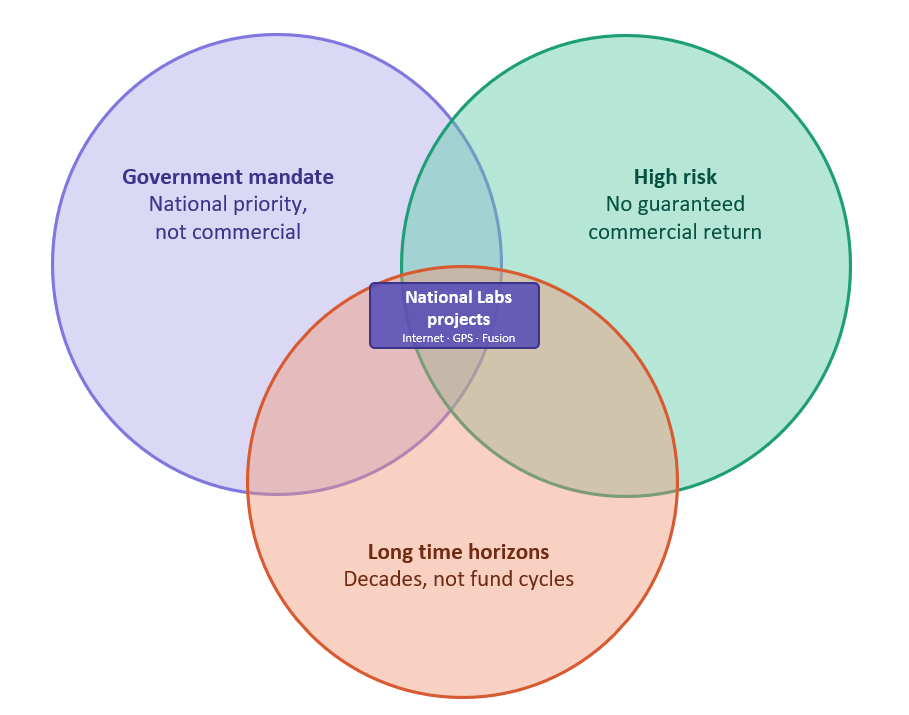
The more recent technologies that the private sector is racing to commercialize, even as they are still under development at the Labs, quantum computing and nuclear fusion, are following the same early stage Labs pattern, though their commercial impact remains to be seen. They are still in the foundational phase.
In December 2022, Lawrence Livermore National Laboratory achieved fusion ignition for the first time in a lab setting. It produced more energy from a fusion reaction than the laser energy used to drive it. This milestone was something like six decades in the making. The lab stuck with it much longer than any private company or venture fund could realistically have.
Then, there is quantum computing. DOE recently renewed its funding for this technology with $625 million to keep the research going for another five years even as private companies like Google and others are trying to commercialize it. The foundational research underneath that race is still, to a significant degree, being paid for by the public.
Driving foundational research and innovation via the first act is one thing. But getting it into the hands of the private sector is where the Labs have excelled.
The tech world is mostly familiar with this seemingly morbid concept called the Valley of Death. It refers to the gap between research and a commercially viable product. Academic researchers have written extensively about this gap.
A 2022 paper in Sustainable Futures reviewed 128 scholarly works and interviewed 30 high-tech startups to understand what causes it. They found that limited funding, lack of commercialization skills, poor collaboration between scientists and industry, bureaucratic delays, and founders who understand technology but not business. Sound familiar? These are well-known, recurring problems.
The National Labs have been the most systematic institutional answer to the Valley of Death problem. They advance technologies from early theory to functional prototype by de-risking the process. Because if you take away the costs of the research and the costs of the timeline, it removes a significant portion of the risk.
By building the infrastructure to address these causes of the Valley of Death, they prep it for the private sector to come in and see a path to market.
The mechanisms that the labs have put in place to facilitate this transfer of knowledge form the content of its playbook. Some of their core methods are as follows.
The Labs make their results, research, and resources accessible by opening up their user facilities and infrastructure to outside researchers for free or for a fee. The deal is that there is no charge for users who are doing non-proprietary work if they publish the research results in the open literature. But a full cost recovery fee applies if the users are going to do proprietary work. So the incentives are well stacked toward making information freely available to the public which can then apply it to create even more opportunities down the road.
The Labs have set up different types of licensing, partnering and collaborating arrangements for the private and public sector to engage with them to commercialize technology and get it to market. One of the most important is CRADA.
The Cooperative Research and Development Agreement (CRADA) enables partnerships between a Lab and a non-federal entity such as a private company, not-for-profit or universities. This supports pooling of resources, sharing expertise, and also jointly protecting intellectual property. For example, Ford and Caterpillar have done multiple CRADAs with Sandia National Lab on engine technology and other manufacturing projects.
The legal structure behind CRADA and other arrangements makes it possible for a startup or even a large company to almost literally ‘walk into’ its advanced research facilities, work with its scientists on a shared problem, and walk out with intellectual property (IP), either jointly owned with the Lab or with favorably negotiated IP terms that it can then independently capitalize on. All this without having to fund the underlying infrastructure that made that research possible in the first place.
The Labs recognized that even the most brilliant scientists sometimes need help with building businesses. The Lab-Embedded Entrepreneurship Program (LEEP) was launched in 2015 as a solution to that concern.
LEEP “recruits top entrepreneurial talent through a competitive national process and embeds them at DOE National Laboratories for two-year fellowships. During this time, fellows receive entrepreneurial training, mentorship, technical support, and access to world-class facilities to develop and launch energy and manufacturing startups. The program also connects participants to local, regional, and national innovation ecosystems, helping early-stage companies overcome barriers to commercialization.
DOE's Advanced Materials and Manufacturing Technologies Office (AMMTO) launched LEEP in 2015. Under AMMTO's leadership for the past decade, 202 LEEP startups have attracted more than $6 billion in follow-on funding and created over 3,900 jobs.”
That’s a pretty significant achievement. The Labs created the conditions for private capital to then take it from there.
Although criticized sometimes for being slow and bureaucratic, every national lab has a Technology Transfer Office. The main goal of these offices is to facilitate the commercialization of the innovations that get developed in the lab. They have business development professionals, licensing experts, and attorneys on staff who can handle the business side of the process.
Combined, all these different pieces form a systematic architecture and pathways for moving science into the market. And the market is exactly where private capital excels at the next act.
The standard venture capital model has been built around a very specific kind of risk. Its patterns are different from the ones that we saw earlier with the National Labs.
VCs invest in startups that have a visible and viable commercial path, an achievable addressable market and a timeline that fits inside a fund cycle. The fund cycle is typically ten years where limited partners or investors put in money at the start of that cycle. The fund needs to return capital to its limited partners, whether individuals, pension funds, university endowments, or family offices, within that window.
Ten years sounds like a long time. America will be 260 years old, ten years from now. But it really isn’t if you’re talking about foundational science, like the Internet, which took almost three decades, or fusion ignition, which took six decades. Certainly no investor is willing to wait that long for a distribution.
We are in 2026 now and that old private capital playbook is slowly starting to give way to a modified one. And it’s starting to share some traits, albeit not all, with the National Labs playbook.
The traditional VC model is straightforward. VCs write a check, sometimes take a board seat, and connect the founder to other founders, other investors, and potential customers. And then wait for an exit either through acquisition or IPO, and these days reverse acqui-hires. That was the value proposition it offered to founders and startups; i.e. capital plus network. And it worked really well for decades, particularly for commercially ready technologies with a defined market.
The emerging model is starting to look different. Some of the largest VC firms are no longer just investing in start-ups and providing the network. They are building entire ecosystems around them. And some of them are making topics of national interest the focus.
Andreessen Horowitz launched a $600 million American Dynamism fund in 2023 with a goal of supporting companies building in the ‘nation's interest’. The sectors they focused on included defense, manufacturing, and robotics. And in January 2026, the firm allocated $1.176 billion from a $15 billion in new funds for its American Dynamism practice backing defense and security related startups. Co-founder Ben Horowitz framed its mission as "ensuring that America wins the next 100 years of technology."
And it is not alone. Founders Fund is backing defense and deep tech platforms; General Catalyst has a global resilience investment thesis focusing on critical infrastructure, defense tech, and supply chain security. Lux Capital is also investing in Frontier Hardware and Advanced Defense Systems. There are some others too.
To be realistic, these initiatives are likely more about opportunity than ideology, given the timing. In the last few years the geopolitical environment has shifted making defense and national security a growth market in a very obvious way. To mention that defense budgets have expanded. There has also been technology convergence. For example AI can be used in the defense space as well. So the motivation for VC investment kinda remains the same below the surface.
Setting money aside to invest in sectors of national interest is one part of this evolving story. A16Z and other leading VCs have built their own podcast network, content engines, and media platforms to help their portfolio companies with distribution and reach. A16Z in particular has spent millions on lobbying in Washington and hosting summits that bring together founders as well as politicians. So VCs are no longer just investing in a company; they are also creating the ecosystem to support startup success.
….Just like the National Labs.
The new VC ecosystem buildout with its shared infrastructure, embedded expertise, policy influence in some cases, distribution networks and connections….all of that is what the National Labs have been doing for 80 years. Of course, the motive is still different and will likely remain so by definition. But, the practice is converging a wee bit.
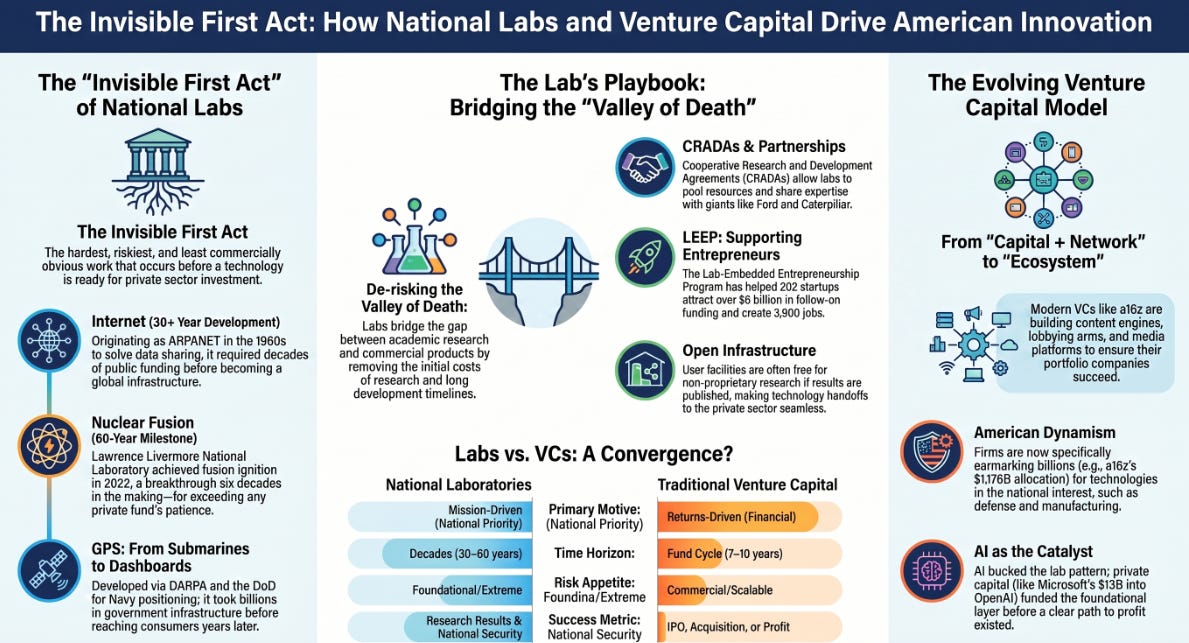
You could dismiss all of the above as coincidence. Or natural evolution. Maybe it is. Except when you think about how AI, in its current form, came to be.
DARPA actually did fund some of the earliest AI research in the 1960s. But in the late 1980s it cut AI funding deeply because the new leadership decided that it was not a priority at the time. The funds were redirected to other initiatives.
To be clear, the National Labs never fully exited AI. They have continued using it as a tool to accelerate their own scientific missions, applying it to fusion research, materials science, and drug discovery.
But the foundational commercial AI layer, i.e. the large language models and the infrastructure that became ChatGPT and its competitors was built elsewhere.
Its seeds were planted first in universities by researchers like Geoffrey Hinton and Yann LeCun and funded largely by academic grants in the 1990s/2000s. Then Big Tech, whose researchers added a layer with the transformer architecture in 2017, which is the breakthrough underlying every major LLM today. And venture capital which invested in OpenAI in its early stages. As did Big Tech company Microsoft.
By the time AI became commercially interesting, the Labs were no longer central actors in the story. They were not the ones to de-risk the Valley of Death for this one.
OpenAI also started its life as a non-profit, research organization and not a startup pursuing returns. A point that, as you may know, recently became controversial when the startup converted itself to a for-profit company. Either way, the non-profit part was intentional, based on what the OpenAI founders believed at the time, that building Artificial General Intelligence (AGI) was too consequential and too long term to be developed under the auspices of a profit-making company. In spite of this, venture capital invested in it.
Basically a similar logic as the National Labs mandate driven charter. In some way it validated the National Labs model and core thesis that truly transformational long term high risk innovations require that kind of organization and can seldom be built around a profit motive.
Whether AI ultimately proves as foundational as the Internet becoming the underlying infrastructure everything runs on or turns out to be a very powerful tool that sits on top of existing infrastructure, we don’t quite know yet. But the bet that venture capital is making on AI is the closest it has ever come to the kind of foundational risk the labs have taken for decades.

Not quite.
There is a distinction. The key one, of course, is the focus on returns in the VC model. VCs are building ecosystems because better supporting founders drives better results. Unlike the National Labs, where profit has never been the motive.
Another distinguishing factor is the time horizon, which remains structurally different. Recently VCs have started setting up extension or opportunity funds, which are for longer duration than the original ten-year runway that funds had. But the purpose of that was not to make accommodations for foundational technology start-ups. They are doing it because many start-ups are staying private much longer, which has less to do with what kind of technology they are building. It has more to do with creating additional runway to return capital to investors.
What is changing, besides the ecosystem build-out, is the range of technologies for which private capital is willing to absorb that first act risk. For a narrow but growing set of technologies where the commercial application is visible enough even if it takes much longer than the time they’ve historically been willing to wait. That’s where the gap between the Labs model and the VC model is narrowing. AI is one example and so is defense tech.
But for the majority of the technologies where the application is genuinely unknowable and the question marks on the timeline are many, the Labs remain the primary investors. For now and for a very long time, in spite of all the the bureaucracy and the political issues that the Labs face, they are the still the ones making the highest risk bets that spur American innovation.
Happy 250th, America! You changed my life in so many meaningful ways. I am forever in your debt.
Comments
Nothing yet. Say the first thing.
Sign in to join the conversation.