
AI can make Design Thinking faster. It can synthesize research, cluster themes, generate ideas, draft prototypes, and help turn a room full of messy input into something useful.
But here’s the part I don’t want us to lose:
AI should support human-centered work, not replace it.
The best Design Thinking with AI still starts with people. You observe them. You interview them. You listen closely. You notice what they say, what they do, what they avoid, where they struggle, and what they hope for.
Then AI can help you make sense of what you are learning.
That is the real opportunity. Not just “prompting ChatGPT for ideas.” Not asking AI to invent customer needs. But using AI as a thinking partner inside a structured, human-centered innovation process.
Recently at the CultureCon AI Summit, I used AI live with a group during a Design Thinking-style experience.
The group was not sitting passively while AI generated answers.
They were reflecting. I was observing them. I was rapidly interviewing them (in a unique way). They were interviewing each other. They shared insights back with the group. They worked to define their needs and turn those needs into insights and questions.
Then they submitted their thinking live through Slido.
That gave us a rich set of real-time human data: reflections, needs, questions, observations, and ideas from the people in the room.
From there, AI helped us synthesize.
It helped cluster responses into themes. It helped create a quick report. It helped identify patterns. It helped generate “How might we” questions. It helped us move toward ideas, recommendations, and prototypes.
But the most important part was this:
I was still in the room with the people.
I was listening. Watching. Asking follow-up questions. Noticing energy. Hearing tone. Seeing where the group was getting curious or stuck. I was also getting my own ideas from what I observed and overheard, then using AI to help turn some of those ideas into prototypes quickly.
That is the mindset I think leaders need with Design Thinking AI:
Be with the people. Then use AI to help make meaning and move forward.
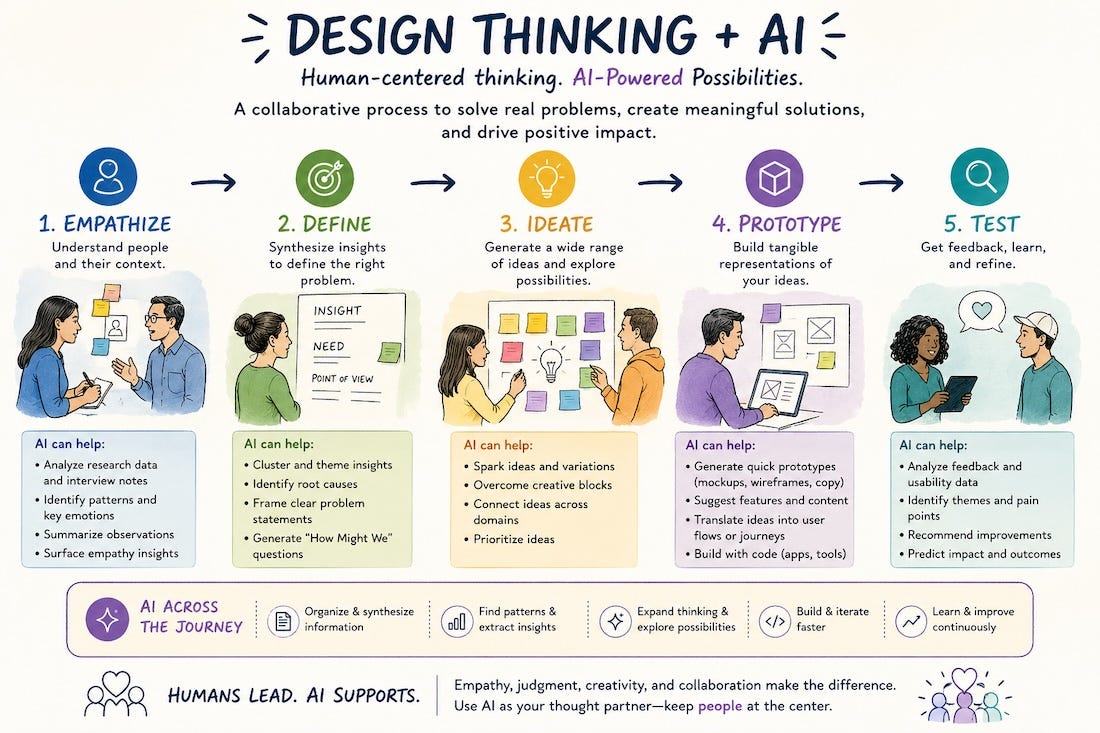
A simple way to apply AI is to map it to the classic Design Thinking stages:
Empathize: Use AI to prepare interview questions, organize notes, summarize observations, and identify patterns. But don’t let it replace direct contact with people.
Define: Use AI to turn messy input into clearer need statements, insight statements, and “How might we” questions. Then have the group review and improve the wording.
Ideate: Use AI to generate many options, remix early ideas, and push beyond the obvious. But treat AI ideas as raw material, not finished answers.
Prototype: Use AI to create rough drafts fast: landing pages, service scripts, app screen descriptions, role-play scenarios, chatbot flows, mockups, or simple coded prototypes.
Test: Use AI to create test plans, synthesize feedback, identify confusion, and suggest next iterations. But keep the evidence connected to what real people actually said and did.
AI is especially useful in the middle of the process, when teams are trying to move from lots of human input to clearer patterns, better questions, more ideas, and something tangible to test.
AI should not replace empathy.
It should not invent needs without evidence. It should not flatten emotional nuance. It should not make the loudest theme look like the most important theme. It should not generate generic solutions disconnected from the real context.
Good Design Thinking is not just fast. It is grounded, participatory, creative, and iterative.
AI can help speed up the work, but speed is not the only goal. The goal is better learning, better alignment, better ideas, and better solutions for real people.
Here are a few simple prompts for using AI inside a Design Thinking project:
Analyze these interview notes. Identify user needs, frustrations, motivations, emotions, and surprises. Include supporting quotes. Do not add assumptions beyond the notes.
Cluster these workshop responses into 5 to 7 themes. Give each theme a short title, a plain-language description, and examples from the responses.
Turn these themes into insight statements. Each insight should explain what people need, why it matters, and what opportunity it suggests.
Generate 15 “How might we” questions from these insights. Make them specific enough to guide ideation but open enough to invite multiple solutions.
Turn this selected idea into three prototype options: a low-fidelity paper prototype, a role-play prototype, and a simple digital prototype. Include what we should test with users.
One of my favorite additions to many prompts is:
Separate evidence from interpretation.
That simple instruction can help keep the AI output more grounded.
The future of Design Thinking is not AI replacing human creativity.
It is people using AI to think, learn, synthesize, build, and test faster while staying connected to the humans at the center of the challenge.
In the best Design Thinking AI projects, the leader is not hidden behind a screen. The leader is in the room, observing, interviewing, listening, synthesizing, facilitating, and helping people participate.
AI becomes a partner that helps the group see patterns, generate options, and move toward prototypes more quickly.
The combination is powerful:
Human empathy.
Group participation.
Facilitated sensemaking.
AI-supported synthesis.
Faster prototyping.
Better testing.
Clearer next steps.
Organizations do not just need more AI tools. They need people who can use AI inside meaningful human-centered work.
I developed a more complete guide with examples, prompts, and a full Design Thinking process walkthrough here:
Best,
Darin Eich, Ph.D.
Founder, Innovation Learning Design Thinking Facilitator Program
Comments
Nothing yet. Say the first thing.
Sign in to join the conversation.