
Work keeps shifting under our feet. AI, hybrid teams, faster customer expectations, organizational change, harder problems. Most of us already know the technical answer matters less than it used to. What matters more is how people respond when the path forward isn’t clear.
That’s the gap I keep seeing in the teams I work with.
People have taken DISC. They’ve taken MBTI, CliftonStrengths, Big Five. They know their style. They can describe their preferences. And they still struggle to innovate, to navigate ambiguity, to have the harder conversations a changing project actually requires.
Self-awareness is a fine starting point. It isn’t the work.
The work is skill development. Specifically, the human skills that let people adapt: asking better questions, noticing opportunities, building trust across silos, testing assumptions before sinking time into the wrong thing, and reflecting honestly on what’s working.
That’s what a future skills assessment is for. Not another personality label. A practical look at the capabilities you can actually practice and improve.
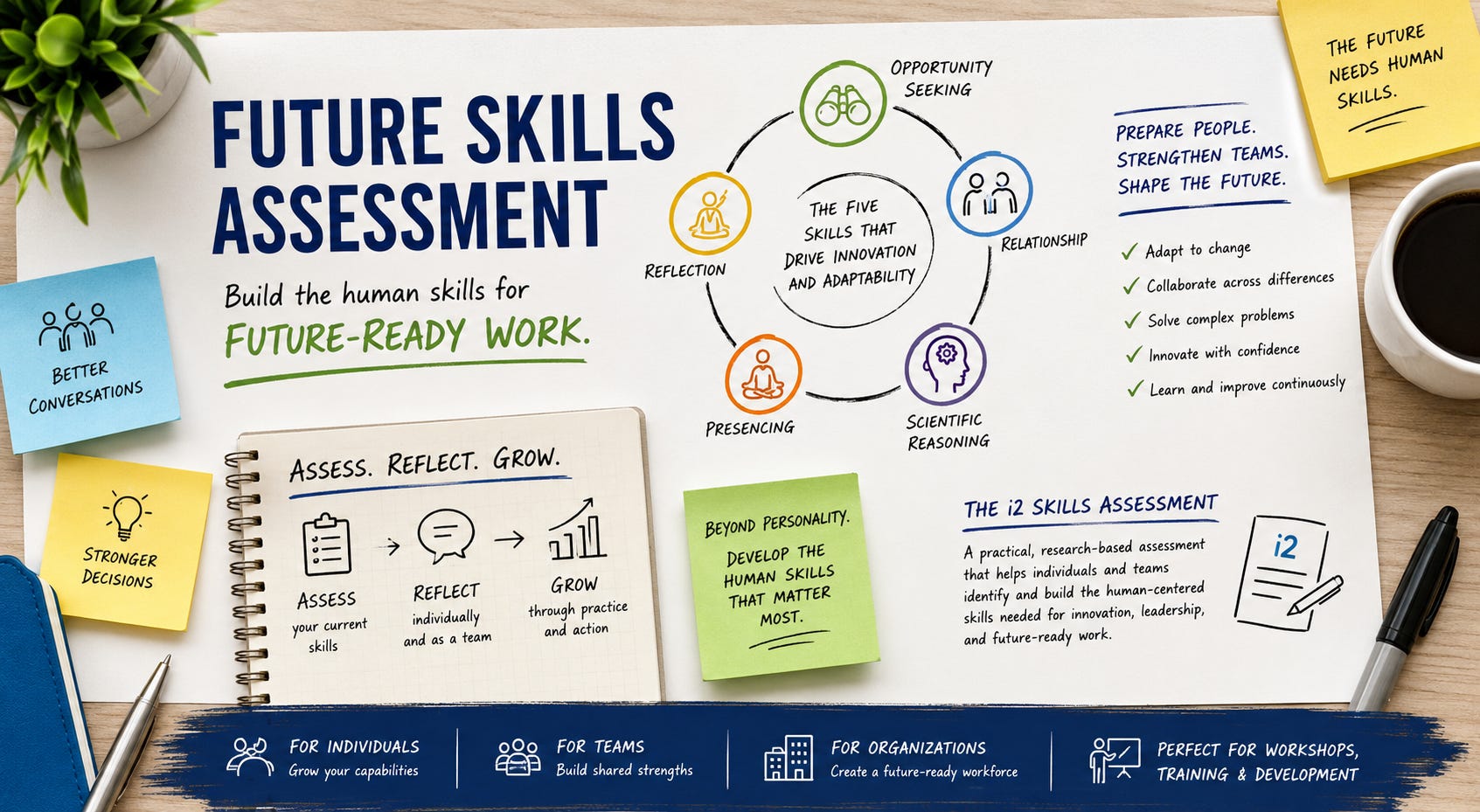
The framework I find useful right now comes from the i2 Skills Assessment, which organizes future-ready human skills into five areas:
Opportunity Seeking — noticing what’s changing and where something could be better.
Relationship — building trust and collaborating across differences.
Scientific Reasoning — testing assumptions, running experiments, learning from evidence.
Presencing — staying grounded and open when things are uncertain.
Reflection — looking back honestly and adjusting.
Read that list with your team in mind. Most groups are strong in one or two and weak in the others. A team great at relationships but weak at scientific reasoning falls in love with ideas and never tests them. A team great at generating ideas but weak at reflection stays busy without getting better.
For too long we’ve called these “soft skills” — which makes them sound optional. They aren’t. Collaborating, listening, adapting, experimenting, and learning are some of the hardest and highest-leverage skills anyone can build right now.
The shift I’d recommend: stop asking “are people good communicators?” and start asking “can people use communication, collaboration, creativity, and reflection to solve real problems in changing conditions?”
That reframes soft skills from a vague HR category into a concrete development path.
If you want to put this to work with a team, the simplest cycle is:
Reflect on where you are. Discuss what the results mean for the real work in front of you. Pick one or two skills to practice. Try new behaviors on a real project. Reflect again.
Most workshops end at insight. The teams that change end at practice.
If you want to dig in further, we have a longer piece on this over on Innovation Training, and we can use the i2 Skills Assessment inside our design thinking and leadership programs when teams want a shared language for this kind of growth.
I also connect this to the broader work we have been doing around innovation skills, future skills, and workshops that help people strategize and practice these capabilities in real work.
The future of work won’t reward people who simply know more. It’ll reward people and teams who can keep learning, adapting, and creating what’s needed next.
Comments
Nothing yet. Say the first thing.
Sign in to join the conversation.