
If Next in Line studies the companies approaching the public markets, Under the Hood studies the forces creating them.
This series explores the industries, market shifts, capital cycles, and structural trends that shape tomorrow’s category leaders.
Today, we go under the hood of India’s space sector.
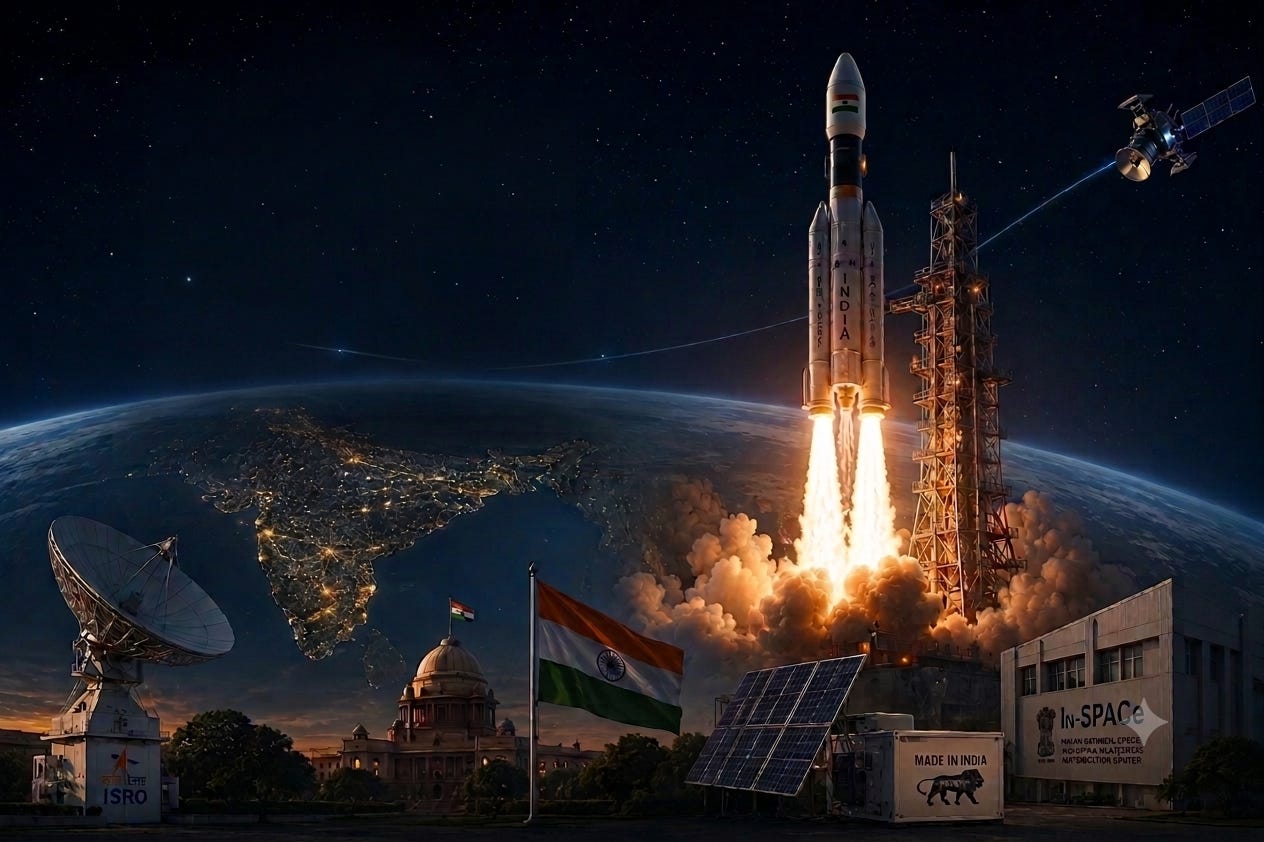
In the last eighteen months, a state government wrote its first ever equity cheque into a private space company. A venture fund built specifically for orbital hardware went from cabinet approval to live capital deployment, with a state owned bank running it like any other fund manager. And a company most of India has never heard of got a call, mid conflict, to do a job the country’s own satellites couldn’t do fast enough.
None of that involved a rocket.
Ask most people what “India’s space economy” means and they’ll describe a launch pad. Fire, smoke, a countdown, a satellite riding on top of an engine somebody spent years perfecting. That image isn’t wrong. It’s just no longer where the story is. The rockets are the visible tip of a stack that now runs from chip design to insurance, and the tip is the part that’s already crowded.
Here’s what’s actually happening underneath it.
Where India Sits, Globally
Starting with the baseline, the global space economy was worth roughly $596 billion in 2024, growing 5 to 8% a year for the last decade, and is projected to reach $1.8 trillion by 2035 at close to 9% annual growth. India’s slice of that today sits at 2 to 3%. The stated ambition is to get to 8 to 10% within a decade, which is where the widely quoted $44 billion by 2033 figure comes from. A separate, more recent estimate from Arkam Ventures puts the current number higher, at $13 billion, and the 2030 target lower in years but similar in scale, at $40 billion, growing at roughly twice the global pace.
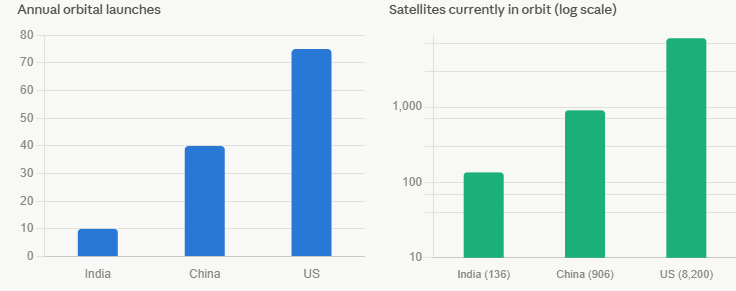
The gap that actually matters is not in the dollar projections. It’s in the hardware count. India runs about 10 orbital launches a year, has 136 satellites in orbit, and operates from two launch sites. The United States runs 75 launches, has more than 8,200 satellites in orbit, and operates from nine sites. China runs 40 launches, has 906 satellites, and four sites.
That is not a story about India’s engineering falling short. Mangalyaan reached Mars on a budget smaller than the film Interstellar’s, and India landed on the lunar south pole before anyone else got there. It’s a story about scale and cadence, and it means the metric to watch over the next five years isn’t funding rounds or revenue. It’s how many satellites actually go up.
The Tailwinds
Every sector claims a tailwind. What makes this one worth underwriting is that three separate forces are moving at once, and none of them are primarily about who builds the best rocket engine.
The policy reset happened faster than most allocators priced in. Single window authorisation through IN-SPACe. Angel tax gone. GST exempted on satellite launch services since July 2023. FDI liberalised to 100% automatic in components, 74% in satellite operations, 49% in launch vehicles. The country’s space budget nearly tripled in a decade, from ₹5,615 crore in 2013-14 to ₹13,416 crore in 2025-26. The technology transfer pipeline that everyone assumed was a slow, bureaucratic drip has actually converted: 71 ISRO to industry technology transfers have turned into six private entities launching 18 satellites, with 25 more payloads flown or scheduled on ISRO’s own experimental platform. That’s government IP quietly becoming private hardware in orbit, and it barely gets discussed next to the funding headlines.
Demand showed up from a place nobody modelled for. Operation Sindoor exposed a real gap in India’s own satellite revisit frequency, and the government has since committed to 52 dedicated ISR satellites by 2029-2030. Kawa Space, a startup building satellite based intelligence and imagery, actually delivered damage assessment imagery during that same operation. Live. In an active conflict. Not a demo, not a pilot.
Capital started showing up in a shape it never had before. State industrial arms are now writing direct equity checks into space startups, something that simply did not happen two years ago.
The VC Money Actually Moving
Here’s where the last twelve to eighteen months get interesting, and where the sector stopped being a thesis and started being a track record.
Agnikul Cosmos has raised $50 million to date and, in May 2024, achieved the world’s first 3D-printed rocket engine launch, a single piece, weld free, seven days to build against months for a conventional engine. It’s targeting 50 launches a year by 2028. GalaxEye Space closed a $10 million Series A led by MountTech Growth Fund and successfully tested its SyncFusion imaging system, which fuses radar and optical sensing on one platform, aboard ISRO’s POEM-4 experimental module ahead of its own Drishti mission. Pixxel raised $95 million for hyperspectral imaging satellites. Inbound Aerospace, founded only in 2025 and building reusable re-entry vehicles timed against the ISS decommissioning in 2030, closed $1 million at pre-seed within the same year it was founded. InspeCity, building the in-orbit servicing stack that almost nobody else in the country is touching, pulled in investors that includes Speciale Invest and public market investor Ashish Kacholia, a signal in itself. Sophisticated early stage capital is now comfortable underwriting deep tech, multi year hardware bets, which is a real departure from how Indian VC has historically treated capital intensive, long gestation categories.
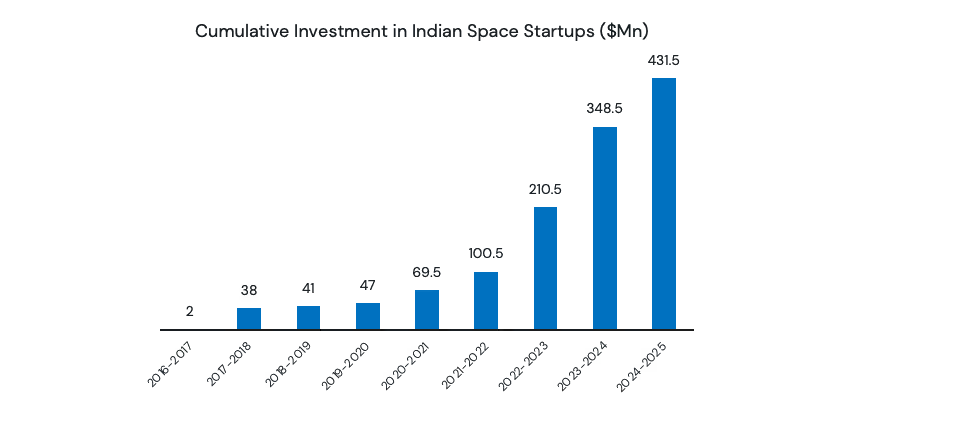
The institutional side moved just as fast. The ₹1,000 crore venture capital fund announced in July 2024 is now fully operational, with SIDBI Venture Capital as fund manager under a signed agreement with IN-SPACe, targeting around 40 startups with ticket sizes of ₹10 to 60 crore through FY2030. Layer on a ₹500 crore Technology Adoption Fund and a separate ₹211 crore injection under the Fund of Funds for Startups scheme, and there’s now a purpose built risk capital architecture for a sector that had none five years ago.
The Gaps Nobody’s Pricing
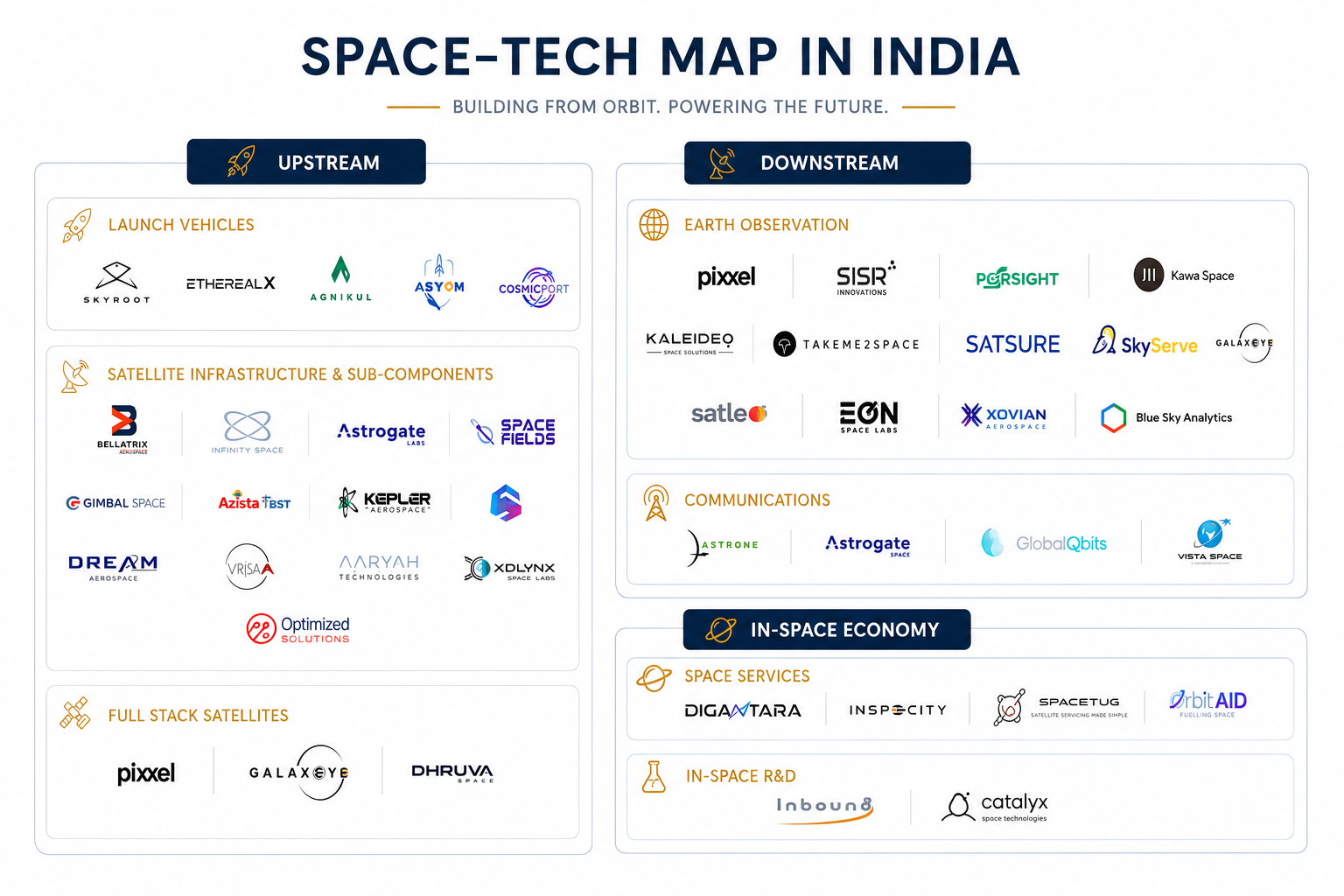
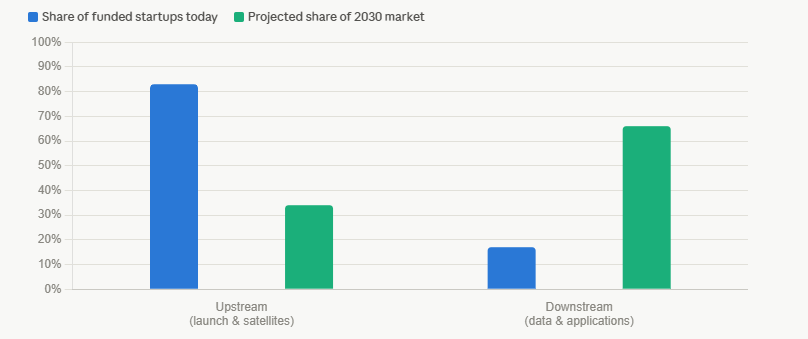
Here’s the number that should be sitting in every space tech memo written in India right now: downstream companies, the ones building data products and applications on top of what’s already in orbit, make up only 17% of active funded startups today, against a share of the Indian space market projected at roughly two thirds by 2030. Of the roughly $500 million invested in Indian space tech, $285 million went upstream, into launch and satellite manufacturing, the most visible and most fundable part of the chain. The most crowded part of any value chain is rarely the part with the best returns left in it. It’s the part that already got there first.
A few other layers sit wide open, and none of them require anyone to build a better engine.
Orbital servicing and debris management. Satellites run out of fuel long before they’re actually worn out, and today the only fix is launching a replacement. InspeCity is building the alternative, a robotic arm and propulsion system that can repair and extend a satellite’s working life in orbit. The global in-orbit servicing market is projected at $14 billion by 2030, and no company anywhere, India included, has locked in category dominance yet.
Sovereign navigation. GPS runs the world’s positioning today and it’s controlled by another country’s military. NavIC, India’s own alternative, is running at four of seven satellites fully functional, and its most recent satellite failed to reach final orbit. VyomIC is building a private LEO positioning constellation aimed less at consumers and more at governments and militaries who need an alternative nobody else can switch off.
Testing, certification and ground infrastructure. More than 400 startups still test almost entirely through ISRO’s own facilities. Every company in this sector eventually needs this.
Component and chip sovereignty. India’s space technology import bill currently runs at roughly twelve times its space export revenue, in high grade electronics, carbon fibre, and precision components. It gets a fraction of the attention a funding round gets, despite tying every strategic mission to foreign export policy.
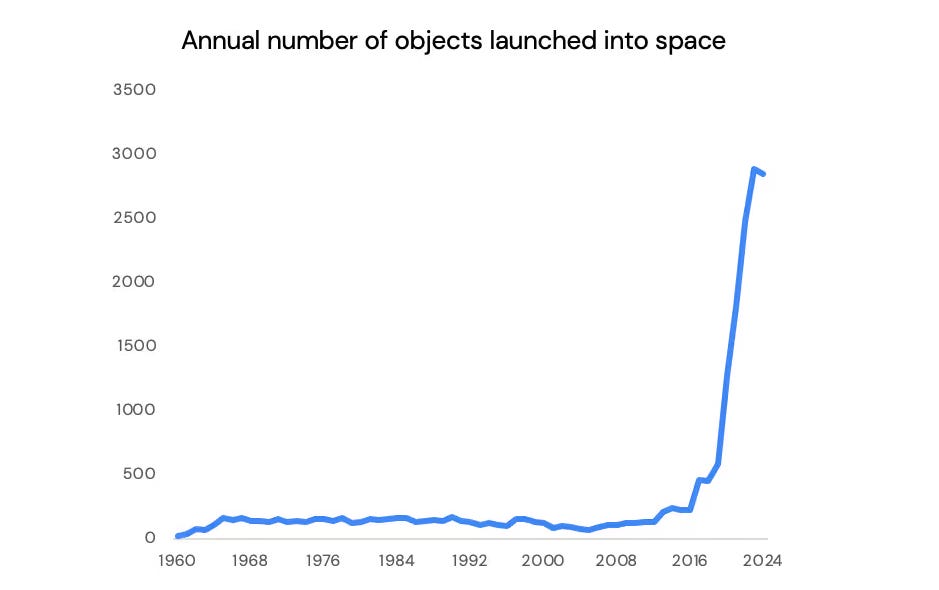
Space traffic management. A roughly 7.1 per cent CAGR global market tracking more than 57,000 objects in orbit, and India has no clear domestic leader building dedicated collision avoidance or space situational awareness as a service, even though ISRO alone has had to run 122 collision avoidance manoeuvres over the last 14 years.
What Could Go Wrong
The optimism above needs a counterweight, because the same period that produced these tailwinds also produced some structural cracks worth sitting with.
Launch reliability has become a commercial problem, not just a technical one. PSLV failed twice in twelve months, once in January 2026 and once in May 2025, its third failure in seven years. India’s global small satellite launch market share collapsed from 35% in 2017 to near zero by 2024, in the same window a single competitor ran more than 130 successful launches in a single year. Perceived reliability matters more than cost in a commercial launch market, and that share loss hits every Indian company trying to sell launch services internationally, not just the state programme.
The military space gap is arguably the most consequential weakness in the whole sector, and it’s the one that showed up hardest during Operation Sindoor, when India’s own satellite revisit times ran up to 14 days for specific locations, pushing reliance onto a foreign commercial provider for daily high resolution imagery, while reports suggest an adversary pulled equivalent imagery from a state partner at sub second latency.
No Indian space startup has crossed ₹100 crore in annual revenue yet. Dhruva Space, founded in 2012, needed twelve years to close its Series A, in 2024. That gap is closer to the honest base rate for this category than an exception worth flagging, and it means gestation assumptions borrowed from software, or from other Indian deep tech categories, are probably miscalibrated for this sector specifically.
The Infinyte View
Every dollar invested in India’s space economy currently generates a $2.54 multiplier, making the sector roughly two and a half times more productive than the broader economy, with around 22,000 direct jobs already created.
Markets tend to move in three waves: infrastructure first, then demand, then the layer that turns raw capability into revenue someone actually pays for. India has clearly built the first wave, policy, launch capability, FDI reform, a working technology transfer pipeline. The second wave, demand, arrived from an unexpected place, a defence gap exposed in an actual operation rather than a market research deck. What’s still thin is the third wave, the downstream products, the testing infrastructure, the component sovereignty, the layer that actually converts existing orbital capability into revenue on this sector’s own timeline.
None of this is a call to skip the rockets. Upstream launch and satellite manufacturing remain genuinely worth backing, and the engineering happening there is hard and real. But hard engineering and outsized returns have never been the same claim, and 17% of funding against two thirds of a future market is the clearest version of that mismatch sitting in plain sight right now.
The rockets built the last decade of Indian space. Whether they build the next one too is a much more open question.
Until then we’ll keep looking where others don’t.
Comments
Nothing yet. Say the first thing.
Sign in to join the conversation.