
If Next in Line studies the companies approaching the public markets, Under the Hood studies the forces creating them.
This series explores the industries, market shifts, capital cycles, and structural trends that shape tomorrow’s category leaders.
Today, we go under the hood of India’s diagnostics industry.
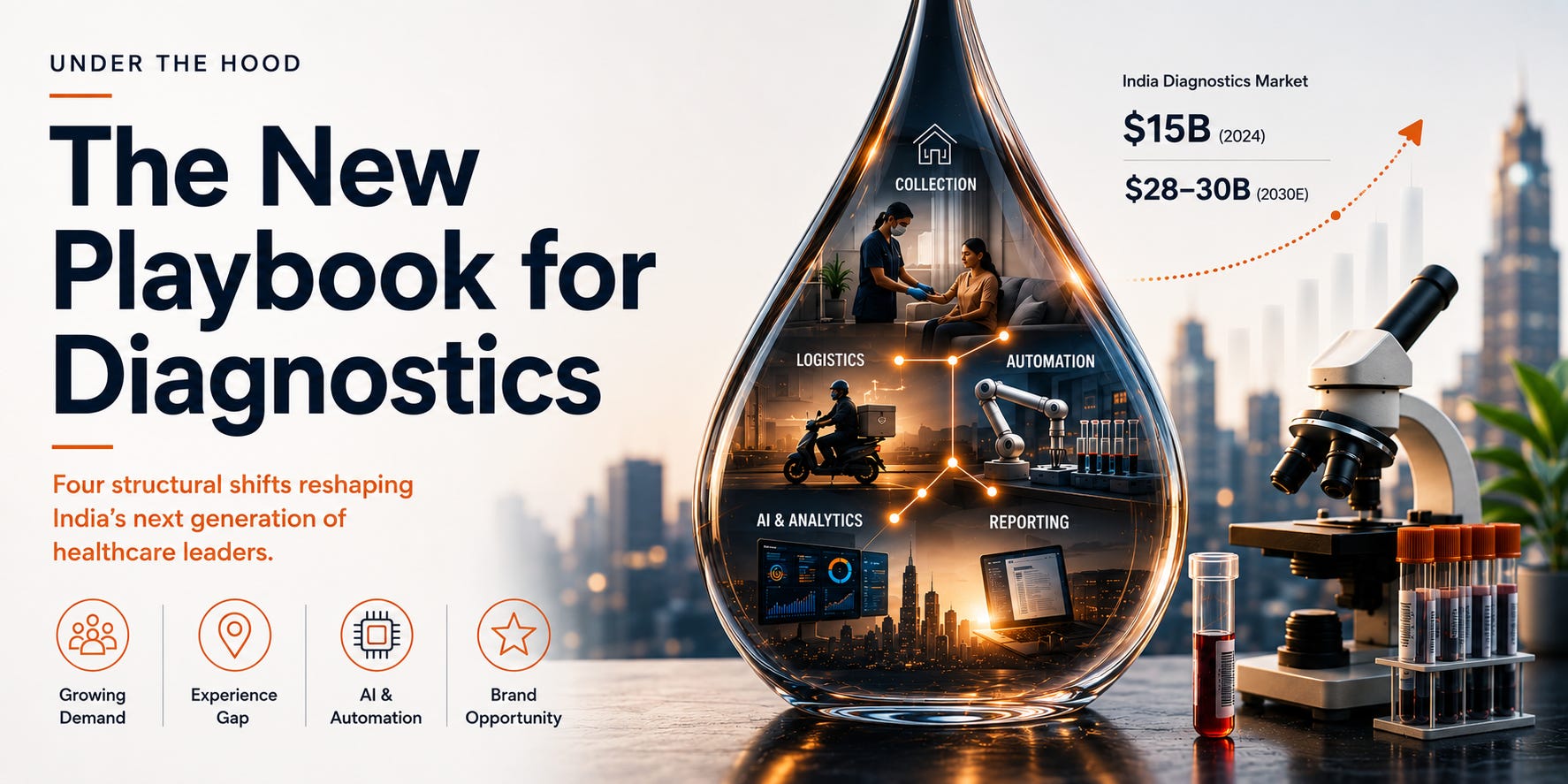
Ten years ago, nobody believed groceries would show up in ten minutes. Now Zepto, Blinkit, and Swiggy Instamart have made anything slower feel broken, and the kirana store down the street that always existed didn’t lose the category, it lost the customer relationship.
The same move is now playing out in India’s diagnostics industry, and the incumbents are already feeling it. When Amazon launched doorstep diagnostics across six cities in mid-2025, shares of Dr Lal PathLabs and Metropolis, the two biggest listed names in the category, dropped as much as 3% in a single session. Nothing about the underlying market had changed. What changed was that the experience provided signficantly improved.
That’s the whole thesis in one move: take a category that already exists, that’s already large and profitable, and win it on experience and brand rather than on inventing something new. Quick commerce did this to grocery. It’s now happening to diagnostics.
Across research reports, one theme remains remarkably consistent: India’s diagnostics sector is expected to sustain double-digit growth for the rest of the decade.
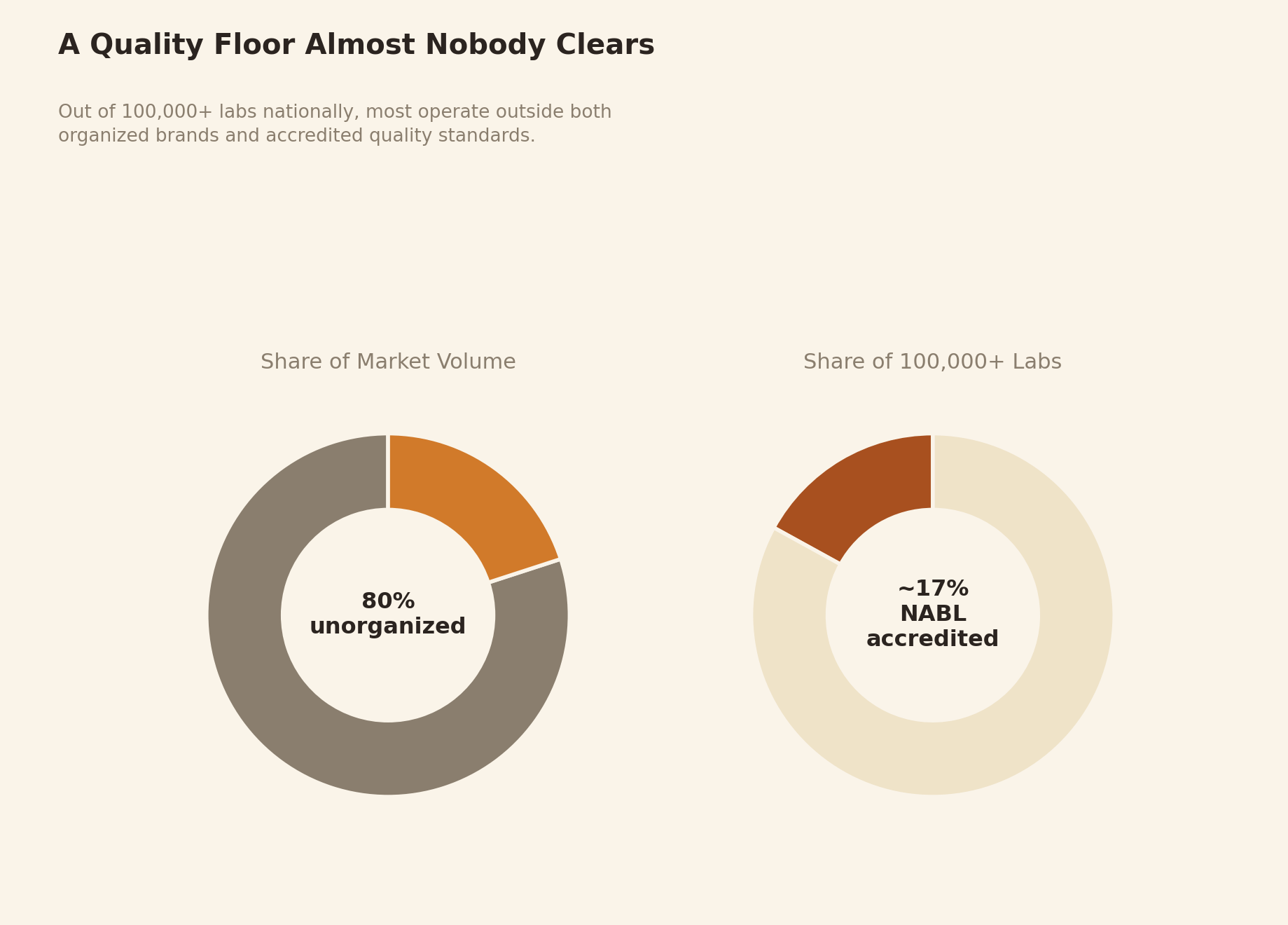
The more useful number sits underneath the market size: roughly 80% of diagnostic volume still runs through unorganized, unbranded operators, and only about one in six of the country’s 100,000-plus labs carries NABL accreditation, the basic quality bar insurers and serious hospitals check for.
a) The customer has changed. India’s median age moves from the late twenties toward the high thirties this decade. The 7-10 million urban households that matter most aren’t price-constrained, they’re time-constrained. A phlebotomist who shows up on time and a report that lands before the doctor’s appointment, not after, is worth paying for.
b) Insurance is pulling spend out of pocket. Health insurance penetration has roughly doubled in recent years, and preventive testing is growing nearly twice as fast as core diagnostic volumes. Once spend moves from cash-in-hand to insured or subscribed, acquisition economics that never worked for diagnostics start to work.
c) Convenience has already proven it can flip an entire category, quick commerce is the live proof. Indians didn’t ask for ten-minute grocery delivery; they simply switched the moment it existed, and never switched back. Diagnostics has the same ingredients quick commerce had before it took off: high frequency of need, low loyalty to the incumbent, and an experience nobody had bothered to fix. The same playbook, dispatch fast, deliver faster, build the brand around the speed, transfers almost directly.
d) The technology to actually deliver that speed, not just promise it, now exists. Automated reporting that triples pathologist throughput, route optimisation that makes 30-minute dispatch operationally real rather than a marketing line, the previous generation of startups didn’t have this. The current one does.
None of these four forces reverse. That’s what makes this a cycle worth underwriting, not just a trend worth watching.
Dr Lal PathLabs and Metropolis scaled into national reference-lab brands through franchise collection centres, then IPO’d. Thyrocare went the opposite way, one hyper-automated lab, asset-light, sold through doctors. Vijaya picked deep regional density in Hyderabad over national ambition, and as a result holds the tightest market share of any listed peer in its own backyard today.
Every one of them won by picking one structural axis and refusing to dilute it. None of them won on service experience, because until very recently, nobody competed on it. Dr Lal in Delhi NCR and Vijaya in Hyderabad are still compounding 10-15% a year in markets where they already hold 25-40% share. The category has never had to defend itself on speed.
What didn’t work: pure discount-led booking platforms that tried to win on price without rebuilding the underlying experience. They’re now squeezed between legacy chains that can match price and newer operators that can match price and speed.
Pathology is the trust-building wedge. Radiology is where the economics actually expand.
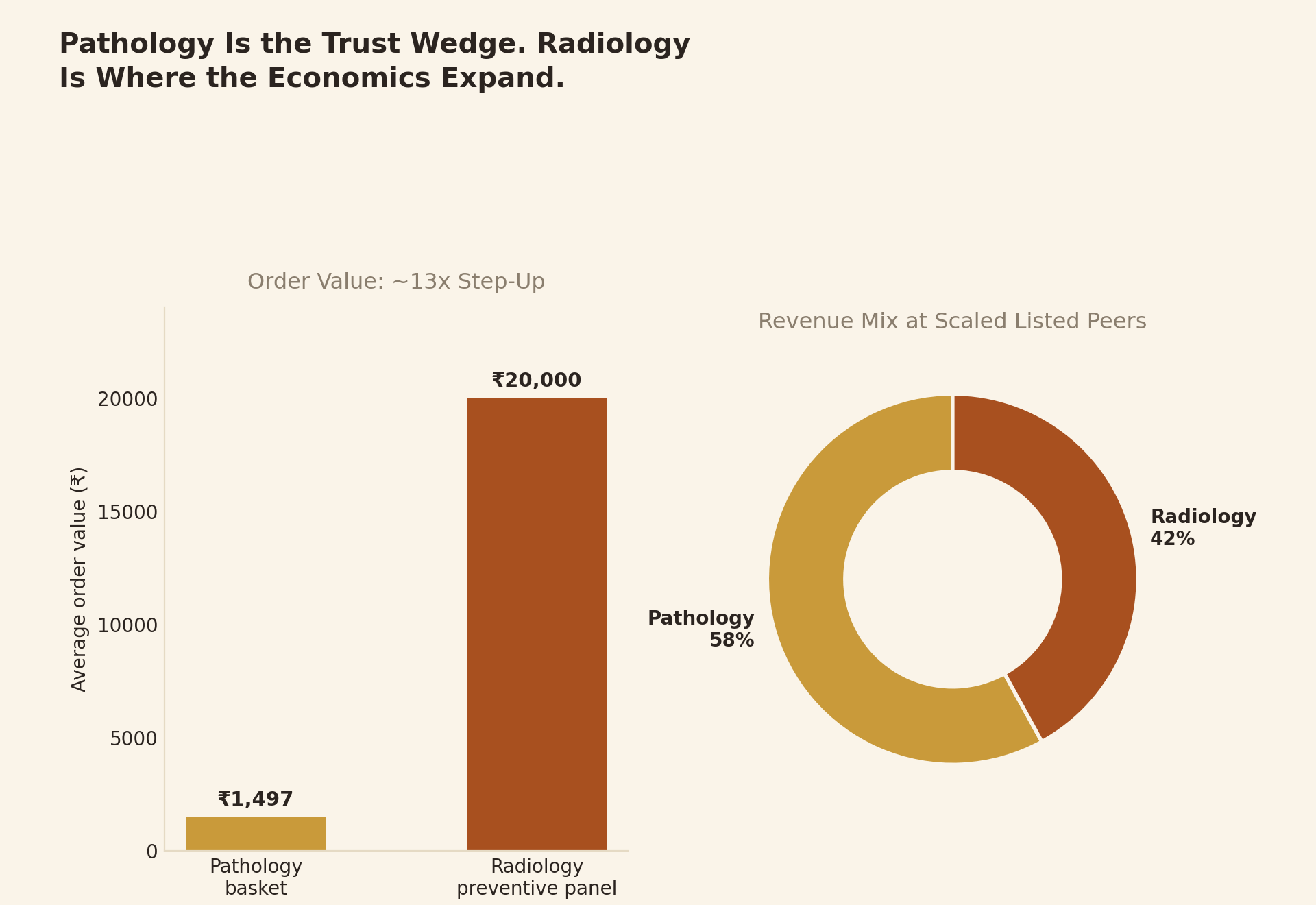
Radiology-inclusive preventive packages command materially higher average order values than pathology-only packages, while radiology already contributes roughly 35–47% of revenue at integrated diagnostics leaders despite accounting for a much smaller share of test volumes.
The other underused asset: the relationship. Diagnostics today is transactional, a patient gets reacquired at full cost every cycle, with no trend line and no reason to come back except needing another test. A brand that earns repeat trust converts a one-time acquisition cost into a multi-year customer, which is exactly the lever quick commerce pulled with subscriptions and habit-forming delivery speed.
What’s actually broken, in three points: the consumer’s problem is friction, not price most volume still requires a centre visit on a schedule that closes by early evening, with 12-18 hour turnaround. The lab’s problem is pathologist throughput, the tightest bottleneck on any faster reporting promise. The doctor’s problem is workflow, results land disconnected from the next clinical decision.
Notice what’s missing: accuracy, and price. The category’s accuracy is broadly fine at accredited labs, and the customers worth acquiring aren’t price-sensitive. The unsolved problems are operational and experiential which is exactly the kind of problem an experience-obsessed, technology-native founder solves better than a pathologist running a lab.
1. The Experience Wedge: This is the highest-conviction bet in the piece, and Orange Health Labs is the clearest live example of it: 30-minute phlebotomist dispatch, 6-hour reports, a four-city network built specifically to feel like Zepto rather than a legacy lab. It’s already taken visible share in Bangalore, the company is now the second-largest diagnostics operator in its lead market, ahead of Dr Lal PathLabs, Metropolis, and Tata 1mg, each of which had a decade-plus head start. The model isn’t a new category. It’s the old category, run at quick-commerce speed, with a brand built around that speed.
2. Embedded diagnostics for platforms that don’t want to build their own. Every consumer health, insurance, and e-commerce platform eventually needs a diagnostics layer. Amazon’s choice to launch its own rather than rely solely on a partner, right after taking a stake in Orange Health, is the clearest signal yet that this layer has become strategically important enough to own.
AI imaging triage and genomics consolidation are real, longer-dated opportunities are worth tracking closely but they depend on regulatory and reimbursement infrastructure that’s still catching up. We wouldn’t lead a check with either today.
Function Health is the closest analogue to where Indian diagnostics is heading, a membership model layering biomarker panels and imaging onto a continuous health relationship, reaching $2.5 billion in roughly three years. The price point doesn’t translate directly to India, but the structure does: convenience and brand first, recurring revenue second.
Guardant Health shows that even a single, narrow, clinically defensible test can support a multi-billion-dollar public company and that the durable moat ends up being clinical and regulatory depth, not algorithms.
Tempus AI proved a diagnostics company can be paid twice: once by the patient, once by a pharma or insurance buyer for the data. That second buyer barely exists in India yet, which is the clearest reason this particular model doesn’t transplant cleanly yet.
The category gets won on experience and brand. Quick commerce didn’t invent grocery, it made an existing category fast and lovable, and that was enough to build category leaders worth tens of billions of dollars. Diagnostics is the same category, the same playbook, several years behind.
Radiology, not pathology, decides who wins long-term. Any operator that can’t credibly cross from pathology into imaging within a few years of scale has a structurally lower ceiling than its growth rate suggests.
The founder profile that wins combines healthcare credibility with consumer-tech execution. Pure pathologist-founders build excellent labs and struggle to build brands people feel something about. Pure consumer-tech founders underestimate regulatory complexity until it stalls them.
Quick commerce in India followed a predictable arc: a category everyone already used, made fast enough to feel new, consolidated around one or two brands that earned the customer relationship while a separate layer of dark-store and logistics infrastructure quietly armed everyone in the category, winners and challengers alike.
Diagnostics is tracing the same arc, a few years behind. The experience-and-brand wedge is where the next big consumer outcome in this category comes from. The infrastructure underneath it, automation, routing, telepathology is the second business this cycle produces, and it doesn’t need to win the brand war to be worth backing.
Until then, we’ll keep looking where others don’t
This piece reflects the views of the authors and is intended for the readers of Under the Hood by Infinyte. It does not constitute investment advice. Market sizing figures vary materially across published sources depending on methodology and scope, we’ve shown ranges rather than single-point estimates where the underlying data disagreed.
Comments
Nothing yet. Say the first thing.
Sign in to join the conversation.