
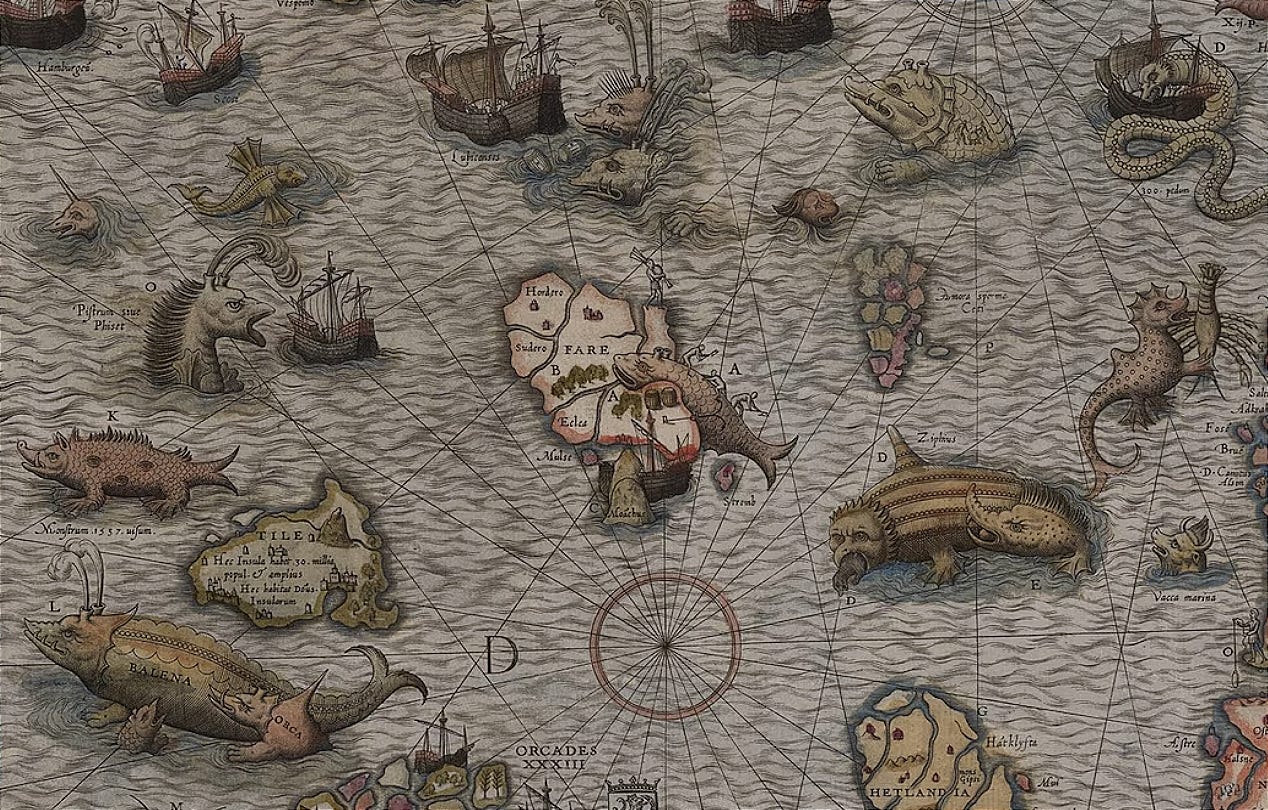
In the 16th century, cartographers faced a curious problem.
Explorers returned with tales of unknown continents and unfamiliar seas, leaving large gaps on the map. Rather than leave these spaces blank, mapmakers filled them with dragons, sea monsters, imagined coastlines, and ornate guesses. Not to deceive, but to provide order. A way to say, “We don’t know what’s here - but something must be.”
It reminds me of a certain slide in every startup pitch deck.
You know the one: the Market Sizing (TAM) slide.
A big, impressive number, like $50B or $200B, anchored by a Gartner logo or pulled from a consulting firm’s report. Founders include it because they think they have to. Investors nod politely. Everyone pretends it’s useful.
But usually, it’s not.
It’s like saying “Everybody eats” to justify opening a restaurant. True, but strategically meaningless.
Big numbers don’t show insight. Especially now that anyone can spin up a billion-dollar TAM with ChatGPT.
This also isn’t about adding more slides, but shifting from performative sizing to narrative clarity. Not “how big is the market,” but “how do you see it?”
While early-stage investors care about scale, it’s only if they can see how you’ll get there. This isn’t just a call for bottoms-up math. It’s a call for clarity: how you see the market, where you’re starting, and why now.
Because early on, insight trumps scale.
You don’t start with the market. You start with a wedge. Small. Painful. Underserved.
Real sizing doesn’t begin with a TAM slide. It begins with a customer, and a point of view.
Ask yourself:
Who feels the pain right now—and what are they doing about it?
If you can’t name them, you’re not in the market yet.Where does the money come from today?
Real customers. Real budgets. No imaginary line items.Why is this the moment?
What’s changed—in tech, culture, or behaviour—that makes this urgent now?How does your wedge naturally grow?
Into adjacent users? Workflows? Price points? If it doesn’t expand, it’s not a wedge. It’s a wall.What structure do you see that others don’t?
Patterns in the mess. Signals in the noise. That’s the real market map.
These aren’t slides to create. They’re questions to work through. You don’t need to present all of them. But the clarity they force is what makes a slide that sounds right from a story that feels right. It sets the stage for the real work: earning trust, building traction, and scaling insight into momentum.
I’ve had this conversation more times than I can count: trying to understand how a founder defines SAM, while they’re trying to figure out the “right” definition. Global or regional? Core verticals or adjacent ones? Everyone’s guessing.
But aligning on a definition often misses the point. It’s not about which acronym you use. It’s about how you think. Seeing the real terrain and picking the right entry point.
A framework I keep returning to:
Wedge → Who are you serving right now? How many more of them are there? What are they already paying for?
Beachhead → Where do you expand next? Are adjacent workflows or segments natural?
Frontier → What’s the bigger play, if you execute well?
Think of it as: start narrow, grow adjacent, then go wide.
Example: Independent Fitness Coaches
If the core belief is that independent trainers with steady clients are stuck with pro-level demands and amateur tools:
Don’t point vaguely at the “$4T global wellness market.”
Instead, anchor in behaviour. Try: “There are roughly 35,000 independent trainers in North America. 35% are mature enough to need tools. We’re targeting those charging $100/month. That gives us around 12,000 coaches × $100/month = a $14 million starting point.
Why them?
Because they run their business like pros. They have predictable revenue, pay for tools, and are burning time on duct-taped workflows—making them high-intent software buyers.
That’s not just a bottoms-up number—it’s a point of view. It says: we know who’s feeling the pain. We know how they work. We know what they pay for, and why now is the moment they’ll switch.
Now, what’s the expansion story?
Maybe it starts with a mobile-first CRM for solo trainers, then grows into big-box gyms or layers on premium features. That’s the beachhead: a clear path to more users, more revenue, and deeper engagement within the initial market.
And if we’re going for venture scale, there needs to be a bigger narrative—how this wedge becomes a billion-dollar opportunity. Maybe it starts with task automation, then evolves into a broader layer that deepens the trainer-client relationship beyond the session. Or it expands into adjacent verticals like nutrition, wellness, or mental health.
Whatever the vision, anchor it back to the same core behaviour or pain. The path from wedge to scale doesn’t need to be linear—but it should be legible.
Not every market is neat. Some look broken. Others aren’t visible at all.
Messy markets are easy to dismiss. Full of legacy players, manual workflows, weird regional quirks, or outdated pricing models. These are the kinds of spaces that get written off quickly: “too niche,” “too undefined,” “too chaotic.” But chaos is often just structure no one’s named yet.
Invisible ones are trickier. They hide in plain sight - no category, no data, no market report. But sometimes, a new behaviour keeps showing up. A strange workflow repeats. A fringe user that becomes a trend.
That’s where great founders lean in. They don’t just size the market—they make sense of it. They don’t sell the TAM—they show the shift.
Because where others see noise, they see pattern. Shared pain. Repeatable workflows. A hidden map beneath the surface.
And from that wedge, they build something others missed entirely.
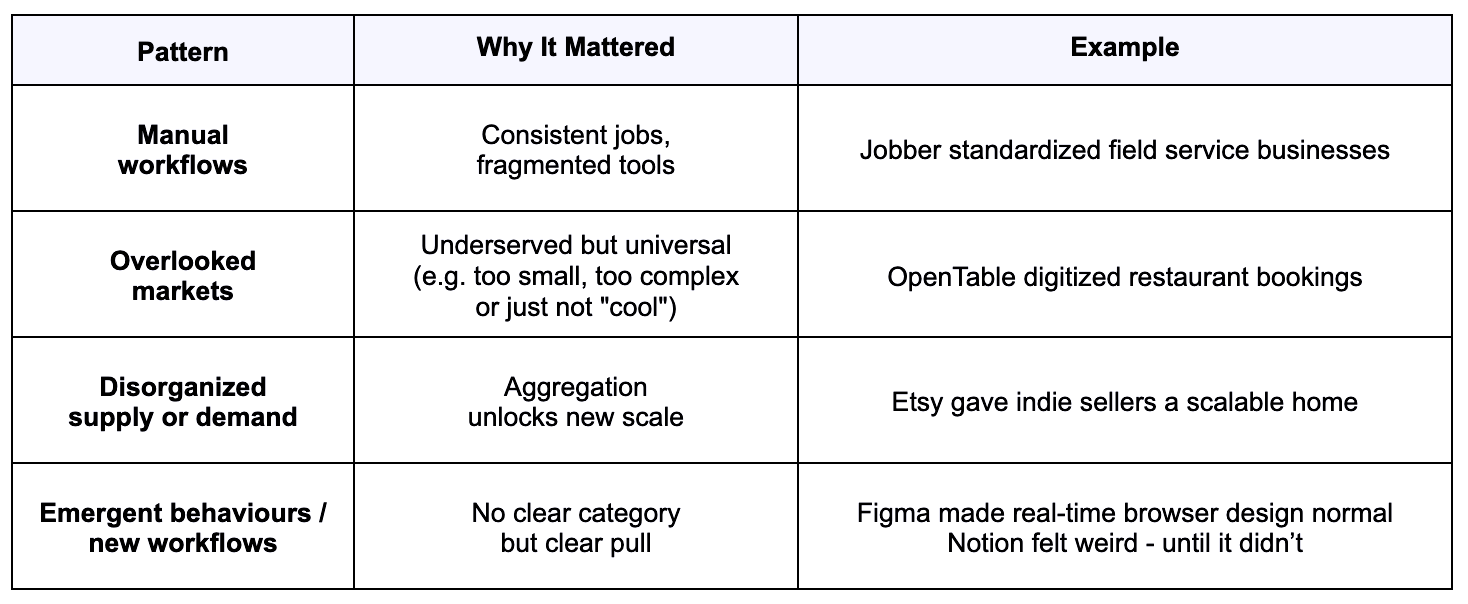
“Start narrow” is common wisdom for a reason. A good wedge unlocks traction, insight, and expansion. But not all wedges expand—some trap you instead.
Too specific → limited surface area. You’ve solved a real problem, but it’s so narrowly defined that there’s no natural pull into adjacent use cases or markets.
Too isolated → weak network effects. The niche exists, but it doesn’t connect to a broader ecosystem—so expansion feel like starting from scratch each time.
Too shallow → low-value workflows. The problem is easy to sell into, but it sits low in the value stack—so you win deals, but can’t drive meaningful revenue or engagement over time.
So ask: Does it lead to deeper insight—or just early revenue?
A good wedge pulls you into the guts of a problem: messy workflows, shared pain, repeatable behaviour. A bad one leaves you stuck—solving something real, but with nowhere to grow.
Early focus is a gift—but only if it points somewhere.
Ultimately, even if you chart the perfect map—you still have to catch the wave.
Market size alone doesn’t build great companies. Timing does.
Markets are like oceans—always moving. Most days, it’s small swells. But every so often, a real wave builds: driven by new technology, regulatory change, or cultural momentum.
That’s the wave you want.
Slack didn’t invent messaging. Shopify didn’t invent commerce. But both caught waves that turned strange new products into obvious necessities.
Your wedge must match market readiness—not just your own.1
And after all this, yes, VCs will still ask about market sizing. It’s often a filter. So be ready.
Most VCs are thinking:
Can this become a $100M ARR business?
Customers x Revenue per Customer. Is there a clear path based on your business model and market size? (That’s also why investors often lean B2B: bigger deals, faster scale.)
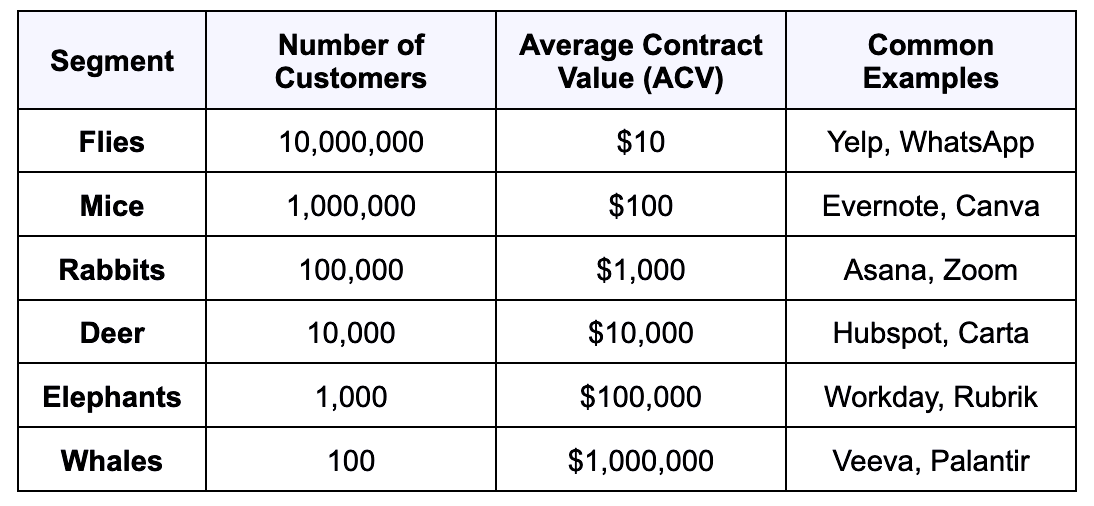
Ways to reach $100MM ARR
Is this market big enough for mistakes?
No startup captures 100% of any market. Your TAM should be 5-10x your revenue goal - enough room to grow, pivot, and compete.2
They’re not looking for a perfect number. Just evidence that you see the path.
So build your TAM slide.
Skip the dragons. Forget the billion-dollar claims no one believes.
Instead, show us the dirt under your nails. The corner you’ve started in. The edge you’ve mapped that others missed.
Because investors don’t buy numbers. They buy your sense of direction.
The best founders don’t just chase scale. They recognize patterns in the noise.
And when the wave finally comes, it’s not the biggest map that wins. It’s the clearest compass.
Thinking about your own market map? Send your wedge. I’ll send thoughts.
I previously built a YC-backed startup to help public companies engage retail investors. The map made sense. The market was real. But this was pre-Reddit / Gamestop. Companies didn’t care yet. The wave hadn’t formed. Someone else rode it later.
Comments
Nothing yet. Say the first thing.
Sign in to join the conversation.