
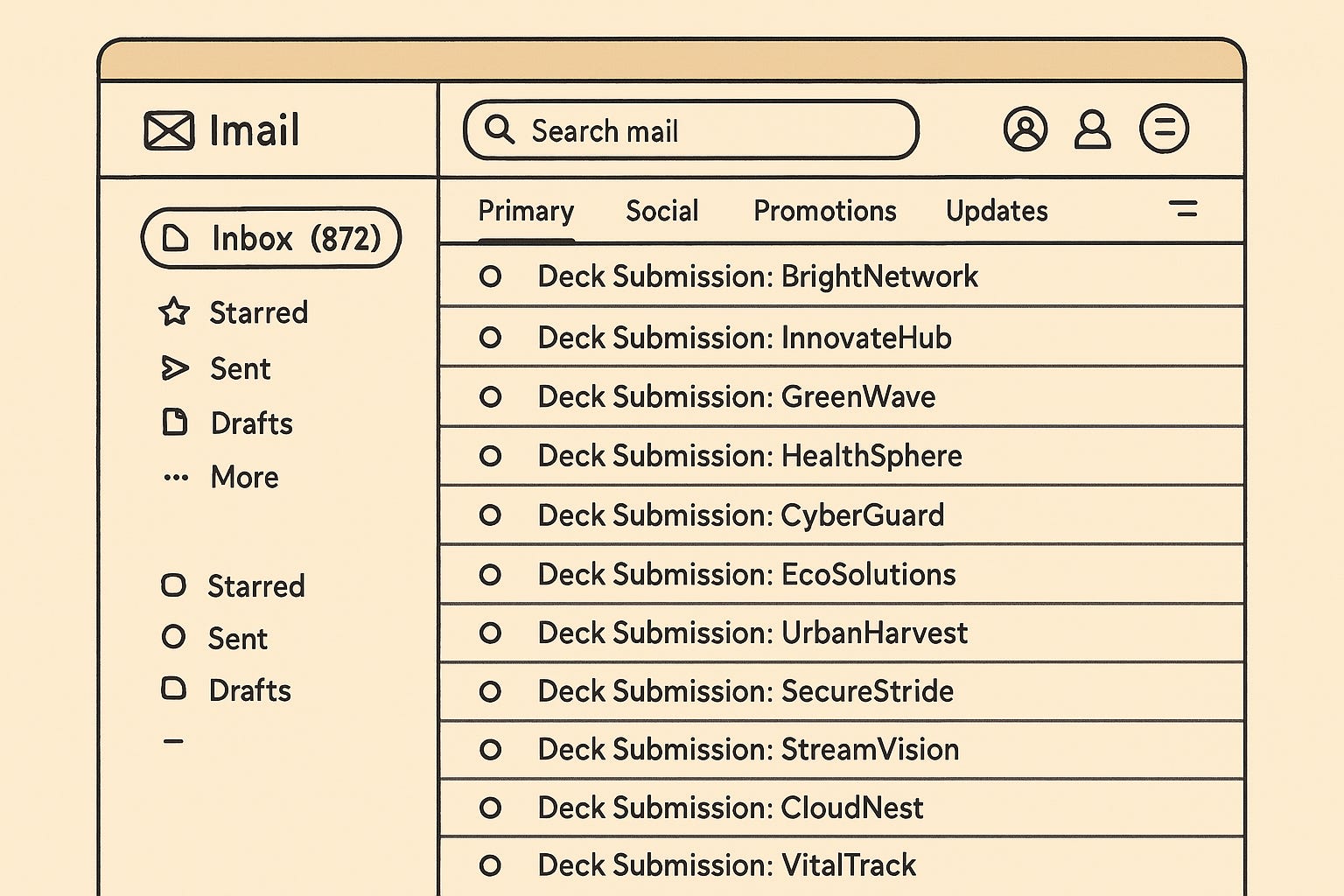
Your pitch deck won’t raise money. It might not even get read. Founders obsess over slides, fonts, and colours—meanwhile, investors decide in 30 seconds.
What No One Tells You About Pitch Decks:
Most investors skim for 2 minutes or less—your beautiful illustrations? Skipped.
Warm intros beat great decks 99% of the time.
If a VC can’t explain your startup in one sentence, you’re already out.
You’ve heard it before: “Decks don’t close deals. Founders do.”
And yet, founders keep getting stuck in the same loop - refining slides, testing new colour palettes and paying agencies thousands to make their deck “stand out.”
Why? Because it feels productive. Demo days, accelerators, and design agencies have glorified the pitch deck into a magic key that unlocks investment. Legendary decks like Airbnb’s get dissected as if they held the secret to fundraising. But it wasn’t the slides that sealed the deal.
The truth is, decks are a proxy — a stand-in for doing the harder, more uncomfortable work: sharpening your story, sending cold emails, taking investor meetings, hearing “no” and coming back again.
But if decks don’t close deals…what do they actually do? And how much do investors really pay attention?
Here’s the reality: most investors barely skim decks before a meeting. And no investor has ever said, “I wasn’t sure about this company, but did you see their typography?”
A DocSend study of 200+ fundraises found that investors spend just 2 minutes and 12 seconds on average per deck.1 That’s 8 seconds per slide.
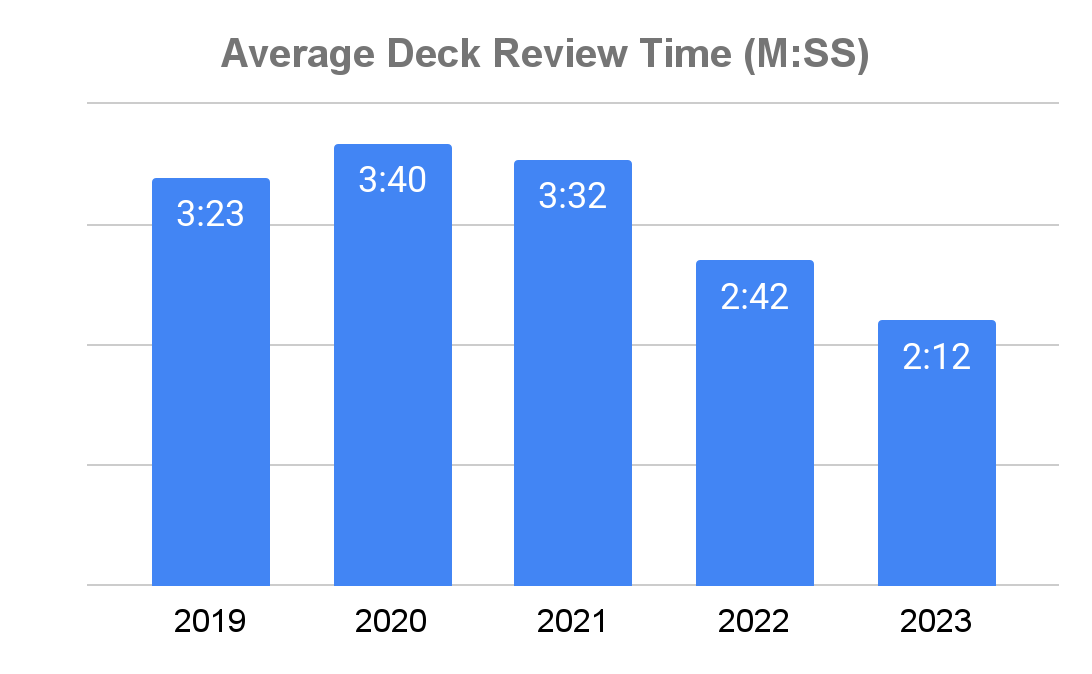
At that rate, there’s no deep analysis—just a quick pattern match. Like skipping a song after the first verse, if the hook doesn’t hit early, no amount of cool bass drops will save you. The lesson: Grab attention early and keep it simple.
So what catches their eye? A few theories but no surprises:
Logos & brand signals (marquee customers, investors, accelerators)
Market size at a glance (big enough opportunity?)
The team slide (who is this founder?)
A single surprising stat (something that stops the skim)
Everything after that? Mostly confirmation bias at work.
And if you want to optimize for investor psychology, Chris Howard has a great article on investor cognitive biases worth considering:
The IKEA Effect
People place higher value on things they help create. Investors value what they help build—so get a former founder/operator on your cap table early.
The Halo Effect
A strong first impression influences everything after. Introduce credibility signals in the first three slides—top-tier backers, a prestigious accelerator, or marquee customers.
Affinity Bias
Investors are drawn to founders who share similarities with them. Find a commonality—same college, former employer, shared mentor—and surface it early.
Fundraising isn’t just about convincing investors—it’s about understanding how they decide, and they decide fast. Most founders assume their deck gets a careful review, but inside a VC firm, the reality is more organic.
Your deck isn’t being analyzed like a college admissions essay. It’s a filter—skimmed in minutes, summarized in seconds, and pitched internally without you in the room.
Here’s how it roughly plays out:
A junior investor spends two minutes, tops, skimming your deck. Their focus isn’t to decide; it’s to filter. Stage? Check. Sector? Check. Geography? Check. They are likely populating the details into a CRM. If your deck doesn’t spark interest (or they don’t get it), it’s dead on arrival.
If it survives, it gets reduced to an internal summary email—a paragraph, maybe two, capturing the essence of your company. This is the first real test—not of your business, but of how well your story translates. If a VC can’t explain what you do in plain English, they won’t even try. And if they won’t try, you don’t move forward.
👉 Don’t let them fumble it—give them the exact words to use.
Then, if you’re lucky, your startup makes it to the Monday partner meeting. This is the moment of truth. A senior investor—your internal champion—has to pitch your company to their colleagues. But here’s the catch: you’re not there. No slides. No explanations. Just one person trying to convince a room full of skeptics that your startup is worth their time. If your story isn’t simple and compelling, it won’t make it to the next step.
👉 Provide preemptive responses they can use in the room to defend against skepticism.
And that’s the part most founders miss. The real pitch doesn’t happen when you’re in the room. It happens when you’re not.
Your fate hinges on whether someone else can retell your story in a clear, concise sentence. If they can’t, the deal dies. And if there are lingering doubts—about market size, defensibility, or founder fit—those gaps widen when an investor tries to explain your company to their partners.
The best decks don’t convince—they equip investors with the words they need to fight for you.
Most founders think they control the narrative. They don’t. Decks don’t sit still. They get forwarded, skimmed, and reinterpreted by people who will never meet you. Your deck isn’t for investors—it’s for gatekeepers—associates, junior partners, LPs—people who need something to reference when you’re not there.
Used well, a deck arms an investor with the words they need to fight for you. Used poorly, it quietly kills your deal before you even knew you had a shot.
Pitch deck structures aren’t a mystery. Google it, and you’ll find endless guidance. AI tools can generate decks in minutes.
The best ones don’t stand out because they’re creative—they stand out because they’re clear. Explicitly, what is the key message of each slide? The moment a founder tries to get too clever, they make investors work harder. And if an investor has to work too hard to understand your pitch, they won’t.
But the real problem? How founders use them.
Some rely on a deck like a script, clicking through slides, letting the visuals do the talking. The result? A forgettable pitch.
Others assume one deck fits every situation. It doesn’t. A casual coffee chat isn’t the same as a formal partner meeting. A deck sent over email needs to stand alone, while a live pitch should revolve around you, not the slides. The best fundraisers know when to use a deck, when to ditch it, and when to adapt it.
The best decks don’t replace a great pitch—they support it. But what if you had to pitch without one? That’s the real test of whether your story is strong enough to stand on its own.
Imagine pitching an investor with no deck. No slides. No visuals.
Just you, your idea, and your ability to explain why this business has to exist—why the world needs it, why you are the one to build it, and why now is the moment.
Now flip it. Imagine the opposite: you’re not in the room at all. You leave your deck behind, and the investor has two minutes to skim through it. No voiceover, no context—just the slides.
Do both versions tell the same story? Would they land with the same clarity, urgency, and conviction?
These are the Blindfold Tests—not just whether you can tell the story without the deck, but whether the deck can tell the story without you. If either side falls flat, the pitch isn’t ready.
Even a perfect pitch isn’t enough—because fundraising isn’t just about what you say. It’s about who’s willing to listen.
The myth of the perfect deck traps early-stage founders. They obsess over every pixel, convinced that a flawless design will unlock investment. But the best fundraisers know the truth: decks don’t open doors—relationships do.
A referral from a top-tier VC? The deal gets taken seriously. Cold outreach from an unknown founder? It might get ignored or skimmed during inbox cleanup.
This is how access masquerades as merit. The best fundraisers don’t just polish slides—they build presence. Fundraising doesn’t start with a deck; it starts months earlier, in casual conversations, advice-seeking, and investor updates.
By the time you pitch, investors shouldn’t just be hearing your story. They should already be leaning in.
Stop over-optimizing your deck—invest time in building investor relationships.
Test your pitch without slides—record yourself explaining your business in 30 seconds, 2 minutes, etc.
Make it easy for investors to pitch you internally.
What’s the key message for each slide? Make it explicit.
Identify and address the hardest investor questions before they ask them.
Want honest, transparent feedback on your deck or pitch? I’m happy to review and give my thoughts.
For pre-seed stage / seed deck viewing times in 2023, it was actually 1:56. https://www.docsend.com/startup-fundraising/
Comments
Nothing yet. Say the first thing.
Sign in to join the conversation.