
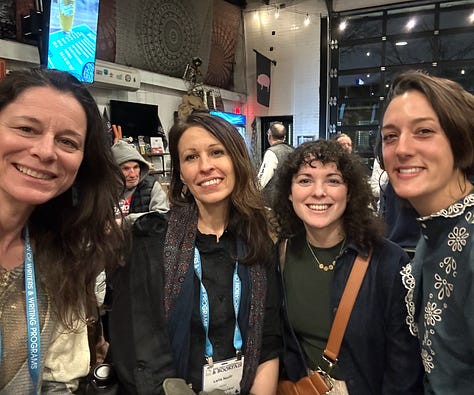
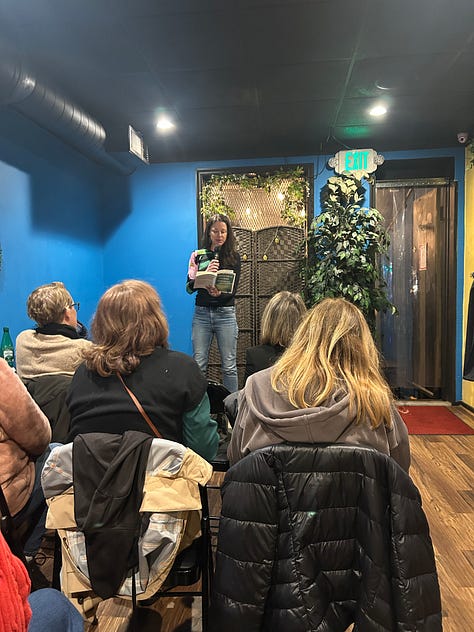
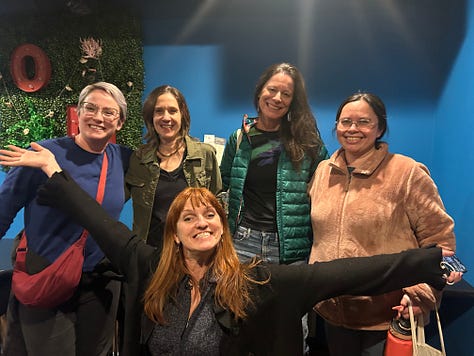
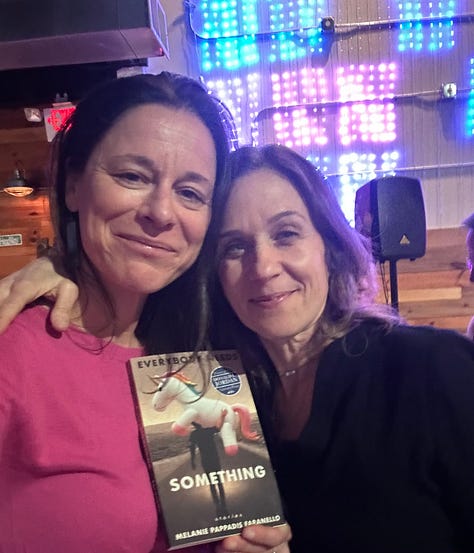
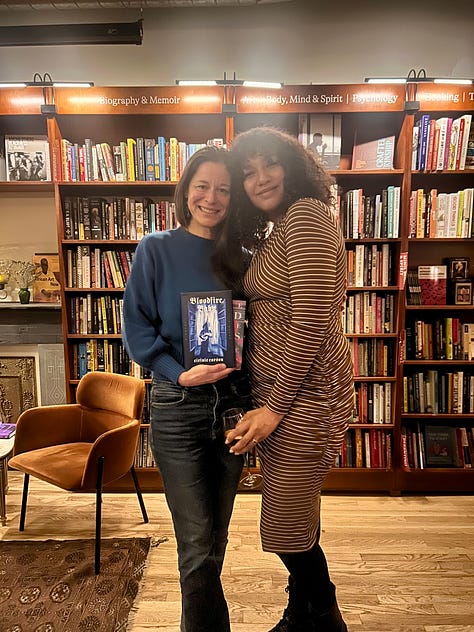
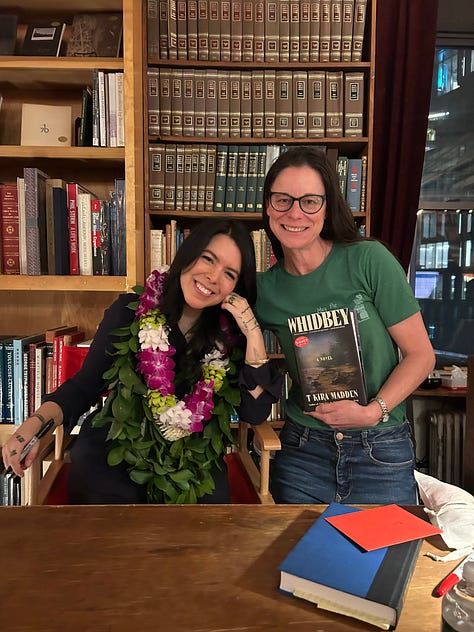
I’m sending this on the last day of March, barely making my self-imposed monthly newsletter deadline, but this month has involved the AWP conference in Baltimore, my daughter’s birthday party, my older sister and niece’s visit from Canada, my birthday, my husband’s live podcast show in Brooklyn, our daughter's Finding Nemo play, a parent-teacher conference, and three friends’ book launches—among other work and life stuff. Here are a few pictures (yes, I match my friends’ books at their launch events). If you can, please support these beautiful writers and buy their books: Melanie Pappadis Faranello’s debut short story collection Everybody Needs Something; Eirinie Carson’s debut novel Bloodfire, Baby, and T Kira Madden’s debut novel Whidbey.
I also wanted to give a shout out to Megan Lui for winning a prize with this gorgeous flash fiction piece in fractured lit, Rock Dove.
Someone told me recently how it’s nice of me to drive for two hours or take trains and subways to friends’ book events and I told them we should all be doing that whenever we can. Books take years—sometimes decades—of sweat, tears, rejection and agony, and showing up at readings and supporting writers and others creatives is vital. It’s always important, but especially now that we live under a government that is trying to erase history and has decimated funding for libraries, schools, literary organizations, and the arts.
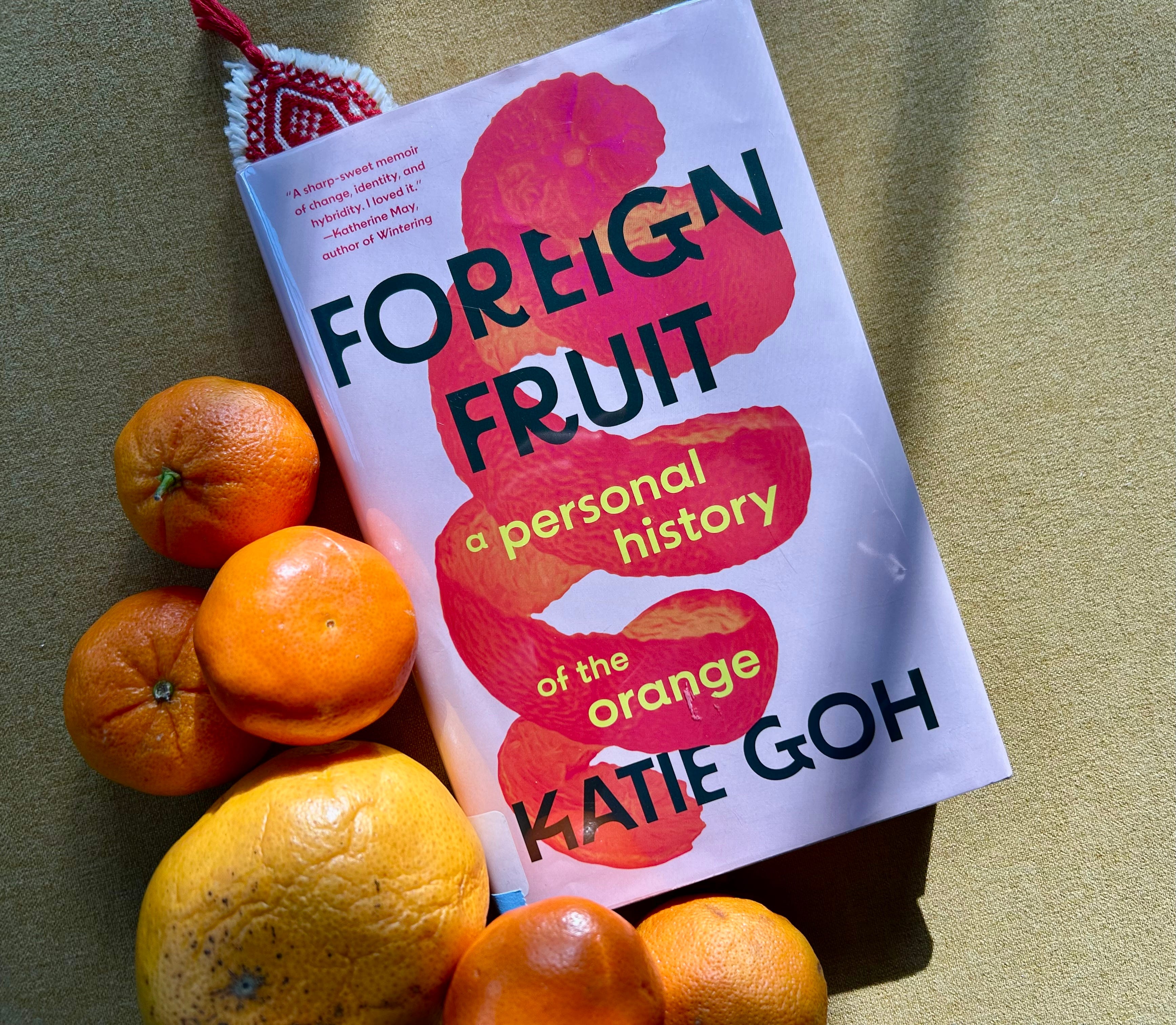
I’m still reading this month’s featured book, Foreign Fruit: A Personal History of the Orange, and enjoying Katie Goh’s exploration of her identity, along with extensive research about the history of citrus. Goh, who grew up queer in Ireland in a Chinese/Malaysian/Irish household, examines her sense of self and traces her roots while diving deep into the history and migration patterns of the orange.
I’ll start with this important Los Angeles Review of Books piece by Hooman Majd called This is My War.
“As for me, what choice do I have but to mourn what is happening in a country that is both so far from and so dear to me? Iran is suffering from a war imposed on it by figures who simply do not care about my people, and certainly not about democracy, freedom, or security. I mourn because this war is doubly mine. This is my war because it is my government that is waging it, brutally and mercilessly. It is mine because the target is a place I love. I yearn for her, my Iran.”
I missed this great essay in February and am thankful my friend—writer, and Minneapolis resident Elyse Moretti Forbes—listed it in her newsletter. Here is Letter From Minnesota: Thirteen Ways of Looking at the Frontier, From an Immigrant in Minneapolis by Sun Yung Shin for LitHub.
“Because of my origins, and the way in which I became an immigrant—legal alien resident—then naturalized citizen of the US, I think about authoritarianism frequently. Because I’m not a man, and the world is ruled and owned mostly by men, and my survival depends on a daily basis on the decisions I make around my behavior when interacting with men, I think about masculinity frequently. Because the country and the world into which I was born was controlled militarily by white nations, I think about whiteness on a daily basis.”
I’ve featured Sarah Aziza’s work here before; her memoir, The Hollow Half, was my favorite of 2025. Here is another gorgeous piece, Ojalá: Toward an Illiteracy of Liberation. I encourage you to read through the whole issue of The Markaz Review called Mother Tongue.
“My journey to Arabic fluency was like this — a re-mothering, a visceral return. Back to my youngest days, a time when body slurred, mingled with sounds and touch. Then, meaning drifted, warm and benevolent, between the material and imaginary, English and Arabic. These categories I had no words for, nor any need to differentiate.”
I loved Christine Huang’s epistolary essay on queerness, dating, and existing in different languages for The Rumpus, To My Date at the Wonder Bar.
“Chinese has a way of undoing me; in my mother tongue, I’m perpetually seventeen: a 乖女兒,at that age where everything feels like flying or falling, where you feel yourself teetering on the cusp. The sound of it spoken in Taiwan, with the gentle, dryly lilting marcato, sounds the way my childhood bedroom smells: instant and instinctive, torquing my insides. Every sentence sounds private, as if for no one’s ears but mine.”
It’s always nice to see friends’ writing out in the world and here is an essay by my grad school buddy Dragica Mikavica, who came here as a refugee from Bosnia. She wrote about the meaning of the Singer sewing machine for her family in Mileva’s Singer Machine for Women Write the Balkans.
“I thought of my mom, aunts, and grandmothers when I read Slavenka Drakulić’s book, How We Survived Communism and Even Laughed about the resourcefulness and tenacity of women living in socialist Eastern European republics, including Yugoslavia, when it came to beauty, hygiene, and survival. I read this book in a college modern European history class, and it put into words what I had already witnessed throughout my life. Women I grew up with, too, would stop a run in their nylon stockings with a touch of old nail polish.”
For Adelaide Literary Magazine, Harshini Rajachander wrote An Ex-Immigrant Who Can’t Stop Dreaming About Flying Back.
“American propaganda is so good at what it does that a person can live their whole lives without recognizing the edges between truth and fiction. It spreads its version of the perfect life to all its neo-colonies. And we, in the global south, consume that content, believe it wholeheartedly, and long for the America Dream that forever remains out of reach even when, especially when, we live within its borders.”
I’ll wrap it up with Hannah Lillith Assadi’s What Keeps Us Human: How My Palestinian Father Met My Jewish Mother in LitHub.
“It was a cruel world. Who could trust anyone in it? As usual, everything was coming undone. Being gay could kill you. Being Palestinian could definitely kill you. Being Jewish, from time immemorial, could kill you. Even making love could now kill you. Everyone was doomed. How could anyone anywhere ever fall in love again?”
Thanks for reading—and if you are enjoying this newsletter, please hit the like button, share it on social media, or encourage a friend to subscribe. Immigrant Strong has been around for free for six years and runs thanks to reader recommendations and support,
Vesna
About this newsletter: Writing about immigrant and refugee life—the struggles, triumphs, and quirks—by immigrants and refugees, children of immigrants and refugees, and others living between countries and cultures. For more info, here is a Q&A I did with Longreads about the newsletter. Photo in the logo: Miguel Bruna/Unsplash.
About me: I grew up in the former Yugoslavia, then immigrated to Canada, and now live in the United States, where I work as a writer for nonprofits in the human rights and international affairs fields. I have written for three anthologies (Back Where I Came From: On Culture, Identity, and Home; Connecticut Literary Anthology 2024; and Connecticut Literary Anthology 2023) as well as Electric Literature, The Los Angeles Review of Books, The New York Times, Pigeon Pages, the Washington Post, the New York Daily News, and Catapult, among others. I was a fellow at the Virginia Center for Creative Arts (‘26), Writer in Residence at Hedgebrook (‘25), participated in Tin House (‘24 and ‘21) and Kenyon Review (‘24) workshops, and won the Poet & Author (‘24) and Parent Writer (‘20) fellowships from Martha’s Vineyard Institute of Creative Writing. Find me on Instagram and Bluesky.
Comments
Nothing yet. Say the first thing.
Sign in to join the conversation.