
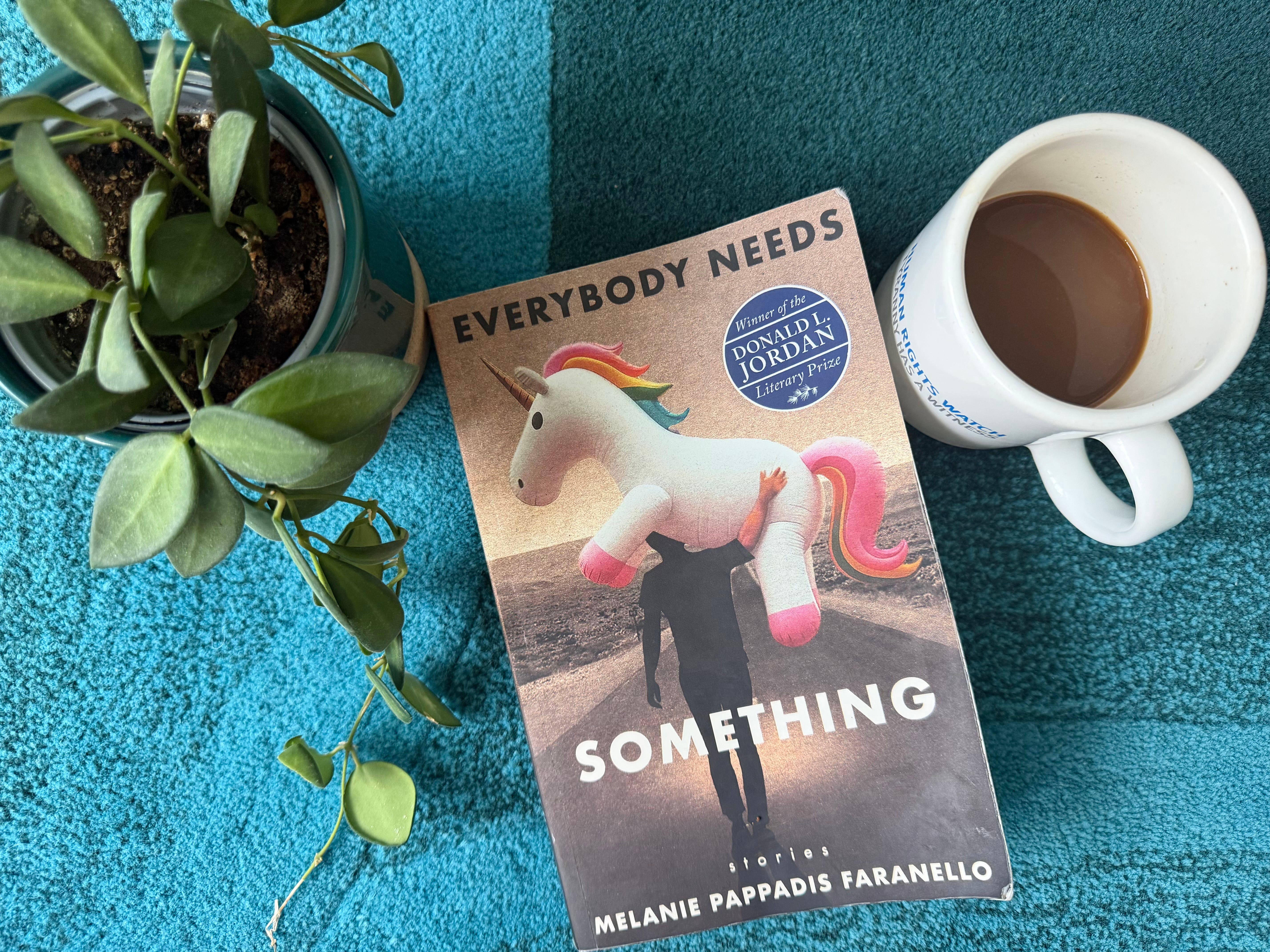
It’s always a pleasure to feature a friend’s book here so I’m thrilled to share Melanie Pappadis Faranello’s debut short story collection Everybody Needs Something, winner of the Donald L. Jordan Literary Prize. The book’s 14 stories—a few of them linked, but most stand-alone—grapple with different relationships, but all center on our need for connection. Whether it’s about spouses, children and parents, or neighbors, the stories explore grief, loss, and our common yearnings and desires. Melanie transformed everyday moments into beautiful prose, and left me thinking about the characters long after I finished reading about them. Pappadis Faranello, who has Greek and Jewish roots, stays away from perfect bow endings—her characters and storylines are often more contemplative and nuanced, much like life itself.
This whole piece about writing and existing in and between languages is well worth your time. For LitHub, here is Writing in the Interim Language: Jhumpa Lahiri and Chiara Barzini in Conversation.
“What happened was that I had reached a point beyond the binary, beyond the boundary between either and or that has more or less governed my life from its beginnings. Was I Indian or American? Did I prefer life in America or in India? Would I marry an Indian or an American? Did I like to speak in Bengali or English? People born into a culturally hybrid and/or bilingual reality are inundated with such questions, and asked to choose a side. And yet choosing a side is impossible, it would betray a fundamental part of us. Unlike Stein, I never have felt a sense of true belonging to any place. I replicated this condition of non-belonging, perhaps subconsciously, perhaps intentionally, when I moved to Rome, learned Italian and then began to write in it.”
I enjoyed Jenny Qi’s Adroit Journal interview, A Conversation with Alan Chazaro.
“Some of my earliest memories growing up in California, and also visiting Mexico, was seeing hella paleteros everywhere. In my neighborhood, there were always older immigrant men wheeling their carts around. As a kid, that evokes a certain kind of joy and excitement. Just pure, good vibes. Once you get older, you start to understand the social and economic layers, and the paleteros become a symbol of not merely joy, but of cultural preservation, of diaspora, of inequality, of perseverance.”
For LitHub, here is Adriana E. Ramírez’s An Unsolved Puzzle: On Identity, Silence and a Legacy of Violence in Colombia.
“Spending over half my childhood summers in Colombia, I was often a tourist on my family’s coastal terrain, more camera than denizen, forever trying to reclaim something my mother left behind when she met and married my father.
To my deeply Colombian grandmother, I am her eldest and most foreign grandchild. I am the daughter of the one who left country and family. I am her only grandchild who speaks Colombian Spanish with a Mexican accent.”
Jidi Guo spent A Month Inside the World’s Largest Refugee Camp and wrote about it for Guernica.
“But all it took to snap me out of it was the rumble of a World Food Programme truck rolling by. Or a glance at my interview notes about slain husbands and conscripted brothers, children who had died on the long walk to the river Naf. Or someone casually mentioning the year of their arrival—as if eight years of confinement, with nowhere else to go, were an incidental detail. The surface-level comfort would crack just enough to remind me where I was.”
I am familiar with the ongoing horrors being inflicted by ICE agents, but it doesn’t make reading another piece about it less painful. I’m grateful for folks like Laurie Lathem, who are volunteering to support immigrants dealing with these abuses. For Electric Literature, here is Observations from Inside Immigration Court.
“A mother from Honduras eyes the agents with fear as her kids play a game on her phone. A young couple arrives; the mother pushes a baby in a carriage, the father carries a toddler. They make their way between two lines of ICE agents, single file, eyes straight ahead, pigtails bobbing over the father’s shoulder. There is no way to know which families will remain intact at the end of the day.”
I’ll wrap it up with this gorgeous Rumpus essay, Always Watching from the Roof by L.F. Khouri.
“From far away—from right here—the houses and the roads look empty. Sometimes I think if I stare hard enough, the emptiness will break, and someone will step into view. I want it to break, but I’m afraid of what might come with it. That’s when I imagine a soldier lifting a scope, a rifle glinting, my stillness mistaken for something else.”
Thanks for reading,
Vesna
About this newsletter: Writing about immigrant and refugee life—the struggles, triumphs, and quirks—by those with immigrant and refugee roots, and others living between countries and cultures. For more info, here is a Q&A I did with Longreads about the newsletter. Photo in the logo: Miguel Bruna/Unsplash.
About me: I grew up in the former Yugoslavia, then immigrated to Canada, and now live in the United States, where I work as a writer for nonprofits in the human rights and international affairs fields. I have written for three anthologies (Back Where I Came From: On Culture, Identity, and Home; Connecticut Literary Anthology 2024; and Connecticut Literary Anthology 2023) as well as Electric Literature, The Los Angeles Review of Books, The New York Times, Pigeon Pages, the Washington Post, the New York Daily News, and Catapult, among others. I was a fellow at the Virginia Center for Creative Arts (‘26), Writer in Residence at Hedgebrook (‘25), participated in Tin House (‘24 and ‘21) and Kenyon Review (‘24) workshops, and won the Poet & Author (‘24) and Parent Writer (‘20) fellowships from Martha’s Vineyard Institute of Creative Writing. Find me on Instagram and Bluesky.
Comments
Nothing yet. Say the first thing.
Sign in to join the conversation.