
Hi there,
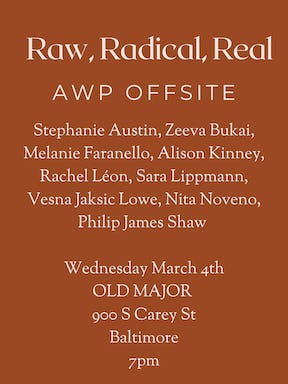
If you’re heading to AWP in Baltimore next week, reach out if you want to connect. I’m reading on Wednesday, March 4 along with some amazing writers. I plan to attend the Must Love Memoir reading on Thursday night and the Pen Parentis/CityLit Project party on Friday night.
This month and next are bringing a few friends’ debuts, so I wanted to give a shout out to my Hedgebrook sisters Eirinie Carson, whose novel Bloodfire, Baby is now out, and T Kira Māhealani Madden, whose novel Whidbey will be released next month. Also next month, my friend Melanie Pappadis Faranello will publish her award-winning short story collection, Everybody Needs Something. If you get a chance to pre-order or buy their books or go to their events, they are fantastic women writers to support.
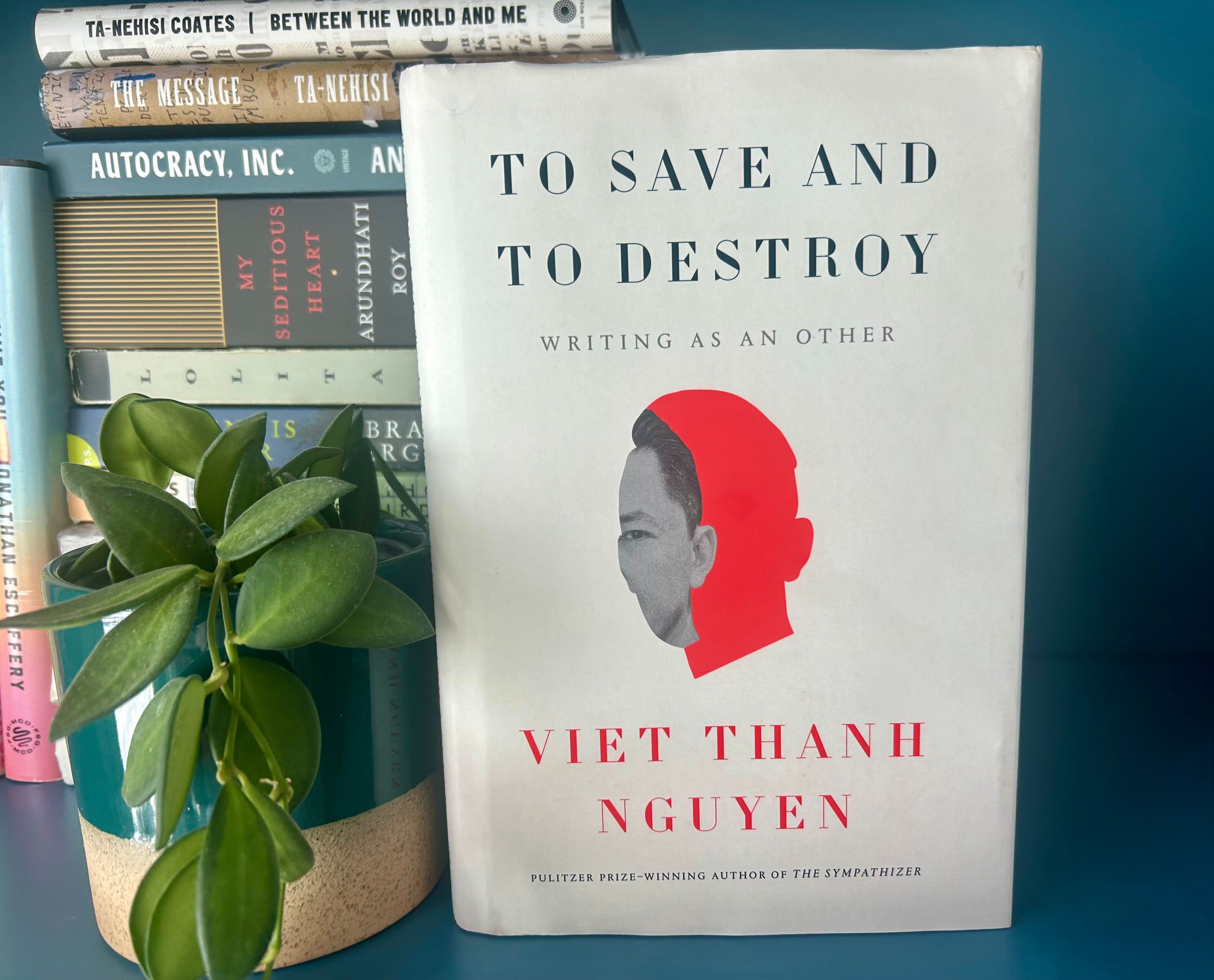
Viet Thanh Nguyen’s latest book, To Save and to Destroy: Writing as an Other, is based on lectures he delivered at Harvard examining the concept of ‘the other’ through literary, historical, and personal lenses. Like much of his work, it is founded in rigorous research and weaves in his family’s story of coming to the United States as refugees from Vietnam. While the United States has a long history of demonizing ‘the other’, I think the book is especially timely now given the severe erosion of democratic norms driven in large part by discrimination and racism. Nguyen discusses issues such as the importance of confronting America’s colonialism and racism, the need for global solidarity, and finding joy in otherness.
I’ve included Sahar Delijani’s work a number of times in this newsletter; here is another fantastic essay from her, Iranians Don’t Need to Prove Their Revolution to You, for the Los Angeles Review of Books.
“I am writing this as a woman who has carried the inheritance of violence, repression and state-sponsored terror all her life, as a little girl who learned early the discipline of silence, who knew what could never be said to strangers about where her parents had been and what had been done to them. As a woman who cannot free herself from the wound, who lives it again and again, and who has made it her life’s work to speak of what dictatorship leaves behind, not merely in one family but passed from generation to generation.”
And here is another piece from an Iranian American writer, Who Can I Dance With? by Arash Dabestani for Guernica.
“After immigrating to the U.S., the first thing I did was enroll in a college. But though I was surrounded by people there, of all ages and from all corners of the world, it was obvious we were each alone: language stood like a wall between us. We couldn’t connect, couldn’t break through the silence of our shared isolation. I remember passing other international students from non-English speaking countries on campus; we would nod politely and sometimes exchange a hesitant smile, but the words never came.”
Janika Oza penned this beautiful piece for the Seventh Wave In My Grandmother’s Words, and Mine.
“If silence was my inheritance, the writer in me demanded that I turn towards that absence and find language for the unsaid. The questions my grandmother left in her wake became a roadmap for writing. What does belonging mean—to a land, a people, a community—when nothing is permanent? How does that kind of rupture, unforeseen and repeated, shape a person’s understanding of rootedness, of home?”
For The Adroit Journal, here is Claire Y. Guo’s clever essay, The Types of Chinese You Meet on Vacation.
“For the first time, your Chinese is not Chinese, not a crutch you can smile and wave away by saying i haven’t spoken in a long time, hoping they’ll forgive your foreign accent or the wariness of your consonants – rather, it is worth nothing at all. Smaller than a seed; an ache you prod gently with your tongue. You’ve forgotten that the Chinese you learned – despite being the Chinese of Chinese After School, with Chinese teachers and Chinese food – is not the Chinese of your ancestry, the Chinese of the soil where your mother grew up; roughened by weather, a peach pit of tilting speech. Yours is glossy modern Mandarin, textbook-lacquered; hers is furred through with rural dialect, handed-down through generations, well-worn.”
This is a beautifully written and heart wrenching essay by Claudia Owusu, Self-Portrait Through Many Doors, for the Offing.
“I’m saying that I will lose/ love Kingsley in a different way than I will lose/love myself. I’m saying the tale is too lofty for the page. I’m saying the only way to make something real is to write it down. I’m working in parts, because this is a story I carry with me everywhere. This is one addressed to me.”
For LitHub, Janie Chang wrote How Writing My Books Helped Me Understand My Chinese Parents.
“My parents weathered social and political forces which were at times brutal, at times liberating, the changes happening at a pace so bewildering that all they wanted for the rest of their lives was some stability, some safe corner of certainty for our family. I only half-understood the influences that formed their world view, and after writing historical fiction, I understand a little bit more. But only just a little bit. Research is no substitute for listening to a first-hand narrative.”
This gorgeous essay deeply resonated with me, and I think it will with many of you. For LitHub, Emanuela Anechoum wrote A Self Divided: What It Means to Leave Your Hometown.
“My gaze is always, always measuring itself against the mirrors of home, the place I fled but never managed to leave behind. I want to exist outside of it, yet everything leads back to it, because a part of me has remained here.”
I’ll end with Geetha Iyer’s lovely Electric Literature essay, Attempting to Garden My Way Out of Sadness.
“For every failed starter pot, the squashes put out new growth, and that verve began to replace my emptiness. No, I was not talking to my plants, but I did anthropomorphize them. That is to say, I projected upon them my sense of self. I had become a sessile organism since moving to Panama. I was an uprooted transplant, far from family, disconnected by time and distance from my closest friends. I missed my friends so much that I had resolved not to make any more for fear of the wrenching separation that I knew would come when my spouse and I eventually moved countries again.”
Thanks for reading—and if you enjoy this newsletter, give it a like, forward it to a friend, or share it on social media. It’s always been free and will continue to be free, but shares and likes help me keep it going,
Vesna
About this newsletter: Writing about immigrant and refugee life—the struggles, triumphs, and quirks—by immigrants and refugees, children of immigrants and refugees, and others living between countries and cultures. For more info, here is a Q&A I did with Longreads about the newsletter. Photo in the logo: Miguel Bruna/Unsplash.
About me: I grew up in the former Yugoslavia, then immigrated to Canada, and now live in the United States, where I work as a writer for nonprofits in the human rights and international affairs fields. I have written for three anthologies (Back Where I Came From: On Culture, Identity, and Home; Connecticut Literary Anthology 2024; and Connecticut Literary Anthology 2023) as well as Electric Literature, The Los Angeles Review of Books, The New York Times, Pigeon Pages, the Washington Post, the New York Daily News, and Catapult, among others. I was a fellow at the Virginia Center for Creative Arts (‘26), Writer in Residence at Hedgebrook (‘25), participated in Tin House (‘24 and ‘21) and Kenyon Review (‘24) workshops, and won the Poet & Author (‘24) and Parent Writer (‘20) fellowships from Martha’s Vineyard Institute of Creative Writing. Find me on Instagram and Bluesky.
Comments
Nothing yet. Say the first thing.
Sign in to join the conversation.