
Earlier this year we released the inaugural 2026 Venture Ranking of the top 100 US-based VC firms, the first transparent, fully data-driven ranking of venture firms. In that list, life sciences appeared as a footnote: only five specialist firms cracked the top 100. Biotech is a distinct and very important part of the VC ecosystem.
We use the same methodology for all venture rankings. The ranking information cutoff date is June 30, 2026. The full methodology is described in our working paper (Strebulaev and Jackson, 2026), and the 2026 Venture Ranking of Top 100 firms is here:
The 2026 Strebulaev-Jackson Venture Ranking: Complete Top 100 VC Firms
·
Jun 22
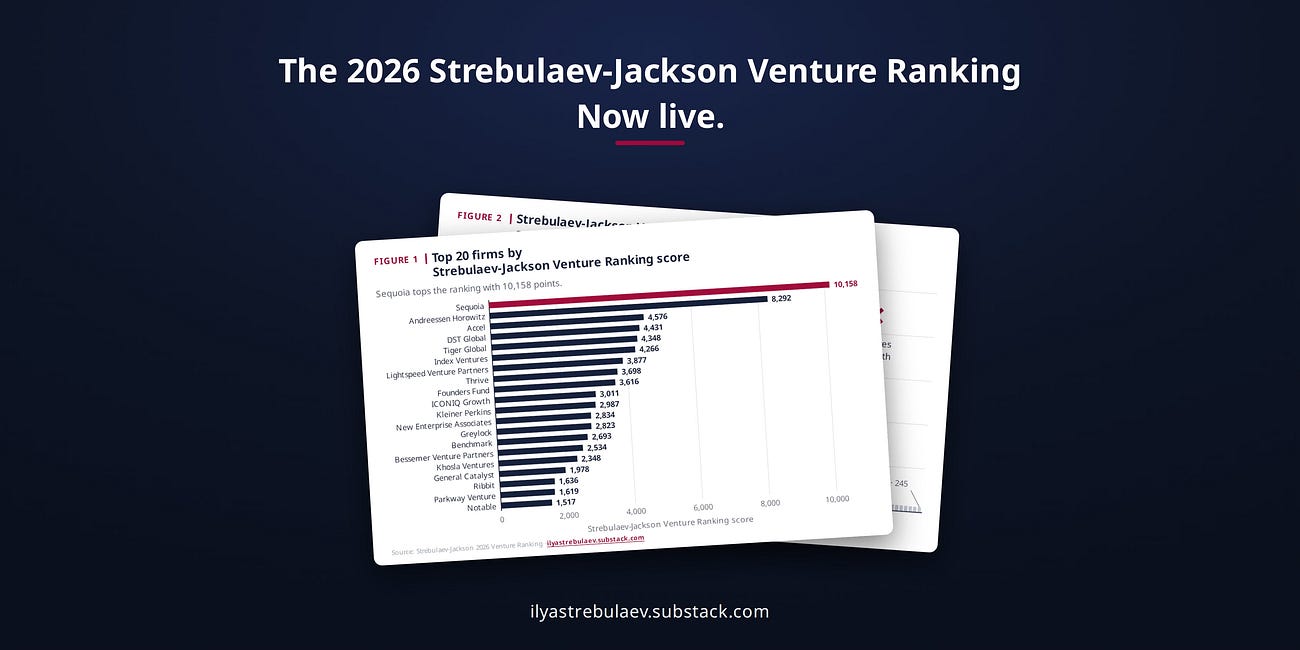
Every founder raising from venture capitalists has heard the same names — Sequoia, Andreessen Horowitz, Benchmark — and every limited partner has a mental shortlist of VC firms that supposedly matter. And while these names are well-known, there, surprisingly has never been a transparent, fully data-driven ranking of which VC firms are actually best at what they do.
For the biotech ranking we apply the same methodology as in our overall ranking, but we restrict the set of underlying investments on which people, and subsequently firms, are scored to qualified VC round investments in biotechnology startups.
We take an expanded view of biotechnology, including both life sciences and medical hardware. To streamline our rankings, we use PitchBook industry definitions and define a portfolio company as biotech if the primary industry code is one of: Biotechnology, Diagnostic Equipment, Discovery Tools (Healthcare), Drug Delivery, Drug Discovery, Monitoring Equipment, Other Devices and Supplies, Other Pharmaceuticals and Biotechnology, Pharmaceuticals, Surgical Devices, and Therapeutic Devices. As elsewhere, we draw affiliation information from a range of other sources.
Institutional US VC firms qualify so long as they have invested in at least five unique biotech companies via qualified VC rounds, the same five-company threshold as the overall rankings, applied to the biotech subset. Note that VC firms that don’t specialize in biotech are included as long as they made at least five investments in biotech companies.
Our algorithm rests on the same six economically grounded factors as in the overall rankings.
Valuation. Two companies can both be “worth $100 billion”: one as a public market capitalization, the other as a private post-money valuation. These are not the same number. Private post-money valuations systematically overstate true value, because the preferred stock VCs buy carries downside protections that common stock lacks. We discount private valuations uniformly. My work with Will Gornall put the average overstatement for unicorns near 50%.
Dilution. A 10% stake at the first round is not a 10% stake at exit. Two companies can both sell for $1 billion, but if one raised four rounds along the way, its early investors were diluted round after round. We track each investment’s ownership down through every subsequent round.
Net profit. Net profit is more informative than gross profit when investors deploy very different amounts of capital. Turning $10 million into $2 billion is a different achievement from turning $1 billion into the same $2 billion. We subtract the cost of every investment, which rewards capital efficiency and penalizes spraying large checks to produce a few headline wins. In our data, roughly three-quarters of investments returned negative net profits.
Value add. Investors who lead rounds and take board seats contribute more than passive check-writers. We award additional points for these roles, reflecting involvement in a company’s outcome.
Human-capital decay. A VC’s skill, network, and judgment depreciate if not continuously exercised. We discount each investment by the time elapsed since it was made, using a half-life of three years. A dollar of value created in 2022 is worth about fifty cents in 2025 and a quarter if it was created in 2019. Two investors who each turned a 20% stake into a $10 billion IPO can look identical on paper. Yet if one invested in 2005 and the other in 2020, the second earned an IRR of 141.9% against 28.7%, and rests on human capital six years old rather than twenty-one. This is what keeps the ranking current: it rewards investors who are good now rather than those resting on a single brilliant bet from two decades ago.
Credit between firm and individual. In principle, the points given to each firm are equal to the sum of the points awarded to its partners. However, investors move between firms. When a partner who made their best deals at one firm decamps to another, both firms deserve some credit. We split it: a quarter to the firm where the investment was made, three-quarters to the firm where the partner works now, reflecting academic evidence that most return variation traces to individuals rather than institutions. This is also part of why a firm’s score and its partners’ individual scores can diverge sharply.
Every point still traces back to a specific investment in a specific company on a specific date. The full methodology is in the whitepaper.
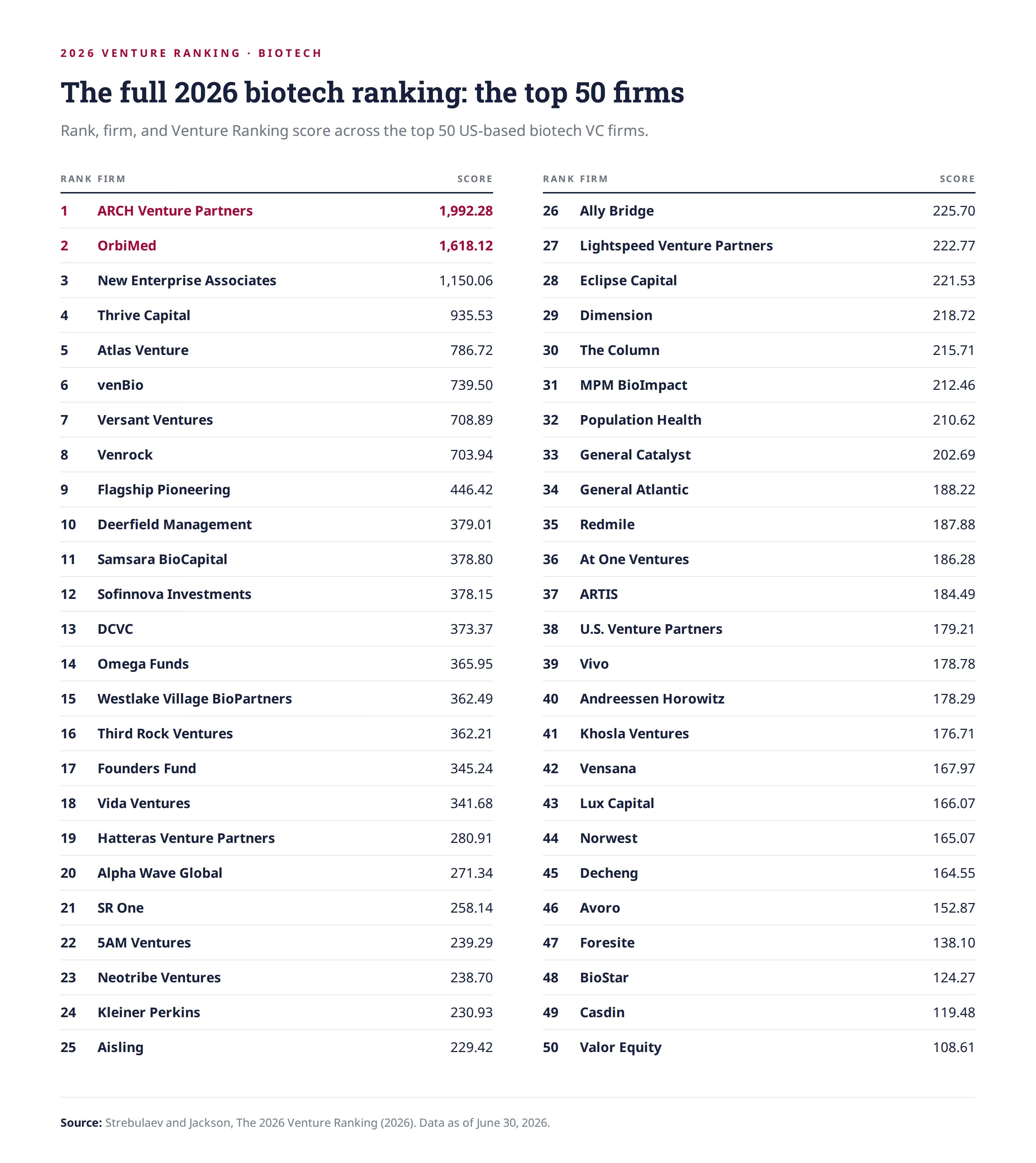
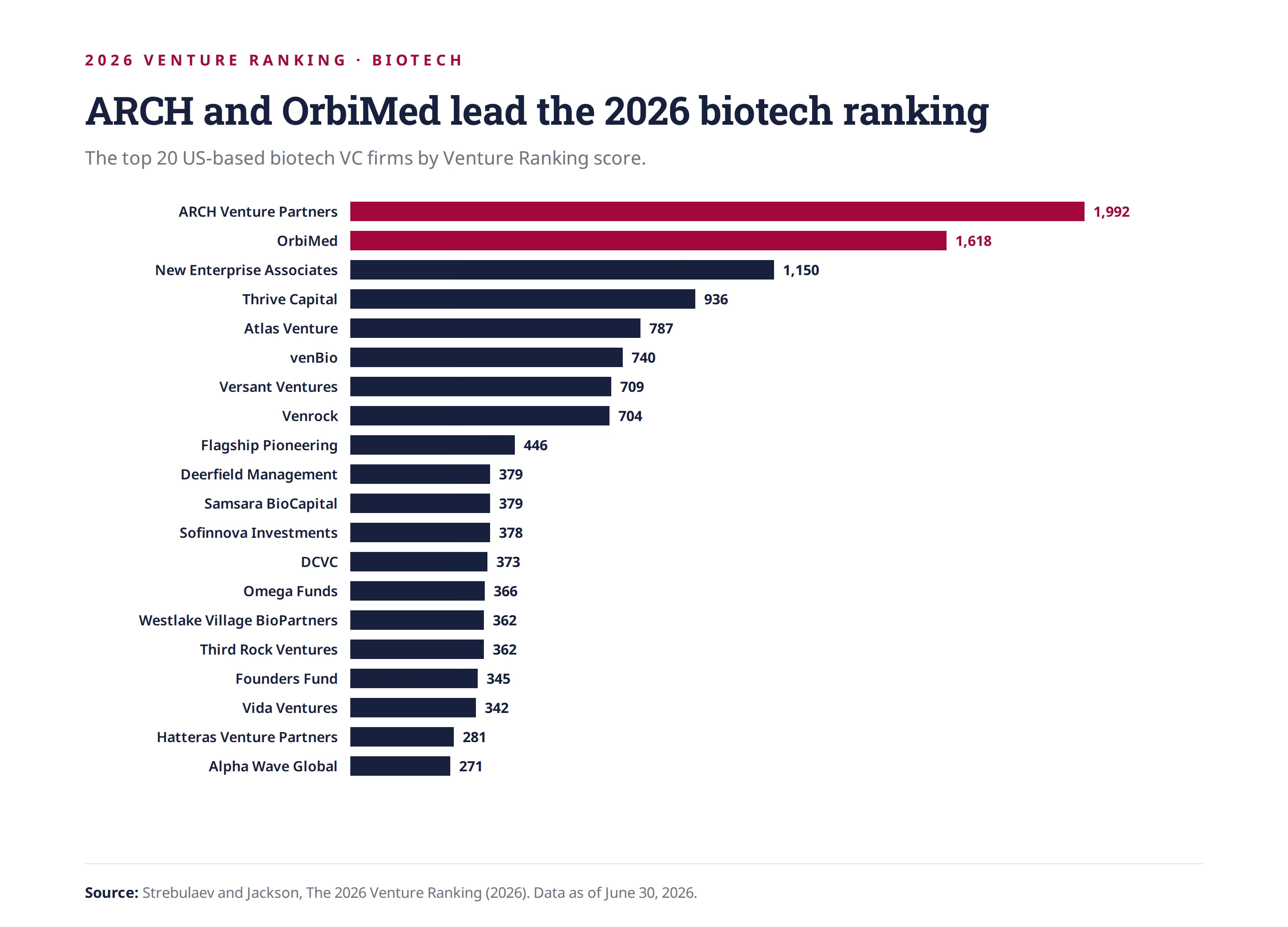
ARCH Venture Partners tops the biotech ranking with 1,992 points. OrbiMed is second with 1,618. New Enterprise Associates, Thrive Capital, and Atlas Venture round out the top five. venBio, Versant, Venrock, Flagship Pioneering, and Deerfield Management complete the top ten.
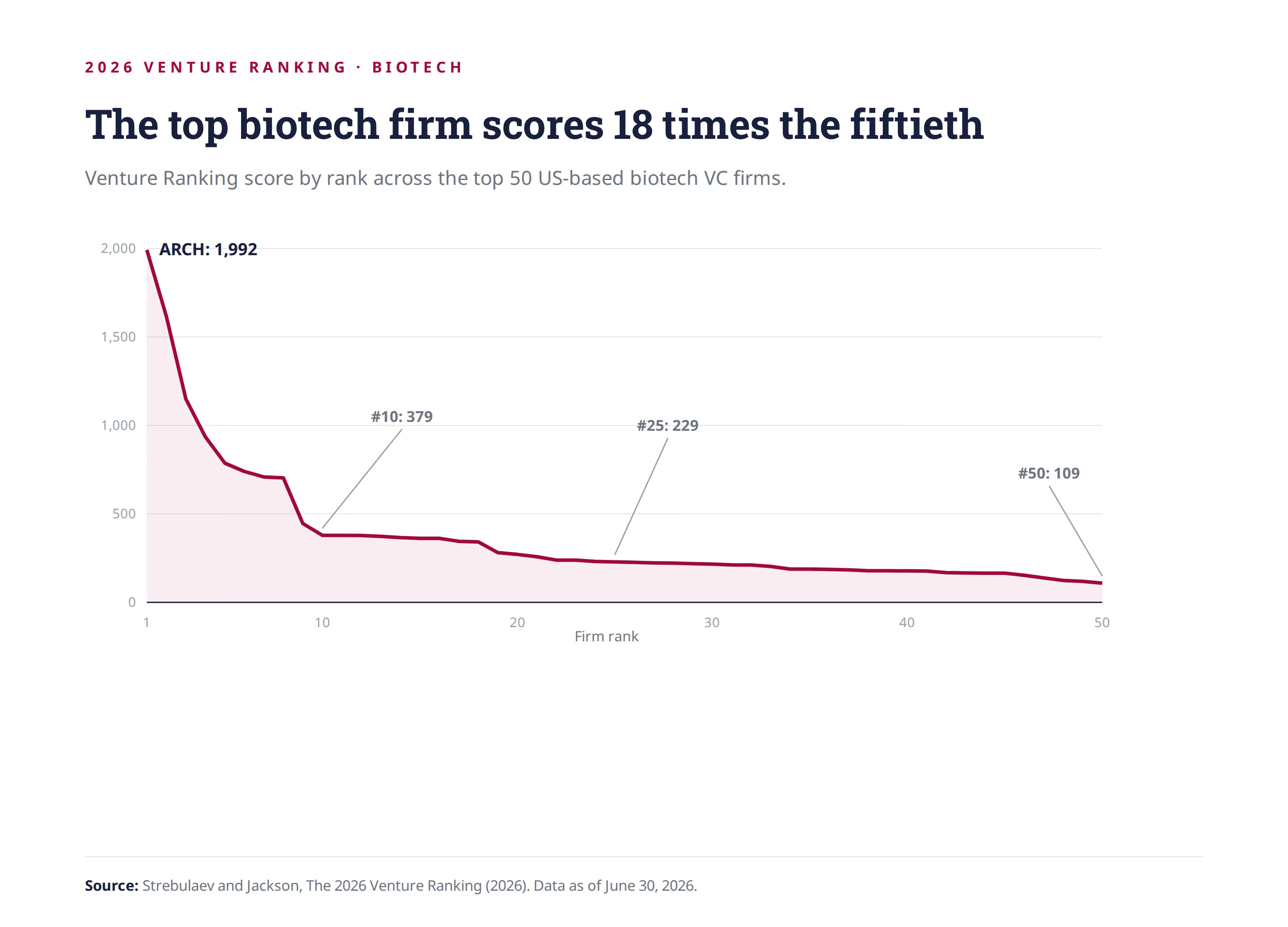
The curve is steep, though not quite as brutal as in our main ranking. By rank 10 the score has fallen to 379, less than a fifth of ARCH’s. By rank 50 it is 109, and the top firm scores roughly 18 times the fiftieth. The top ten firms account for 51% of all points across top 50, and the top five alone for 35%. Venture’s power law holds inside biotech just as it does across the VC industry overall.
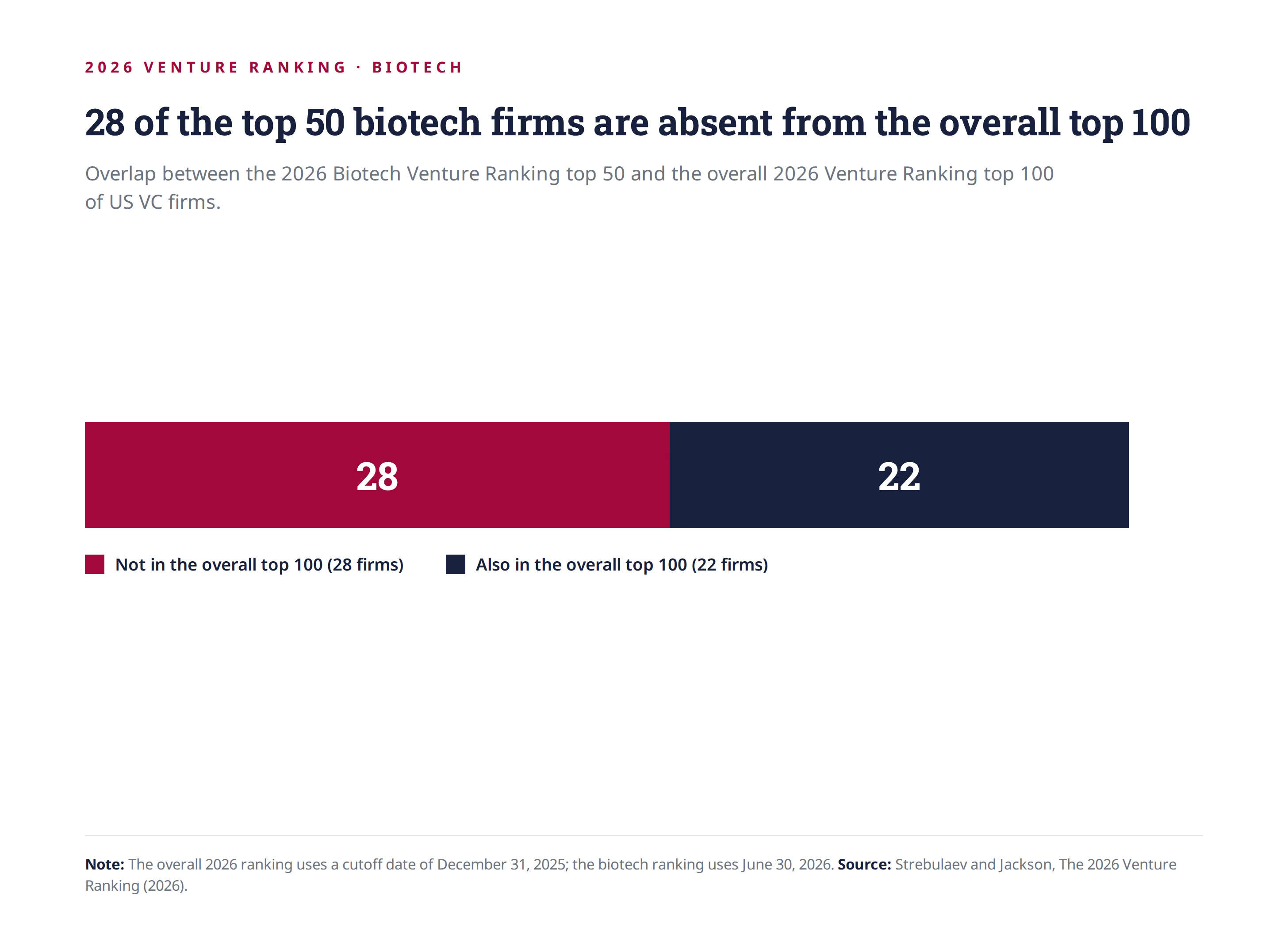
Twenty-eight of the top 50 biotech firms appear nowhere in our overall top 100 of US VC firms. Flagship Pioneering (9th here), Deerfield (10th), Samsara BioCapital (11th), Omega Funds (14th), Westlake Village BioPartners (15th), Vida Ventures (18th), Hatteras (19th), and 5AM Ventures (22nd) are successful biotech VC firms with measurable track records that are not in our overall ranking. (Note: our 2026 overall ranking cutoff date is December 31, 2025.)
The reverse is just as instructive. Sequoia, first overall in our overall ranking, ranks 64th in biotech. Andreessen Horowitz, second overall, ranks 40th. Lightspeed, seventh overall, ranks 27th. These results clearly show that these firms have chosen to deploy their capital elsewhere; the ranking reports where the value was created.
I believe this is the clearest argument for sector rankings, such as the one I present here.
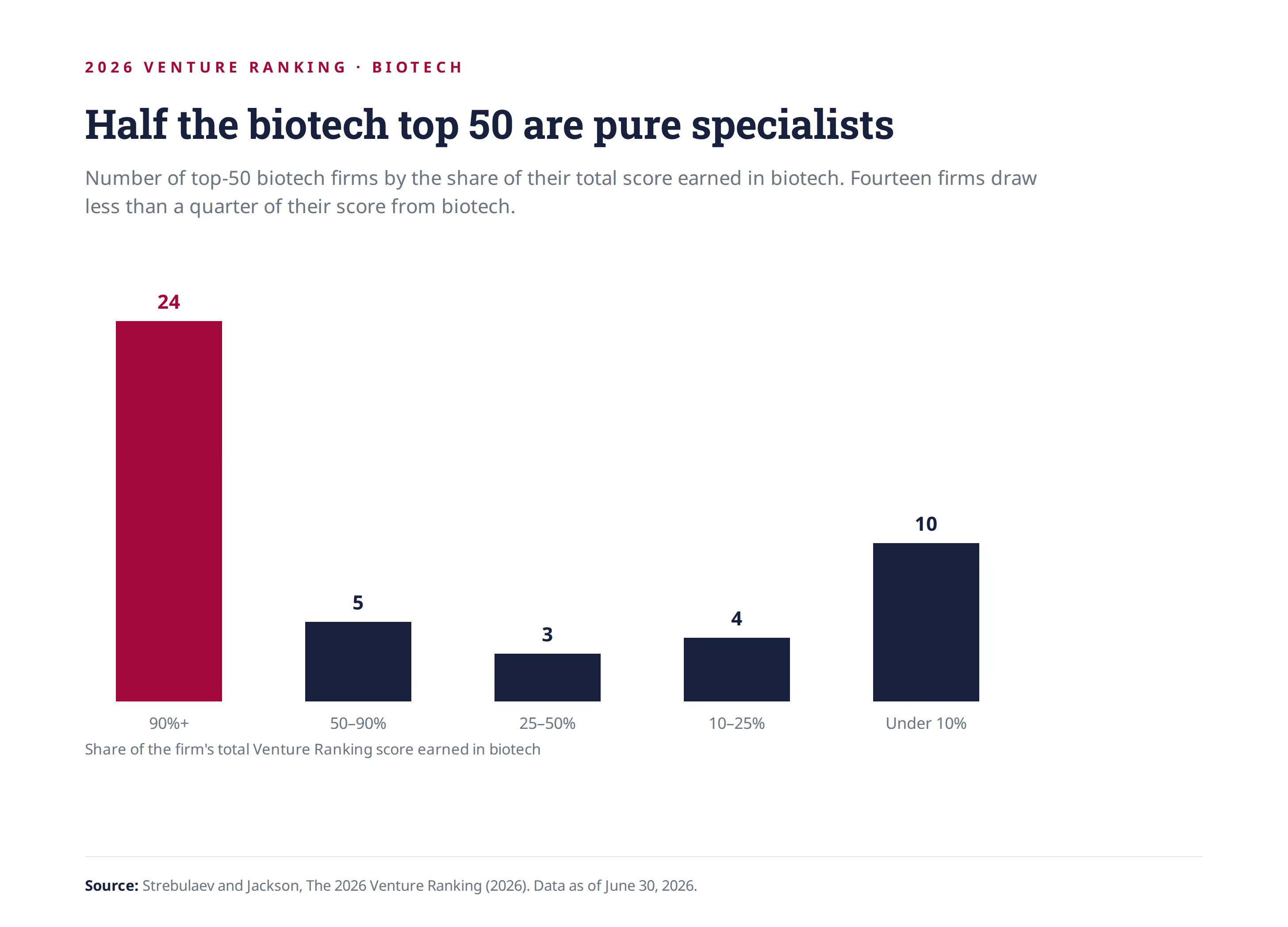
We can measure how concentrated each firm is by asking what share of its total score comes from biotech deals. For 24 of the top 50 firms, essentially all of their score is biotech: ARCH, OrbiMed, venBio, Versant, Samsara, Sofinnova, Omega, Third Rock, Vida, 5AM, The Column, MPM BioImpact, Vensana, Avoro and others are, on this measure, pure-play life-sciences and/or medical hardware investors.
Yet 14 firms in the top 50 draw less than a quarter of their overall score from biotech, and several draw almost none: biotech accounts for roughly 3% of Founders Fund’s score, 4% of Kleiner Perkins’, and under 1% of Andreessen Horowitz’s and Lightspeed’s. These firms still rank 17th, 24th, 40th and 27th in biotech, respectively. A generalist writing a handful of large, well-timed checks into life sciences can land in the top half of a specialist list, a fact worth knowing for any founder weighing a generalist term sheet against a dedicated one.
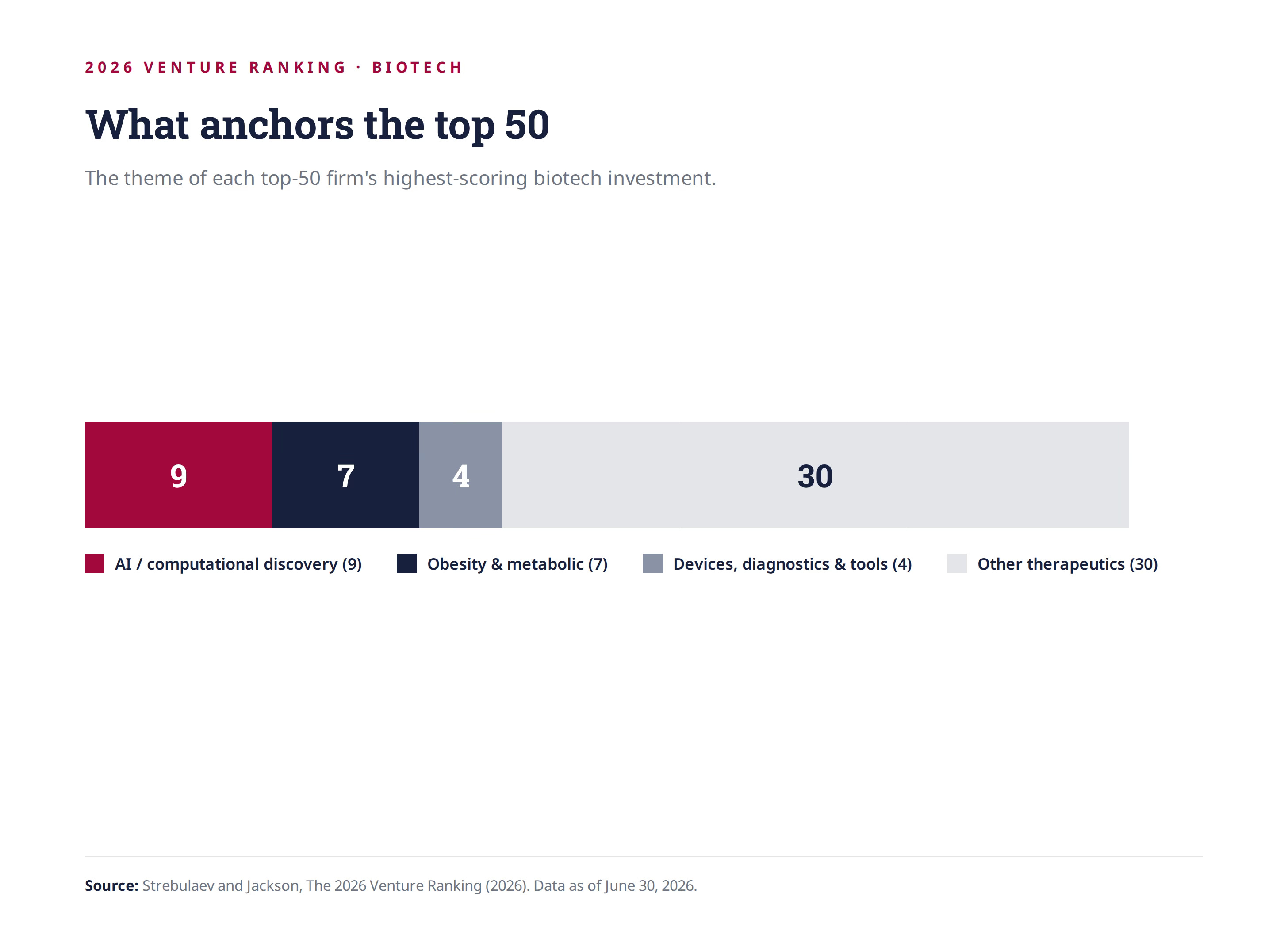
In the overall ranking, nearly a quarter of firms owed their top position to a frontier-AI or AI-infrastructure company. Biotech is not far behind, and the wave is unmistakably recent. For nine of the top 50 firms, the highest-scoring investment, or one of them, is a company built around computational or machine-learning-driven discovery: Isomorphic Labs (Thrive), Xaira Therapeutics (Foresite), NewLimit (Founders Fund, Kleiner Perkins, and Dimension), Ten63 Therapeutics (Hatteras), Science (ARTIS and Khosla), and Colossal Biosciences (At One). Across the extended ranking of top 100 biotech VC firms, sixteen firms owe their top position to this cohort.
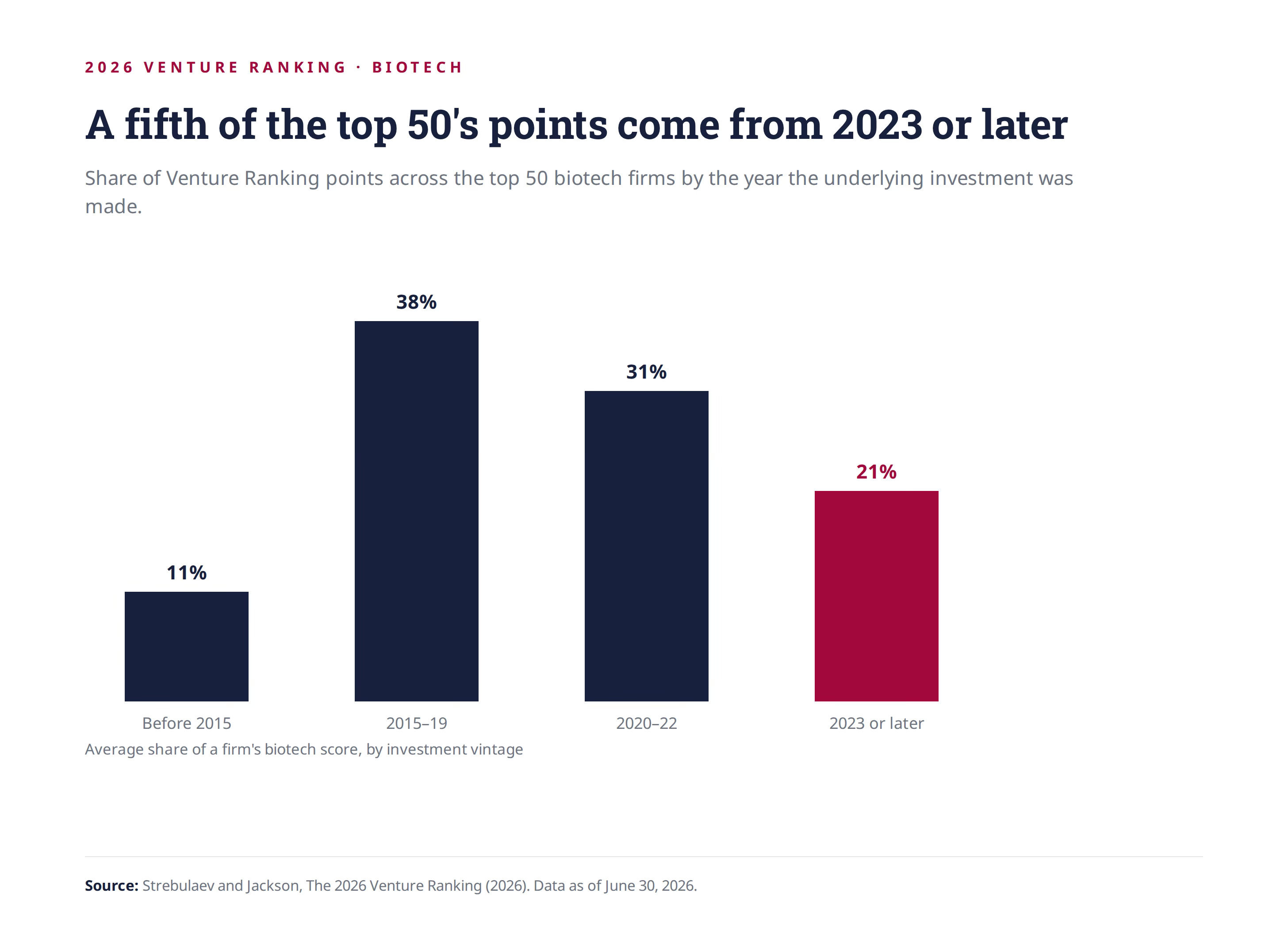
The decay factor makes the timing visible. Thrive’s biotech score is almost entirely (99.9%) earned on investments made in 2023 or later; the same is true for the bulk of Dimension’s (79%), Founders Fund’s (71%), and Kleiner Perkins’ (69%). Across the top 50, roughly a fifth of all points come from investments made since the start of 2023 and only 11% from investments made before 2015.
The second theme running through the top of the list is metabolic. Seven of the top 50 firms get high scores from their position in one of four companies in obesity and metabolic disease: Metsera (ARCH and Population Health), Versanis Bio (Atlas), Akero Therapeutics (venBio and Versant), and Terns Pharmaceuticals (Deerfield and Vivo). Both of the top two firms on the entire list are anchored by recent metabolic or antibody-platform positions.
The remaining 30 firms in the top 50 are anchored by conventional therapeutics, and oncology dominates that group: Scorpion Therapeutics, RayzeBio, Loxo Oncology, ProfoundBio, Arcellx, Forty Seven, and IDRx are examples — alongside cell and gene therapy names such as Sana Biotechnology, Spark Therapeutics, Neurona and Kate Therapeutics.
Only four firms in the top 50 are anchored by a device or diagnostics company. The value in our ranking is overwhelmingly in drugs rather than tools.
As in the overall ranking, the same companies keep reappearing. Across the top 50 firms there are only 38 distinct highest-scoring companies; across the extended list of top 100 there are 75. AbCellera Biologics is the top position for four different firms, and Metsera, NewLimit, BillionToOne, Cellares, and Xaira Therapeutics for three each. A small set of companies anchors a large share of the entire ranking. This is why identifying the right investors early matters so much.
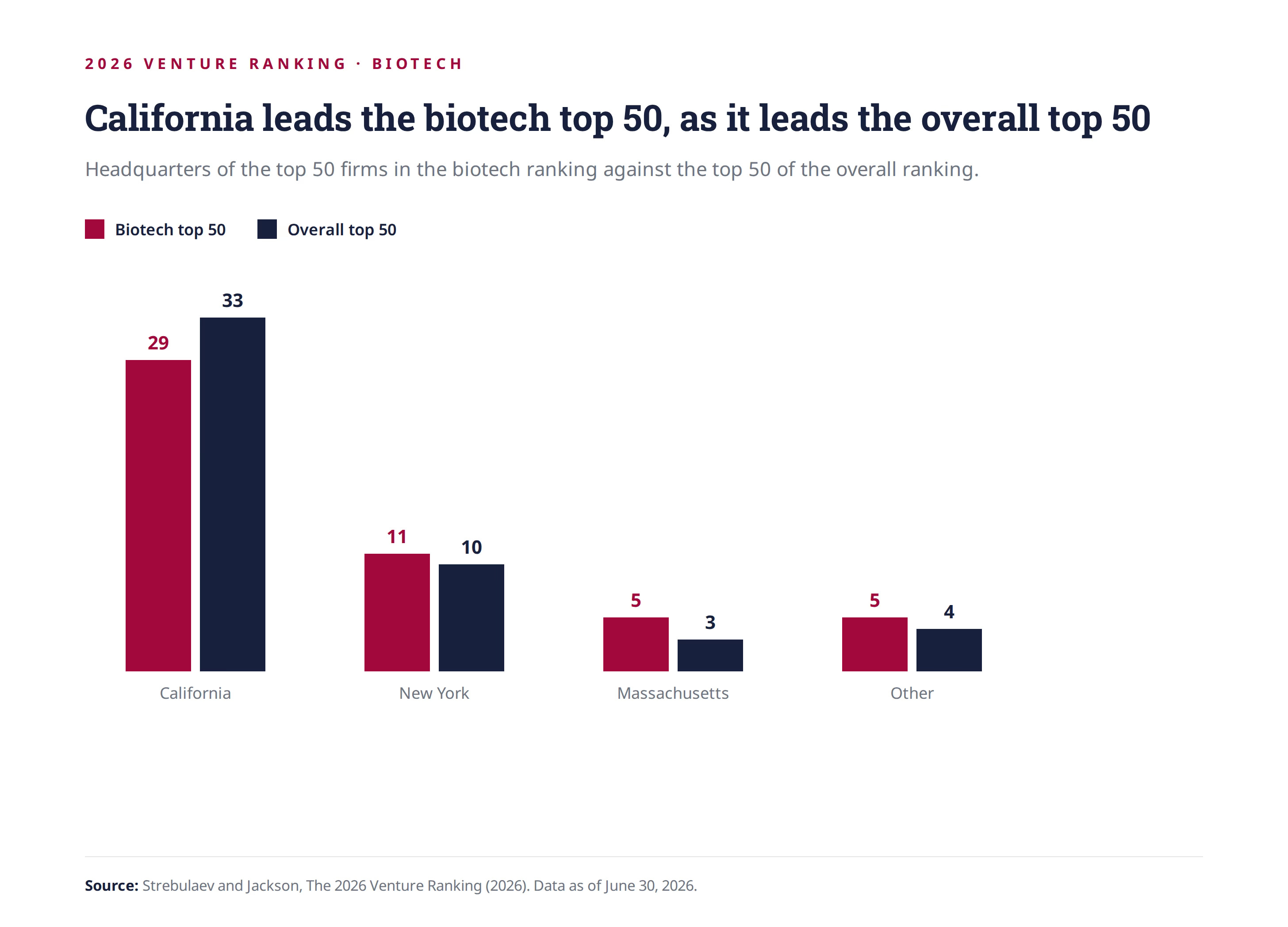
California still leads, with 29 of the top 50 firms and 56 of the extended top 100, concentrated in the broader Bay Area (San Francisco, Menlo Park and Palo Alto). New York is second with 11 firms in the top 50 and 17 in the extended top 100. Massachusetts is third with five firms, with all five being dedicated life-sciences houses: Atlas Venture (5th) and Flagship Pioneering (9th) in Cambridge, Omega Funds (14th), Third Rock (16th) and MPM BioImpact (31st) in Boston. In the extended top 100, thirteen are headquartered in Boston or Cambridge, against six in the overall top 100.
The generational range is wide. Norwest, founded in 1961, is the oldest firm in the top 50; ARCH dates to 1986, OrbiMed to 1989, and Atlas to 1980. Fifteen of the top 50 predate 2000. At the other end, ten were founded in 2015 or later and four since 2020: Dimension, founded in 2022, ranks 29th; Population Health, founded in 2020, ranks 32nd; SR One, in its independent form since 2020, ranks 21st. As in the overall ranking, a firm does not need a long history, but in biotech it does help, and the old guard is better represented here than in software.
Because the score is built on net profit, value created minus capital deployed, a small fund with a concentrated position can outrank a far larger platform. Median reported assets under management in the biotech top 50 are about $3.8 billion. Six firms in the top 50 manage under $600 million, including BioStar ($286m, 48th), Dimension ($350m, 29th), Neotribe ($450m, 23rd), At One ($500m, 36th), and ARTIS ($501m, 37th). Teams are small too: the median top-50 firm lists 12 investment professionals and 7 senior ones.
Comments
Nothing yet. Say the first thing.
Sign in to join the conversation.