
This is the first open Q&A I have run on this Substack. I asked for your questions and received far more than I could answer in one post, so what follows is a selection, grouped by theme.
A few of them deserve a full article rather than a paragraph, and those will appear here as separate posts later.
Hi, I’m Ilya. I teach Venture Capital and Private Equity at Stanford GSB, and this is where I publish my research — including the investor rankings— along with materials straight from my Stanford classes.
I plan to do this regularly, so stay tuned for the next open round. For paid subscribers, there is a Q&A running right now (please leave all your questions under this post!), and it closes at the end of August.
Q1: As AI enables much smaller teams to build companies of unprecedented scale, do you expect venture capital to become less essential, or will distribution, networks, credibility, and access to follow-on capital become even more important sources of advantage? In other words, will AI democratize company creation while making category leadership even harder to access?
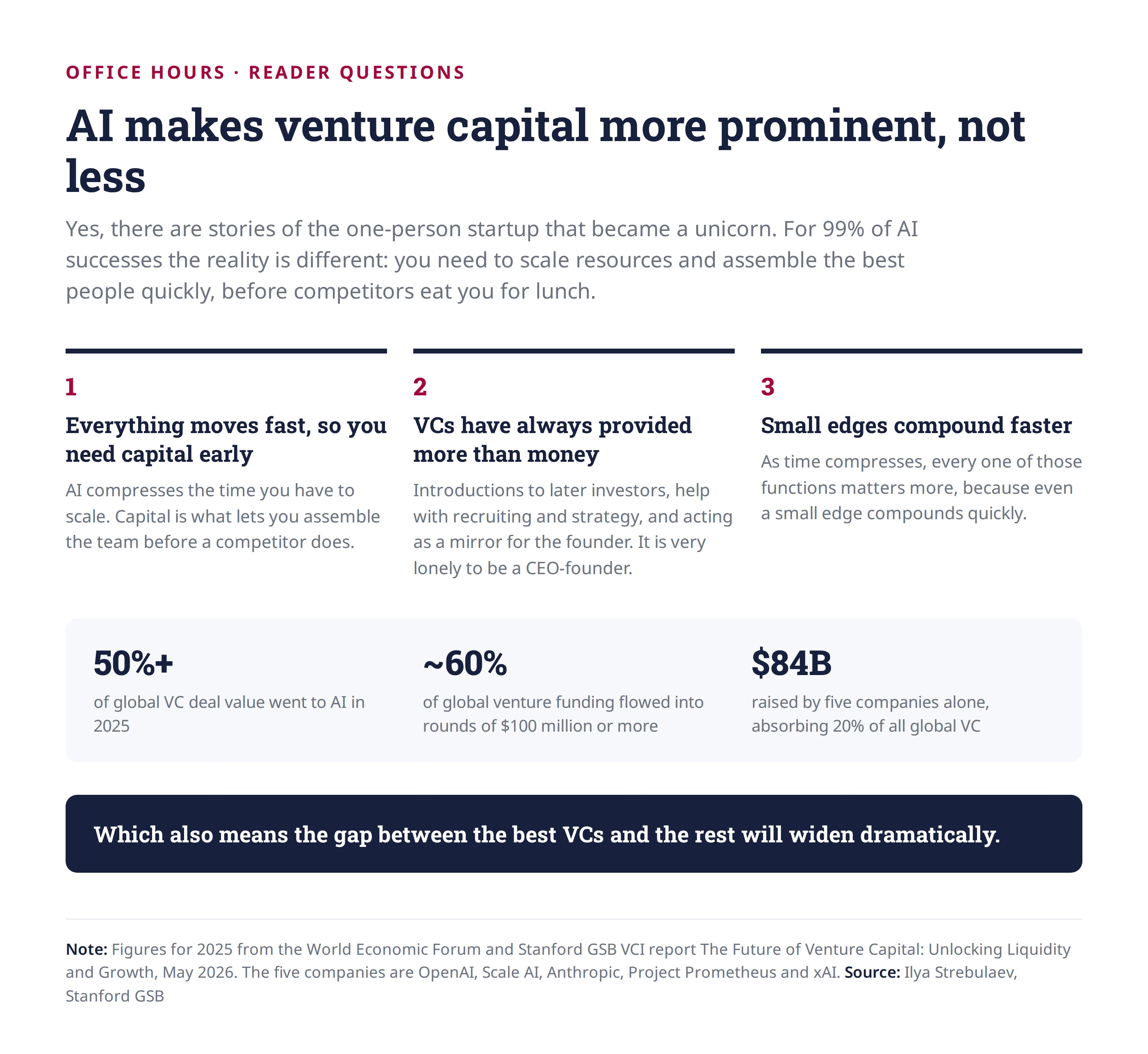
If anything, I expect AI to make VC more prominent not less. There are several reasons behind this. First, AI makes everything turn fast and so you need capital to scale early on. Yes, there are stories of one-person startup that became a unicorn but the reality for 99% startup successes in AI is different: you need to scale resources and assemble the best eople quickly, before your competitors eat you for lunch. VCs become more important. Second, VCs traditionally provided more than money. They introduced to further investors down the line, helped with recruiting and strategy. The best VCs act as “mirror” for CEO-founders (it is very lonely to be a CEO-founder). As time compresses in the AI world, all of these functions will become more prominent simply because even a small edge can compound quickly. Of course, this means that the difference between the best VCs and the rest will also increase dramatically.
Q2: As AI changes both how new ventures are built and the skills founders need, how should universities rethink entrepreneurship education? Which parts of today’s curricula remain valuable, and which new capabilities should become central if universities want to prepare students to build companies that can compete globally?
A great question – as I am redesigning our Stanford VC class for this coming academic year – this is the question of utmost importance. Several thoughts. First, education needs to be more applied, hands-on, practical right away. The days of long lectures and theoretical results of unclear practical value are gone. Second, education needs to be encompassing I mean by this the need to cover everything in broad strokes that would be useful for the entrepreneurs and investors. When I review entrepreneurial textbooks (I don’t use any in my VC class but it is a useful exercise), they tend to concentrate on technical aspects because it is easier to teach them, but as a result they are too specialized. Finally, and critically, learning must be long-lived. There are lots of facts and skills that are not only of little practical value but get outdated very quickly. My goal is for students to be able to go to my class notes and ideas we developed years after they take the class. In fact, today in the world of AI, many of my former students find their VC class notes even more useful.
Q3: You’ve shown how much VC behavior is shaped by fund structure and incentives. Is there a widely accepted VC practice that persists more because of those incentives than because the evidence actually supports it?
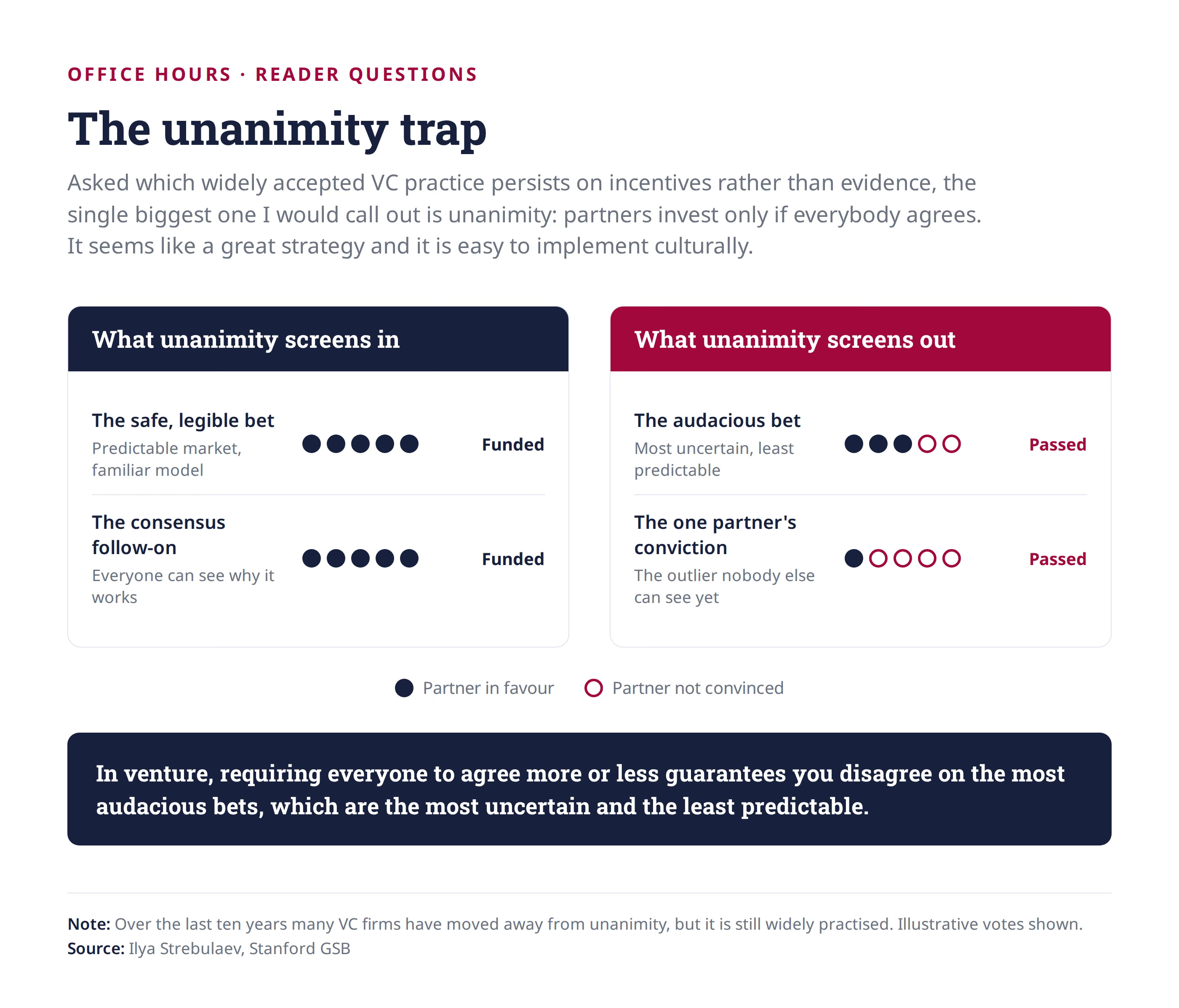
Great question. Yes, and many. The single biggest one I would like to call out is “unanimity” where partners decide to invest only if everybody agrees. Seems like a great strategy and easy to implement culturally, but in the world of VC it more or less guarantees you disagree on the most audacious bets that are the most uncertain and the least predictable. Over the last ten years a lot of VC firms have pushed away from unanimity, but it is still widely practiced.
Q4: How much are VCs actually aware of the numbers, tendencies, and studies that you show them? As a founder meeting many investors, I feel that they often do not act the way they speak. This could be intentional but may also happen at an unconscious level. Are there any glaring examples of this dissonance between self-reports and actual behavior?
There are two layers behind what you are asking. Smart VCs are aware of my insights, they are voracious consumers of every information that can marginally improve their outcomes. For example, when I co-wrote The Venture Mindset, the idea was to have an impact on corporate decision-makers. But in fact many VC firms assign this book to all the associates and junior partners to read. However, it does not mean that the same VCs will show their knowledge to founders. It is a competitive market and information is valuable and strategic. Don’t expect VCs to be your “professors.” Also, VCs are people and like other people they are subject to biases (many of which we document in the book and I dive into them in various articles on this Substack), some of these biases are unconscious and can lead sometimes to dramatic changes in outcomes for VCs and for founders they back.
Q5: I think VCs and even investors/LPs don’t invest as much in founders as they invest in traction. The narrative about founders being the epitome of investment decisions is a false data point shared by investors to produce better founders. They generally only invest in people they know or in traction data points, even if the founders are faking it. Most risky and early investments are only done by accelerators, and accelerators are like charities that allocate as per their yearly objectives. Do you feel I am being cynical, or is this the reality?
VCs investing in better people and VCs trying to find “better” people is not a fake data point. Preponderance of evidence of all kings has documented this again and again. And they often do invest in people they don’t know that well, including first-time founders. For many seed startups traction data is also frankly not available. But – and this is important – at later stages traction data starts dominating because it is an indicator of how good the management team is at executing. Accelerators require a separate article and discussion (!), but yes they are of course riskier because of the stage. But they fulfill a very different function in the ecosystem, I don’t think we should compare them to VCs.
Q6: What do you think is the biggest long-term advantage in venture capital that most people underestimate? Is it brand, network, access, decision-making, fund structure, platform, or something else entirely? Has your thinking on this changed after studying more than 4,000 unicorns?
It is not easy to pick a winner here but my experience suggests it is the decision-making process within the VC firm and the structure of incentives. This determines in particular the long-term success of the VC firm. Studying unicorns over many years allows one to see persistence of some VC firms and that has taught me a lot.
Q7: As a VC scout I’m noticing that VC is an ‘interest-based investment’. Fund managers, LPs, and definitely fund employees all see VC as an opportunity to learn new things about tech businesses and to participate in building the future. How would you approach this question as a researcher: how to measure the percentage of investors who invest for profit versus those who invest for interest and learning?
You are right: learning is critically important. In fact, my research on corporate VC suggests that ability to learn from institutional VCs is one of the major success factors in CVC. Measuring percentages is difficult, but also not sure it will lead to any deep insights. More importantly is whether learning then leads to better returns in the future. This in fact depends on the longevity of decision-makers, not in a biological sense but in an organizational one. For example, going back to CVCs, many of them fail because they have a very large turnover and so soft knowledge they have accumulated within has tendency to disappear. By the way, do not discount another important learning aspect: learning about fund managers. Observing fund managers up close and being able to attribute success or failure to specific investors can improve your future financial returns.
Q8: How do VC criteria change from round to round, in particular from pre-seed to seed to Series A? How do expectations evolve?
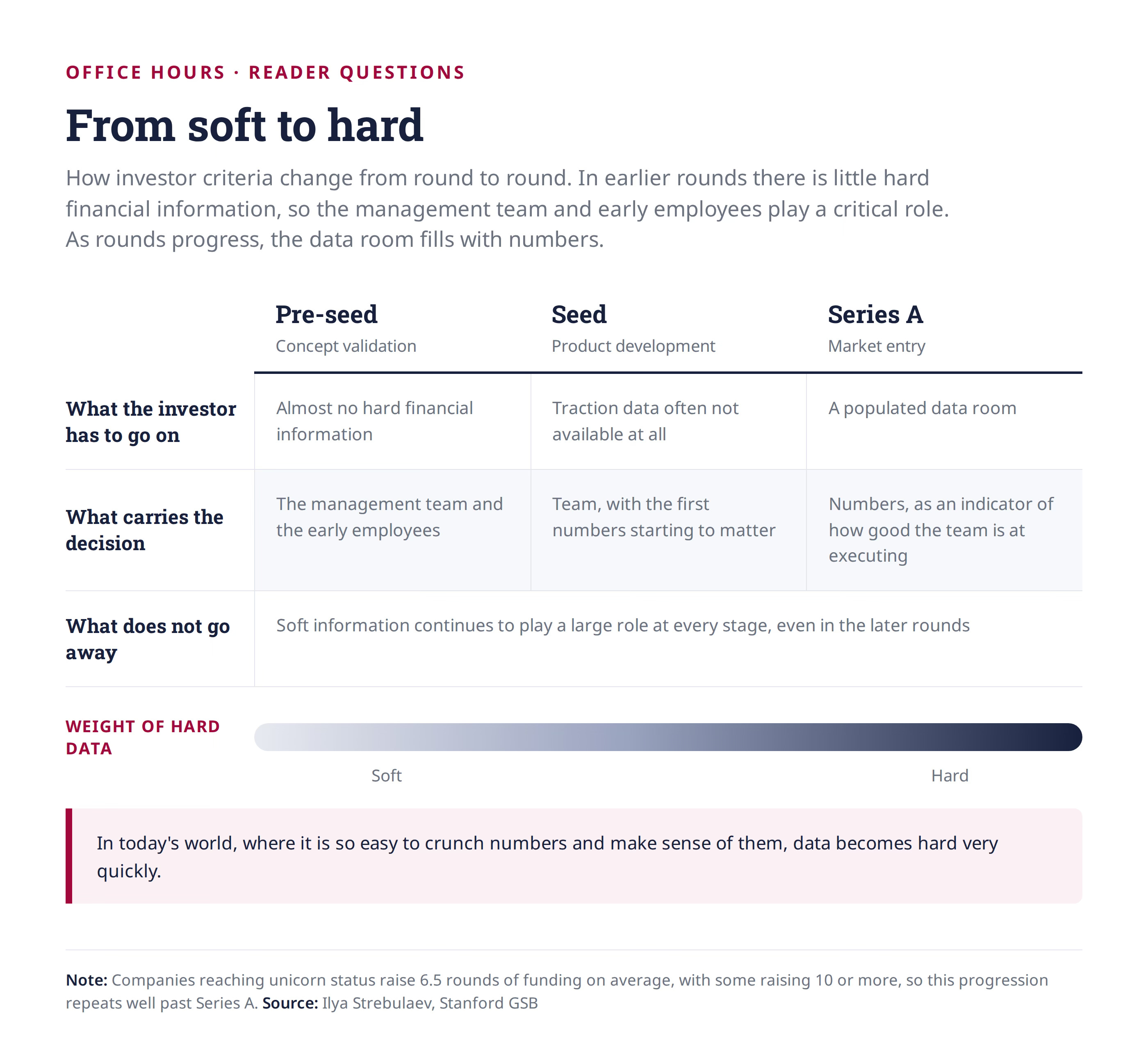
From “soft” to “hard.” In earlier rounds there is little hard financial information. The management team, early employees play a critical role. As the rounds progress, data room becomes populated with numbers. Especially in the today’s world where it is so easy to crunch the numbers and make sense out of them, data becomes “hard” very quickly. But soft information continues to play a large role, even in the later rounds.
Q9: Some of the biggest opportunities are in traditional industries, but adoption is often the hardest part. How do investors evaluate startups trying to transform these markets when the biggest challenge is not only building the technology, but also changing how an industry works?
The truth is that VCs know it is very very difficult, and so the threshold is often higher for startups trying to disrupt existing markets. Healthcare is an obvious example where so many people thought disruption would happen in like 2010 and fifteen years later we are still at the same station (of course, now many people again believe that healthcare is about to get disrupted: maybe but it is difficult because of conservative nature of the mature industry). Often VCs think not in term of disruption but in terms of complementarities and integration. Who will buy this service or product or indeed this company within the industry, as a result.
Q10: Most of total VC money consistently goes to non-hardware (software, services, biotech, and digital AI) startups. Hardware startups can’t even get started due to FDA clearances or patent prices. Besides grants, what are some novel avenues founders and VCs look into to close the “valley of death”?
Hardware startups in robotics (think drones or military tech) are very hot right now, a clear example of how quickly perceptions and financial model assumptions change. But you mentioned FDA and so your sentiment suggested medical hardware – which has been undergoing some difficult times. One of the biggest reasons is the slow speed of adoption and conservative nature of the medical industry (see my answer to the previous question). Partnership with existing players and the increased role of CVCs are important avenues for these companies. By the way, I am about to publish the ranking of biotech investments which includes both life sciences and hardware, so check out!
Q11: Even well-funded, highly valued startups sometimes end in disappointing exits for their founders. Given that success is never assured, how should founders think about managing their personal financial outcomes, from secondary sales to exit timing and liquidation preferences?
Absolutely. There are many examples of this, often because founders did not follow the basics of VC 101 (I wish they would have taken my VC class first!) Secondary sales and diversifying sound great – the reality is that unless your company is truly successful, it is difficult to accomplish. Investors in particular do not like it unless they feel there is a strong rationale because at the end of the day they know that as founders sell their shares they may become less interested in the outcome. Investors also generally do not allow founders to have liquidation preferences unless founders also act as investors and put significant amount of money in their startup.
Q12: How do you recommend I get my startup idea validated, since I am struggling with it?
If it is very early stage, angels and accelerators are a good idea. Talking to an investor who has ever invested in a similar space before could be very valuable. But often you don’t need investors – you need your own data from customers. At Stanford, a very successful startup course requires students to survey 100 potential customers to find feedback. My advice is to build a profile of your customer and survey one hundred of them. You will learn a great deal if you do it in a smart way!
Q13: Why do some regions produce so many more unicorns than others? Which countries lead unicorn production, which lag behind, and what explains the gap?
Because creating a startup and scaling one are two very different things, and the second is far more concentrated geographically than the first. Start-ups now emerge everywhere. Unicorns do not.
Start with the conversion rate, which I find more revealing than the raw counts. In Northern America and Asia, roughly one in 60 VC-backed companies becomes a unicorn. In the Middle East and North Africa it is one in 100. In Europe it is one in 135. In sub-Saharan Africa it is one in 330. The United States and China together account for about 70% of all unicorns by count and 82% of their aggregate post-money value, so the disparity in value is even sharper than the disparity in numbers. Speed differs too. In the US a company now reaches a $1 billion valuation in an average of 3.4 years. Outside the US, the median unicorn between 2020 and 2025 took eight years to get there.
Now adjust for size, because absolute counts flatter large countries. On a per capita basis Singapore leads the world with 6.8 unicorns per million people, ahead of the US at 4.9 and Israel at 4.7. Measured per unit of GDP the table reorders again, with Israel at 11 and Singapore at 10 unicorns per $100 billion of GDP, ahead of the US at seven. Six European countries sit in the global top 10 by density. This tells me something important: most of these countries are not failing to invent companies. Europe produces roughly 12% of the world’s unicorns and holds about 8% of their value, and of the 87 privately held decacorns in the world it has five.
So what explains the gap? Three things, in my view. The first is the depth of domestic capital. European pension funds allocate 0.12% of their assets to VC and growth equity, while major public pension systems in the US and Canada typically allocate 1% to 3%. VC investment in the European Union has averaged 0.3% of GDP a year over the past decade, less than a third of the US level. The second is the credibility of the exit path, because founders and their investors need to believe a large outcome is achievable at home rather than only after relocating. The third is regulatory fragmentation, which I think is the most underappreciated of the three. A company incorporated in Delaware can hire in California, sell in Texas and list on NASDAQ inside a single legal and securities framework. A startup expanding from Berlin to Paris to Madrid faces three incorporation regimes, three employment law frameworks and three treatments of stock options. That is a tax on scaling, and it is invisible because it never appears as a line item.
There is a fourth factor that compounds over time, and it is the one policy-makers tend to forget: talent recycling. Ecosystems that produce big winners get the alumni of those winners. Klarna, Spotify and Zalando alumni have founded 183 new start-ups between them, which is a large part of why Sweden ranks in the global top 10 per capita. That flywheel takes one generation of successful companies to start turning, which is exactly why the regions that lag find it so hard to catch up.
Morale: the goal for most countries is not to produce more start-ups. It is to raise the share of start-ups that can scale at home. See the two charts below, from the report I co-authored with the World Economic Forum.
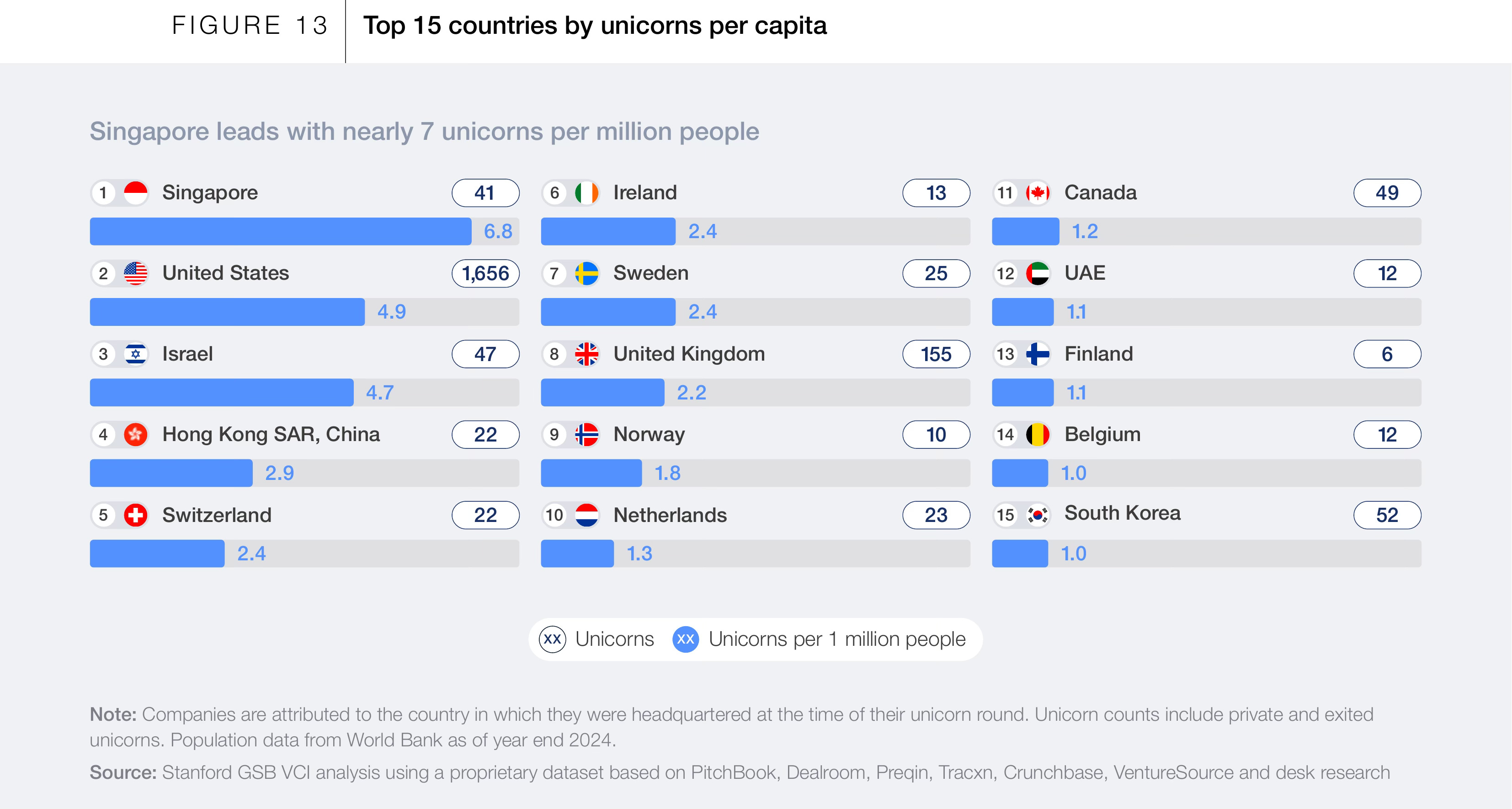
From The Future of Venture Capital: Unlocking Liquidity and Growth, World Economic Forum in collaboration with Stanford GSB Venture Capital Initiative, May 2026.
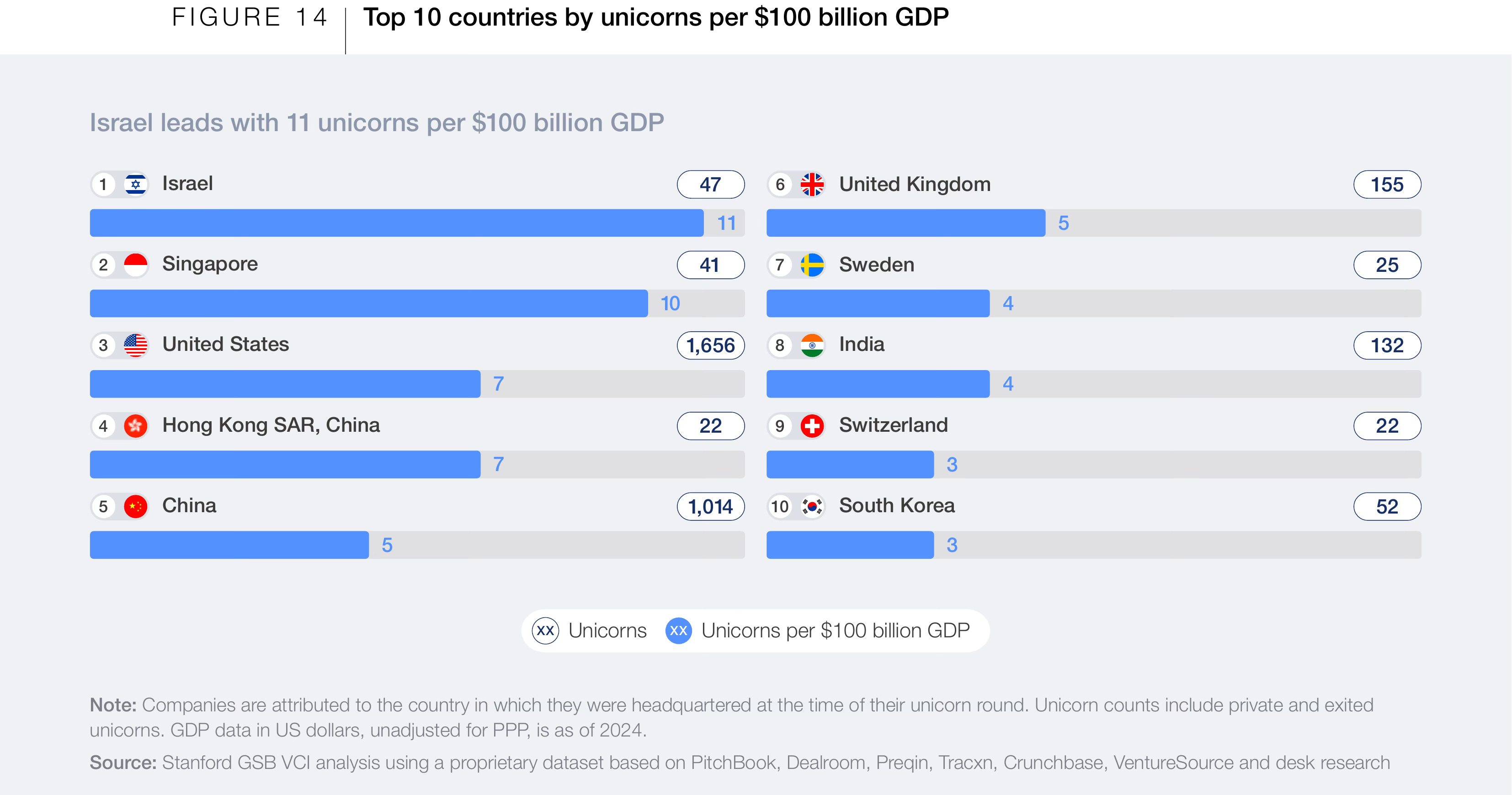
From The Future of Venture Capital: Unlocking Liquidity and Growth, World Economic Forum in collaboration with Stanford GSB Venture Capital Initiative, May 2026.
Thank you to everyone who sent a question. Several of the ones I did not get to here are worth a post of their own, in particular how young founders with no track record can demonstrate they are fundable, and how to break into the industry from outside it. I will come back to both.
Keep the questions coming. The next open round will be announced here, and the Q&A for paid subscribers is open until the end of August.
Ilyastrebulaev.substack is a reader-supported newsletter for founders and investors. I teach Venture Capital and Private Equity at Stanford GSB, and this is where I publish my research — including the investor rankings — along with materials straight from my Stanford classes.
No posts
Comments
Nothing yet. Say the first thing.
Sign in to join the conversation.