
Earlier this year we released the inaugural 2026 Venture Ranking of the top 100 US-based VC firms, followed by the 2026 Biotech Venture Ranking. Both lists are dominated by established firms. Yet some of the most consequential investments of the past decade were made by firms that did not exist ten years ago.
Today we pre-release the 2026 Venture Ranking of the top 100 US-based Emerging VC Firms, with the extended top 200 ranked as well. The ranking will be publicly released on August 31 2026 at 10am Pacific Time.
We use the same methodology for all venture rankings. The ranking information cutoff date is June 30, 2026. The full methodology is described in our working paper (Strebulaev and Jackson, 2026), and the 2026 Venture Ranking of Top 100 firms is here:
The 2026 Strebulaev-Jackson Venture Ranking: Complete Top 100 VC Firms
·
Jun 22
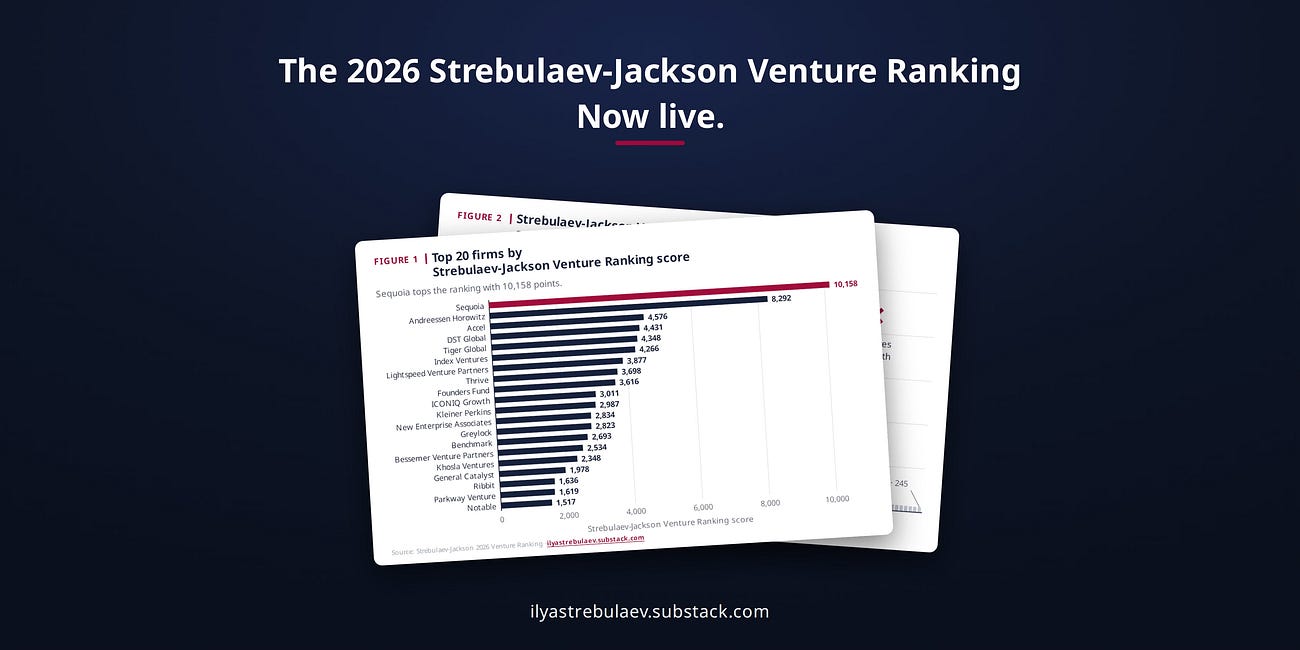
Every founder raising from venture capitalists has heard the same names — Sequoia, Andreessen Horowitz, Benchmark — and every limited partner has a mental shortlist of VC firms that supposedly matter. And while these names are well-known, there, surprisingly has never been a transparent, fully data-driven ranking of which VC firms are actually best at what they do.
For the emerging VC firm rankings, we apply the same methodology as in our overall ranking, but we further restrict the set of eligible firms to include only firms that were founded in 2016 or later and raised their first fund in 2016 or later.
Every other criterion is unchanged. Firms must be institutional US VC firms and must have invested in at least five unique companies via qualified VC rounds and have at least one partner who earned at least five points. We do not restrict eligibility by fund size, team size, or sector: a firm founded in 2016 that now manages fifteen billion dollars is emerging by this definition, and so is a solo general partner running a fifty-million-dollar vehicle.
One point deserves emphasis. This is a ranking of firms early in their institutional life rather than a ranking of small funds or new funds. Some are already very (!) large.
Our algorithm rests on the same six economically grounded factors as in the overall rankings. If you've already read this in our previous articles, feel free to scroll down to the results :)
Valuation. Two companies can both be “worth $100 billion”: one as a public market capitalization, the other as a private post-money valuation. These are not the same number. Private post-money valuations systematically overstate true value, because the preferred stock VCs buy carries downside protections that common stock lacks. We discount private valuations uniformly. My work with Will Gornall put the average overstatement for unicorns near 50%.
Dilution. A 10% stake at the first round is not a 10% stake at exit. Two companies can both sell for $1 billion, but if one raised four rounds along the way, its early investors were diluted round after round. We track each investment’s ownership down through every subsequent round.
Net profit. Net profit is more informative than gross profit when investors deploy very different amounts of capital. Turning $10 million into $2 billion is a different achievement from turning $1 billion into the same $2 billion. We subtract the cost of every investment, which rewards capital efficiency and penalizes spraying large checks to produce a few headline wins. In our data, roughly three-quarters of investments returned negative net profits.
Value add. Investors who lead rounds and take board seats contribute more than passive check-writers. We award additional points for these roles, reflecting involvement in a company’s outcome.
Human-capital decay. A VC’s skill, network, and judgment depreciate if not continuously exercised. We discount each investment by the time elapsed since it was made, using a half-life of three years. A dollar of value created in 2022 is worth about fifty cents in 2025 and a quarter if it was created in 2019. Two investors who each turned a 20% stake into a $10 billion IPO can look identical on paper. Yet if one invested in 2005 and the other in 2020, the second earned an IRR of 141.9% against 28.7%, and rests on human capital six years old rather than twenty-one. This is what keeps the ranking current: it rewards investors who are good now rather than those resting on a single brilliant bet from two decades ago.
Credit between firm and individual. In principle, the points given to each firm are equal to the sum of the points awarded to its partners. However, investors move between firms. When a partner who made their best deals at one firm decamps to another, both firms deserve some credit. We split it: a quarter to the firm where the investment was made, three-quarters to the firm where the partner works now, reflecting academic evidence that most return variation traces to individuals rather than institutions. This is also part of why a firm’s score and its partners’ individual scores can diverge sharply.
Every point still traces back to a specific investment in a specific company on a specific date. The full methodology is in the whitepaper, linked here.
Pre-release: the entire list of Top 100 US Emerging VC Firms available to paid subscribers. The extended ranking of firms 101 to 200 is also available to founding members who support my research team.
Comments
Nothing yet. Say the first thing.
Sign in to join the conversation.