
What follows is drawn from my experience working with hundreds of my founder students, both current and former, and from years of researching and interviewing hundreds of investors and founders. In this article, I summarize the most important mistakes founders make in the fundraising process and in their relationships with investors. You may have seen pieces of this elsewhere in my Substack and in my research, but the subject matters enough that I wanted all of it in one place.
Hi, I’m Ilya. I teach Venture Capital and Private Equity at Stanford GSB, and this is where I publish my research — including the investor rankings — along with materials straight from my Stanford classes.
I have split this into two articles that follow the chronological sequence of a typical founder’s fundraising. Part 1, this article, covers the mistakes founders make before any investor says “yes” to that first meeting — that is, before you pass through the very first layer of the deal funnel. Part 2 covers the mistakes founders make from that first meeting to the wire.
First-time founders are systematically overoptimistic about how long it takes to raise a first round. In reality, it takes much longer. My research shows that it takes 80+ days on average between meeting an investor and having that investor’s cash in your bank account. And that clock starts only once you meet the investor who will actually invest in you. In other words, 80+ days is not the duration of your fundraising campaign, which also includes every investor who did not invest. Your campaign starts long before that winning first meeting.
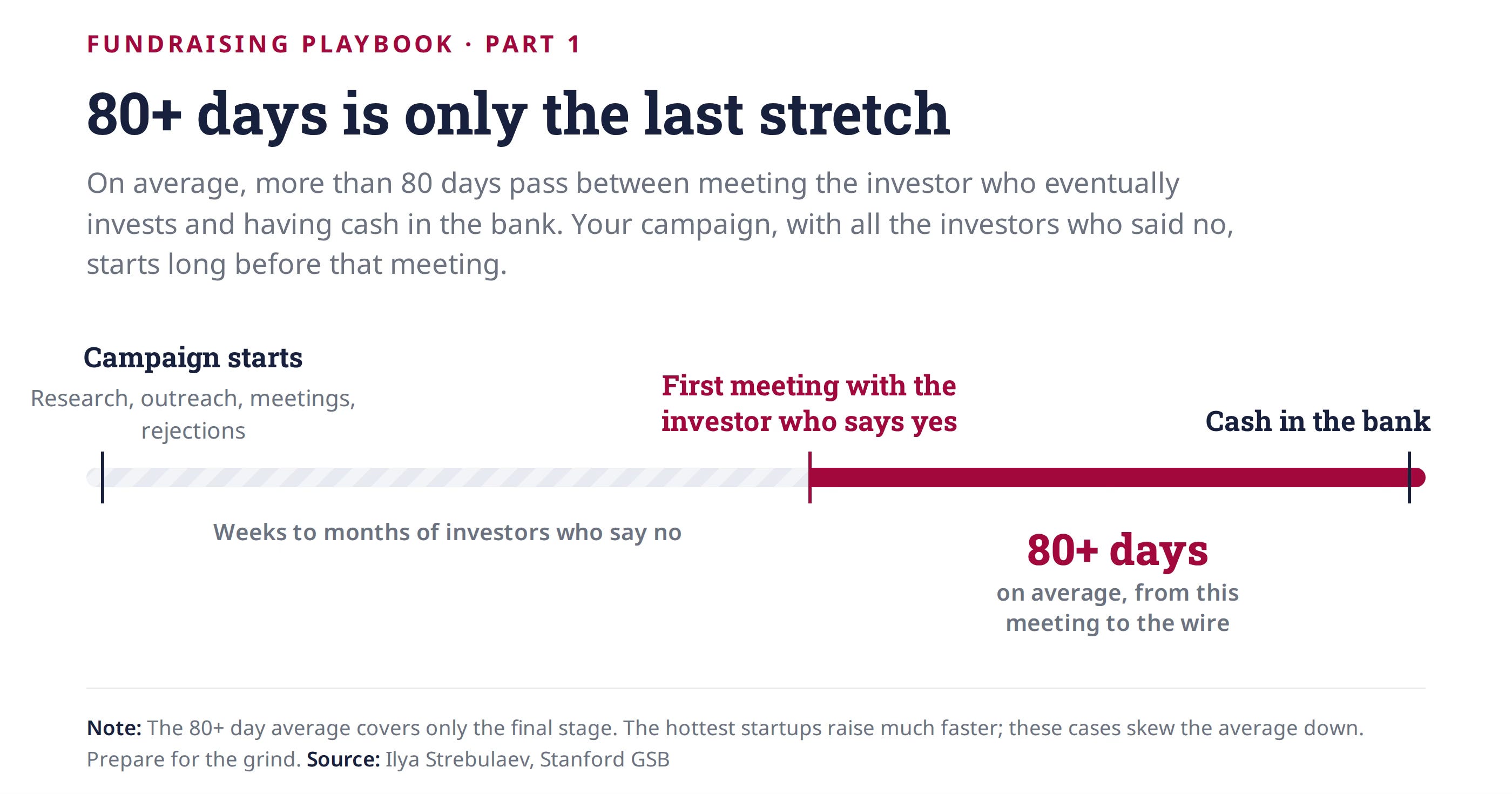
There is an important caveat here, because the distribution is bimodal. For the “hottest” startups, even a first round can come together very quickly. We all know the stories of founders who had commitments in hand before they left their previous job. There are cases, especially in today’s AI-driven market, where founders started a company precisely because they already had significant investment commitments.
These are exactly the stories that travel on social media, and they pull the average down. The far more common experience is the opposite: fundraising takes considerably longer than 80 days. You would love to be in the camp of the hot hitters. Plan for the grind instead.
Moreover, investors act in packs. For a long stretch you may see no interest from anyone. Once one investor gets interested, the others wake up. It is not uncommon to have no term sheets for months and then receive two in the same week.
Moral: Start fundraising early and build in a buffer for a longer journey than you expect.
So many founders, once they raise that first round, set funding concerns aside and concentrate on building their product, assembling their team, and finding their customers. Understandable. Not advisable.
When I ask experienced founders about their single biggest takeaway from fundraising, a striking number of them give the same answer: fundraising is a never-ending process.
Simple math explains why. Early-stage companies raise roughly every fifteen months, and many raise sooner, because cash burn runs higher than expected or scaling happens faster than expected, or both. And as we have just seen, while a campaign takes three months on average, it can easily take four or five or six. If the market cools in the interim, it may take considerably longer still. The horizon is much tighter than it appears.
I have observed this in particular when first rounds come from angels. There is a reason the second round is often harder than the first. While you are raising the first round, your answer to many difficult questions can be: “Yes, I have thought about it, and here is how I would do it […then insightful details…] — but I have not done it yet, because we don’t have a penny.” By the second round, that move no longer works. If you did not spend money on X, it is no longer because you had no money; it is because X was not a priority. Now you have to show what your spending actually produced.
Professional investors understand this dynamic. If your lead is an experienced VC, they will be guiding you along these lines well before the second round begins. But first rounds these days are so often raised from friends and family, from accelerators and incubators, from angel clubs and part-time micro-seed investors. Those investors frequently think about your next round no more than you do.
Moral: Start thinking about the next round immediately after closing the last one. In fact, I always tell my Stanford students to think about the second round before they raise the first. Formulate clear milestones for what your startup will have achieved by then, and a clear timeline for hitting them. That is what it means to say that fundraising never ends.
Here is what to do right after closing the first round, if not before. Ask your current investors which new investors you should be targeting, and who could lead that second round. Meeting those investors early — for feedback, not for money — puts you on their radar on your own terms. It also lets you adjust your plan if what you hear back is not what you had in mind.
Many startups fail not because the product was uninteresting or the market too small, but because they ran out of money. A leading cause is allowing too little time to raise.
The related risk is subtler and worse: as cash dwindles, your bargaining power collapses. New investors, and existing ones reinvesting, will demand lower valuations and tougher terms precisely because you are desperate. For the same dollars raised, a lower valuation means substantially higher dilution — and that dilution falls disproportionately on the common shareholders, meaning you and your team, because of contractual terms such as anti-dilution protection that I discuss elsewhere in my VC 101 posts.
Moral: build a cash cushion of double your expected timeline. If your burn is $100,000 a month and closing takes six months, you want $1,200,000 in the bank before you start, not $600,000. Put another way, you should have roughly at least twelve months of cash at your current burn on the day you begin raising.
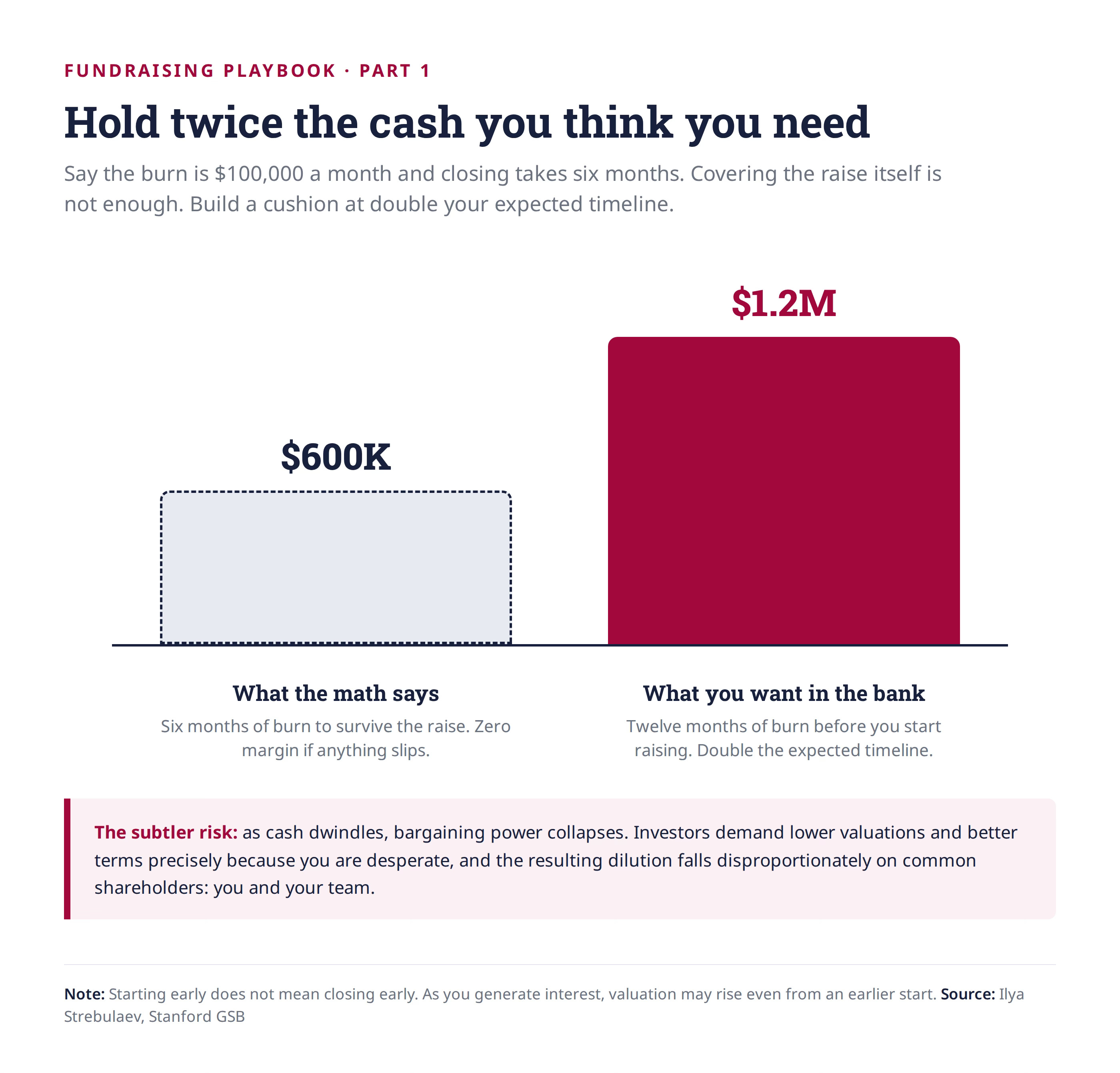
Notice what this implies. If you raise roughly every fifteen months and need twelve months of cash on the day you start, you are back in the market about three months after you close. That is not rhetorical exaggeration of the point above. It is simply the arithmetic.
Founders often frame this as a trade-off: unnecessary dilution if you raise too early, catastrophe if you raise too late. But starting early does not mean closing early. As you generate interest, your valuation may well rise, even though you started sooner.
Comments
Nothing yet. Say the first thing.
Sign in to join the conversation.