
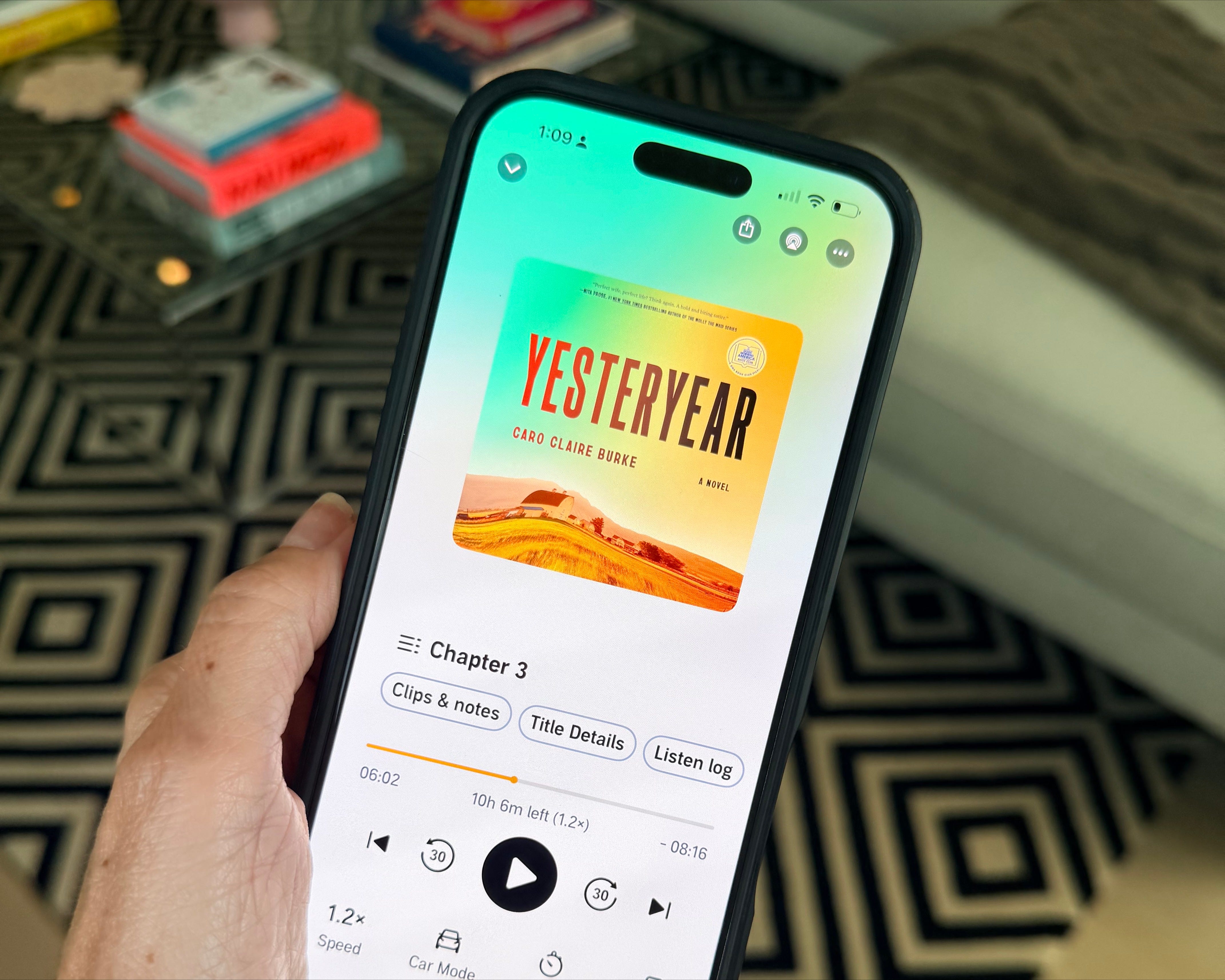
I finished Yesteryear about two weeks ago. I listened to the audio version in two days, could not put it down, and then proceeded to make roughly ten separate videos trying to talk about it, because apparently, I have too many thoughts for one take. So then I decided my best bet was a substack post, so I had time to organize exactly what I wanted to say. I won’t give away the main twist, but there are some spoilers. If you haven’t read it, Yesteryear is about a “tradwife” influencer who romanticizes old fashioned values and is then forced to confront the brutal realities of pioneering life when she wakes up one day in the 1800s. There’s a lot to unpack, but I decided to focus mainly on the content creation piece and my experience reading a book while knowing a little too much about both the author and her inspiration from social media. To be honest, I went back and forth about whether I liked the book as I was reading it, but as someone who also posts about my family online, I often found myself wondering— would the author judge me as harshly?
Here’s my main issue: I did not read this book as a work of fiction about a “tradwife influencer” named Natalie. I read it as fan fiction about Ballerina Farm (aka Hannah Neeleman), written by a woman I know doesn’t like Ballerina Farm because I’ve followed the author’s content on Tiktok for years. Caro Claire Burke is actually the first person I ever heard use the term “tradwife” and I’ve listened to her explain many times why she thinks influencers like Ballerina Farm are dangerous for women, through a series of videos specifically dissecting her lifestyle and content, all of which have since been deleted. So, early on in the book, when Natalie describes the “angry women” who hate watch her videos, I think it’s fair to place the author herself in that category. I’m not even sure the author would argue with that assessment. So what would be the fantasy for a hate watcher of Ballerina Farm? It would be that while she performs this picture perfect version of domestic farm life and motherhood, she is actually miserable. And not just quietly miserable internally, like many “angry women” like to believe Hannah Neeleman is, but outwardly a terrible wife, mother and person when the camera is off too.
Natalie is very smart but also insufferable, judgmental, and cruel. She loathes her husband, resents her kids, and thinks she’s better than everyone around her, online audience included. Her inner monologue distills family members and acquaintances down to the absolute worst parts of themselves. She wishes harm on them sometimes too. There was something that made me feel uneasy about the author taking all the surface-level, publicly available pieces of a real person’s life and imagining the worst possible interior for her. Yes, it made for a deliciously juicy read, but it was also mean-spirited and felt kind of unethical. Like gossiping behind a friend’s back. Of course, novelists pull from real life all the time. Often characters are written as thinly veiled versions of family members or high school friends and the author just takes the risk that person might recognize themselves and be upset. But it felt like a parasocial version of that same risk — the author isn’t writing about someone she actually knows, just someone she’s watched from a distance for a long time. And then assumed her life to be one big lie. Which, of course, is one of the major points of the book— to hold a lens up to the massive difference between real life and online life, through the eyes of a creator who is so invested in her fabricated version, she fools even herself.
To be fair, I don’t think anyone in this book gets off easy; even the characters that portray a lifestyle that is probably closer to the author— characters like Rena (Natalie’s college roommate), Vanessa (her high school classmate) and Shannon (her new young producer). Natalie’s internal dialogue rips apart progressive and outwardly ambitious women with fervor. Her assessments are shockingly cruel but also feel true, like reading a burn book of all your worst qualities. So if we are to believe that the author relates more to these characters, she’s not sparing herself either. I guess I wish I could have read the book without all that background knowledge, because I didn’t like knowing how the author felt about the characters as I read it. I suggested Yesteryear for my book club and I think many of them had a different experience reading it.
I will say, I enjoyed reading the book and being inside Natalie’s mind. Much like you might enjoy reading snark about a creator on a reddit page. “I knew there was a reason I didn’t like her!” And once I accepted the mean spirited nature of the writing style (which is full of uncomfortable truths), the book gave me a lot to think about, especially since as a content creator myself, there were a lot of cringe inducing similarities between me and Natalie.
One of the big cracks in Natalie’s online persona isn’t just that she is unhappy, or performing, or trapped. It’s that the content creation itself is the actual labor. The housework, the homeschooling, the farm work — all outsourced, all hidden. What she’s actually spending her time on is strategy, filming, editing, and figuring out the shot. That’s the big secret about “tradwife” content. And I have to be honest: reading how much work goes into content creation landed differently for me than I think it’s supposed to, because I am well aware that making content is a full time job, whether your kids are present or not. I watch everyone’s videos with the illusion lifted, imagining them setting up the shot before the shot itself. But I could still feel how it would sound to the reader. There’s a moment where Natalie describes filming a recipe and then taking an overhead shot of the food she just made her kids, and I laughed out loud because I have absolutely done that. Served dinner, then told the kids to wait a beat before they start eating so I can get my shot. The way it’s written, it made me feel several levels of shame, but is it really that bad? A lot of the time I shoot the food, because it’s a way to show dinner without putting the camera in my kids’ faces.
There is also a scene in the book where Natalie is giving her new producer a tour of her farmhouse and quietly steering her away from the room stuffed with PR boxes, trying to keep the illusion intact — and I was listening to that scene on audio while literally cleaning my own apartment, waiting for my new assistant to arrive for her first day. I was wondering if my space would match whatever image my assistant already had in her head from watching my content, and Natalie quite literally says the same thing in the book. There is another scene where Natalie is approached by a fan at Target and talks about how she tries to meet the expectations of the person they know online. Natalie falls short because she is actually a cruel person who thinks little of her audience, but I understand the desire to live up to whatever idealized version a fan might have of you. It’s not that my online self and my real self are different, it’s that you have a very limited time to convey that you are as nice and normal as they expect before it starts getting awkward. I often walk away from a fan encounter thinking— did I do too much? Did I do too little? Just like Natalie. Now, how does someone like the author so easily articulate this? I think because Burke also has a large following and probably gets approached quite a bit too, so she’s familiar with the feeling as well.
Over and over, as I was reading the book, I found myself wondering if the author would have as harsh an opinion about me as she does about Ballerina Farm. Whether she would wish me the same fate that Natalie encounters by the end of the book. I’m not a tradwife obviously, and I think my life is pretty authentic to what I show, but maybe that doesn’t matter. I’m still performing a happy married life with kids and leaving out a lot of the things that make my life less shiny. I think we all do that online, whether we have a large following or not. One big difference between me and Natalie is that I don’t try to hide the labor of content creation. I would honestly prefer if people recognized how hard it is to do this for a living! When I left advertising to be a blogger/creator full time, one of my biggest worries was that people would read my choice as deciding to become a stay-at-home mom with a hobby, rather than what it actually was, a strategic career decision. So I’ve tried, over the years, to just be honest that this is a job. I’ve had a nanny, I’ve rented office space, I have a full time assistant, my husband does a large share of the housework and I never tried to hide any of those things. But there does seem to be an unspoken rule online that creators aren’t really supposed to talk about how much work this is, or we risk sounding tone deaf or ungrateful for something a lot of people would consider a dream job. People like to believe content creation is easy and so their favorite creators are often the ones who make it look effortless, regardless of what is actually going on behind the scenes. The labor mostly stays invisible, because that’s part of what the audience is there for — and then when it turns out someone like Ballerina Farm has a team and a schedule and a real strategy behind it, it can land like a betrayal, even though, if you really thought about all the effort that goes into setting up a single shot, let alone a whole day full of them (and the fact that to build and retain an audience you have to do all that daily), it’s pretty obvious how much work it is.
Another part of the book I have a hard time with is Natalie’s hatred of her kids. Not “struggling,” not “overwhelmed,” but genuinely resentful of them in a way that reads almost like a caricature. I actually looked up whether the author has kids herself, and it did not surprise me that she does not. I also struggle with the way Burke portrayed what reads like neglect, because I think most of us have been there. I’ve forgotten to feed my kids dinner on time because I was mid-project. I’ve definitely skipped a bath or two because I ran out of time. I’m sure, when my kids were younger, there were instances of someone crying or hanging off my leg while I was trying to meet a deadline. That’s just what juggling work and motherhood looks like sometimes, and I think you can read those specific moments in the book two totally different ways — either “she’s a monster” (which felt to me like what the author was trying to convey) or “she’s a hot mess like the rest of us” which is normal and forgivable, just not the mother Natalie imagined herself to be.
There’s also an argument to be made that Natalie was experiencing postpartum depression and kept popping out kids so she never recovered, but I don’t really think that’s what the book was trying to do. I think Burke was trying to portray a woman who would have been a lot happier if she made very different choices (no husband, no kids, career focused, and maybe even some therapy), but instead Natalie was so determined to stay faithful to her (rather ambiguous) religious beliefs and got high on the superiority she thought she could claim when others strayed, that she sacrificed her own health and happiness.
Lastly, and this is a bit of a spoiler, but I found that the book leans heavily on Natalie losing her grip on reality, which explains away some of what doesn’t quite track, like why anyone would sleep with her husband as she’s described him. I don’t mind Natalie being an unreliable narrator, but when you use “she was losing her mind” to explain almost any plot points that don’t add up, it feels like maybe that’s doing a little too much narrative work. I know a lot of people hated the ending, which I won’t reveal. I didn’t hate it. It made sense to me and was what I was expecting. But maybe that’s because knowing the author’s thoughts and feelings on tradwife influencers, I was not expecting a redemption arc or any sort of happy ending. The fantasy is the misery and so Natalie digging herself deeper into an unrecoverable place is almost like the author’s version of a happy ending. It read a bit like revenge porn to me.
Here’s the question I keep circling back to, which I would love your opinions on— I think one of the main things the author wants me to take away from the book is that “tradwife” influencers are frauds. That they are business people selling a version of domesticity that only looks and feels aspirational because it’s a highly curated performance. While I agree with part of that sentiment, I don’t know that I can find fault with the creator. I believe Natalie is an ambitious woman who wanted a bigger, more important life than her husband could provide, so she figured out how to get it herself without compromising her traditional values. I think this is the reason we have so many Mormon mom influencers— they figured out a loophole in the system that was set up for them, that allows them to make money and a name for themselves by being at home and doing the skills they were taught— cooking, cleaning, homeschooling, crafting. I’m guessing the success of their online platform brings them a level of happiness they couldn’t achieve by just staying home with the kids and as ambitious woman myself, I find that pursuit admirable.
As for what the popularity of tradwife accounts means for society, I probably agree with the author that it leads nowhere good. It pairs neatly with the manosphere and red pill content, which feeds into the ugly politics of today and possibly the rollback of women’s rights. But Natalie (or Hannah Neeleman) is just one individual who genuinely holds those conservative values, so is she herself at fault for promoting them? Or is the audience the problem for suspending several levels of disbelief to accept it at face value? If we recognized the work behind the facade and the money needed to run such a business, does that change anything?
Let’s pretend for a moment that Hannah Neeleman is as happy as she says she is. If that’s the case, is there anything wrong with what she’s doing? Maybe making the character of Natalie miserable is the author’s way of assuring herself that she’s chosen a better path to happiness and success.
Actually, one of the things I really hated about the book was almost a throwaway comment toward the end. Something Shannon said implied that Caleb was the real reason that Natalie’s social media platform had grown into what it did. And as much as I hated Natalie in the book, I didn’t want anyone to take away the fact that she had built her own business and orchestrated her success despite all the things she was taught and the factors working against her. I thought it was interesting that a book railing against traditional gender norms would end up giving all the credit to the husband.
Ultimately, I enjoyed the book and resented it at the same time. Which is pretty much how I always felt about Caro Claire Burke’s tiktoks back when she posted regularly. I didn’t always agree but they introduced new concepts, challenged my preconceived notions and got me to self-reflect. And here I am, still turning Yesteryear over in my mind two weeks later, writing and rewriting this post as my thoughts continue to evolve. Which, honestly, might be the best endorsement I can give it.
If you read Yesteryear, please let me know your thoughts and feelings in the comments below! Did you love it? Did you hate it? Did you see Natalie more as a villain or a victim? What did you think about Caleb’s role in both time periods? If only she had just let him be a kindergarten teacher!
No posts
Comments
Nothing yet. Say the first thing.
Sign in to join the conversation.