
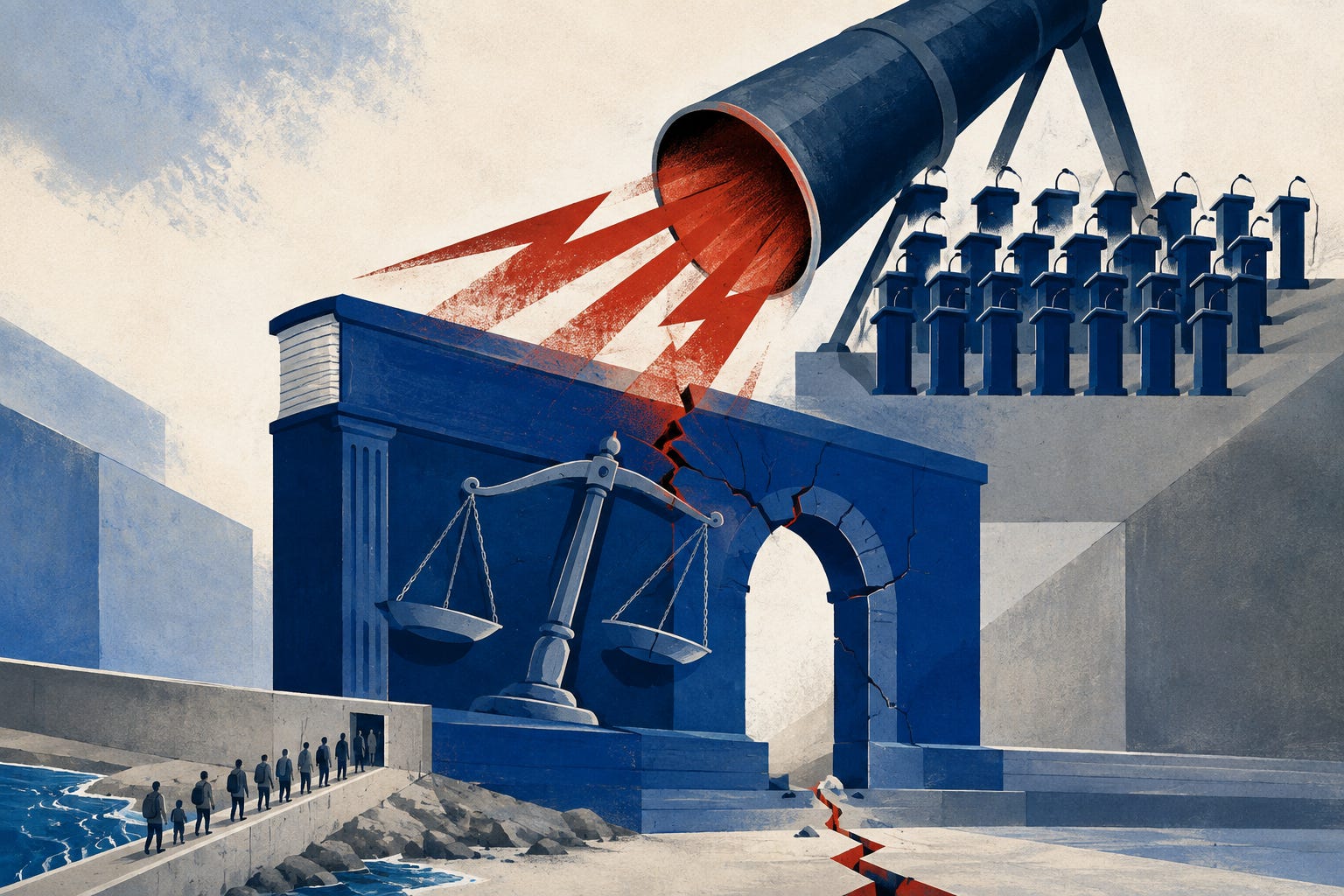
As anti-migration rhetoric has become a highly valuable electoral asset across much of Europe’s right, Spain’s crisis offered a valuable opportunity to catch two birds with one stone: at once stirring anti-immigrant sentiment and delivering a blow to a political rival – one of the most prominent symbols of the global left, Pedro Sánchez. But this is precisely what the Migration Pact was aimed at avoiding: the handling of migration as a perennial stress to EU unity, subject to the political will of individual Member States
IEP@BU does not express opinions of its own. The opinions expressed in this publication are those of the authors. Any errors or omissions are the responsibility of the authors
“The Migration and Asylum Pact is a step in the right direction”, stated Danish Immigration Minister Kaare Dybvad Bek after the European Parliament approved the legislation in April 2024.
In April 2025, Giorgia Meloni pushed to accelerate the application of some of the Pact’s provisions, welcoming them “with great satisfaction”.
As the Pact entered into application in June 2026, it was paired with the regulation on returns – celebrated by Meloni as a “historic legislation” and a “great success for Italy”, while Danish Prime Minister Mette Frederiksen described it as marking “new important milestones.”
Barely six weeks later, these same governments have been leading a political offensive against Spain in the Ceuta migrant crisis, despite Spain having respected all provisions of the Pact.
This inconsistency suggests that EU leaders might be dangerously placing political propaganda ahead of the rule of law.
After over 70 thousand people crossed from Morocco into Ceuta last week, Meloni and Frederiksen coordinated a letter co-signed with 20 other EU leaders.
The letter accused Spanish policies of serving as “pull factors,” and raised the prospect of national governments reintroducing controls at their internal Schengen borders.
Italy effectively reintroduced controls at its air and sea borders with Spain from 1 August to 1 September, citing the risk of secondary movements following the events in Ceuta.
The central complaint of the letter is that Spain has adopted a national policy to regularize migrants already living in the country, which they argue is incompatible with Europe’s common migration policy and having encouraged the Ceuta crossings.
Yet no evidence supports this view and the timing casts doubt on it: Spain’s one-shot regularization policy entered into effect in April 2026 and applied only to migrants who have lived in Spain for more than five years and arrived in the country up to December 2025. It’s unlikely that seventy thousand migrants collectively happened to misinterpret Spain’s policy as still applicable and simultaneously decided to storm the Ceuta border on a random day two months and a half after the law’s passing.
Also, past waves of mass crossings from Morocco to Ceuta – most recently in May 2021 – have occurred repeatedly, well before the introduction of Spain’s recent policy.
Increasing evidence, instead, points to the fact that migrants have been victims of a coordinated social-media deception, presumably orchestrated with the involvement of foreign secret services. Migration seems to be increasingly used as a geopolitical pressure strategy.
From the perspective of Spain, this represents an unexpected migration shock that, under the current regulation, could trigger the provisions of the Migration Pact to support the Member State facing the crisis. And it should have also triggered, at least prima facie, the support and solidarity that the EU showed in past migration crises to other Member States.
During the 2015 refugee emergency, for instance, the Council created exceptional relocation mechanisms explicitly for the benefit of Italy and Greece.
When Turkey pushed migrants to the Greek border in 2020, Ursula von der Leyen travelled to the frontier and declared that Greek concerns were European concerns. She thanked the Greek authorities, promised operational support and €700 million in assistance, and concluded by thanking Greece for acting as Europe’s “shield.”
When Lithuania faced a sudden increase in crossings from Belarus in 2021, Frontex and Europol deployed assistance. European countries supplied shelters, generators and other equipment, and the Commission described the response as one of “strong solidarity with Lithuania.”
When Lampedusa experienced a wave of arrivals in September 2023, von der Leyen traveled to the island alongside Meloni. The Commission presented a ten-point plan that included Frontex and EU assistance, transfers from Lampedusa and use of the voluntary solidarity mechanism.
In all these instances, although the implementation might have later proven inadequate, the spoken principle was clear: disproportionate pressure on an EU external-border State requires pan-European support. This is also one of the key principles of the Migration Pact in effect since June of this year.
At Ceuta, instead, Spain was met with the opposite of solidarity. Its policies were insinuated to have attracted the arrivals, with no basis for such accusations. Its commitment to border control was questioned, despite the army having been deployed and nearly all migrants having been returned to Morocco within days.
Internal Schengen controls were activated, despite the absence and the geographical impossibility of secondary movement – as travel from Ceuta to continental Europe is heavily monitored.
This difference in reaction cannot be explained by facts or by the law. It is explained by domestic politics.
As anti-migration rhetoric has become a highly valuable electoral asset across much of Europe’s right, Spain’s crisis offered a valuable opportunity to catch two birds with one stone: at once stirring anti-immigrant sentiment and delivering a blow to a political rival – one of the most prominent symbols of the global left, Pedro Sánchez.
But this is precisely what the Migration Pact was aimed at avoiding: the handling of migration as a perennial stress to EU unity, subject to the political will of individual Member States.
The Pact establishes a common framework to handle the migration crisis; it regulates screening, asylum procedures, responsibility for applications, reception conditions, returns, crisis management and solidarity between Member States.
Its framework was specifically designed to deal with sudden mass arrivals like the one at Ceuta. But if, at the first major crisis after its entry into application, national leaders revert to unilateral border measures and public accusations unrelated to its provisions; the authority of the Pact is undermined almost immediately.
Furthermore, the Pact does not establish common legislation on migrant regularization.
Member States retain the sovereignty to set their own rules for granting a permit to stay to migrants. As a result, Spain’s criticized law is perfectly compatible with the Pact.
Other Member States are entitled to disagree with it, but it does not exempt them from complying with the provisions they wrote in the Pact. This is the opposite of what Italy did when it reintroduced internal border controls.
Schengen is not merely a travel convenience. The removal of internal borders is a core element of the EU’s legal and economic infrastructure. Re-instating internal border controls to attack another government’s politics turns Schengen into an instrument of diplomatic pressure. By restricting one of the Union’s central achievements, countries show that they are willing to put their political propaganda above the core freedoms and principles of EU unity.
When this propaganda pull grows stronger, facts become secondary. The lives of the migrants approaching Ceuta, the provisions of the Migration Pact, the bindingness of common EU regulations in general, even the unprecedentedly swift resolution of the crisis by Spain – all fade into the background of the national media frenzy.
The absurdity of Spain facing criticism from Italy, after having repatriated in four days more migrants than Italy repatriated in four years, might be the single most relevant indicator of how detached from reality the partisan propaganda has gotten.
This is why the 22 leaders’ letter is more worrisome for what it represents than for what it actually says. It represents the willingness of Member States to put, once again, national political gains above common EU principles and legislative advancements.
Ceuta is therefore about more than just Spain’s border, in two ways. First, it is an early test of whether the new migration system will function as law.
The lesson from the Pact’s first crisis might be stark: Europe spent years negotiating common rules, only to allow propaganda to overrule them within weeks.
Head of Labor and social policy Unit

Pietro Galeone is a researcher at IEP@BU and lecturer at Bocconi University. His research currently focuses on education and labor economics, youth policies and social inclusion. He obtained his BA in Social Studies from Harvard University, focusing on the relevance of economics for euroscepticism, with a secondary degree in Astrophysics.
He then completed his PhD in Economics at Bocconi University, focusing on migration and school-to-work transitions.
In 2021-2022, he served as economic advisor to the Italian Minister for Labor and Social Policies, representing Italy in the Council of the EU’s employment committee (EMCO) and in the G20 Employment working group.
He was also EU Youth Guarantee coordinator for Italy and Italian representative in the Minimum Income Network (MINET) of the European Commission.
Ceuta Exposes Europe’s Enemies Within
·
Aug 5

Some even suggest that Morocco, Israel and the US want to pressure Spain into relinquishing Ceuta, opening a corridor into Europe that would bypass Spanish — and therefore European — sovereignty and deal a fatal blow to the EU’s ambitions for strategic autonomy
Europe Between Empire and Rules
·
May 27

There are two ways to avoid double standards. One is the Trump way: remove the standards. Trump is not hypocritical because he has no standards. The other is to try to live up to one’s standards and narrow the gap between norms and power

Founded by Bocconi University and the Institute Javotte Bocconi, the Institute for European Policymaking @ Bocconi University combines the analytic rigor of a research institute, the policy impact of a think tank, and the facts-based effort of raising public opinion’s awareness about Europe through outreach activities.
The Institute, fully interdisciplinary, intends to address the multi-fold obstacles that usually stand between the design of appropriate policies and their adoption, with particular attention to consensus-building and effective enforcement.
The Institute’s mission is to conduct, debate, and disseminate high-quality research on the major policy issues facing Europe, and the EU in particular, its Member States, and its citizens, in a rapidly changing world.
It is independent of any business or political influence.
Marta Cartabia
President
Sylvie Goulard
Vice-President
Paloma Lopez-Garcia
Director
Silvia Colombo
Deputy Director
Carlo Altomonte
Arnstein Aassve
Valentina Bosetti
Elena Carletti
Daniel Gros
Eleanor Spaventa
Nathalie Tocci
Comments
Nothing yet. Say the first thing.
Sign in to join the conversation.