
Media reports suggest that the European Central Bank was “notified” of the intervention. By contrast, European finance ministers, and in particular Eurogroup President Kyriakos Pierrakakis of Greece, appear to have been kept in the dark. Yet in Europe, exchange rate policy is a shared responsibility of the central bank and the political authorities. This is all the more surprising because the purchase of the Japanese currency was conducted not against dollars, but against euros. The European authorities were not asked for permission
IEP@BU does not express opinions of its own. The opinions expressed in this publication are those of the authors. Any errors or omissions are the responsibility of the author
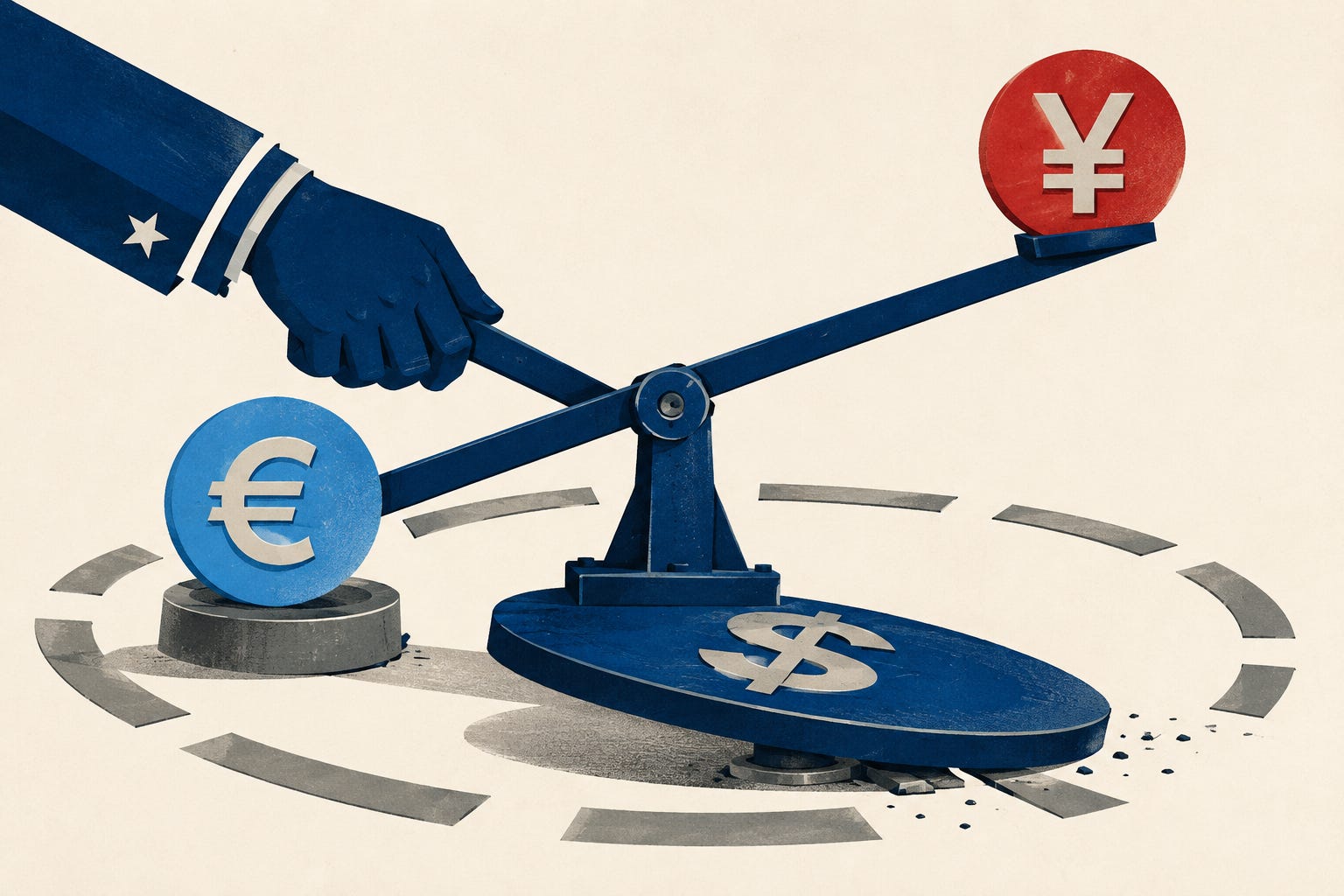
The extraordinary intervention in the foreign exchange market carried out by the US Treasury on Friday 31 July to support the Japanese yen has raised serious questions, both about the way it was conducted and about its underlying rationale.
The first concern is the absence of any reference to the G7 coordination framework, which in the past provided the basis for all interventions in foreign exchange markets. This is the first time that a purely bilateral operation has been undertaken by the finance ministries of the two countries. The last intervention involving the yen, in 1998, was conducted within the G7 framework.
This is a significant departure. Foreign exchange interventions affect not only the relationship between the currencies directly involved, in this case the dollar and the yen, but other currencies as well, starting with the euro. On this occasion, the US and Japanese authorities acted without regard for the others, ignoring the system of monetary cooperation developed over the past 40 years.
Media reports suggest that the European Central Bank was “notified” of the intervention. By contrast, European finance ministers, and in particular Eurogroup President Kyriakos Pierrakakis of Greece, appear to have been kept in the dark. Yet in Europe, exchange rate policy is a shared responsibility of the central bank and the political authorities.
This is all the more surprising because the purchase of the Japanese currency was conducted not against dollars, but against euros. The European authorities were not asked for permission.
The second concern relates to the objectives of the foreign exchange operation. The explanations provided publicly are not particularly convincing.
The official justification was that the yen’s exchange rate had become excessively volatile and that the currency was at risk of collapsing. The data, however, show that the volatility of the Japanese currency was no greater than that of other currencies.
As for the yen’s depreciation over recent months, it largely reflects the gap between short-term interest rates in the United States, at just under 4 per cent, and those in Japan, which remain at 1 per cent. Under these conditions, borrowing in yen and investing in dollars represents a particularly profitable speculative strategy, the so-called carry trade.
The yen’s depreciation is, in fact, primarily the result of the different underlying conditions of the two economies. As long as this divergence persists, the yen will continue to depreciate and interventions in the foreign exchange market will have only temporary effects.
To counter the yen’s depreciation, the interest rate differential would have to narrow. The Federal Reserve would need to cut US interest rates, while the Bank of Japan would have to raise Japanese rates. In the current environment, however, neither move appears particularly plausible.
As long as inflation remains high in the United States, the Federal Reserve is more likely to raise rates than to cut them. In Japan, rates should rise, but the central bank is facing pressure from the government to move in the opposite direction.
The market appears to have understood this. The joint intervention initially strengthened the yen by around 8 per cent, but after a few days the Japanese currency gradually began to slide again.
Some commentators suspect that the intervention’s real purpose is to put pressure on the Federal Reserve and discourage it from raising interest rates at its next meeting in September. If the Fed will raise rates, the effects of the recent intervention will vanish and the pressure on Japanese government bonds will rise again.
Yields on ten-year Japanese government bonds recently reached 2.75 per cent, a level not seen for 30 years. Yields on 30-year bonds climbed as high as 3.90 per cent.
The US Treasury fears that a crisis in Japan’s public debt, which has stabilised at around 205 per cent of GDP, could spill over into the US Treasury market.
The intervention was conducted in euros rather than dollars precisely to avoid encouraging the sale of US government bonds, which would have had a negative impact on investor confidence.
The most interesting aspect, and one that has attracted little attention from commentators, concerns the intervention’s effects on the euro-dollar exchange rate. One might have expected the sale of euros to weaken the European currency. Instead, the euro held its ground and even appreciated against the dollar.
This suggests that financial markets now regard the euro as sufficiently robust and liquid to absorb this kind of intervention. It also indicates that investors are not entirely convinced by the merits of the US Treasury’s action nor by its consistency with monetary policy.
The US intervention to support the yen is not yet an own goal, but it may soon become one.
A previous version of this article was published in the Italian daily Il Foglio

Lorenzo Bini Smaghi holds a degree in Economic Sciences from the Université Catholique de Louvain (Belgium) and a Ph.D in Economic Sciences from the University of Chicago. He has been Chairman of the Board of Directors of Société Générale since 2015. He is an IEP@BU non-resident fellow
Europe is Paying for Putin’s War
·
Jul 17

We are approving tens of billions of pounds in military and financial aid so that Ukraine can fight off the Russian army. At the very same time we are sending Russia billions of pounds that it uses to fund that same army. We arm the victim with one hand and pay the aggressor with the other. It is not a policy. It is a farce
Making EU Inc. Fit for Venture Capital
·
Jul 17

The proposed amendments share a single guiding rationale: that innovative startups (as well as scaleups) need, and should be granted, materially greater contractual freedom than the Proposal currently envisages. The reason is grounded in how high-growth firms are financed
Europe Between Empire and Rules
·
May 27

There are two ways to avoid double standards. One is the Trump way: remove the standards. Trump is not hypocritical because he has no standards. The other is to try to live up to one’s standards and narrow the gap between norms and power

Founded by Bocconi University and Institute Javotte Bocconi, the Institute for European Policymaking @ Bocconi University combines the analytic rigor of a research institute, the policy impact of a think tank, and the facts-based effort of raising public opinion’s awareness about Europe through outreach activities. The Institute, fully interdisciplinary, intends to address the multi-fold obstacles that usually stand between the design of appropriate policies and their adoption, with particular attention to consensus building and effective enforcement.
The Institute’s mission is to conduct, debate, and disseminate high-quality research on the major policy issues facing Europe, and the EU in particular, its Member States and its citizens, in a rapidly changing world.
It is independent of any business or political influence.
Marta Cartabia
President
Sylvie Goulard
Vice-President
Paloma Lopez-Garcia
Director
Silvia Colombo
Deputy Director
Carlo Altomonte
Arnstein Aassve
Valentina Bosetti
Elena Carletti
Daniel Gros
Eleanor Spaventa
Nathalie Tocci
Comments
Nothing yet. Say the first thing.
Sign in to join the conversation.