
Photo by Wikipedia “Wm3214”/Creative Commons attribution
In December 2023, Niall Ferguson wrote an essay in the Free Press entitled, “Treason of the Intellectuals,” in which he updated for the twenty-first century the thesis of Julien Benda’s La Trayson des Clercs (1927). That book addressed the collaboration of university professors with the fascist right in Weimar Republic Germany. Benda saw a betrayal of their vocation and creed – the unbiased pursuit of truth – in their allegiance to a radical political agenda. Their treason was the death knell of Germany’s leadership as the high citadel of scientific research and scholarly excellence in the arts and humanities. It has never recovered, while Ivy League and other elite universities in the United States (Johns Hopkins, M.I.T., Stanford, Chicago, Berkeley, etc.), to which the Germans fled rose to the international preeminence that they still hold today.
What Professor Ferguson found almost one-hundred years later in American universities was the same type of betrayal, except in the opposite political direction. He pointed to an unholy alliance of doctrinaire leftists and Jihadi Islamists leading their universities down an illiberal path in the service of a doctrine that is formally called “critical race theory.” This doctrine has gone so rapidly from a fringe ideology to the dominant belief system of the Ivy League that alumni of these schools are shocked and dismayed when they see a terrorist encampment arising on the doorstep of their college library.
It is a betrayal, he wrote, for academics to neglect the separation between Politik (politics) and Wissenschaft (science) (distinction by Max Weber) and pretend to pursue disinterested scholarship when they are really serving a partisan political agenda. The circumstance that bridges German universities of the 1920s and American universities of the present day, he continued, is a startling and ferocious outburst of antisemitism, which destroyed the intellectual primacy of Germany in the 1920s and 1930s and threatens to do the same to America today.
Are the Zionists weaponizing antisemitism? That alarm has been sounded so often of late that it is now conventional wisdom in progressive op-eds and campus editorials. For instance, Ben Rhodes, “[o]f course there is antisemitism amid Israel’s critics that must be condemned, but the charge is now applied so broadly that it is being debased.” (New York Times, December 1, 2025.) Likewise, Michelle Goldberg, “[c]ertainly, some criticism of Israel is antisemitic, but it’s entirely possible to criticize Jewish ethnonationalism without being a bigot.” (New York Times, December 1, 2024.) In fact, an open letter to Columbia’s then-president, dated April 5, 2024, was published in the Columbia Spectator under the title “Jewish Faculty Reject the Weaponization of Antisemitism.”
Mark Mazower, a Columbia history professor, added his “why” to their “wherefores” in Antisemitism: A Word in History (2025). He claims, at book length, that a concept once crystal clear is now hopelessly ambiguous (“impossibly multifaceted” and “a hall of mirrors”). That is because it’s been repurposed by Israeli interests and their American allies (the UJA, the AJC, the ADL, etc.) from a shield for protecting Jews into a sword for attacking Muslims, Palestinians, and anyone who challenges the Zionist narrative.
A term that began as a way to describe the hostility faced by Jews as a minority struggling for their legal rights is now used to defend a Jewish majority state depriving the minority within it of their own. Fighting antisemitism once meant battling ethnonationalism; now it often justifies ethnonationalism’s excesses.
To put this in the parlance of critical race theory, antisemitism is a case of “white fragility” applied to Jews. To put it in the parlance of the street, Jews were once the victims of Nazis but now Jews are the Nazis.
The obvious retort is that Judaism itself is “impossibly multifaceted,” a religion, ethnicity, and nationality all wrapped up in one. A broader answer would also factor in the history of Jewish exclusion. Columbia once had a quota and even a junior college to keep the Jews from swamping Morningside Heights. But the flood gates swung open after WW II. And restricted Columbia became Jewish Columbia. What, then, to make of the Bedouin encampments and the student fellahin with their role-playing, clowning, and euphoric charades – the keffiyehs, drum circles, and “cultural” dances? They looked less like college protests and more like the manic spring festivals of a messianic cult. That was troubling enough. But even more troubling was that they seemed to mark the end of an era when Jews were not just welcome at Columbia but were its very heart and soul.
Theater of the absurd
On April 29, 2024, as the final encampment reached its fevered crescendo, a phalanx of professors in dayglo orange vests with yellow and gray stripes (are they moonlighting as crossing guards?) linked arms to form a human chain to keep administrators and police away from the marching and chanting of their rebellious young scholars.
They thought they were leading the charge against the “anti-Black, anti-queer, anti-migrant right” and the “longtime crusaders against the airing of Palestinian narratives” who are dedicated to “shutting down critical study of historical truths that undermine their simplistic, self-serving accounts of complicated events and ideas.” (Deep breath, please.)
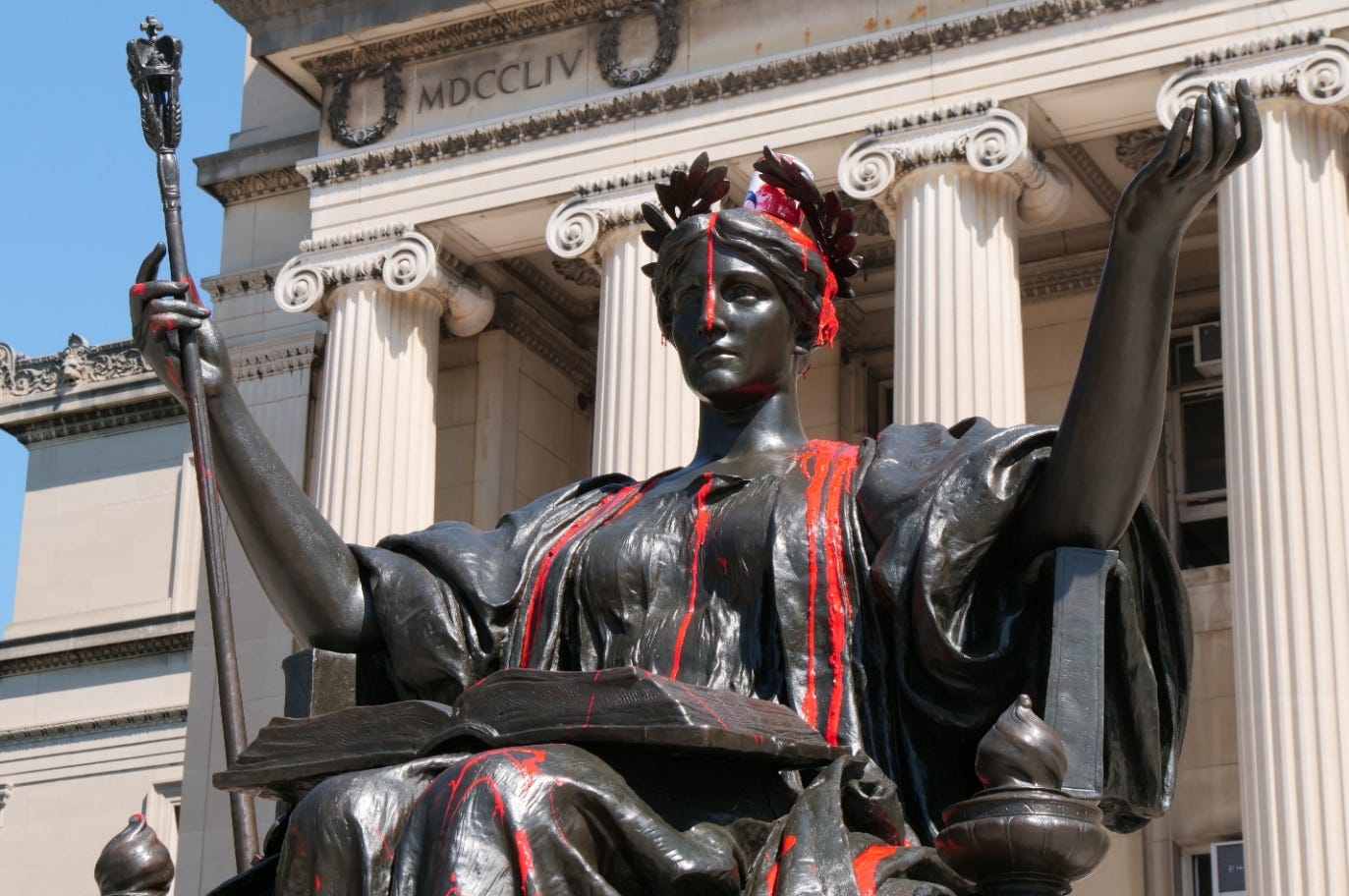
“We demand boycott, not further engagement with Israel,” they told the New York Times. “We’re open to negotiation if the university wants to meet us on the negotiating table. If not, we’re willing to stay out here.” That evening, their students answered the call by climbing the statue of Alma Mater to wrap her neck with a keffiyeh and place a Palestinian flag in her hand.
Then, in the early morning hours on April 30, dozens of picketers broke from their lines and charged for Hamilton Hall. For the chaos that ensued, leaf back to the Columbia Spectator of that day –
they draped flags and banners out the windows of Hamilton, beginning with a Palestinian flag from the third floor…. ‘We will honor all the martyrs, all the parents, mothers, fathers,’ protestors chanted. ‘We will honor all the martyrs, all the children, sons, and daughters.’
Likewise, from the New York Times of May 2, 2024 –
[they] covered security cameras and threaded heavy metal chains through windows they had smashed in the building’s French-style doors, securing them with bicycle locks…. They made a chart for security duties in two-hour shifts, and listed three Maoist revolutionary slogans as inspiration, according to police videos. “Political power comes from the barrel of a gun,” one of the slogans proclaimed.
The spectacle of a flag-waving terrorist patrolling the roof of Hamilton Hall was intended to send a chill through every Jew who ever went to Columbia. This was a tableau for the execution of hostages. But it was also a flashback to the “upward psychopathic mobility to the point of divinity” of the 1960s (Lionel Trilling, Sincerity and Authenticity), the godlike freedom to feign alternative selves in the quest for liberation and self-renewal that was the signature of radical chic provocation even back then. Like scenes out of Marat/Sade, these ecstatic and dreamlike hallucinations were more performance than protest, not so much political statements as transgressive and thrilling improvisations in the theater of the absurd.
“The Zionist stronghold of Columbia University”
Mark Mazower recounted these fever dreams as if they were good old-fashioned pep rallies with some students waving “red-green-white-and black” Palestinian flags and others waving “blue and white” Israeli flags. As if this was Baker Field and this was an Ivy League football game. “I saw the arguments around me as a form of education,” he recalls, “unruly but also admirable.”
Unruly, yes – and bewildering for sheer weirdness, as well – but there was nothing educational and nothing admirable about the calculated mayhem of the Columbia and Barnard students who were masking their faces, banging on drums and kettles, and chanting stilted slogans at the hapless Jews who were scurrying past them on their way to the library. What he failed to see was the “comprehensive abuse” and “systemic antisemitism” that David French reported on March 14, 2024, or that John McWhorter recounted on April 23, 2024, “the relentless assault of this current protest – daily, loud, louder, into the night and using ever-angrier rhetoric… beyond what any people should be expected to bear up under.” The House Committee on Education and the Workforce, for its part, cited numerous instances of malicious taunting and thinly veiled threats meant to humiliate Jews and drive them off the campus.
On the night of April 20, they included murderous incantations such as “We say justice, you say how? Burn Tel Aviv to the ground,” “Al-Qassam, you make us proud! Take another soldier out!” and “Hamas we love you, We support your rockets too!” The highlight of these festivities was the following oration:
We are here today because on October 7 the Palestinian resistance in Gaza broke through the walls of their open-air prison, shattering the illusion of the invincibility of their occupiers. [Cheers from the crowd.] By setting up this encampment in the heart of the Zionist stronghold of Columbia University, we intend to do the same.
That is “the delirium that now reigns,” as Israeli diplomat Michael Oren (CC ’77) recently put it. Like the “two minutes hate” in Nineteen Eighty-Four, these exorcistic rituals – shouted at a Jewish face in the novel – nullified rationality, selfhood, and civilization itself.
The hollow core of the core curriculum
Indeed, the keystone of a Columbia education has always been “Contemporary Civilization,” a survey course of the classics of political philosophy. Any philosophy professor could suggest a syllabus for this legendary course. It could be based on great philosophers, or the history of philosophy, or schools of philosophy, or on themes such as theories of history, theories of justice, theories of law, theories of science, ethnicity and the state, religion and the state, economics and the state, democracy and the state, the qualities of a just war, the qualities of a good life, etc.
Columbia has chosen the thematic route but framed “CC” (also the acronym for Columbia College) with the following topics – “Conquest of the Americas,” “Revolutions and Rights,” “American Perspectives,” “Anti-Colonialism and Resistance,” “Race, Gender, and Sexuality,” and “Climate and Futures.” That is, as Bret Stephens put it, “all the ways in which western civilization is an extended act of imperialism and colonialism, human exploitation and environmental despoliation, misogyny and white supremacy.”
And what great authors are relevant to the “non-white knowledge systems” that Columbia has long suppressed? Not Alexander Hamilton and John Jay, nor John Dewey and Robert Nozick. The faculty has replaced the usual suspects (white, male, dead) with the testimony of the silenced Islamic and Third World voices, such as Ibn Tufayl, Al Ghazali, Ibn Khaldun, the Qur’an, Felipe Guaman de Ayala, Francisco de Vitoria, Samson Occom (Mohegan), Sojourner Truth, Frederick Douglass, the Haitian Constitution, W.E.B. DuBois, David Walker, Frantz Fanon, Mahatma Gandhi, B.R. Ambedkar, and the Combahee River Collective.
As John M. Ellis recently noted (A Short History of Relations Between Peoples (2024)), courses like “CC” were never intended to sanctify and glorify all things western, but rather “to equip students with a thorough knowledge of the history and nature of modernity – something that is urgently needed if they are to thrive in modern times.” That is why they’re frontloaded with classics from Greece, Rome, and northern Europe – lands where modernity commenced before it enlightened the rest of the world. Columbia, however, has done exactly the opposite, revamping “CC” from an engagement with seminal works of science, law, religion, history, and economics into a vehicle for critiquing the “epistemic violence” of these texts and “the colonial hierarchies perpetrated by universities.” Hence the belief that capitalism, Judeo-Christianity, and western civilization itself are the most pressing problems of our world. That is the new hallmark of a Columbia education.
“Palestine is Everywhere”
Adam Kirsch, in On Settler Colonialism: Ideology, Violence, and Justice (2024), described the version of western civilization that Columbia now teaches – that white supremacy is its original sin, which persists in the global south many decades after the European empires devolved into independent states. The mantra of this teaching – “invasion is not an event, but a structure” – explains why descendants of the settlers are still the oppressors and descendants of the natives are still the oppressed. The original sin of white supremacy is a human stain as indelible as Adam’s fall from grace. In addition to servitude and dispossession, the settler-colonists erased (or “committed erasure of”) indigenous memory and culture, which fits under a newly enlarged conception of genocide that can now occur amidst a population explosion.
The origins of antizionism are often attributed to the tenets of religious Islam. But according to Zineb Riboua, a research fellow of the Hudson Institute, most Americans who glorify Jihad and sanctify its “martyrs” hold no commitment to Islamic law or religious governance. “Today’s condemnation of Israel comes from a different lineage – a conviction that the West is the permanent oppressor and that any movement arrayed against Western power is inherently righteous.”
The same framework that condemns Israel also condemns American power: Israel as the local embodiment of Western domination, and the U.S. as the global structure that sustains it…. In the Third-Worldist imagination, America is the final imperial actor and Israel its most visible extension. Hostility toward Israel becomes a socially acceptable proxy for hostility toward American identity, institutions, and global leadership.
Hence every pejorative applied to Zionism (imperialist, colonialist, capitalist, racist) serves to localize in the Jewish state the global theory that “oppression is a total structure expressed in overlapping forms [that] embody the architecture of Western domination.” At Columbia, this new dispensation is the focus of the moral imagination of today’s youth (as Reihan Salam puts it), as well as a rejection of secular humanism in favor of critical race theory and identity politics, that is, a passing of the torch from the heirs of Lionel Trilling to those of Edward Said, or in generational terms, from the Jewish intellectuals of the twentieth century to the Third World intellectuals of the twenty-first.
It is also the reason why rescinding the statehood of Israel is the great moral cause of our time with Jews once more standing at “the still point of the turning world” (T.S. Eliot), the fixed and immovable axis around which the fight for redemption and deliverance revolves. That point is what it has always been for Jews, the most dangerous possible place to be.
On October 8, 2023, Joseph Massad, professor of Modern Arab History, declared his “jubilation and awe” at the latest atrocity in “the ongoing war between the Israeli colonial army and the indigenous Palestinian resistance.” His jubilation encompassed the prospect of the next massacre, and the next after that, in “the interminable struggle between the colonizer and the colonized.”
His paean for the carnage, barbarism so hubristic that it filmed itself in action, should have shocked the conscience of Columbia. But just the opposite happened. The cruelty and fury unleashed that day stirred hundreds of students – even Jewish students, devoid of any instinct for survival – to join the Third World resistance against the colonizers of Palestine.
Adam Kirsch, again: “Young people today who celebrate the massacre of Jews and harass their Jewish peers on college campuses are not ashamed of themselves for the same reason that earlier generations were not ashamed to persecute and kill Jews – because they have been taught that it is an expression of virtue.”
“I’ll show you why you hate the Jews”
Indeed, there was more to the joyous zeal on campus than the sense that justice for Palestine is finally being done. This was the ancient ritual of Jewish scapegoating, that is, the recovery of innocence by burdening the Jew with one’s guilt. Jews have seen this movie before. Douglas Murray is fond of quoting Vassily Grossman, who wrote, ”show me what you’re guilty of, and I’ll show you why you hate the Jews.”
Their guilt on display was remorse for the capitalist, cosmopolitan, philosemitic American empire, as well as for the secular, democratic state in “Palestine” with seven million deracinated Jews. They’ve been schooled in “intersectionality” (“all these struggles are intertwined,” as one student told the Spectator), so humiliating the Jewish professionals, intellectuals, and financiers (“shattering the illusion of their invincibility”) will break the spell of their domination and redeem the world from fascism, nationalism, militarism, misogyny, patriarchy, hierarchy, homophobia, transphobia, Islamophobia, etc.
The scapegoating at Columbia took the form that it always does – defamation, ostracism, and quarantine. Hence, the dismissals and expulsions, the encampments and occupations, the boycotts and cancellations. They even took pride in scaring off Jewish parents on “accepted students’ weekend” (“WE DON’T WANT NO ZIONISTS HERE”), and Jewish graduates at the annual reunion where they commandeered a tent to hang banners and shout insults (“WE’RE BACK BITCHES”). Then, on October 7, 2024, they once more convened on the steps of Low Library to honor the one-year anniversary of the opening salvo in the war for the liberation of Palestine.
“How to experience confrontation”
The faculty is all on board with such precocious innovation, the “wholly new political imaginaries” that the rising generation of progressives has invented for itself. “I didn’t meet violent, illiberal radicals,” wrote Haviv Rettig Gur of the students who disrupted his lecture at Haverford College, but “intellectually and emotionally neglected children surrounded by adults who are paid a fortune… not to challenge them, not to inculcate the great gifts of substance, grit, and nuance.” To the contrary, they’ve been taught that “being an activist [is] the highest good.” And that “the barricade is the most desirable place to be.” (Douglas Murray, again.) Bruce Robbins, for one, urged his Columbia College English majors not to be “distracted” from Zionist atrocities by the antizionist atrocities of October 7. He’s an expert on atrocities, having written a book by that title. He then moved his class on “atrocities” into the encampment.
He also signed the Open Letter from Jewish Faculty (April 5, 2024), in which they declared that “the University has no obligation to protect anyone from the discomfort of having their politics disagreed with or criticized. Discussions and debates that can be uncomfortable or provocative are part of the pursuit of knowledge.” They graciously committed, however, to helping their Jewish students “learn how to experience confrontation as part of learning how to disagree productively as members of society.” (This is stuff you can’t make up.)
They went on to vent their contempt for the “mendacious logic” of the mainstream liberals who don’t share their fervor for resistance to Israel, as well as for the Task Force on Antisemitism, calling it a “brazen” attempt to “circumvent institutional procedure in the service of right-wing politics.”
Two weeks later, Mahmoud Mandami – Herbert Lehman Professor of Government – added his voice to the outcry against the Task Force and its “law-and-order report.” He also said that antisemitism is “part of the currency the administration uses to demonize protests like this.” (Well, maybe they need that currency to pay his salary.)
On September 7, they followed up with a second attack on the Task Force, pleading with the President “to disband the Task Force before it further imperils faculty members, threatens academic freedom, damages the University’s reputation, and exacerbates the divisions that have been plaguing us.” Their letter was delivered by Joseph Howley, the professor who chairs the Humanities (“Lit Hum”) course of the core curriculum. He already was on record as blaming “our leaders, our trustees” for
trying to force our University and campus to conform to the whims of the genocidal government now in power in Israel. They’re trying to restrict speech and use police violence here the way they use it in Israel… to make it as illegal to talk about Palestine on an American campus as it is in Israel [and] to make it as unsafe for Palestinians in this country as it is for Palestinians in occupied Palestine.
He went on to charge Israel with “plotting to destroy the culture and reputation of this University [just as its] military has already literally destroyed every university in Gaza.” (Columbia Spectator, February 27, 2024.) There’s no doubt something piquant about a fiery, sidewalk oration by a humanities professor – turned out in full academic regalia, no less. Every day seems like Halloween at Columbia. But – news flash – Columbia does not make American foreign policy. It’s not at war with Palestine, Israel, or anyone else. It has nothing to do with the war in Gaza.
They may scoff in the faculty lounge, but there is always a price to pay for the treason of the intellectuals. The mystery to me, however, is why they cannot see that these protests were not about taking sides in a foreign war but were rather a call to end the epoch of Jewish Columbia. That is why the students for Hamas dressed themselves in terrorist apparel and did everything they could do to shock the Jews with their frantic rage. They wanted to shatter the illusion that Jews are still welcome at Columbia.
“Gaza Calls, Columbia Falls”
In the context of the not-so-distant past, it is breathtaking to see how far Columbia has fallen. The late Dan Wakefield, in New York in the 50s, wrote that “I admired the savvy and intelligence of New York Jews, and envied their early ingrained love of learning and unashamed respect for literature, music, and the arts.” He went on to quote Rabbi Harold Kushner (When Bad Things Happen to Good People) at their class of ’55 reunion: “half of us were bright Jewish kids from Brooklyn and Queens who wanted Columbia to help us transcend our parochial origins and gain admission to the greater American scene… and the other half of us were high school hotshots from the Midwest who hoped that Columbia would help us to pass for New York Jewish intellectuals.”
The Jews who attended Columbia in midcentury America left a remarkable legacy in every field of American culture including poetry (Allen Ginsburg, Louis Simpson, John Hollander, Kenneth Koch, Louise Glück), sports (Robert Kraft), composing (John Corigliano), book publishing (Robert Gottlieb), magazine journalism (Norman Podhoretz), newspaper journalism (Max Frankel), television journalism (Lawrence K. Grossman), fiction (Erica Jong, Paul Auster), politics and finance (Richard Ravitch), singing (Art Garfunkel), comedy (Joan Rivers), cartooning (Ed Koren), acting (George Segal), appellate judging (Judith Kaye), French literature (Richard Howard, Susan Rubin Suleiman), translating (Robert Alter), literary history (Steven Marcus), political commentary (David Horowitz), architecture (Robert A.M. Stern), physics (Leon Cooper, Melvin Schwartz), science fiction (Isaac Asimov, Robert Silverberg), philosophy (Robert Nozick), and public interest law (Norman Dorsen).
They also produced the first Jewish Dean of Columbia College (Robert Pollack, CC ‘57) and the first Jewish President of Columbia University (Michael Sovern, CC ‘53). One must ask what is lost when Columbia harries and vilifies its Jews in furious antizionist protests. To paraphrase Niall Ferguson, the answer is the same thing that was lost when the universities of Heidelberg, Marburg, Tübingen, and Königsberg, drove out their Jews in the 1930s. Academic preeminence.
To be clear, the desecration of Hamilton Hall was not a “discussion,” “debate,” or “productive disagreement,” nor was the scrawling of graffiti on the walls and furnishings of Butler Library, nor was the acceptance of diplomas with zip-tied hands and the performative violence of ripping them up on stage.
“There can be no graduation as usual during genocide,” declared “Columbia University Apartheid Divest” – the coalition that orchestrated the Gaza protests and is under a “zero tolerance” ban for inciting violence against Jews. “We have a duty to rise. We have a duty to disrupt. We have a duty to be brave. Glory to the Martyrs! Victory to the Resistance!” These are the students who retracted the apology they made after one of their members said that Columbia was lucky he wasn’t out killing “Zionists.” (So much for the culture and reputation of this university.)
The author of Antisemitism: A Word in History is loath to define that word at all lest it be used “to clobber dissent and assail civil liberties.” But who is being clobbered and who is being assailed? Again, Bret Stephens, “We have the honor of being hated by an axis of the perfidious, the despotic, the hypocritical, the cynical, the deranged, and the incurably stupid.” It goes without saying that Columbia doesn’t subsidize genocide, spy on its faculty, or fatten its endowment with Zionist blood money. Those don’t even register as plausible lies. That still leaves the question, though, of what apocalyptic impulse, what nihilistic derangement, could animate the siege of Milbank Hall, the invasion of Butler Library, and the occupation of Hamilton Hall?
Could it be a noxious hybrid of post-Marxist relativism and Islamic fundamentalism – two totalizing ideologies that concur only in their hatred of the West? Or could it be a relapse into that tendentious “word in history” – antisemitism? Whatever it is, this is still an American university and not a stage set for performative nihilism and theater of the absurd. That is why Columbia needs to shield its Jews from hectoring and confrontation about foreign wars and conspiracy theories that have nothing to do with their studies, but everything to do with their Judaism. It must recognize the ageless hatred in the guise it has assumed in the rising generation and make Columbia once more a safe haven for civility and academic freedom for all, “Zionists” and “Antizionists” alike. Not for the sake of Israel, or for the sake of Palestine, but for the sake of Columbia.
The IHRA definition explained
The post-Gaza war initiative on antisemitism was announced in two policy documents, “Advancing Columbia University’s Work to Combat Antisemitism” (March 21, 2025), and “Our Additional Commitments to Combatting Antisemitism (July 15, 2025). The critics of these policies claim that Jews should not get preferential treatment at a school they have dominated for decades. They also claim that penalizing students who have offended their classmates by speaking the truth about Israel and Palestine will only stir up further resentment of what has long been a privileged minority on campus. Finally, they claim that these policies are just one piece of a right-wing conspiracy to stifle progressive politics and bring the universities to heel.
The focus of their ire is the IHRA definition of antisemitism (no pun intended), which was adopted by Columbia as part of its settlement of civil rights charges brought by the Departments of Education and Health and Human Services. This definition (sponsored by the “International Holocaust Remembrance Alliance”) is effective for universities because it addresses the dilemma posed by the Zionist loophole, that is, by the antisemite who claims that “I don’t hate Judaism, I only hate Zionism.”
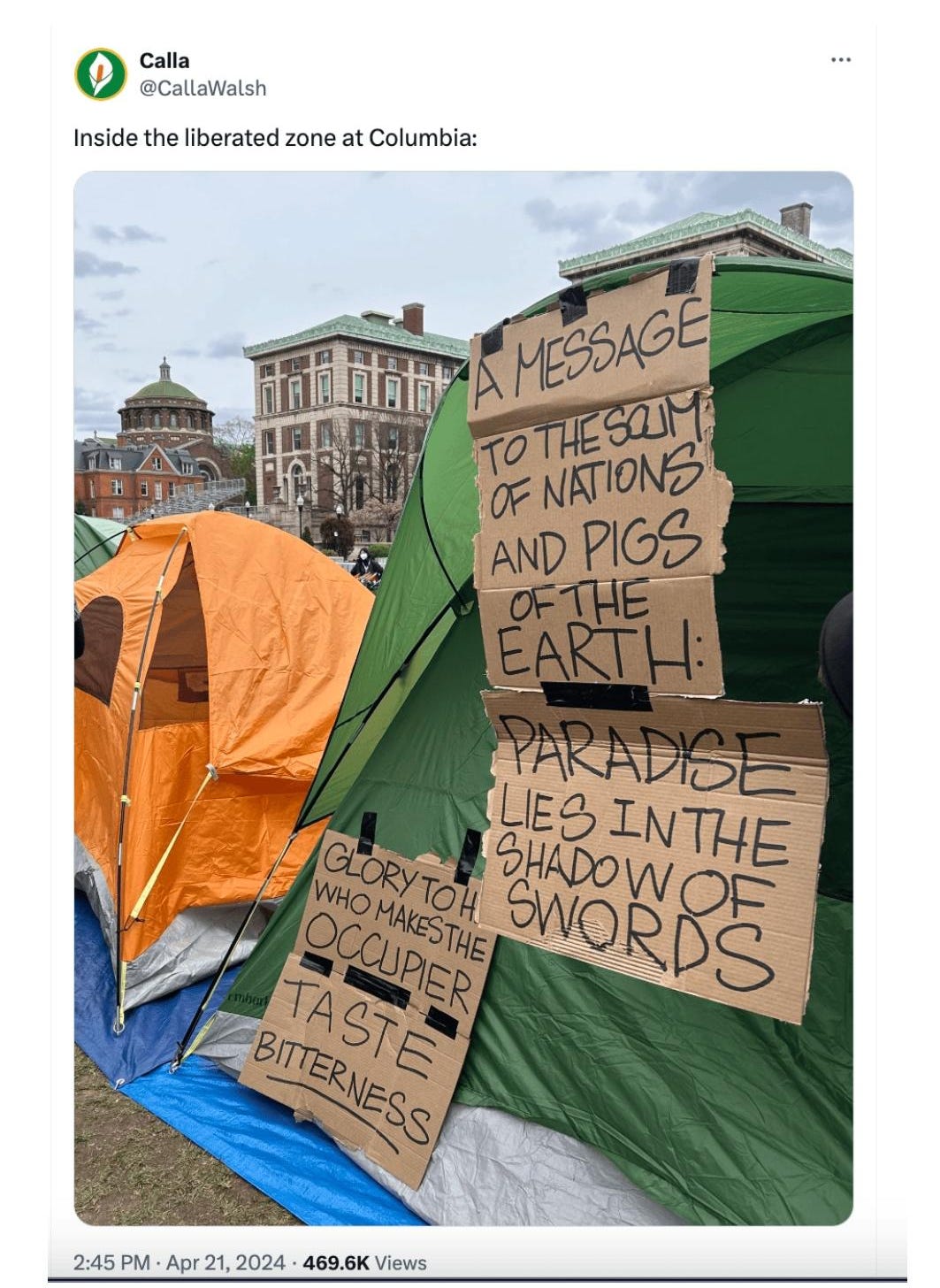
To start at the most vexing point, the principal charge against the IHRA definition is that it uses the sanctions of civil rights law to silence the critics of Israel. Rashid Khalidi declared to the Guardian that he can no longer function at Columbia because “[t]he IHRA definition deliberately, mendaciously, and disingenuously conflates Jewishness with Israel, so that any criticism of Israel, or indeed description of Israeli policies, becomes a criticism of Jews.” (August 1, 2025.) This grievance is completely groundless, even without the pejorative adverbs. It is necessary to listen to what Columbia says because a definition is only the preface to a legal framework (as lawyers say, it isn’t “self-executing”). When enforcing the rules and contracts that bind it, the university agreed to “consult” the IHRA definition, “but to do so in ways that do not abridge first amendment principles.” The Office of Institutional Equity (OIE) has officially determined that conveying “political views regarding another country’s policies” is not harassment unless those views are “infused with discriminatory comments” about people in the protected class. (Understanding How We Incorporate the IHRA Definition of Antisemitism, August 4, 2025.) In other words, Columbia protects antizionist speech under the rubric of institutional neutrality, provided that expression of antipathy to Israel does not normalize the disparagement and defamation of Jewish people, such as comparing them to toxic sewage or filthy, barnyard animals, e.g., “THE SCUM OF NATIONS AND PIGS OF THE EARTH.” That is the mandate of the Civil Rights Act of 1964 (Title VI).
Second, according to the IHRA definition, “criticism of Israel similar to that leveled against any other country cannot be regarded as antisemitic.” (Emphasis added.) The thesis of Antisemitism: A Word in History is that any criticism of Israel, post-IHRA definition, is now presumptively antisemitic, which makes the book’s failure to cite this stipulation completely devastating. The “any other country” caveat is how the IHRA definition balances almost limitless criticism of Israel with the legal duty under Title VI of forestalling a hostile environment for Jews on campus. In fact, anything you can say about the “original sin” of America, you can say about Israel too. The conditional language of the IHRA definition, moreover – which the book attributes to “shoddy drafting” – allows for deliberation about context and intent in any adjudication of a discriminatory harassment charge. It is true that Holocaust denial is singled out as antisemitic, as well as calling Israel a “racist endeavor,” and so is using the “Nazi” epithet to traumatize Jewish students on the campus of their own university (another “N-word” to avoid). It is obviously antisemitic to taunt Jews with their near extinction in the Holocaust. The IHRA definition does not, however, forbid projects that examine war crimes allegations or charges of human rights violations. Israel, like any other country, is not exempt from such scrutiny.
Third, the inference that Columbia is catering to its Jewish students, “who alone are entitled to protections that other groups apparently don’t merit,” is not only misleading, but unequivocally false. Marianne Hirsch (yet another English professor) told the New Yorker (August 18, 2025), that she could be charged with discriminatory harassment if she assigned Eichmann in Jerusalem by Hannah Arendt, and two sociologists, Gil Eyal and Peter Bearman, claimed that the IHRA definition could require them to self-censor their research into comparative genocide. The New Yorker, however – which reported on “The Troubling Lines That Columbia Is Drawing” – failed to cite or even to mention Columbia’s official response to these silly allegations (“a regime of intense surveillance,” etc.), much less reference the four-volume report of the Task Force on Antisemitism, which gave dozens of examples of the way that Jews at Columbia have been uniquely targeted for bullying and ostracism since the Gaza war began. The reporter did, however, interview Mark Mazower about his forthcoming book. In fact, the Task Force studied the issue and found no impediment to assigning “academically valuable controversial texts,” or critiquing Israel in the classroom, provided that they don’t single out Jewish students for hostility and reproach, and are pertinent to the subject matter of the course.
Fourth, the examples in the IHRA definition do not prohibit criticism of Israel. They only require that it remains within the bounds of the any other country caveat, that is, abstain from “double standards” that are exclusive to the Jewish state. (In a Spectator op-ed (August 6, 2025), Professors Eyal and Bearman argued that they hold Israel to a higher standard for that very reason – because it is a Jewish state. Surely, however, there’s something wrong with signaling one’s own Jewish virtue at the cost of someone else’s Jewish life.) Although the IHRA definition says that Jews can’t be held collectively responsible for Israel and can’t be accused of dual loyalties that favor Israel, those limitations don’t inhibit any criticism of the government, military, or society of Israel itself.
Finally, the right to criticize Israel is further protected by another part of the legal framework – the First Amendment principle that forbids content and viewpoint-based censorship of political speech in a public forum. Columbia implements that principle while channeling it through a complementary principle, that of “time, place, and manner” restrictions. This allows heated attacks on Israel while Jewish life proceeds around them without intimidation or bullying. These rules would protect Palestinian advocacy on campus regardless of whether the university adopted the IHRA definition, the “Jerusalem Declaration” definition, or no definition at all. Columbia authorizes political protests in designated areas (“speakers’ corners”) but keeps them in a daylight time frame and away from academic buildings, libraries, dining halls, and dormitories. (Interim Policy for Safe Demonstrations, February 19, 2024.) The test for political speech is whether, however offensive to some, it would limit anyone else’s ability to participate in campus life or benefit from their education. That, again, is the mandate of Title VI. It is only unwanted and inescapable confrontation – “discriminatory harassment” – that is forbidden in public spaces on campus.
Then and Now – Contemporary Civilization (“CC”) 1991
from David Denby, Great Books: My Adventures with Homer, Rousseau, Woolf, and Other Indestructible Writers of the Western World (1996)
The Greek and Roman World
Thucydides, Plato, Aristotle, Cicero
The Sources of the Judeo-Christian Tradition
The Bible, St. Augustine, St. Thomas Aquinas, Christine de Pizan
Renaissance and Reformation
Niccolo Machiavelli, The Protestant Reformation (anthology), John Calvin
The New Science
René Descartes, Galileo Galilei
New Philosophy and the Polity
Thomas Hobbes, John Locke
The Enlightenment and the French Revolution
Jean-Jacques Rousseau, David Hume, Immanuel Kant, James Madison, Federalist Papers (selections)
Economy, Society, and the State
Adam Smith, Georg Wilhelm Friedrich Hegel, Karl Marx, John Stuart Mill, Mary Wollstonecraft
Science and Revolution
Charles Darwin, Friedrich Nietzsche, Sigmund Freud, Max Weber, Antonio Gramsci, Hannah Arendt, Vladimir Ilyich Lenin, Jürgen Habermas
Class, Race, and Gender
Simone de Beauvoir, Catherine MacKinnon, John Rawls, Frantz Fanon, Malcolm X, Michel Foucault
No posts
Comments
Nothing yet. Say the first thing.
Sign in to join the conversation.