
0:00
-1:36
A patient passes a spontaneous breathing trial at seven in the morning. Somebody at the bedside says the words “he’s high risk,” and that phrase determines whether the next four hours are spent under a mask or under a nasal cannula.
I want to know what those two words mean.
Not rhetorically. Literally. Because in July I read two separate meta-analyses, published three months apart in two different journals on two different continents, both asking whether high-flow nasal cannula or noninvasive ventilation is better for exactly that patient. Both found nothing. Every confidence interval crossed one.
And both of them said, in their own words, that the reason the question may be unanswerable is that the trials could not agree on who the patient was.
Here is the part that stopped me. When I went back to the 2017 CHEST and ATS liberation guideline, the one that made a strong recommendation for preventive noninvasive ventilation in high-risk patients, I found that the guideline panel had already written it down. In their own evidence summary. There was heterogeneity between studies in defining the high-risk patient.
They made a strong recommendation about a category, and noted in the same document that the category was not consistently defined.
Nine years later, we are still saying the words at the bedside as though we know what they mean.
ICCN Update
The new ICCN website is live at iccn.io. Every article published in the past two weeks is now archived in one place, and our new Research section pulls recent published data from 26 major critical care and medical journals into a single curated feed for subscribers. Bookmark iccn.io.
This is the third and final week of a Tuesday arc on the artificial airway. We started with the cuff and found that the interventions we perform most reliably move process measures. We moved to airway clearance and found 46 studies whose only consistent outcome was the weight of the sputum. This week the tube comes out, and the pattern completes itself.
Extubation failure is not a small problem. Reintubation is consistently associated with longer ventilation, longer ICU stay, and higher mortality, and the association is strong enough that the entire post-extubation support literature exists to prevent it.
So the field did the sensible thing. It identified patients at elevated risk, and it tested whether giving them prophylactic support immediately after extubation would help. That work produced a strong guideline recommendation in 2017. Then high-flow nasal cannula arrived, patients tolerated it far better than a mask, and the field spent a decade asking whether it was good enough to replace NIV in the patients who needed support most.
Two 2026 syntheses now answer that question. And the answer is more interesting than the null result suggests.
Qin and colleagues searched PubMed, Embase, the Cochrane Library, and ClinicalTrials.gov without language restriction for randomized trials comparing high-flow nasal cannula against noninvasive ventilation in post-extubation patients.¹ The primary outcome was reintubation within 72 hours. Certainty was graded with GRADE.
Eleven trials, 2,765 patients. Here is the complete result set.
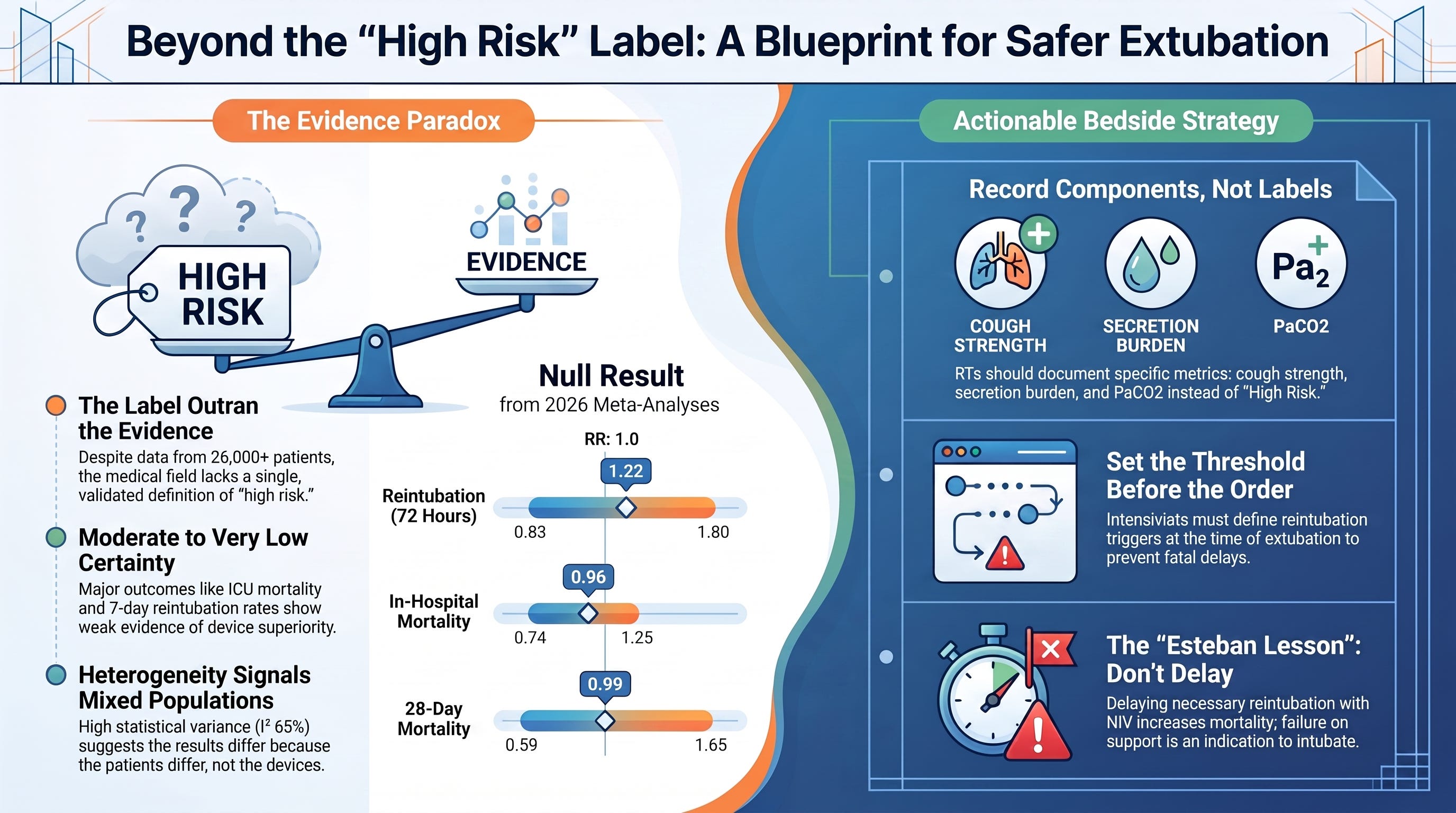
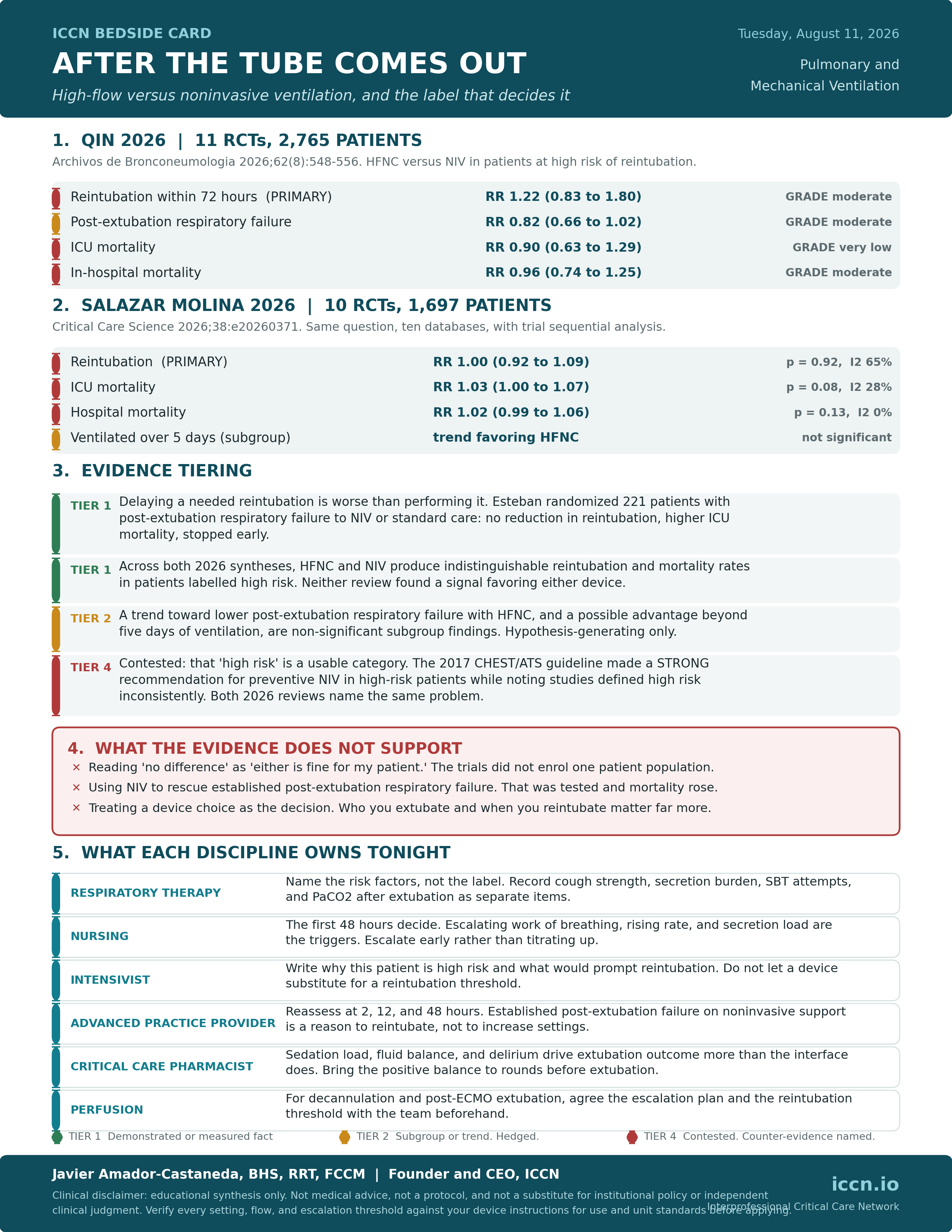
Reintubation within 72 hours: RR 1.22, 95% CI 0.83 to 1.80, moderate certainty.¹
Reintubation within 7 days: RR 1.23, 95% CI 0.90 to 1.69, low certainty.
Post-extubation respiratory failure: RR 0.82, 95% CI 0.66 to 1.02, moderate certainty.
ICU mortality: RR 0.90, 95% CI 0.63 to 1.29, very low certainty.
In-hospital mortality: RR 0.96, 95% CI 0.74 to 1.25, moderate certainty.
Twenty-eight-day mortality: RR 0.99, 95% CI 0.59 to 1.65, moderate certainty.
Every interval crosses one. The authors concluded that compared with NIV, HFNC was not associated with increased reintubation or mortality, and then added the sentence that this article is really about: variability in study definitions may limit direct applicability to bedside decision-making in individual high-risk patients.¹
Now the second review. Salazar Molina and colleagues searched ten databases, including grey literature sources, and performed a trial sequential analysis alongside conventional meta-analysis.²
Ten trials, 1,697 patients.
Reintubation: RR 1.00, 95% CI 0.92 to 1.09, p = 0.92, I² 65 percent.²
ICU mortality: RR 1.03, 95% CI 1.00 to 1.07, p = 0.08, I² 28 percent.
Hospital mortality: RR 1.02, 95% CI 0.99 to 1.06, p = 0.13, I² 0 percent.
ICU length of stay: mean difference minus 0.51 days, 95% CI minus 1.85 to 0.82, I² 63 percent.
Hospital length of stay: mean difference 0.80 days, 95% CI minus 1.72 to 3.32, I² 47 percent.
They also reported a non-significant trend toward lower post-extubation respiratory failure and lower ICU mortality with HFNC in patients ventilated more than five days.²
I should be honest about something the two reviews share. They overlap. Ten and eleven trials drawn from the same modest pool of randomized comparisons means these are not two independent replications. They are two teams making somewhat different inclusion decisions about largely the same evidence, and arriving at the same place.
That overlap matters less than it might, because the concordance is not the interesting part. The interesting part is what both teams say about why they cannot go further.
To understand the ground they are standing on, you need the two landmark trials underneath.
Hernández and colleagues randomized high-risk patients to HFNC or NIV after extubation and reported HFNC noninferior for reintubation.³ Thille and colleagues, in HIGH-WEAN, randomized patients at high risk to HFNC alone or HFNC alternating with NIV, and the combination reduced reintubation.⁴ Those two trials point in slightly different directions and they used overlapping but non-identical entry criteria.
And behind all of it sits Esteban. In 2004, across 37 centers in 8 countries, 221 patients who developed respiratory failure after extubation were randomized to NIV or standard medical therapy.⁵ NIV did not reduce reintubation. ICU mortality was higher in the NIV group. The trial was stopped early after interim analysis. The accepted explanation is that noninvasive support delayed a reintubation that was going to happen anyway.
1. The guideline already knew, and said so.
When the CHEST and ATS panel evaluated extubation to preventive NIV, they wrote that high-risk patients were those who failed more than one SBT, had a PaCO2 above 45 mm Hg after extubation, had more than one comorbid condition, had a weak cough, or had upper airway stridor not requiring immediate reintubation.⁶ Then they wrote that there was heterogeneity between studies in defining the high-risk patient, and that risk factors across the included trials variously included COPD, heart failure, hypercapnia, older age, and higher severity of illness.
That is a composite assembled from trials that each built their own composite. And it received a strong recommendation.
I want to be careful here. A strong recommendation with moderate quality evidence was defensible in 2017 given what the pooled data showed. My argument is not that the panel erred. My argument is that the fragility they documented in their own text never made it to the bedside, and the phrase hardened into something we say as if it were a diagnosis.
2. Two reviews, two nulls, one shared explanation.
Qin names definitional variability explicitly as the limit on applicability.¹ Salazar Molina reports I² of 65 percent for the primary reintubation outcome, which is substantial statistical heterogeneity in a comparison of two well-defined therapies.² Heterogeneity that high in a two-device comparison is a signal that the patients differed, not that the devices did.
3. The risk-factor literature is enormous and still unsettled.
Torrini and colleagues searched two decades of observational work on extubation failure in patients who passed an SBT and underwent planned extubation. Sixty-seven studies. Twenty-six thousand eight hundred and forty-seven participants.⁷ Their framing, after all of that, was that risk factors remain a matter of research.
Twenty-six thousand patients and the field cannot hand you a validated definition.
We have twenty-six thousand patients of data on who fails extubation and no agreed definition of who is at risk. The label outran the evidence and nobody called it back.
4. The trend that survives is not about the device.
The one directional signal Salazar Molina found was in patients ventilated beyond five days.² Not a device effect. A duration effect. Which is to say the strongest hint in either review points back at the patient, not the interface.
5. The certainty ratings tell their own story.
Look at the GRADE column in Qin. ICU mortality: very low. Reintubation at seven days: low.¹ These are the outcomes clinicians care about most, and they carry the weakest certainty in the review. Moderate certainty on the primary outcome is the ceiling here, not the floor.
Here is my read.
The two therapies do different things, and the fact that they perform identically in trials is itself informative.
Noninvasive ventilation provides inspiratory pressure support. It unloads the respiratory muscles, augments tidal volume, and can correct hypercapnia. High-flow nasal cannula does almost none of that. It washes out anatomic dead space, delivers a modest and variable positive pressure, provides fully conditioned gas, and permits the patient to speak, eat, and cough.
Those are not competing versions of one therapy. They are different interventions.
If they produce identical reintubation rates across 2,765 patients, one of two things is true. Either the mechanism that prevents reintubation is common to both and is something more basic than pressure support, or the populations enrolled were so mixed that any real subgroup benefit was diluted into invisibility.
When two therapies with different mechanisms produce identical results, suspect the population before you conclude the mechanisms do not matter.
I think both are partly true, and I think the tolerance question is doing quiet work in the background. A patient who removes the mask repeatedly is not receiving NIV. The trials measured assigned therapy. The bedside delivers tolerated therapy. Any comparison in which one arm is systematically better tolerated will understate that arm’s mechanistic disadvantage.
That is not a criticism of the reviews. It is a reason the null should not be read as “these are interchangeable.”
Now the part that matters more than any of it.
Esteban tested what happens when noninvasive support is applied to established post-extubation respiratory failure, and mortality was higher.⁵ The mechanism was almost certainly delay. Time spent titrating a mask on a patient who needed a tube.
So the sequence that actually governs outcome is not device selection. It is three decisions in order. Who do we extubate. What are we watching for. When do we stop watching and reintubate.
The 2026 reviews are about the least consequential of the three, and they found nothing, and that is entirely consistent with the third one being the decision that carries the weight.
Let me put the six disciplines into this properly.
Respiratory therapists own the delivery and the titration of both therapies, and on most units the selection too. You are also the discipline best positioned to fix the underlying data problem. Every time you write “high risk” without the components, you contribute to the same ambiguity that made these reviews uninterpretable. Cough strength, secretion burden, number of SBT attempts, PaCO2 after extubation, and comorbidity count are separate, recordable facts. Record them separately.
ICU nurses own the surveillance window. Extubation failure concentrates in the first 48 hours, and the nurse at the bedside sees the trajectory before any number does. Escalating respiratory rate, rising accessory muscle use, a patient who stops talking in full sentences, secretions that outpace clearance. Those are the triggers. And you own something the trials measured poorly: whether the patient is actually keeping the interface on.
Intensivists own the two decisions that matter. Write down why this specific patient is high risk, listing the criteria rather than the conclusion. Then write the reintubation threshold before you need it. A threshold agreed at eight in the morning is worth more than any device chosen at eight in the morning.
Advanced practice providers own the staged reassessment. Two hours, twelve hours, forty-eight hours. And the Esteban lesson belongs to whoever is at the bedside at hour six: established post-extubation respiratory failure on noninvasive support is a reason to reintubate, not a reason to increase the settings.
Critical care pharmacists own variables with a larger effect on extubation outcome than the interface. Cumulative sedation, delirium burden, and fluid balance all appear repeatedly in the risk-factor literature.⁷ Bringing a positive cumulative balance to rounds the day before a planned extubation is a higher-yield intervention than any device conversation.
Perfusionists own the post-decannulation and post-ECMO extubation window, where the patient often carries several of the classic risk criteria at once and where the escalation pathway is least standardized. Agree the plan and the threshold with the team before the tube comes out.
1. Respiratory therapists: record the components, never the label alone.
In your extubation note, list the actual criteria: SBT attempts, cough strength assessment, secretion burden, PaCO2 after extubation, comorbidity count. If your unit does this for a year, you will have something the trials do not: a consistent local definition. That is how a field with 67 studies and 26,847 patients eventually gets a usable one.⁷
2. ICU nurses: own the first 48 hours with named triggers.
Define and document escalation triggers rather than an instruction to monitor. Rising respiratory rate, new accessory muscle use, inability to complete a sentence, secretion load exceeding clearance, and falling saturation on stable settings. Also document interface tolerance and time off the device, because a therapy the patient will not keep on is a therapy the patient is not receiving.
3. Intensivists: write the reintubation threshold at the same time you write the extubation order.
State the criteria that define this patient as high risk and state what would prompt reintubation, with a time limit on noninvasive support. Esteban is the reason.⁵ A device selected without a threshold is a plan to delay.
4. Advanced practice providers: reassess at two, twelve, and forty-eight hours, and treat failure as failure.
Build the checkpoints into the day. At each one, ask whether the patient is improving, static, or worsening on noninvasive support. Worsening on support is an indication to reintubate. Increasing the settings on a patient who is failing is the specific behavior that carried excess mortality in the trial that tested it.
5. Critical care pharmacists: work the modifiable risk before extubation, not the device after it.
The day before a planned extubation in a patient with any risk criteria, bring cumulative fluid balance, sedation exposure, and delirium status to rounds. These appear across the extubation-failure risk literature and they are modifiable in a way the patient’s comorbidity count is not.
6. Perfusionists: agree the escalation pathway before decannulation and post-ECMO extubation.
These patients frequently carry several risk criteria simultaneously and the handoff is where thresholds get lost. Confirm the plan, the device, and the reintubation trigger with the bedside team in advance.
High heterogeneity in a trial of two well-defined devices is almost always a statement about the patients.
Salazar Molina reported I² of 65 percent for reintubation.² Both arms received a specified therapy with specified settings. The interventions were not the variable source. When the intervention is standardized and the results still scatter, the population was mixed.
This is a general reading skill and it is worth carrying past this topic. Before you attribute heterogeneity to differences in how a therapy was delivered, ask whether the eligibility criteria were the same across trials. If the entry criterion is a composite label, and each trial built its own composite, then the reviews are pooling different diseases under one name and the pooled estimate answers a question nobody asked.
Last week’s pearl was that a review declining to pool is telling you the field never agreed on what to count. This week’s is the sibling. A review that pools with high heterogeneity may be telling you the field never agreed on whom to count.
Standardized intervention, scattered results. The variable was never the device. It was the patient definition.
Do not assume these reviews show HFNC and NIV are interchangeable. They show no detectable average difference in mixed high-risk populations. Patients with hypercapnia and chronic lung disease are a specific group in whom pressure support has a mechanistic rationale that dead-space washout does not replace, and the pooled data do not exclude a real difference there.
Do not assume the two reviews are independent replication. They draw on a largely shared pool of trials with different inclusion decisions. Treat them as two readings of one evidence base.
Do not assume the ICU mortality estimate in Salazar Molina (RR 1.03, 95% CI 1.00 to 1.07, p = 0.08) indicates harm from HFNC. It is non-significant with an interval touching unity, and it sits alongside a null hospital mortality estimate and Qin’s null ICU mortality estimate.² ¹
Do not assume the 2017 guideline is wrong. It made a strong recommendation on the evidence available, comparing preventive NIV against no preventive support. That is a different comparison from NIV against HFNC. Both can be true: preventive support may help, and the choice between the two modes may not matter much on average.
Do not assume this means preventive support is optional. Neither review compared either device against nothing.
Do not assume the label is useless. The individual criteria inside it, weak cough, prior SBT failure, hypercapnia, comorbidity burden, are supported by a large observational literature.⁷ The problem is the aggregation, not the components.
Both 2026 reviews pool trials with non-identical eligibility criteria, which is the article’s central point and also its main constraint. Qin included 11 trials and 2,765 patients with GRADE certainty ranging from very low to moderate across outcomes.¹ Salazar Molina included 10 trials and 1,697 patients with I² of 65 percent for the primary outcome and 63 percent for ICU length of stay.² The two reviews overlap substantially in included trials, so concordance between them is weaker evidence than two independent syntheses would be. Salazar Molina performed trial sequential analysis, but the published abstract does not report where the cumulative z-curve fell relative to the monitoring boundaries, so no conclusion about firm evidence or futility is drawn here.
Neither review compared either device against conventional oxygen alone. Both are restricted to patients labelled high risk, which excludes the low-risk population where HFNC has separate supporting evidence. Open-label delivery is unavoidable in this comparison and interface tolerance almost certainly differed between arms in ways the pooled estimates cannot capture.
The Esteban trial is from 2004, before contemporary sedation and mobility practice, and enrolled patients with established failure rather than as prophylaxis.⁵ The 2017 CHEST and ATS guideline predates both 2026 reviews and both landmark HFNC trials in the high-risk population.⁶ The Torrini meta-analysis included observational studies published between 1998 and 2018 and excluded non-English publications.⁷ Investigators publishing in this field have reported personal fees and travel support from a manufacturer of high-flow and humidification equipment, which is disclosed in the underlying literature and is relevant context for the device comparison as a whole.
Two 2026 meta-analyses asked whether high-flow nasal cannula or noninvasive ventilation is better after extubation in high-risk patients. Across 2,765 patients in one and 1,697 in the other, every confidence interval crossed one.¹ ²
Both teams pointed at the same reason the question may be unanswerable as posed. The trials did not enrol the same patients, because the field has never agreed on what “high risk” means. The 2017 guideline that made a strong recommendation about that category wrote the same caveat into its own evidence summary nine years ago.⁶
So the practical answer is that the device is not where the decision lives. Write down the criteria instead of the conclusion. Own the first 48 hours with named triggers instead of an instruction to monitor. And set the reintubation threshold before you need it, because the one trial that tested noninvasive support in established post-extubation failure found higher mortality, and the mechanism was delay.⁵
Three weeks ago we started this arc at the cuff. What the airway has told us, at every station, is the same thing. We have built careful practice around categories and schedules, and the evidence keeps pointing past the device to the judgment.
That is the whole arc. Next Tuesday we open a new one.

Recent medical reviews from 2026 indicate that high-flow nasal cannulas and noninvasive ventilation perform similarly when used to prevent extubation failure in patients considered high risk. Despite these findings, researchers argue that the results are difficult to apply at the bedside because the medical community lacks a standardized definition of what constitutes a high-risk patient. This ambiguity suggests that inconsistent patient selection across various studies may be masking the true effectiveness of these different respiratory therapies. Rather than focusing solely on the choice of device, the text emphasizes the importance of individualized risk factors and establishing clear reintubation thresholds to avoid dangerous delays in care. Ultimately, the sources highlight that clinical judgment and precise documentation of patient symptoms are more critical to success than the specific equipment used.
Qin J, Liao Y, Liao X, Wang G, Han D. High-flow nasal therapy versus noninvasive ventilation for post-extubation patients at high risk of reintubation: a systematic review and meta-analysis of randomized controlled trials. Arch Bronconeumol. 2026;62(8):548-556. doi:10.1016/j.arbres.2026.04.006
Salazar Molina AE, Hernández Garcés H, Carangui Urgilés MA, Bustamante Celleri OP. The efficacy of high-flow nasal cannula versus non-invasive mechanical ventilation in preventing reintubation in patients at high risk of extubation failure: systematic review and meta-analysis with trial sequential analysis. Crit Care Sci. 2026;38:e20260371. doi:10.62675/2965-2774.20260371
Hernández G, Vaquero C, Colinas L, et al. Effect of postextubation high-flow nasal cannula vs noninvasive ventilation on reintubation and postextubation respiratory failure in high-risk patients: a randomized clinical trial. JAMA. 2016;316(15):1565-1574. doi:10.1001/jama.2016.14194
Thille AW, Muller G, Gacouin A, et al. Effect of postextubation high-flow nasal oxygen with noninvasive ventilation vs high-flow nasal oxygen alone on reintubation among patients at high risk of extubation failure: a randomized clinical trial. JAMA. 2019;322(15):1465-1475. doi:10.1001/jama.2019.14901
Esteban A, Frutos-Vivar F, Ferguson ND, et al. Noninvasive positive-pressure ventilation for respiratory failure after extubation. N Engl J Med. 2004;350(24):2452-2460. doi:10.1056/NEJMoa032736
Ouellette DR, Patel S, Girard TD, et al. Liberation from mechanical ventilation in critically ill adults: an official American College of Chest Physicians/American Thoracic Society clinical practice guideline: inspiratory pressure augmentation during spontaneous breathing trials, protocols minimizing sedation, and noninvasive ventilation immediately after extubation. Chest. 2017;151(1):166-180. doi:10.1016/j.chest.2016.10.036
Torrini F, Gendreau S, Morel J, et al. Prediction of extubation outcome in critically ill patients: a systematic review and meta-analysis. Crit Care. 2021;25(1):391. doi:10.1186/s13054-021-03802-3
Girard TD, Alhazzani W, Kress JP, et al. An official American Thoracic Society/American College of Chest Physicians clinical practice guideline: liberation from mechanical ventilation in critically ill adults. Rehabilitation protocols, ventilator liberation protocols, and cuff leak tests. Am J Respir Crit Care Med. 2017;195(1):120-133. doi:10.1164/rccm.201610-2075ST
Hernández G, Vaquero C, González P, et al. Effect of postextubation high-flow nasal cannula vs conventional oxygen therapy on reintubation in low-risk patients: a randomized clinical trial. JAMA. 2016;315(13):1354-1361. doi:10.1001/jama.2016.2711
Fernández R, Subira C, Frutos-Vivar F, et al. High-flow nasal cannula to prevent postextubation respiratory failure in high-risk non-hypercapnic patients: a randomized multicenter trial. Ann Intensive Care. 2017;7(1):47. doi:10.1186/s13613-017-0270-9
Nava S, Gregoretti C, Fanfulla F, et al. Noninvasive ventilation to prevent respiratory failure after extubation in high-risk patients. Crit Care Med. 2005;33(11):2465-2470. doi:10.1097/01.ccm.0000186416.44752.72
Ferrer M, Valencia M, Nicolas JM, Bernadich O, Badia JR, Torres A. Early noninvasive ventilation averts extubation failure in patients at risk: a randomized trial. Am J Respir Crit Care Med. 2006;173(2):164-170. doi:10.1164/rccm.200505-718OC
Fernando SM, Tran A, Sadeghirad B, et al. Noninvasive respiratory support following extubation in critically ill adults: a systematic review and network meta-analysis. Intensive Care Med. 2022;48(2):137-147. doi:10.1007/s00134-021-06581-1
Jaber S, Quintard H, Cinotti R, et al. Risk factors and outcomes for airway failure versus non-airway failure in the intensive care unit: a multicenter observational study of 1514 extubation procedures. Crit Care. 2018;22(1):236. doi:10.1186/s13054-018-2150-6
Pham T, Heunks L, Bellani G, et al. Weaning from mechanical ventilation in intensive care units across 50 countries (WEAN SAFE): a multicentre, prospective, observational cohort study. Lancet Respir Med. 2023;11(5):465-476. doi:10.1016/S2213-2600(22)00449-0
Thille AW, Boissier F, Ben Ghezala H, Razazi K, Mekontso-Dessap A, Brun-Buisson C. Risk factors for and prediction by caregivers of extubation failure in ICU patients: a prospective study. Crit Care Med. 2015;43(3):613-620. doi:10.1097/CCM.0000000000000748
Blakeman TC, Scott JB, Yoder MA, Capellari E, Strickland SL. AARC clinical practice guidelines: artificial airway suctioning. Respir Care. 2022;67(2):258-271. doi:10.4187/respcare.09548
Rossi V, Callera M, Trombetta G, et al. Physiological and clinical effects of selected airway clearance techniques in mechanically ventilated adult ICU patients: a systematic review and synthesis without meta-analysis. Crit Care. 2026. doi:10.1186/s13054-026-06158-8
This article is educational content for licensed healthcare professionals and does not constitute medical advice, a clinical protocol, or a standard of care. Post-extubation support selection, flow rates, pressure settings, interface choice, escalation criteria, and reintubation thresholds must follow your institution’s approved policies and the manufacturer’s instructions for use. Decisions about extubation readiness and reintubation require direct bedside assessment of an individual patient. Nothing here replaces independent clinical judgment or institutional governance. Verify every parameter locally before applying it at the bedside.
Javier Amador-Castaneda, BHS, RRT, FCCM | Founder and CEO, ICCN
No posts
Comments
Nothing yet. Say the first thing.
Sign in to join the conversation.