
0:00
-1:39
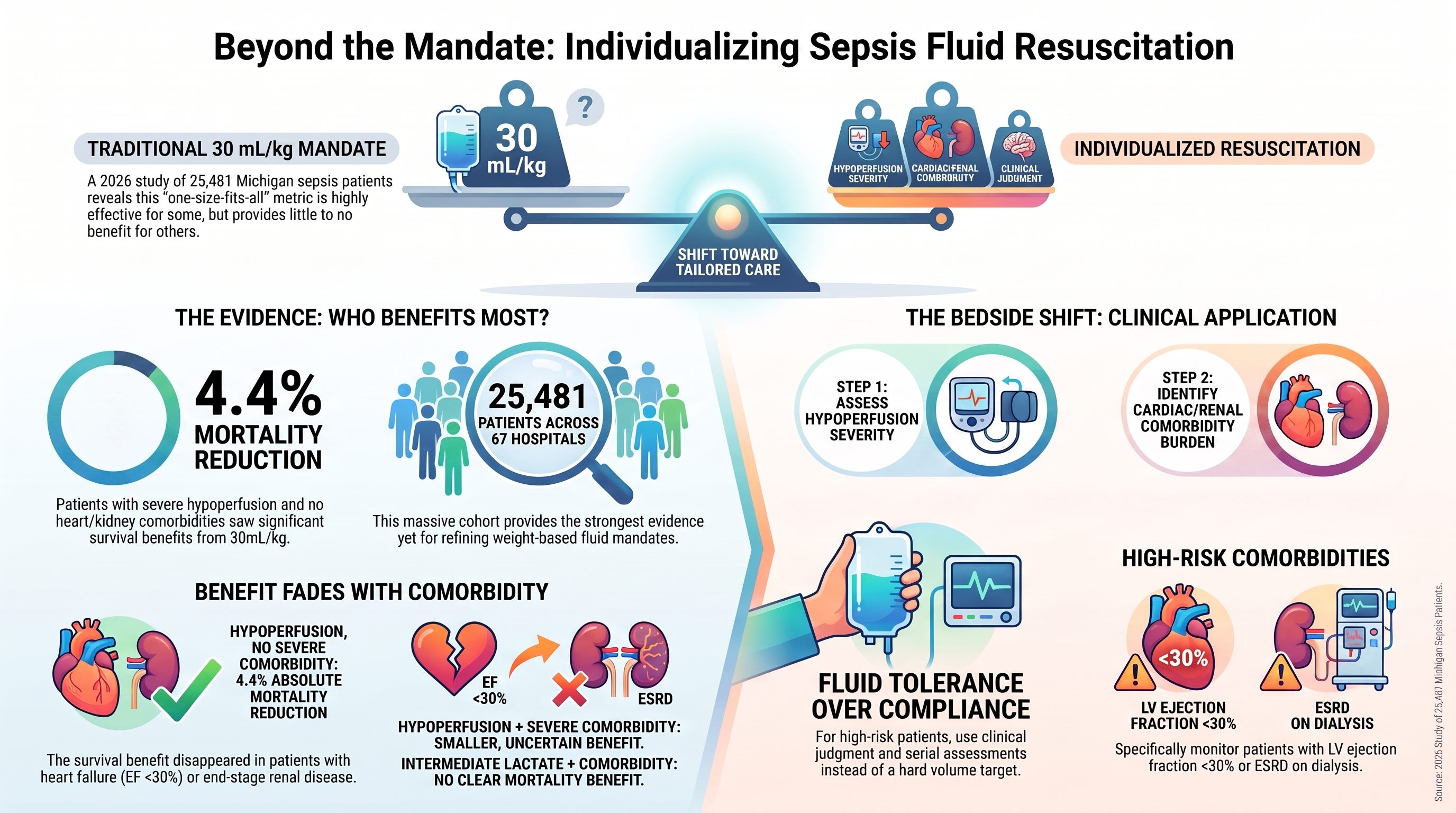
The June 2026 JAMA Network Open cohort study from the Michigan Hospital Medicine Safety Consortium, senior-authored by Hallie Prescott, analyzed weight-based fluid resuscitation across 67 hospitals and four clinical subgroups defined by hypoperfusion severity and comorbidity burden. In patients with hypoperfusion and without severe cardiac or renal comorbidities, 30 mL/kg or more was associated with a 4.4 percentage-point mortality reduction. The pattern attenuated or disappeared in the other three subgroups. Prescott is also first author of the 2026 SSC guidelines. This is the guideline author’s own group refining the guideline mandate. Week twelve of the ICCN Monday sepsis arc.
Hallie Prescott is the first author of the 2026 Surviving Sepsis Campaign guidelines. Those guidelines, published in Critical Care Medicine and Intensive Care Medicine in March and April of this year, carry forward the recommendation to administer at least 30 mL/kg of intravenous crystalloid within three hours to adults with sepsis-induced hypoperfusion or septic shock. The recommendation is graded with low-certainty evidence and includes language asking clinicians to consider individual patient characteristics. But it remains a recommendation for 30 mL/kg as the operational default, and it is the basis for the CMS SEP-1 audit metric that has driven US sepsis protocols for a decade.
On June 12, 2026, Hallie Prescott’s own research group published a paper in JAMA Network Open that refines that mandate.
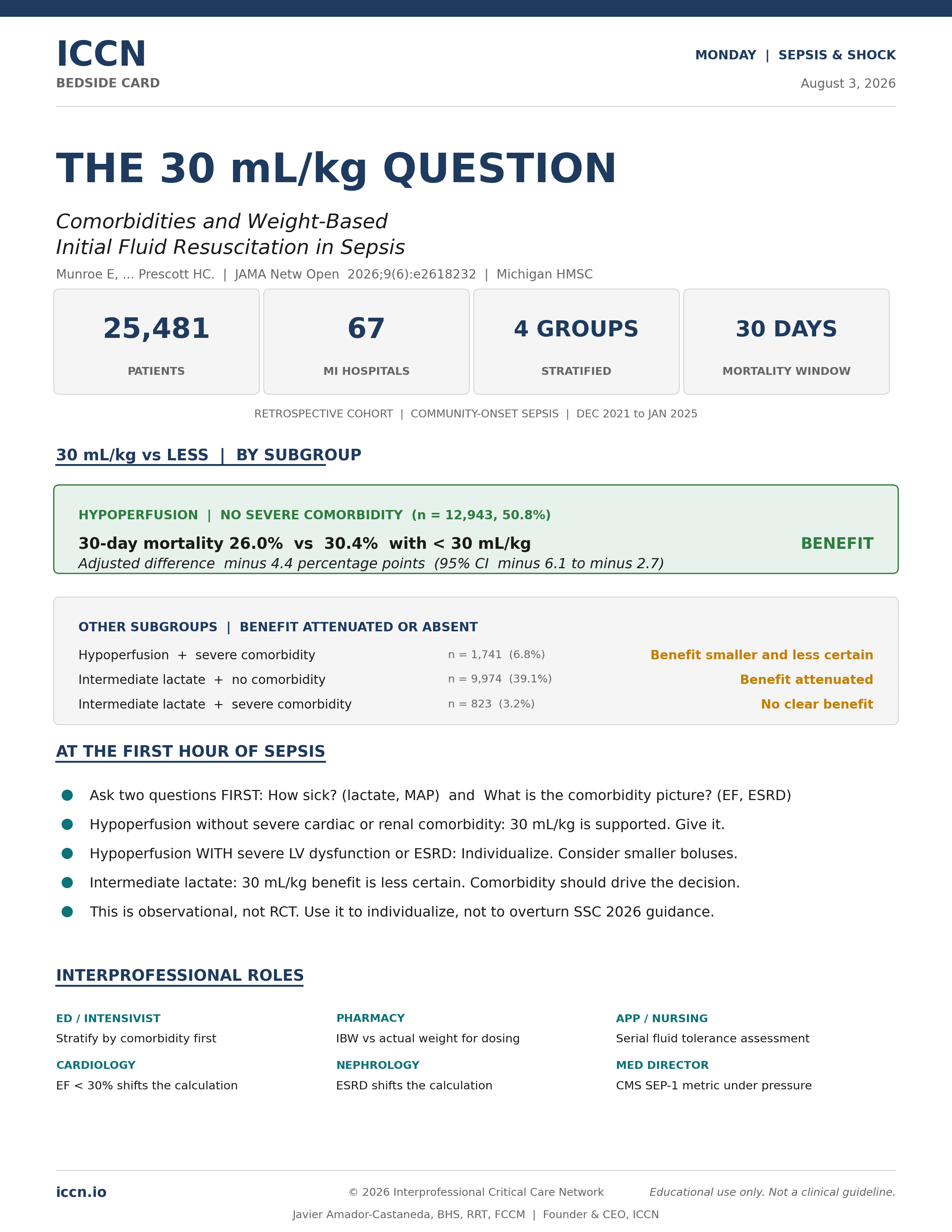
Munroe, Walzl, Seelye, and colleagues, with Prescott as senior author, analyzed 25,481 adults hospitalized for community-onset sepsis across 67 hospitals in the Michigan Hospital Medicine Safety Consortium between December 2021 and January 2025. They stratified patients into four subgroups by two variables: severity of hypoperfusion (hypoperfusion defined by lactate 36.0 mg/dL or greater, versus intermediate lactate elevation of 18.0 to 36.0 mg/dL) and presence of severe cardiac or renal comorbidity (left ventricular ejection fraction below 30 percent or end-stage renal disease). They then examined the association between administering 30 mL/kg or more of fluid within 6 hours of hospital arrival versus less than 30 mL/kg, and 30-day mortality.
In the largest subgroup, 12,943 patients (50.8 percent of the cohort) with hypoperfusion and no severe comorbidities, the 30 mL/kg or greater dose was associated with 30-day mortality of 26.0 percent, versus 30.4 percent with less than 30 mL/kg. The adjusted absolute difference was minus 4.4 percentage points, with a 95 percent confidence interval of minus 6.1 to minus 2.7. This is a large, robust, and clinically meaningful signal for benefit in a specific patient population.
In the three other subgroups, the pattern was different. Patients with hypoperfusion plus severe comorbidities (1,741 patients, 6.8 percent) showed a smaller and less certain benefit. Patients with intermediate lactate elevation without severe comorbidities (9,974 patients, 39.1 percent) showed attenuated benefit. Patients with intermediate lactate plus severe comorbidities (823 patients, 3.2 percent) did not show clear benefit.
For the interprofessional ICU team, this is the individualization evidence we have been waiting for. The 30 mL/kg mandate is not wrong. It is also not universal. It is supported in the largest and sickest subgroup of sepsis patients without severe cardiac or renal comorbidities. It is less well supported everywhere else. Comorbidity should inform the decision.
This is week twelve of the ICCN Monday sepsis arc. Weeks 9 and 10 covered the ARISE FLUIDS and ARISS trials, both extending the fluid conversation. Week 11 pivoted to post-sepsis care through ACCOMPLISH. This week we return to acute care with a paper that provides the observational counterpart to the randomized ARISE FLUIDS, CLOVERS, and CLASSIC data. Together, the RCTs and this cohort study point to the same conclusion: individualized resuscitation, informed by comorbidity, is the evidence-based approach.
ICCN Update
The new ICCN website is live at iccn.io. Every article published in the past two weeks is now archived in one place, and our new Research section pulls recent published data from 26 major critical care and medical journals into a single curated feed for subscribers. If you have not visited yet, take a minute now. Bookmark iccn.io.
The 30 mL/kg fluid mandate has been the most operationally consequential recommendation in the Surviving Sepsis Campaign guidelines for a decade. It appears in the CMS SEP-1 core measure, which drives hospital quality reporting, physician compliance audits, and reimbursement pressures across the US health system. Every emergency department clinician in the United States has been asked at some point to justify why a specific sepsis patient did or did not receive 30 mL/kg within the three-hour window. The mandate has shaped protocol design, EMR order set defaults, and institutional sepsis pathway metrics.
Underneath that operational weight, the evidence base for the specific 30 mL/kg number has always been thin. The 2013 revised SSC guidelines introduced 30 mL/kg based on expert consensus rather than randomized evidence. The 2016, 2021, and 2026 iterations carried it forward, softening the language with each cycle but not removing the number. The 2026 SSC guidelines, senior-authored by Prescott, explicitly acknowledge low-certainty evidence and ask clinicians to consider individual patient characteristics. Both ARISE FLUIDS and CLOVERS and CLASSIC have shown that after initial fluid loading, restrictive versus liberal strategies do not differ on patient-centered outcomes. But no randomized trial has directly tested 30 mL/kg versus a lower dose in specific comorbidity subgroups.
The Munroe/Prescott paper does not provide randomized evidence either. It is a retrospective cohort study, and observational evidence cannot establish causation. But it does provide the largest and most clinically stratified observational analysis to date of the 30 mL/kg question. The 25,481 patients across 67 hospitals give it substantial statistical power. The prespecified four-subgroup stratification, defined by two clinically meaningful variables (hypoperfusion severity and comorbidity burden), gives it interpretive precision. And the senior authorship by the same person who leads the SSC guidelines gives it a specific kind of authority in the field. When Hallie Prescott’s group publishes an analysis showing that the 30 mL/kg association depends on comorbidity, the field pays attention.
For the interprofessional ICU team, the implications are practical and immediate. The 30 mL/kg mandate is not being overturned by this paper. It is being refined. In patients who match the largest and best-studied subgroup (hypoperfusion without severe cardiac or renal comorbidities), the mandate is supported by the observational evidence and should be followed. In the other three subgroups, especially patients with LV EF below 30 percent or ESRD, individualized clinical judgment supported by fluid tolerance and fluid responsiveness assessment should govern the decision. This is the individualized-resuscitation framework we have been building across Monday coverage all year, now supported by both randomized negative-strategy data and observational subgroup-refinement data.
The institutional implication is that SEP-1 audit metrics may need to evolve to reflect this evidence base. A metric that treats 30 mL/kg as a hard compliance target across all sepsis patients may be creating protocol pressure that does not serve the specific patients most likely to be harmed by liberal fluid strategies (heart failure, ESRD). Sepsis committees should review their institutional metrics with this in mind.
Comments
Nothing yet. Say the first thing.
Sign in to join the conversation.