
0:00
-1:47
Your patient is in atrial fibrillation at 120, the blood pressure is soft, and the monitor is showing a pulse pressure variation of 18 percent.
That number is meaningless. Not borderline, not approximate. It is a calculation whose validity conditions the patient no longer meets, and the monitor displays it with exactly the same confidence it displays a valid one.
This is the third and last piece in a rhythm arc I did not fully plan when I started it. Two weeks ago I wrote about postoperative atrial fibrillation. Last week I wrote about atrial fibrillation in sepsis and general critical illness. Both pieces generated the same follow-up question from readers, phrased several different ways: fine, but how am I supposed to assess this patient once the rhythm is irregular?
A review published in Intensive Care Medicine in June by Monnet, Chew, and Lai gave me the frame I wanted for answering it. What I want to give you today is one sorting rule, applied to every tool you have at the bedside, so that you never again act on a number that stopped being valid three hours ago.
ICCN Update
The new ICCN website is live at iccn.io. Every article published in the past two weeks is now archived in one place, and our new Research section pulls recent published data from 26 major critical care and medical journals into a single curated feed for subscribers. Bookmark iccn.io.
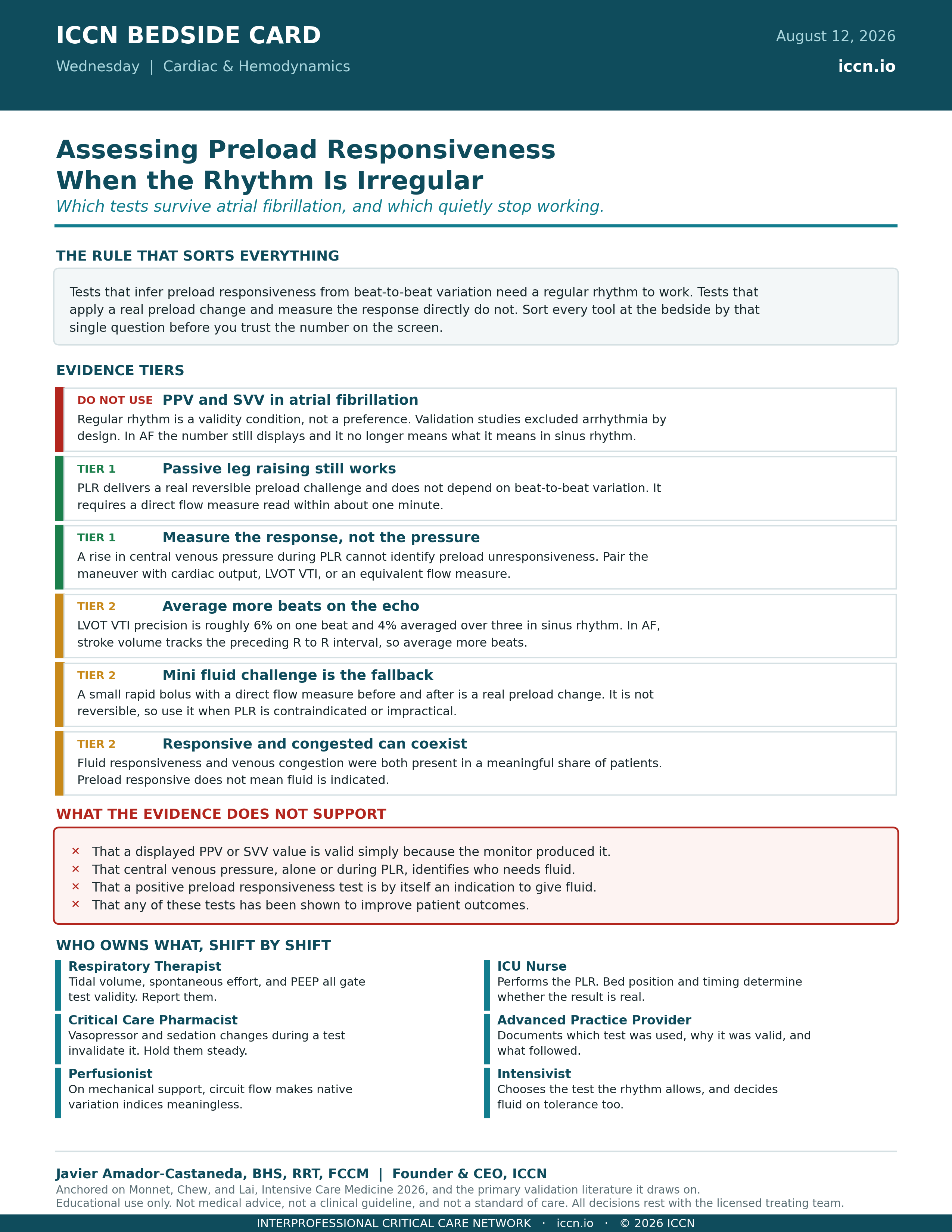
Here is the sorting rule, and it is the whole article in one sentence.
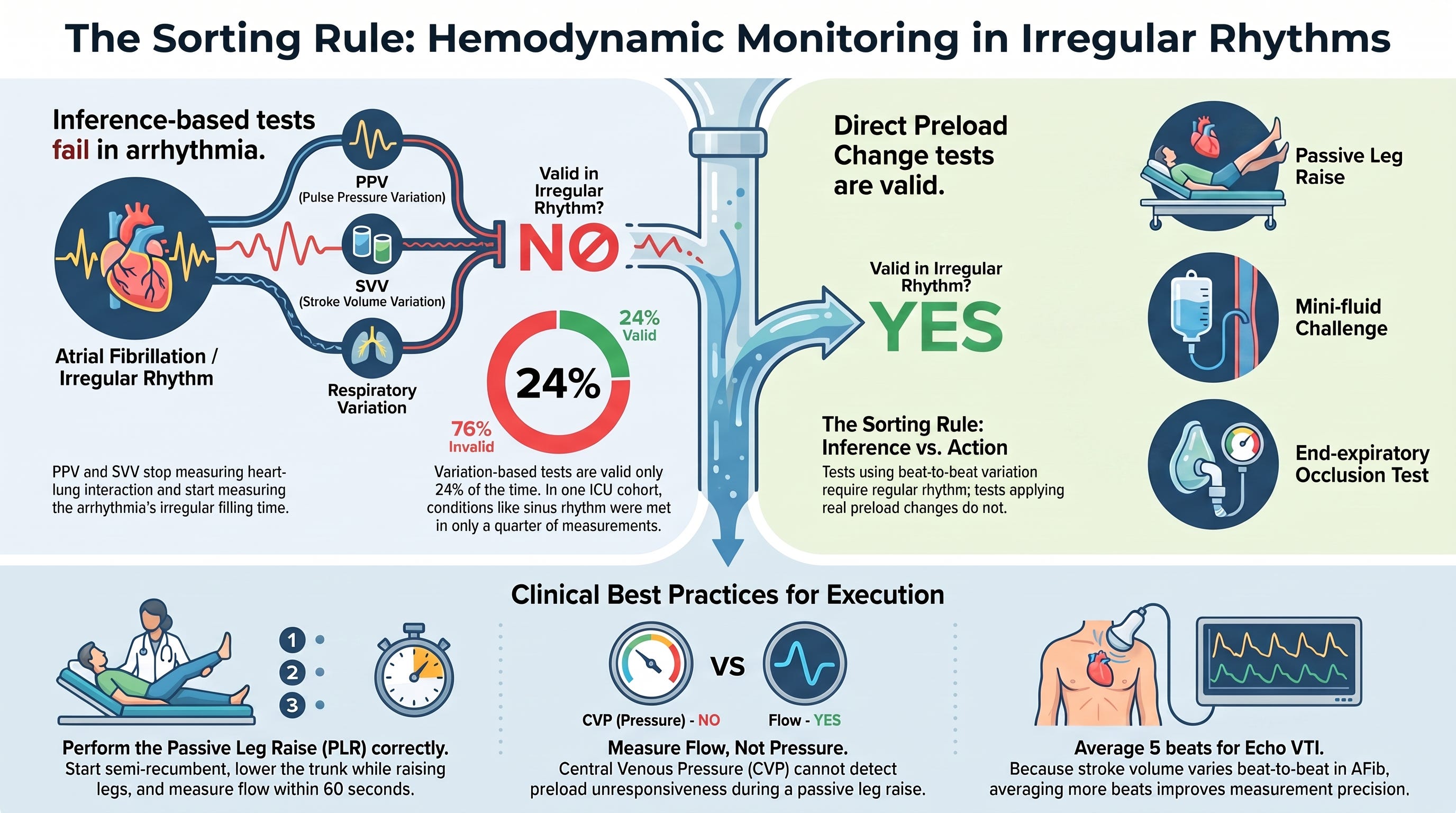
Tests that infer preload responsiveness from beat-to-beat variation require a regular rhythm. Tests that apply a real preload change and measure the response directly do not.
Everything else follows. Pulse pressure variation, stroke volume variation, and the respiratory variation indices all work by watching how much the circulation wobbles as the ventilator cycles. That inference requires that the only meaningful thing changing between beats is the ventilator. In atrial fibrillation, the dominant source of beat-to-beat stroke volume variation is the irregular filling time, not the ventilator. The calculation still runs. It is just now measuring the arrhythmia.
“In atrial fibrillation, pulse pressure variation is no longer measuring the heart-lung interaction. It is measuring the arrhythmia, and reporting the answer in the same units.”
The passive leg raise works on an entirely different principle. It moves roughly a few hundred milliliters of blood from the legs and splanchnic bed into the central circulation, which is a real, reversible preload challenge. Then you measure what the heart does with it. No inference from variation is involved, so the irregularity of the rhythm does not invalidate the logic.
This distinction matters more than it might sound, for a reason that is easy to miss. In one prospective ICU cohort documenting conditions immediately before 1,241 thermodilution measurements in 88 patients, stroke volume variation met its validity conditions of sinus rhythm and controlled mechanical ventilation in roughly 24 percent of measurements.¹ Applicability was highest early after admission and fell over time, and varied enormously by subgroup. That is a single-center study and the exact figure will differ in your unit. But the direction is the point. For most of most ICU stays, the variation-based number on the screen is not interpretable, and nothing about the display communicates that.
Comments
Nothing yet. Say the first thing.
Sign in to join the conversation.