
0:00
-1:45
A JAMA trial reported that a new catheter lock solution reduced central line complications by 32 percent. It did. But the composite that moved was carried almost entirely by one component, and the component every clinician actually worries about contributed five events across 1468 patients. Here is how to take a composite apart.
Here is a number I want you to hold onto: two hundred.
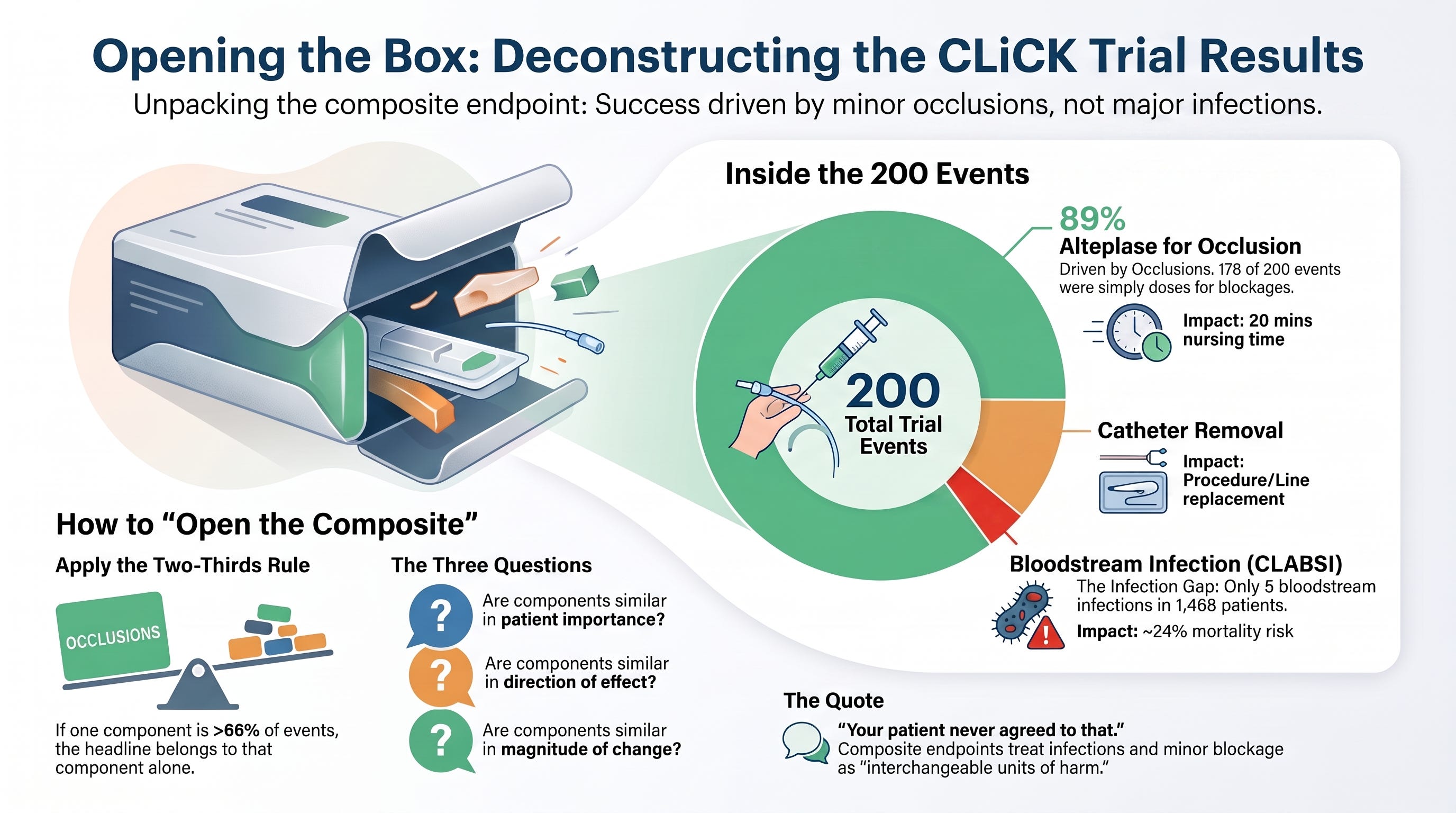
That is the total count of primary outcome events in a trial published in JAMA in May of this year. The CLiCK trial randomized 1468 adult ICU patients across six Canadian hospitals to a 4% tetrasodium EDTA catheter lock solution or to usual care, and its primary outcome was a composite of three things: central line-associated bloodstream infection, catheter occlusion requiring alteplase, and catheter removal because of occlusion.
The composite moved. Thirteen point one events per 1000 catheter-days with the intervention against 19.9 with control. Adjusted rate ratio 0.68, confidence interval 0.47 to 0.96, P equals .03. Number needed to treat, twenty. That is a real result from a triple-blind, cluster-randomized trial, and it deserves to be taken seriously.
Now open the box.
Of those two hundred events, 178 were doses of alteplase given for an occluded lumen. Seventeen were catheters pulled because they were blocked.
Five were bloodstream infections. Two in the intervention arm, three in control, across 1468 patients and nearly twelve thousand catheter-days.
The trial is honest about this. The abstract says so directly, and the discussion says so again. But the summaries will not, and the conversation in your unit will not, because a composite endpoint that includes the word “bloodstream infection” gets remembered as an infection trial. It was not one. It was an occlusion trial that also counted infections and did not find enough of them to say anything.
That gap, between what a composite is called and what a composite is made of, is the subject of this article.
ICCN Update
The new ICCN website is live at iccn.io. Every article published in the past two weeks is now archived in one place, and our new Research section pulls recent published data from 26 major critical care and medical journals into a single curated feed for subscribers. Bookmark iccn.io.
Composite endpoints are everywhere in critical care research, and for defensible reasons. Our event rates are low, our trials are expensive, and pooling several related outcomes into one count buys statistical power that a single outcome cannot afford. Without composites, most of the trials we rely on would be unaffordably large.
But there is a price, and the methodology literature has been describing it for twenty years. Freemantle and colleagues laid it out in JAMA in 2003 in a title that says the whole thing: greater precision, but with greater uncertainty. Montori and colleagues followed in the BMJ in 2005 with the validity criteria. Ferreira-González and colleagues then went and looked at what actually happens in practice, reviewing cardiovascular trials with composite endpoints, and found the pattern that should worry all of us: treatment effects tend to be larger for the less important components and smaller for the most important ones. Cordoba and colleagues found in a 2010 systematic review that composites are frequently defined, reported, and interpreted poorly. Tomlinson and Detsky summarized the whole problem in a JAMA editorial title that I have never improved on: there is no free lunch.
Here is why this matters to you specifically, on a weekday, in a unit.
A composite endpoint is a claim about equivalence. When you pool bloodstream infection with a dose of alteplase, you are asserting, structurally, that those events are interchangeable units of harm. One of each counts the same toward the total. Your patient does not experience them that way. A CLABSI carries roughly 24% mortality in reported cohorts and adds days of ICU stay and tens of thousands of dollars. A dose of alteplase costs a nurse twenty minutes and a delayed antibiotic.
Both are worth preventing. They are not the same thing, and a design that counts them identically will report a result that most readers will attribute to the more frightening component.
“A composite endpoint quietly asserts that its components are interchangeable. Your patient never agreed to that.”
CLiCK was a pragmatic, triple-blind, multicenter, cluster-randomized crossover trial run in six Canadian hospitals, three community and three academic. Enrollment ran from March 2022 to September 2024.
The design choice is worth understanding. Rather than randomizing individual patients, each ICU was randomized to lock every eligible catheter with either 4% tetrasodium EDTA or control fluid for 3.5 months, then observe a one-month washout during which enrollment stopped, then cross over to the other condition for another 3.5 months. The stated reason was to reduce nursing workload, since tracking individual patient randomization status at every lock would have been operationally brutal. That is an honest reason and it improves the odds that what was tested resembles what would actually happen in practice.
The control arm was current usual care: 0.9% sodium chloride for most catheters, and 4% citrate for hemodialysis catheters. Study syringes were prefilled, identical, and masked. Participants, clinical staff, the study team, outcome adjudicators, and the primary data analyst were all blinded. Locking and aspiration technique was identical between arms.
Eligible patients were ICU adults with a central venous access device in place and at least one lumen not in use. All device types were included: nontunneled central venous catheters, PICCs, dialysis and trialysis lines, and implanted devices. Triple-lumen central venous catheters made up about two thirds of the total.
Of 3124 patients screened, 1574 were enrolled and 1468 entered the intention-to-treat analysis, 696 to t-EDTA and 772 to control. Mean age 60, 37.7% female, mean APACHE IV about 82, median catheter days 6. Nearly twenty thousand individual locking events were recorded.
The planned sample size was 1524, powered at 80% to detect a 30% relative reduction in the composite. The trial enrolled 1468, which is 96% of target.
The primary result: 13.1 versus 19.9 events per 1000 catheter-days, adjusted rate ratio 0.68 (95% CI 0.47 to 0.96), P equals .03, adjusted absolute rate reduction 5.1 (95% CI 0.85 to 11.19), NNT 20. A sensitivity analysis using total locking events rather than catheter-days as the offset gave a similar answer.
Four things.
1. The event distribution. Occlusion requiring alteplase supplied 66 events in the intervention arm and 112 in control, for 178 of the 200 total. Catheter removal for occlusion supplied 17. CLABSI supplied 5. When you read that the composite fell by 32%, you are reading, almost entirely, that fewer lumens needed alteplase.
2. Only one component reached significance, and the trial says so. Alteplase-requiring occlusion: rate ratio 0.66, confidence interval 0.46 to 0.96. CLABSI: rate ratio 0.74, confidence interval 0.10 to 4.48, which is an interval so wide it is compatible with a 90% reduction and a fourfold increase simultaneously. Catheter removal for occlusion: rate ratio 0.61, confidence interval 0.21 to 1.60. Two of the three components are uninformative on their own, and the trial reports this plainly rather than burying it.
3. Two secondary outcomes pointed the other way. Catheter colonization occurred 11 times with t-EDTA and 5 times with control, rate ratio 2.54, confidence interval 0.84 to 8.66. Thrombosis occurred 9 times versus 6, rate ratio 1.65, confidence interval 0.59 to 4.94. ICU mortality gave a rate ratio of 1.10, confidence interval 0.86 to 1.41. None of these is statistically distinguishable from chance, and the investigators are appropriately cautious, noting that the absence of standardized catheter removal and microbiological testing protocols and the sheer rarity of these events preclude conclusions. I agree with that. I also think a reader who reports the composite reduction and omits these numbers has not reported the trial.
4. The hemodialysis subgroup showed no benefit. Dialysis catheters were about 10% of devices in each arm, and the composite did not improve in that subgroup. The investigators call for adequately powered future work, which is the right call, and it means that the perfusion and CRRT teams do not yet have an answer for the circuits they manage.
“Two of the three components had confidence intervals spanning a ninety percent reduction and a fourfold increase. Pooling them with a component that moved does not make them informative. It only makes them invisible.”
Why would a chelating agent reduce occlusion more clearly than infection?
The mechanistic story is coherent. Tetrasodium EDTA sequesters divalent cations, calcium, magnesium, and iron, that bacteria require for cell wall integrity and biofilm stability, and it has anticoagulant activity through the same chelation. Biofilm and thrombus in a catheter lumen are not separate problems; Raad and colleagues described the relationship between thrombotic and infectious catheter complications in JAMA three decades ago, and microbiological analysis of removed ICU catheters has found biofilm essentially universally, whether or not clinical infection is present.
So the plausible sequence is that intraluminal debris accumulates early, causes occlusion, and only much later and much less often progresses to clinical bloodstream infection. An agent that keeps the lumen clean would show its effect first and most visibly on the early, common, mechanical problem.
I want to label that carefully. It is biologically plausible and the investigators offer it as their explanation. It is not something this trial demonstrated. The planned biofilm analysis of a convenience sample of catheters was not operationalized because of logistics and cost, so there is no direct evidence from CLiCK about what happened inside the lumens.
There is also a simpler and less interesting explanation available, and honesty requires naming it. Median ICU stay in this trial was six days, and only three days at the cardiac surgery site. All five CLABSI events occurred in patients with catheters in place for at least seven days. In a population where most catheters come out before the infection risk period really begins, a trial will struggle to detect an infection effect no matter how real it is. The trial was not underpowered for infection because infection does not respond to the intervention. It was underpowered for infection because the population barely had time to develop any.
That distinction matters enormously for what happens next. It means CLiCK neither supports nor refutes an infection benefit. It means the question is open.
And that is exactly where the surrounding literature gets uncomfortable. The Chakraborty 2025 meta-analysis in Infection Control and Hospital Epidemiology pooled eight studies and reported that EDTA significantly reduced catheter-related and central line-associated bloodstream infection and reduced colonization, while having no effect on thrombolytic treatment or mortality. CLiCK reports close to the mirror image: a clear thrombolytic effect, no detectable infection effect, and numerically more colonization in the EDTA arm.
Those two accounts cannot both be complete. The meta-analysis drew heavily on long-dwell populations, home parenteral nutrition and pediatric intestinal failure, where catheters stay for months and infection is the dominant failure mode. CLiCK studied a short-dwell ICU population where occlusion is the dominant failure mode. The most likely reconciliation is that dwell time determines which component you are able to see, which is a hypothesis rather than a finding, and one that a longer-follow-up trial could test directly.
“The same intervention looks like an infection therapy in a population with catheters for months and an occlusion therapy in a population with catheters for six days. Before you argue about whether it works, establish which question your unit is actually asking.”
1. Nurses: this trial’s finding is about your time, and that is not a small thing.
Every one of the nearly twenty thousand locks in this study was performed by ICU nursing staff. The reduction the trial actually demonstrated is fewer occluded lumens requiring alteplase, which means fewer interruptions, fewer delayed infusions, and less time troubleshooting a line that will not draw. The investigators name this explicitly and connect it to the global nursing shortage. When this trial is discussed in your unit, the honest headline is a workflow and throughput finding, and nursing should be the voice that says so.
2. Pharmacists: own the alteplase denominator before you own the formulary question.
The most concrete lever here is measurable in your own data. Pull your unit’s alteplase administrations per 1000 catheter-days for the last year. That number tells you whether the problem CLiCK solved is a problem you have. A unit with low baseline occlusion has little to gain from a 34% relative reduction, and an NNT of 20 against a rare event is a different economic proposition than an NNT of 20 against a common one.
3. Intensivists: correct the framing in the room before it reaches the policy document.
The specific failure mode to prevent is a value analysis committee reading “reduced central line complications including bloodstream infection” and approving a purchase on infection-prevention grounds. That would be an evidence error, not a purchasing error. The trial supports an occlusion claim. It is silent on infection. Whoever presents this internally should say both sentences.
4. APPs: the intervention with the best evidence in this space is still line removal.
Nothing in this literature displaces the daily question of whether the catheter is still needed. Pronovost and colleagues demonstrated two decades ago what a systematic bundle does to catheter-related bloodstream infection in the ICU, and necessity review remains the highest-yield element of it. A lock solution reduces the risk attached to a line that exists. Removal eliminates it.
5. Respiratory therapists: you share these lumens, and you see occlusion early.
Sedation infusions, vasoactive agents, and the lines we access during transport and procedures run through the same devices. An RT who notices sluggish flow or a lumen that will not aspirate during a repositioning or a transport is often the first person to detect an occlusion, and reporting it before it becomes an alteplase event is a genuine contribution to the outcome this trial measured.
6. Perfusion and CRRT teams: you do not have an answer yet, and that should be stated.
The hemodialysis catheter subgroup showed no improvement in the composite. Dialysis catheters in the control arm received 4% citrate, which is an active comparator rather than saline, so this subgroup was testing a harder question. Whatever your institution decides about central venous catheters, the dialysis circuit question remains open and should not be settled by extension.
Here is the portable version, and it takes about thirty seconds on any composite endpoint trial.
Find the component event counts and calculate what fraction of the total came from the least serious component. If that fraction is above roughly two thirds, the trial’s headline belongs to that component, whatever the composite is named.
For CLiCK: 178 of 200, which is 89%.
Then ask the follow-up that Ferreira-González and colleagues taught the field to ask: are the components of similar importance to a patient, and did they move in the same direction and by similar magnitude? When the answer is no on any of those three, the composite has combined things that should have been reported separately, and your job as a reader is to do the separating the design did not.
Most composite trials will not hand you this cleanly. CLiCK does, in a table, which is to the investigators’ credit and is part of why it makes such a good teaching case.
We should not assume CLiCK shows that t-EDTA does not prevent bloodstream infection. It shows that a trial with five total CLABSI events cannot detect an infection effect of any size. Those are entirely different statements, and the second one is the true one.
We should not assume the colonization and thrombosis signals represent harm. Eleven versus five and nine versus six, with confidence intervals crossing 1.0 by wide margins and no standardized removal or culture protocol, is noise-compatible. It is also not nothing, and the correct posture is to record it and watch for it in the next trial rather than to dismiss or to alarm.
We should not assume the composite result is invalid. It is a legitimate, prespecified, adequately analyzed primary outcome, and the design was rigorous in ways many ICU trials are not: triple blinding, identical technique, cluster crossover, an active comparator for dialysis lines, and no missing primary outcome data. Opening a composite is not the same as rejecting it.
We should not assume the protocol adherence subgroup finding means the intervention works better than the headline suggests. Patients with at least 80% study syringe adherence showed a rate ratio of 0.66 against 0.88 in the less adherent group, but that analysis is explicitly post hoc, and adherence is not randomized. Units and patients with better protocol adherence differ from those without in ways that also affect outcomes.
And we should not assume industry funding invalidates the result. The manufacturer supplied a grant-in-aid and the investigational product, which is disclosed, and the reported funding statement records no funder role in design, conduct, analysis, or publication decisions. The correct response to that disclosure is heightened attention to how the result is framed downstream, not dismissal of the trial itself.
The trial did not reach its planned sample size, enrolling 1468 of 1524, though 96% of target is a modest shortfall.
Follow-up ended at ICU discharge because of logistical and funding constraints, so any effect appearing after ICU stay is unmeasured. Given that all CLABSI events occurred in catheters dwelling at least seven days and the median stay was six days, this truncation is likely to matter for the infection question specifically.
The trial spanned pandemic and post-pandemic periods, requiring the addition of a sixth ICU mid-study when admissions fell. The investigators argue that stratified allocation of unit pairs, the cluster crossover structure, and the limited nine-month site duration address time bias, which is reasonable but not a guarantee.
CLABSI was used rather than catheter-related bloodstream infection. The investigators chose it deliberately for comparability with surveillance reporting and because it does not require systematic catheter testing, and they acknowledge that catheter-related bloodstream infection is the more rigorous measure.
Baseline antibiotic and anticoagulant use was higher in the t-EDTA arm (87.1% versus 79.0% and 68.8% versus 62.4%), which is a real imbalance in a cluster design. It was handled with covariate adjustment in the regression model, which is the standard approach and is not the same as randomization having balanced it.
The planned biofilm analysis was not performed, so the proposed mechanism remains untested within this trial.
Secondary outcome event counts were small enough that the investigators themselves state interpretation is limited.
CLiCK is a rigorous, well-blinded, honestly reported positive trial, and it is about occluded catheters.
The composite fell from 19.9 to 13.1 events per 1000 catheter-days, rate ratio 0.68, NNT 20. That result is real. But 178 of the 200 total events were doses of alteplase for a blocked lumen, only that component reached significance on its own, and the component clinicians most fear contributed five events across 1468 patients and produced a confidence interval spanning a 90% reduction and a fourfold increase. Colonization and thrombosis were numerically higher with the intervention and neither is resolved. The hemodialysis subgroup showed no benefit. Mortality and length of stay were unchanged.
What that adds up to is a defensible claim that t-EDTA locking may reduce catheter occlusion and the nursing and pharmacy burden that comes with it, and no claim at all, in either direction, about bloodstream infection in a short-stay ICU population.
The skill I want readers to carry forward is not about catheter locks. It is that a significant composite is the beginning of the reading, not the end of it. Find the component counts. Ask whether the components are comparable in importance. Check whether any of them moved the other way. That takes half a minute, and it is the difference between reporting a trial and repeating a headline.

The provided text examines the CLiCK trial, a study evaluating the effectiveness of a tetrasodium EDTA catheter lock solution in reducing intensive care complications. While the study reported a significant 32 percent reduction in a combined endpoint, the author reveals that 89 percent of those events were merely minor catheter blockages rather than serious infections. This analysis highlights a common issue in medical research where composite endpoints can mask the fact that a treatment may not actually impact the most dangerous clinical outcomes. By deconstructing the data, the source argues that the intervention primarily serves as a workflow and maintenance tool for nursing staff rather than a proven solution for preventing bloodstream infections. Ultimately, the text serves as a critical guide for clinicians to look beyond headlines and independently evaluate the individual components of research results.
Ornowska M, Wittmann J, Blitz S, et al. 4% tetrasodium EDTA to prevent central venous access device-associated complications: a randomized clinical trial. JAMA. Published online May 18, 2026. doi:10.1001/jama.2026.6025
Ornowska M, Wong H, Ouyang Y, et al. Control of Line Complications With KiteLock (CLiCK) in the critical care unit: study protocol for a multi-center, cluster-randomized, double-blinded, crossover trial. Trials. 2022;23(1):719. doi:10.1186/s13063-022-06671-5
Ornowska M, Smithman J, Reynolds S. Locking solutions for prevention of central venous access device complications in the adult critical care population: a systematic review. PLoS One. 2023;18(10):e0289938. doi:10.1371/journal.pone.0289938
Ornowska M, Wittmann J, Reynolds S. Central venous access device locking practices in the adult critical care setting. Br J Nurs. 2022;31(19):S16-S25. doi:10.12968/bjon.2022.31.19.S16
Chakraborty S, Bhattacharya S, Ghosh A, Chatterji S. Role of EDTA lock solution in preventing catheter-related bloodstream infections or central line-associated bloodstream infections: a systematic review and meta-analysis. Infect Control Hosp Epidemiol. 2025;46(10):1035-1042. doi:10.1017/ice.2025.10246
Takashima M, Schults J, Mihala G, Corley A, Ullman A. Complication and failures of central vascular access device in adult critical care settings. Crit Care Med. 2018;46(12):1998-2009. doi:10.1097/CCM.0000000000003370
Pronovost P, Needham D, Berenholtz S, et al. An intervention to decrease catheter-related bloodstream infections in the ICU. N Engl J Med. 2006;355(26):2725-2732. doi:10.1056/NEJMoa061115
Mermel LA, Allon M, Bouza E, et al. Clinical practice guidelines for the diagnosis and management of intravascular catheter-related infection: 2009 update by the Infectious Diseases Society of America. Clin Infect Dis. 2009;49(1):1-45. doi:10.1086/599376
Raad II, Luna M, Khalil SA, Costerton JW, Lam C, Bodey GP. The relationship between the thrombotic and infectious complications of central venous catheters. JAMA. 1994;271(13):1014-1016. doi:10.1001/jama.1994.03510370066034
Parienti JJ, Thirion M, Mégarbane B, et al; Cathedia Study Group. Femoral vs jugular venous catheterization and risk of nosocomial events in adults requiring acute renal replacement therapy: a randomized controlled trial. JAMA. 2008;299(20):2413-2422. doi:10.1001/jama.299.20.2413
Montori VM, Permanyer-Miralda G, Ferreira-González I, et al. Validity of composite end points in clinical trials. BMJ. 2005;330(7491):594-596. doi:10.1136/bmj.330.7491.594
Ferreira-González I, Busse JW, Heels-Ansdell D, et al. Problems with use of composite end points in cardiovascular trials: systematic review of randomised controlled trials. BMJ. 2007;334(7597):786. doi:10.1136/bmj.39136.682083.AE
Freemantle N, Calvert M, Wood J, Eastaugh J, Griffin C. Composite outcomes in randomized trials: greater precision but with greater uncertainty? JAMA. 2003;289(19):2554-2559. doi:10.1001/jama.289.19.2554
Cordoba G, Schwartz L, Woloshin S, Bae H, Gøtzsche PC. Definition, reporting, and interpretation of composite outcomes in clinical trials: systematic review. BMJ. 2010;341:c3920. doi:10.1136/bmj.c3920
Tomlinson G, Detsky AS. Composite end points in randomized trials: there is no free lunch. JAMA. 2010;303(3):267-268. doi:10.1001/jama.2009.2017
Lim E, Brown A, Helmy A, Mussa S, Altman DG. Composite outcomes in cardiovascular research: a survey of randomized trials. Ann Intern Med. 2008;149(9):612-617. doi:10.7326/0003-4819-149-9-200811040-00004
This content is provided for professional education and does not constitute medical advice. It is not a substitute for clinical judgment, institutional protocol, or individualized patient assessment. Catheter lock solution selection, thrombolytic use for catheter clearance, and vascular access device management require interprofessional evaluation and institutional governance. Readers should consult primary sources, infection prevention leadership, and current guidelines before changing practice.
Javier Amador-Castaneda, BHS, RRT, FCCM
Founder and CEO, Interprofessional Critical Care Network
No posts
Comments
Nothing yet. Say the first thing.
Sign in to join the conversation.