
I came across a photographer on Instagram, who I thought had an incredible eye and a keen sense of timing as a street photographer. His compositions brought a sense of beauty and order to what would otherwise be scenes of chaos. I know from experience the challenge of making such photographs, and I was impressed by his apparent talent.
A street photograph often consists of fixed and fluid elements that make up the composition. Fixed elements are things that do not move, that will not change from second to second. Fixed elements include buildings, signs, kiosks, sidewalks, streetlights, and waste bins. These are things that help the photographer to compose before a moment reveals itself. This is the foundation that street photographers who “fish” rather than “hunt” rely on.
The fluid elements are those things that shift and change from moment to moment. They are people, cars, bicycles, birds, dogs, light, and shadow. These transitory things are what make a scene change over the course of seconds and minutes. This is the heart of the theater of the street, the performance that the photographer hyperfocuses on, hoping for that magical moment of synchronicity when elements both fixed and fluid converge into something both beautiful and surprising.
This is the hardest skill to develop as a street photographer because it relies on anticipation. It is the ability to look at multiple disparate elements, moving in and out and throughout the frame, and to make a calculation. What do you include in the frame? What do you exclude? Where do things need to be? When is the right moment to depress the shutter release button so that every puzzle piece falls into place?
Years of experience allow a photographer to hone this skill. It does not guarantee a result, but it increases the likelihood that when that magical convergence happens, the photographer is ready. The reality is that most photographers, even the most seasoned, miss more than they get. However, they recognize that the reinforcement of that keen awareness of the fixed and the fluid is the muscle that needs to be exercised every time they make a photograph.
So, with that understanding, I came to this photographer’s work. It was when he shared posts demonstrating how he creates his images using software that my perspective shifted. In those videos, he demonstrated how he eliminated multiple distracting elements using the Remove Tool and Generative Fill. I was disappointed that the results he achieved were more reliant on software than on an in-the-moment practice.
I appreciate his honesty about how he achieved his images, which are admittedly very beautiful. I did, however, take issue with his use of the hashtag “street photography” when posting. To me, that tag defines not just the photographs themselves, but the practice involved in creating them. Speaking for myself, images identified as street photographs follow a certain approach that does not involve the deletion of distracting elements. Though street photography need not adhere to the stringent post-processing rules of photojournalism, deleting elements that existed in the moment makes it a photograph, not a street photograph.
I have countless images where a distracting element ruined an otherwise good photograph. It is frustrating, and I feel it in the moment. It is when a white car enters the frame, or someone walks in front of my camera. Most of the time, I am aware of it as I depress the shutter release button, rather than discovering it later on my computer screen. It is an awareness that keeps me in place, working through the scene, pushing past feelings of frustration and disappointment, hoping that the next second will fulfill the potential that I had sensed initially, and prompting me to bring the camera to my eye.
Countless little things have helped keep what could be a great photograph just out of my grasp. It is disappointing, sometimes maddening, but it is part of the process. It is the price of admission.
I have many photographs that could be improved with modern photo editing software, but I choose not to use it. I forgo not out of a sense of moral superiority. I do so because I know that I would look at those images and be reminded I had missed the moment. Using Generative Fill tools would make the resulting image a fabrication of what I wanted the moment to be, but not what it actually was.
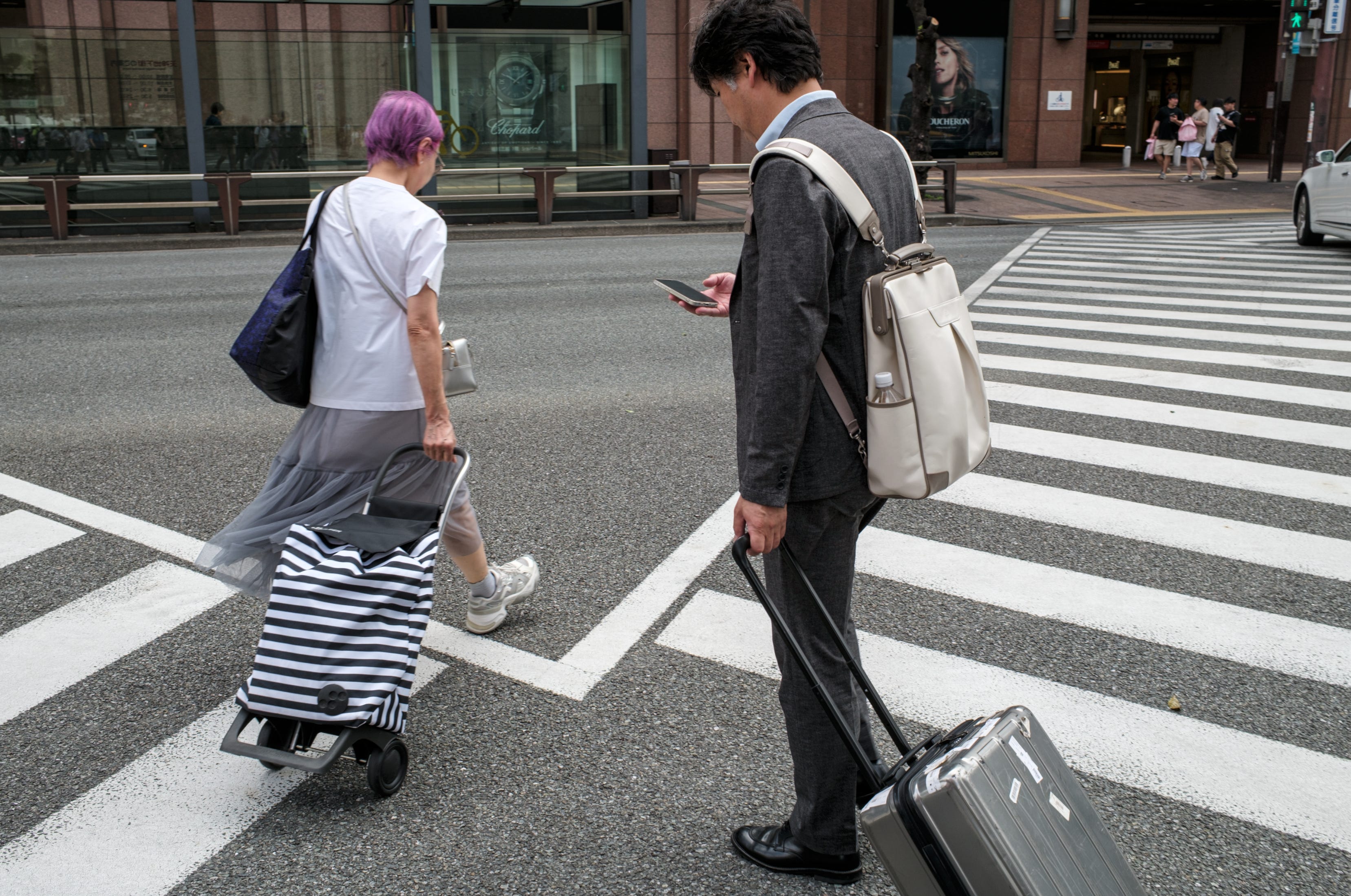
The image in this post is a perfect example. The image would have worked had it not been for the car in the upper right-hand corner. I was aware of it while crossing the intersection in Japan. I was actively shifting my position and my camera, trying to eliminate it, but couldn’t. The interplay between the two figures was great, as was the pattern of the woman’s shirt mirroring the stripes of the sidewalk.
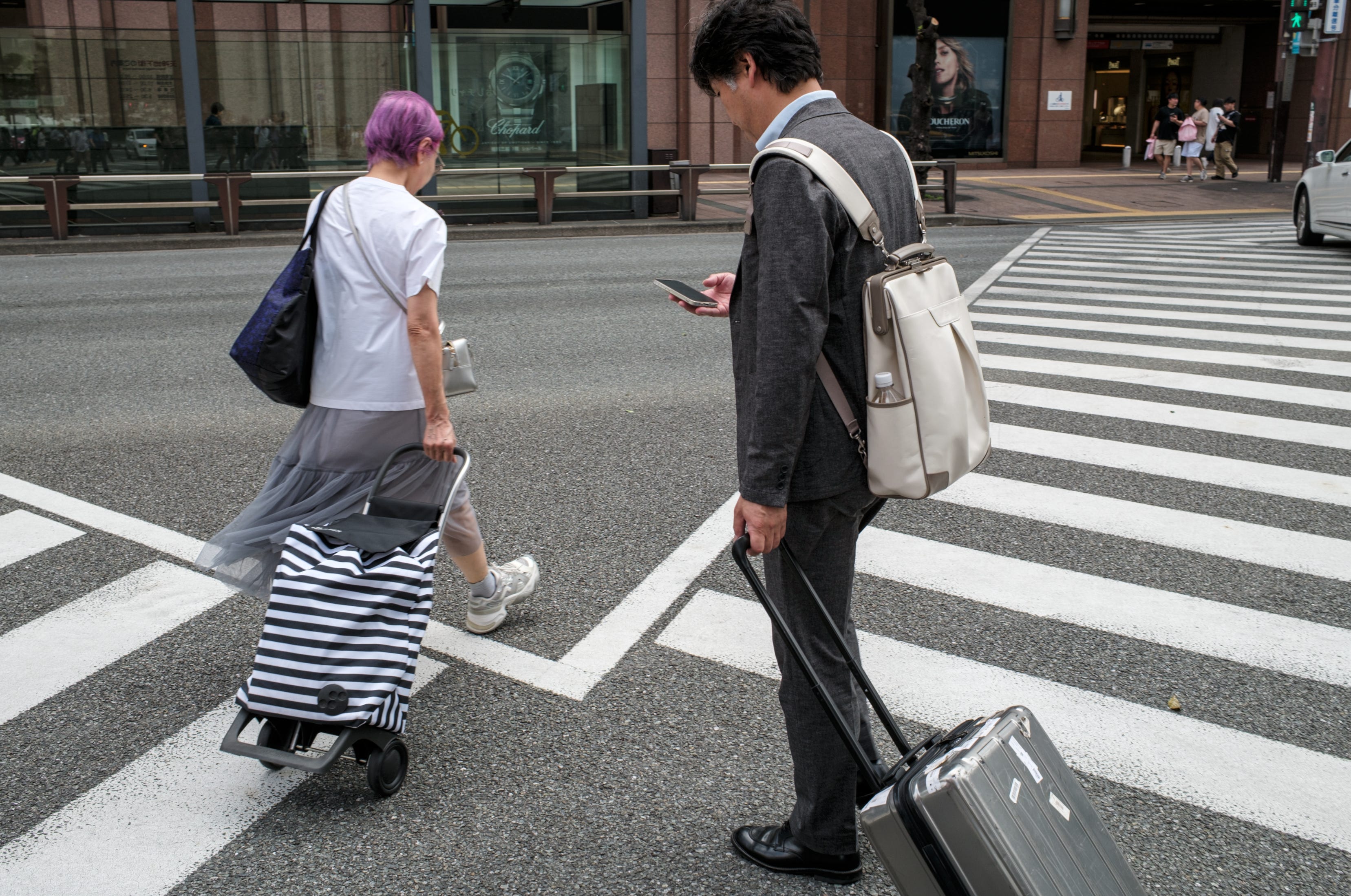
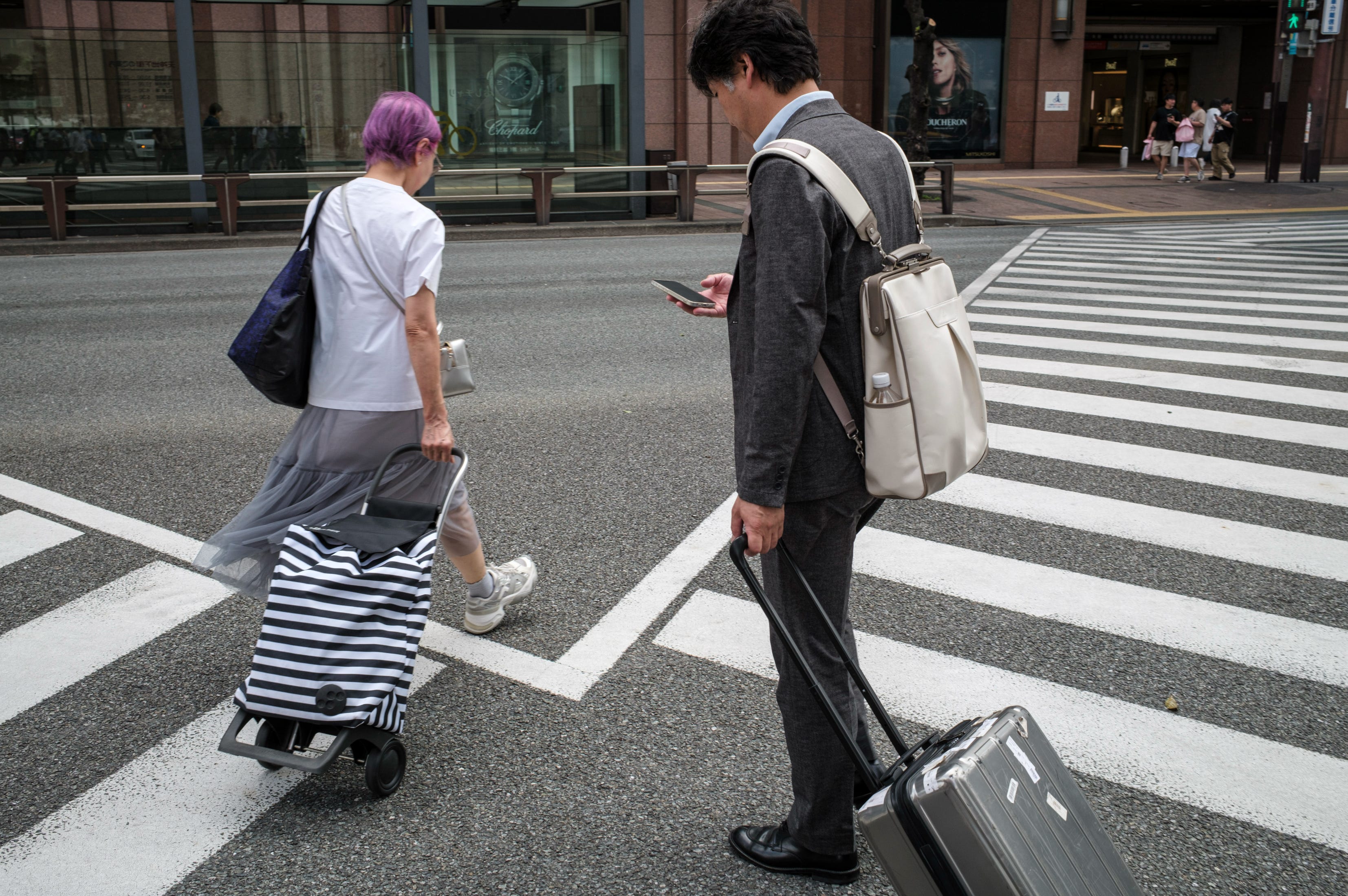
The car ruined the shot for me. I used Generative Fill to create the scene as I would have preferred it. It confirms that the car was not present; the photograph would have succeeded. However, I would not choose to delete the car and include that photograph among a selection of spontaneously created images. It would be dishonest, as the viewer would assume that such an image, along with the other, was composed in-camera and not fabricated.
I make this choice not because of a purist sensibility that I believe everyone should adhere to. I do it simply because every time I look at such an image, my first thought is that I missed the moment and had to fix it with software. It would rob me of any sense of joy in what I had achieved in the moment, in camera.
It is such a satisfying and exhilarating feeling to know I have captured the moment on camera. It is a feeling that I am always in pursuit of. Succumbing to the temptation to fix later in post, I fear, would make me less persistent about capturing moments spontaneously. Why push that hard when I could so easily fix it in Photoshop?
I do not take anything away from the photographer and anyone who chooses to use photo-editing software in this way. If this is how they express their photographic creativity, I vehemently defend their right to do so if they are upfront about their practice and do not claim the results were achieved entirely in camera.
For me, the pursuit of the spontaneously created street photograph drives my creative hunger, and it will never be satiated by anything else.
Comments
Nothing yet. Say the first thing.
Sign in to join the conversation.