
For many years, psychologists were content that animals and children could respond to images in learning and discrimination tasks. Richard Herrnstein (of Bell Curve infamy) famously argued in the 1960s that pigeons could have “concepts” (Herrnstein & Loveland, “Complex Visual Concept in the Pigeon,” Science, 1964). In a related vein, Julian Hochberg raised his child without exposure to pictures, magazines and television and tested him with books, finding that the child understood them with little difficulty upon presenting them for the first time (“Pictorial Recognition as an Unlearned Ability,” American Journal of Psychology, 1962).
As the cultural relativism of Nelson Goodman or Melvin Herskovits morphed into postmodern skepticism, it was natural to turn to findings such as these as proof that our responses to images are not completely conventional. Because, after all, couldn’t children and animals respond to them? The philosophy Arthur Danto used the findings of Herrnstein in particular to argue for “The Pigeon within Us All” (Beyond the Brillo Box). The sentiment was more or less this: can we please stop entertaining outrageous theses about the completely conventional nature of pictures and move on to more interesting topics (like, what is art?)?
It’s easy to accept Danto’s sentiment without the actual evidence marshalled on his behalf, because a great deal of research findings suggest that reactions to images do not necessarily reflect pictorial ability at all but merely perceptual object recognition. In other words, images are indeed being responded to, but more as proxies or substitutes for reality, rather than as pictures qua pictures.
Work by scholars like Juan Delius (“Picture-object Recognition in Pigeons,” 2000) or Joel Fagot (“Picture Perception in Birds,” 2010) point out how pigeons have different visual systems leading us to question whether they should have similar responses to images as us (for example, using a video display, the flicker fusion point of their eyes might not even register the image!). Fagot in fact argues that even in anthropoids there is little evidence of understanding of images as signs (if so, it may only be with bonobos and chimpanzees). In one experiment with Claire Parron, a pictorially naïve baboon eats a picture of a banana. The monkey clearly registers the stimulus with “confusion.”
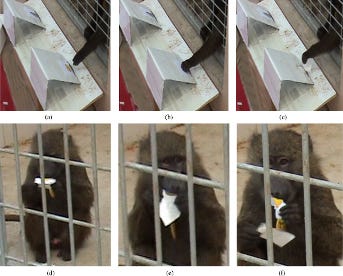
If these results rebut, in a sense, the early optimism of Herrnstein, something similar has happened to the child studies of Hochberg. There are ways to note a differential response by infants to a picture of a thing versus the thing itself in shorter inspection time. Similarly, we can observe babies (of about 9 months) presented with a thing and a picture of a thing to reach for the former.
Most interestingly, when just images are given to these same babies, we can find them manually exploring them, touching them, attempting to pick them up, and put them in their mouths. Judy DeLoache in now-classic experiments recorded these babies more or less treating the depicted items as if they were the things themselves (“The Origins of Pictorial Competence,” 2003). In other words, like the baboons, the small children operated under a condition of confusion.
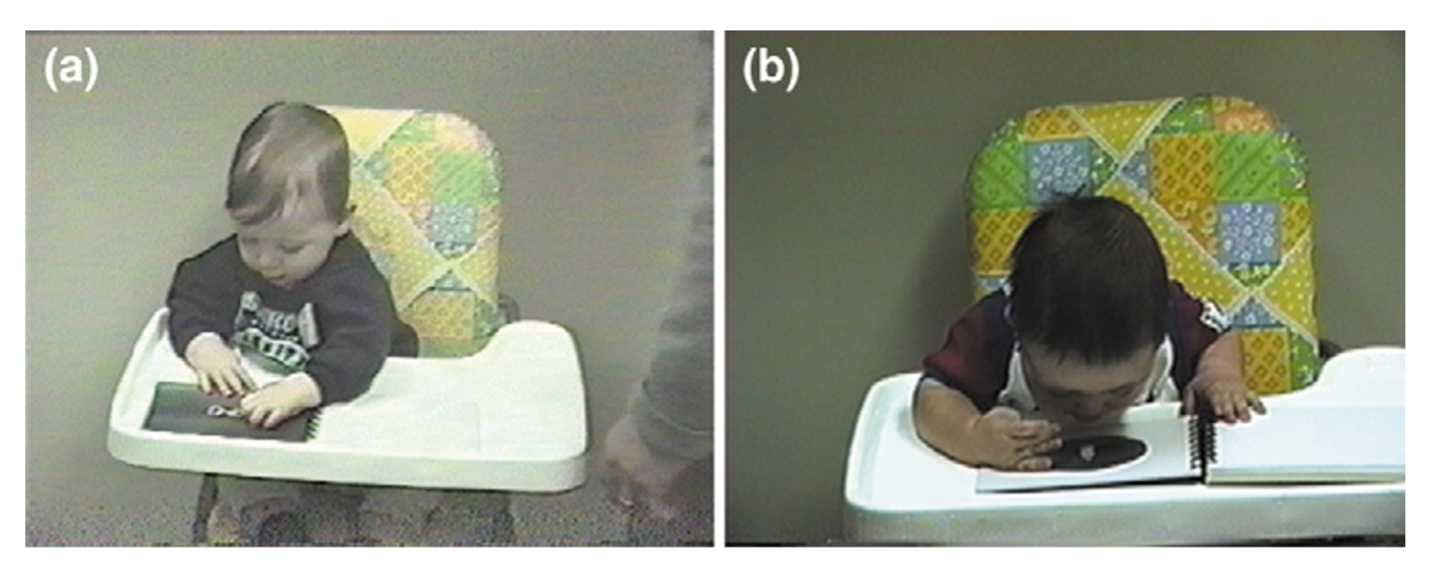
Subsequent research has nuanced these findings. For example, it has been argued that using images that don’t make neat figures on a ground (like cars, or keys) like texture elicits similar behavior. Therefore, it is more difficult to assert that there is full-blown confusion. Also, if an experimenter provides the image next to the real thing, then the exploratory behavior ceases immediately. Therefore, there are bounds to the level of confusion.
In any case, the lesson is clear. Interacting with images is not direct evidence of understanding of pictures. There are many ways to test whether or not the animal or child is treating the depicted object as a sign of the referent and not as the object itself. The two cases reveal pictorial representation-object conflation. And similar cases can be investigated in evolution and in other domains.
No posts
Comments
Nothing yet. Say the first thing.
Sign in to join the conversation.