
This post is inspired by the remarkable independent arrival at two graphic models of human consciousness and pictorial consciousness. The first is from the German Gestalt psychologist, Wolfgang Metzger, which he used in his standard textbook, Psychologie (various editions). The actual diagram used here, however, comes from an article in English espousing his critical realist epistemology. The second diagram is devised by the developmental psychologist Lynn Liben.
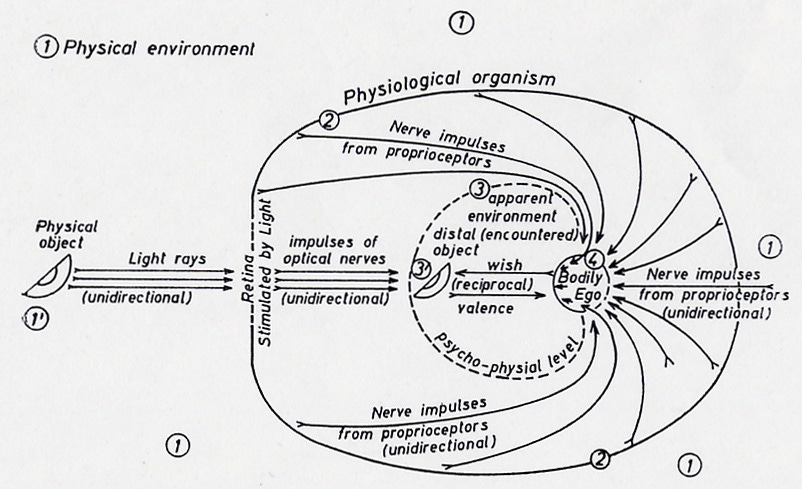
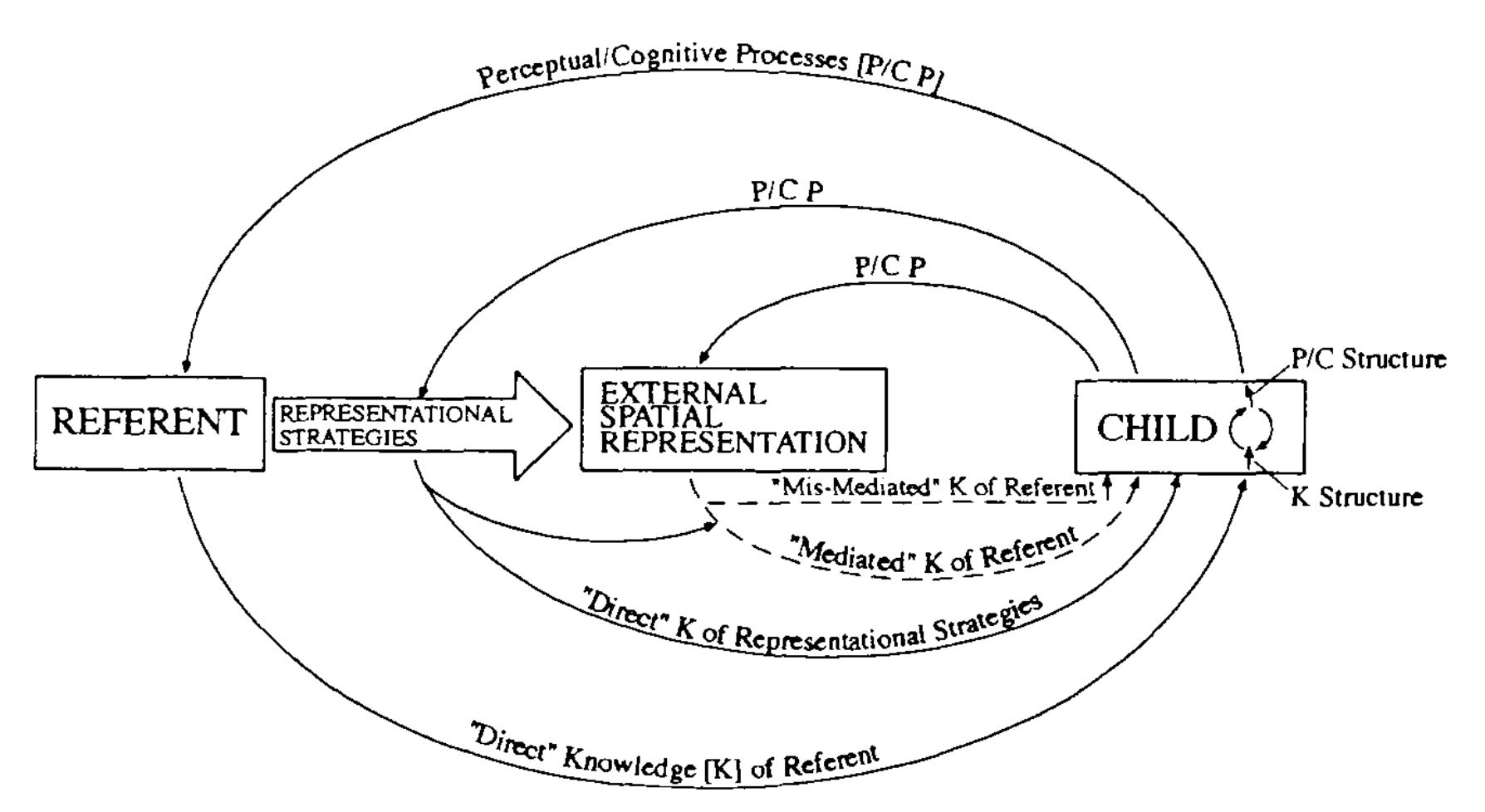
Studying the two diagrams, we have a basic consonance:
Perceiving the World Perceiving a Picture
Principal Node “Bodily Ego” “Child”
Constructed “Apparent Environment” “External Spatial Representation”
External Element “Physical Object “Referent”
There is no like element in Metzger’s diagram to correspond to Liben’s “’Direct’ Knowledge [K] of Referent, but one could easily posit physical invariant relations, like bumping into a wall, that give “direct” acquaintance with the external physical world. Interesting is the feedback between the environment and ego in Metzger and the “’Mediated’ K of Referent” and “’Mis-mediated K of Referent.” Metzger posits the motivational valence between the ego and perceived environment but they have a nice, parallel meaning.
What we essentially see is that each author in different ways is spelling out the same mediated nature of different kinds of representations, one of the world and the other of pictures. Typically in epistemology when we argue that the qualities of our experience are at least partially different from the qualities of the external world, we are talking about critical realism. What will be fascinating to investigate are fruitful connections between these two models.
In explaining the reality of qualia, precisely those kinds of representations that do not align with reality, philosopher Gary Hatfield (“Reality of Qualia”) avoids a sense-data account (that we see third things) by affirming that we do see representations: “These representations, these phenomenal experiences, are not that which we see, but that by which we see.” One could make a similar argument about mental images, for example, by improvising the idea – rejected by Evan Thompson in “Look Again” (2007) – that “what one remembers is the past occurrence, not the mental image, but that one remembers the past by way of the mental image” (152).
It is interesting to see that some similar locutions occur also in the pictorial realm. In “Eye and Mind” (1961), Maurice Merleau-Ponty remarks on the wall paintings of Lascaux in a remarkable way: “I would be at great pains to say where is the painting I am looking at. For I do not look at it as I do at a thing; I do not fix it in its place. My gaze wanders in it as in the halos of Being. It is more accurate to say that I see according to it, or with it, than that I see it (je vois selon ou avec lui plutôt que je ne le vois pas)” Modern versions of this approach are Rob Haskins writing of representational inflection or Emanuel Alloa and “seeing with.”
Does this mean that seeing the world is like seeing a picture? No. To borrow from Husserl, seeing is a presentation while pictures are kinds of re-presentations. Metzger’s diagram merely shows the indirectness between perceived object and experience. The drawing or representation reflects the same mediated quality. The primordiality of direct experience is not reflected in pictorial experience of real objects but instead the primordiality of the physical substrate of the picture, the “phonemic or graphic appearance that offer up audio-video data” (Eldridge, “Depicting and Seeing-In,” 2018)
No posts
Comments
Nothing yet. Say the first thing.
Sign in to join the conversation.