
Countless archeologists and historians have taken inspiration from biological, ethological and evolutionary psychological studies to argue for the naturalness of images; we are, they argue, homo pictor. This makes images part of our human inheritance – “innate” or “hard-wired.” What often follows is the smuggling of the normative elements of such historical preferences into discussions of contemporary art behavior, describing an apparent proclivity (we effortlessly understand images) becomes proscriptive (only images that reinforce these proclivities will be successful).
On one hand, the error is overcome by understanding that preferences are mere tendencies and not actual probabilities. But a more grave error is that evolution can actually tell us much different things. Let’s flip things on their head to look at those physical anthropologists who interpret human evolution extremely gradually. This means that relatively large brain sizes and the complexity of behavior are quite old. Now we can no longer artificially separate the unfortunate Neanderthals (and any number of other “species”) from modern humanities (The image of the dumb Neanderthal is remarkably persistent, at once another species yet somehow – contrary to the definition of species – contributing to our modern gene pool). Once we have more or less “psychological modernity” for hundreds of millennia, then it becomes harder to argue for innate behaviors because we then have to account for when they appear or are discovered. Examples are the emergence of visual pantomime, language, image making, and written language. The psychologically modern human is not really anatomically different before and after each discovery, so we feel the full weight of a real explanation. How could it have happened? What’s actually natural about the image?
Honestly, we see how a lot of theories cheat or use a certain kind of event to explain away our problem. Thus, in the evolution of language we have “big bang” explanations (Bickerton) which in the eyes of others appears to be simply “God-given” (Wolfgang Wildgen). The most common of these is simply to identify some behavior – language, image making, with an event of speciation. The “symbolic behavior” comes wrapped up in some genetic change, or mutation, resulting in the modern allele. This is, in the words of John Hawks, behavior change by taxonomy. In a post, “A Look at the Intentional Markings of Homo erectus,” he writes: “the taxonomic question is boring-who cares what species we call them? We cannot answer the cognitive question by citing taxonomy; we must examine what we know of their behavior.” This cancels all variety of silver bullet explanations, from megadroughts and volcanic winters to projectile weapons, anything posited to be responsible for some rapid speciation, punctuated equilibrium, saltation that on the backend can coincide with some element of modernity.
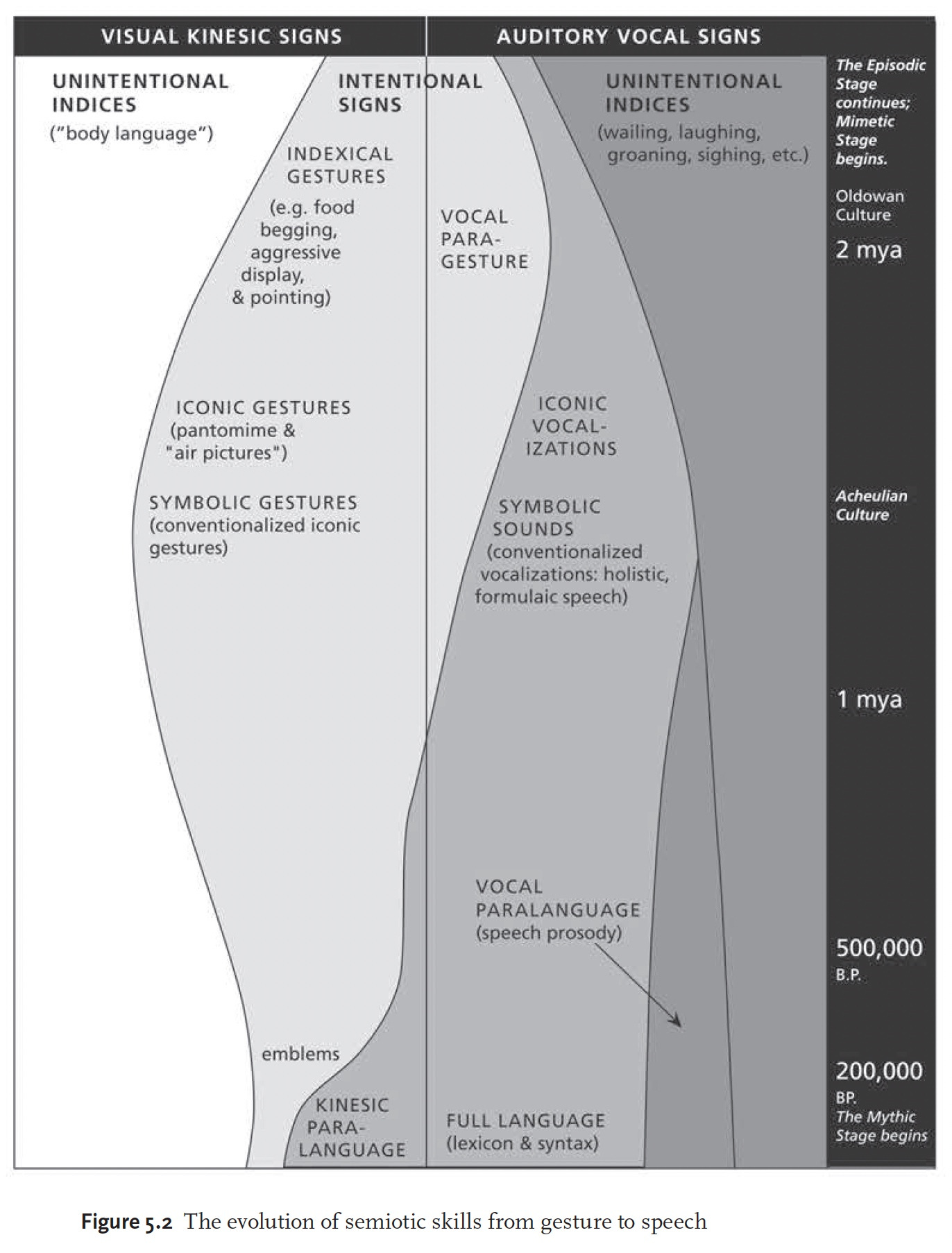
Without such explanations, how do you explain image making? That’s when real cognitive archeology, phenomenology and semiotics begins. What we find in a variety of authors are cases of excruciatingly slow development of what are in retrospect apparently simple semiotic competences. Looking at Christopher Collins’ diagram above, from his Paleopoetics, shows how over 2 million years hominids developed communicational resources, eventually (almost) taken over completely by auditory vocal signs. We have to imagine something similar happening with images, where pantomime and gesture accompanied visual signs that simply contributed to the pragmatics of the story, only to emerge tens of thousands of years later as quasi-independent. Here’s to explanations of excruciatingly slow processes!
No posts
Comments
Nothing yet. Say the first thing.
Sign in to join the conversation.