
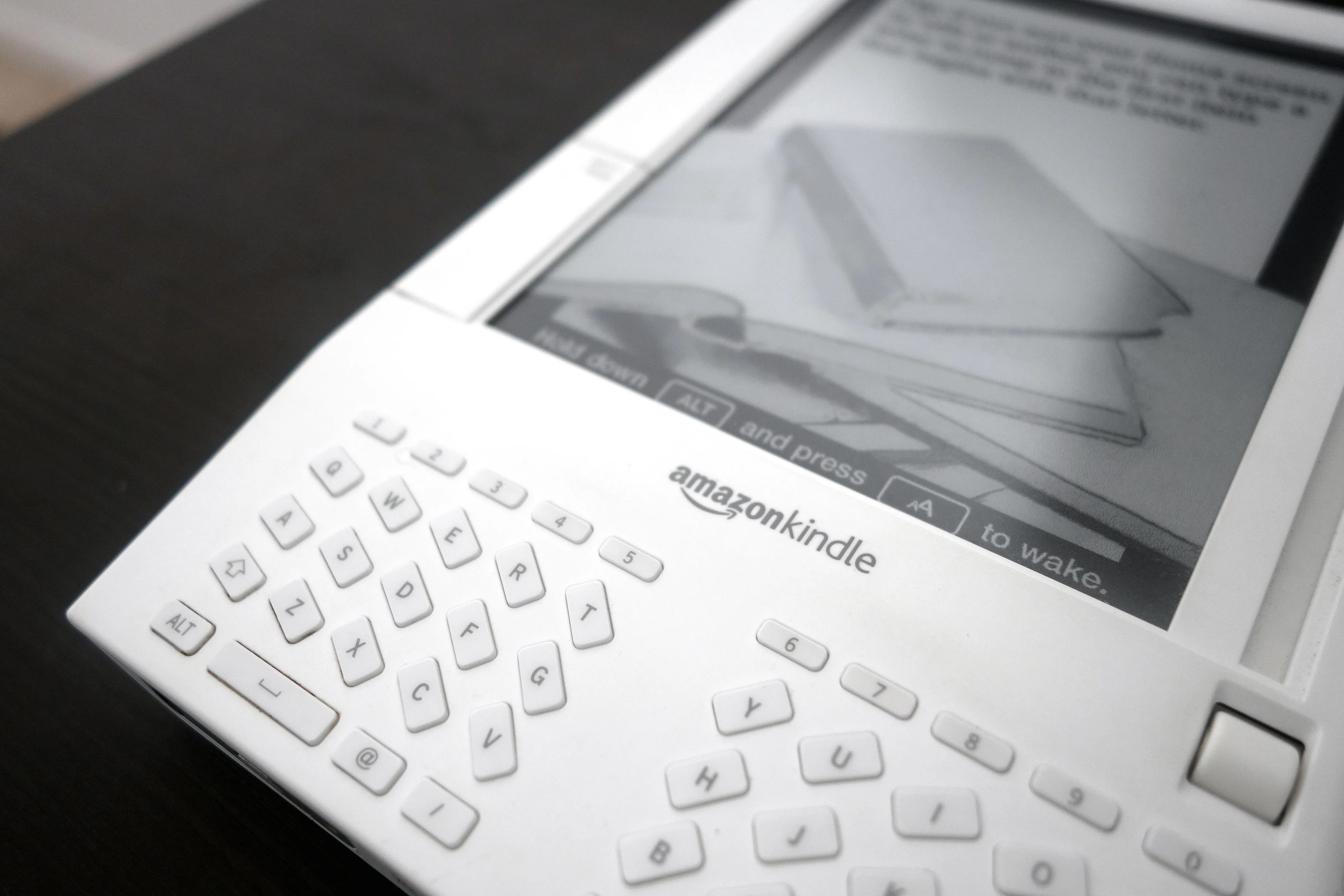
Just about a week ago, Amazon made an announcement regarding some of their oldest Kindle devices - that they would be ending support for all pre-2012 devices on the 20th May 2026.
This was greeted by a cacophony of complaints from the affected users and strangely many others including a whole raft of websites covering consumer electronics. It was quite surprising just how much noise was created by this announcement. So much noisy commentary that you could believe that some of it was not just coming from affected users, but also coming from all sorts of people who have an axe to grind about Amazon, Big Tech, DRM, copyright, freedom to use as they wish, and format shifting.
The key issue was that the removal of support was going to directly impact the devices ability to download content, and even later re-setup of the device if you reset it post the loss of support. Some of the commentators incorrectly stated that this amounted to bricking of the devices, or blocking/removal of access to the e-books themselves.
Of course, most of the more emotional commentary was out of kilter with the facts even though Amazon was incredibly clear about what would and would not work with these devices. To quote the Amazon message:
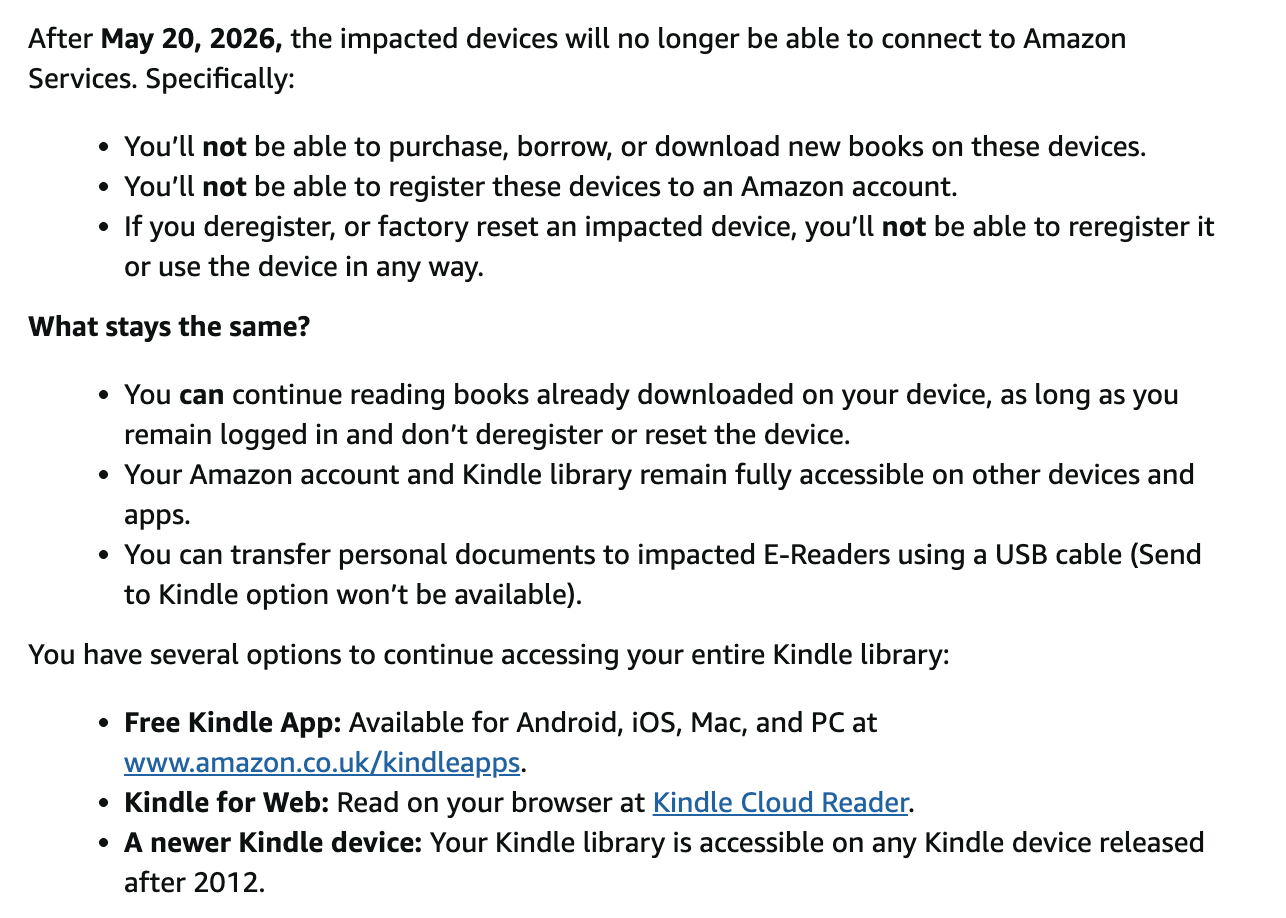
However it would be correct to call this a ‘soft bricking’, as the device would ultimately fall foul of a number of issues that would result in the device being non-working. It is also true that the amount of notice is not exactly a lot - with it being just over a month before the soft bricking actually could start impacting the operation of the device.
The reason for the dropping of support and the move to disconnect them from the running Amazon service was that Amazon was concerned about the device’s ability to continue to connect securely with Amazon’s servers and/or support the packaging of the books themselves without continuing considerably efforts and costs for Amazon, that could be more reasonably done by the users moving to other Kindles and Kindle clients. After all, regulations have come into play in many countries and regions requiring devices connected to networks to be ‘supported’ for security fixes as long as they are being relied upon to be used by consumers, and that these devices are cybersecurity ‘safe’ for use.
At the end of the day, the range of devices that are affected are between 14 and 19 years old - well outside of norms for obsolete consumer electronics in this digital age. How many ‘supported’ computers and/or operating systems have reached 14 years or more? I am not aware of any - any that continue to be supported.
The support policies of Android devices have ranged from as little as 2 years of software support, through to a more normal 7 years for the most modern devices - after which not even security fixes would be applied.
For Apple devices, they are very clear support can only be expected to be mainstream for 5 to 7 years and you MAY get security updates on a longer period but the oldest device to have received a security fix has been the recent update to the iPhone 5, which was to fix an emergency calling capability on that oldest device - but these devices are barely safe for anything other than voice calling as mainstream software security fixes have not been applied for some time. It is important to note that iPhone 5 is 12 years old, and actually still newer than the Kindles affected by this announcement.
As for desktops and laptops, for Microsoft based machines we are in a very extended period of support for Windows 10 right now - which is originally from 2015, but technically you need to actually have the release of 22H2 from 2022 which is only 4 years old to be ‘supported’ and safe from a security and functionality perspective, and only then until later this year for most users.
For the Apple MacOS, the situation is very similar with mainstream hardware support being set by policy to be 5 to 7 years and three main releases for the OS. Nothing like the support provided on the much lower cost Kindle hardware.
The difference though is that when these devices go out of support, they don’t degrade in functionality so starkly, although anyone who has an old iPad/iPhone knows that applications do stop working fairly rapidly, but again not as starkly as has happened with the Kindle.
The thing to understand about Kindles are that they are embedded devices - devices that have a specific limited use case and making use of very optimised system on chip architectures with cut down operating systems - these are not like desktop PCs, and are not general purpose.
What should also be understood is that Amazon is an integrator making use of silicon provided by third parties - specifically Arm based (but differently able) SoCs from Freescale/NXP for the very oldest devices, and Mediatek SoCs on the later devices. These SoCs come with expected lifetimes that can be measured usefully in periods of 5 to 10 years at most (even then that would be termed Long Term Support).
It is also correct to say that the earlier devices and the later ones are incredibly different on a hardware level - the obsolete devices having less than 256MB of RAM and 2GB/4GB or less of storage for books and some having as little as 32MB / 64MB RAM and 256MB / 2GB of Storage. Compare this with the later more performant devices that have upwards of 1GB of RAM and 16GB/32GB/64GB of storage.
As you can also guess, the software architecture has also changed significantly over this time (in 19 years we have gone from PowerPC based OSX10.5 Macbooks, through Intel versions and now to M series based MacOS 26), certainly moving away from the original Java based implementations to much more modern web based technologies on the higher specified devices released over the last few years. This is all for reading the same books but many of them are now more graphically rich and complex, with more web links than those original early versions - or the typical out of copyright texts that people seem to equate to what an e-book reader handles.
At the core, there is also great differences in the cut down Linux implementation that serves the old devices and new - and not just down to available RAM. It includes the level of Linux kernel support for specific things like SSL/TLS and security handling and other functionality, such that upgrading/modifying the implementation to keep up with security and functionality requirements has become increasingly difficult. This is even more understandable when it is grasped that the Linux implementation is almost certainly not coming from Amazon, but from the silicon vendor - very optimised to the specific SoC, with some configuration only by Amazon.
All of this means that continuing support is not just down to Amazon - it is down to its suppliers whims, almost certainly with higher and higher costs / subsidisation from Amazon to the silicon provider to keep these chipsets functional in the face of changing software and security requirements. And then you have the significant difference in capability between the older devices and the new, especially knowing e-books now involve images/diagrams/tables and other multimedia capabilities (links to webpages direct from the text for example), as well as supporting things like text to speech capabilities and even audiobook support.
This is a lot of work for the older devices (actually almost impossible and costly in my view) and there will always come a point when the cost of support exceeds the value of the continuing the support. This is particularly true as many consumers who purchased these older devices have already upgraded naturally to the much more capable later models. It is a diminishing returns issue that drives others to cut support much more quickly than Amazon has done here.
As I mentioned, the commentators of all sorts have come up with a whole lot of arguments that the move to obsoleting these old devices has drawn out. These are:
Amazon are doing this on purpose and they could afford to keep these up to date, but they are greedy and want your money - I think we have dealt with this, with the only addition being that we have to understand that companies like Amazon are not charities.
Amazon have locked me out of access to my e-books - again, dealt with in the original message from them, that no access to e-books is blocked as the customer can continue to read them on the ‘soft bricked’ device as long as they are downloaded before the date, that they don’t reset the device, and if that takes place then they can always read them via the Windows, Mac, or Smartphone apps - hell even from a web browser, without special software.
Amazon are purposefully locking access to these e-books behind a proprietary format with DRM, stopping me reading the books - well this has been the case from the start, something that was well understood when the ebooks were being purchased, and which does not stop you reading the books as the apps are free on all the devices, and you don’t have to specifically buy a Kindle to read the books.
Amazon made changes to the handling of e-books such that you cannot download them except within the supplied devices and/or software - it is somewhat true that they have done this, but this is within the realms of the agreed copyright restrictions that are on every book (although admittedly much more liberal for physical books). There is no right being purchased to format shift, or to distribute them outside of the official Kindle Store to device interactions. What Amazon have done here is more strictly enforce the copyright use that you buy on an e-book.
I want to open up an alternative view to the view that Amazon is enforcing a proprietary closed system, that restricts your ‘valid’ purchase and rights that you should have to be able to do whatever you want with your downloaded books, as you would with ‘real’ books.
The alternative view is that Amazon are providing you a very open system to reading any Kindle books on whatever device (mostly) that you want to use, and that you are actually paying to have ‘forever’ access to the ebook provided through the e-book service. You are not buying the book, you are buying the right to use the book forever, as long as you use the supported methods of access. The money for the Kindle device that has e-paper capabilities is paying only for one access method that is not mandatory.
In some respects, this is not actually an alternative view - it is what it actually is. You are paying for the copyright license to read the book forever by any supported device.
Now that ‘forever’ reference - forever is a very long time. For physical books, it has been 10s to 100s of years, which is a very long time but not for every book ever printed. Physical books suffer damage and loss naturally, and we forget that books today are somewhat consumables, as only some keep them around on shelves.
For digital e-books, it is certainly true that one Amazon may go away, and in actual fact I am sure they will - and the question will be what happens then? Will you lose the books? Who knows yet, because it actually has not really happened with any digital content today.

Yes there has been an issue with, interestingly, a version of 1984 by George Orwell, which was removed from Kindle devices because the supplier of the book did not completely have all the rights sorted out, but Amazon was roundly legally impacted by that - and they will not doing that again based on the results of the court case - really setting a precedence for what a service provider can do to a device you use to access their service.
Digital content access has not been lost in real terms. What has happened with other forms of media ‘purchased’ in digital form when companies have shutdown? In closing down, the content has been migrated between different services as companies have stopped serving the content or full compensation has been given - i.e. the money given back.
This may not be very satisfactory, and actually I do agree that this is far from ideal. I do believe we need a more robust regulatory or commercial commitment as to what happens with digital content in such a situation. There should be a clear approach mandated that there should be a continuance of service with a 3rd party or the transition of the format to a version that can be used without the support of the original company service. This would mean format changing or at the very least transitioning the content into an offline version that can be used without reference ot the original cloud service.
This is needed because consumers do need more consumers confidence around digital content, but it will almost certainly take a real situation to happen where a consumer loses access to content, and then the consumer pressure can be validly targeted at real impact, and not this situation that has happened around the oldest Kindle devices - which reasonably have reached the end of their supported life.
I am embedded in the Kindle ecosystem, ever since I purchased the Kindle Keyboard variant back in 2011. I have purchased many Kindle since, as I find them great for accessing purchased content, as well as being a ready place to have access to digital content supplied in PDF and Word document formats - in other words specifications, standards, white papers, green papers, review versions of documents I have produced, amongst many other things.
I find them eminently useful, so much that I invested in the Kindle Scribe as well, which allows me to mark up documents with handwriting, or whole loads of notes. Certainly a lot easier to carry than hundreds of books and literally thousands of documents.
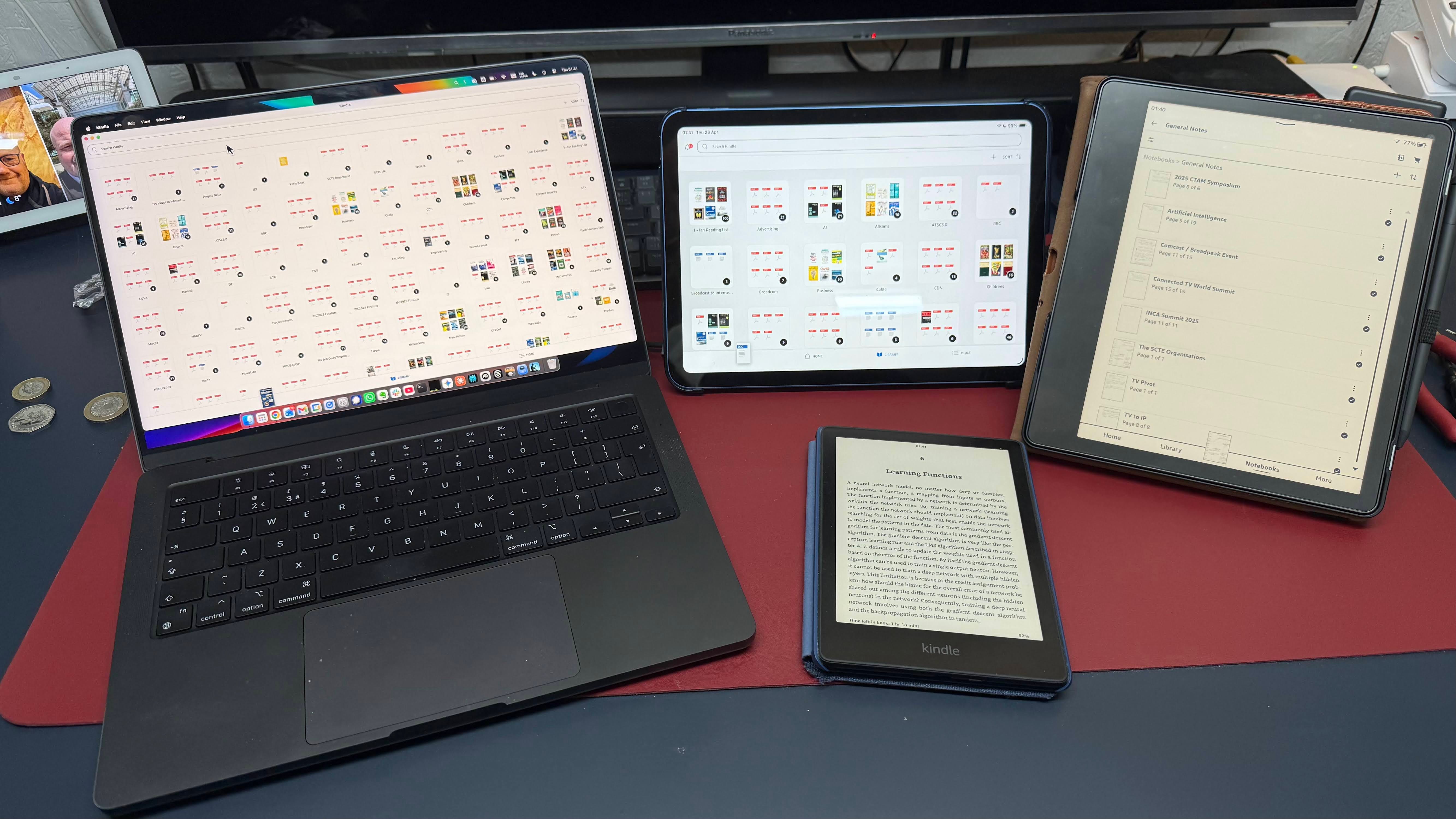
I also carry more than one Kindle at times, because there is always the need to cross reference things - for which having more than one book open at a time is normal, and I spread my access out over my Macbook and iPad - creating a very data centric approach to accessing information. It does not matter for me which device I used - I use the one that makes most sense at the time, i.e the one I have with me or the one that has the e-paper screen with pen support.
It is also important to note that I no longer own any of my earliest devices - I upgraded naturally to later and more capable Kindles over time, after all the e-paper screens have gotten better and better, and quicker and quicker, with more and more storage that has grown as my usage has grown.
I am invested in digital content.
No posts
Comments
Nothing yet. Say the first thing.
Sign in to join the conversation.