
Every week someone tells me the data analyst job market is dead.
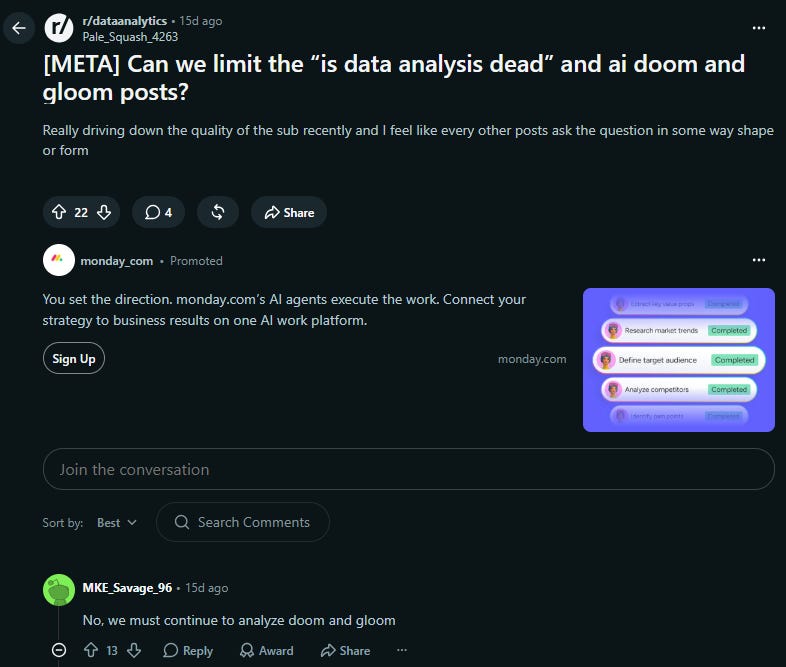
They send me the Reddit thread. 600 comments, everyone agreeing that entry level is finished, that AI ate the junior roles, that you need a master’s now. Then they close the tab, buy another course, and decide they’ll start applying once they finish it.
6 months later they’ve got more skills and the same number of interviews.
Then they send me the thread again.
Here’s what’s happening on the other side of that application.
A hiring manager posts one junior analyst role on a Tuesday. By Friday it has 400 applicants. She’s not a recruiter. She’s an analytics lead with her own reporting due, and she gives the whole pile about 90 minutes on a Monday morning.
That’s roughly 13 seconds per resume.
In those 400 she sees the same Google certificate a couple hundred times. She sees the Titanic dataset. She sees a COVID dashboard. She sees “passionate about turning data into actionable insights” in 300 different fonts.
She picks 8 people to phone screen. Every one of them is someone she could describe out loud afterwards.
So here’s my honest take. 399 of those applications were interchangeable, and that’s most of the reason they got nothing back.
Which changes what you should do next. Every hour you spend on a 6th tool is an hour you didn’t spend becoming the one applicant she can describe to her boss in a sentence.
That’s the whole game right now.
Every one of those 400 applications exists because a company wanted an analyst badly enough to open a req and defend the budget for it. Demand is real. It’s just being met 400 times over on the first day.
Look at what happens 2 years further up. Roles asking for 2 to 3 years of experience sit open for weeks. Companies chase those people. Recruiters cold message them on a Sunday.
Same industry. Same tools. Completely different level of competition.
The first 18 months are the hard part, and after that the same market starts working in your favor. So everything you do right now should be pointed at getting through the door, not at looking impressive once you’re already inside.
The instinct after a rejection is to assume you were underqualified. So you go add something. Python. Then a bit of machine learning. Then cloud. Then statistics, properly this time.
All 400 of those applicants had the same instinct.
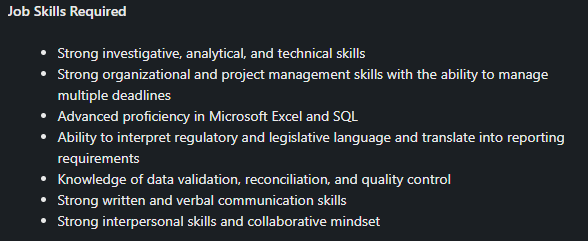
The technical bar for a junior analyst hasn’t moved in years. SQL you can write under pressure, joins and window functions included, without a tab open. Excel or Sheets you know cold. One BI tool you can build in without a tutorial running on the second monitor. That’s the bar.
Most people who think they’re past that bar aren’t. They can follow a SQL tutorial and they’ve never written a query against a table they didn’t design, with 3 columns that mean the same thing and no documentation. That’s the version that gets tested.
Everything you stack on top of it just makes you later. An 11 item roadmap costs you 6 months and doesn’t change a single screening decision.
The people getting hired stopped learning at the right point and moved on to the part that actually gets judged.
A project that ends with “here’s a dashboard” gives the hiring manager nothing to say about you. She’s seen a dashboard today. She’s seen 4.
A project that ends with “based on this, the business should stop spending on X and move that budget to Y, and here’s roughly what that’s worth” gives her a line she can repeat to somebody else. That’s the whole mechanism. Whoever she can quote in the hiring meeting is whoever gets the interview.
The difference shows up at the very start, in the question you pick. “Analyzing Airbnb listings in Barcelona” produces charts. “Which listings should raise their price and by how much” produces a recommendation, and it forces you into the messy parts on the way there: what counts as comparable, what you do about the 11% of rows with no review data, which assumption breaks the whole answer if it’s wrong.
Those are the parts an interviewer can actually question you on. Nobody asks a follow-up about a bar chart.
2 of those is enough. I’d take 2 where you can defend every assumption over 6 built from a tutorial that you can’t explain when someone pushes on them.
This is the part people get wrong most often, and it’s exactly what I walk through inside Analyst Hive: how to pick a question a real business would pay to have answered, and take it through to a recommendation somebody could act on this quarter.
Waiting until you feel ready is the most expensive decision available to you, and it’s free at the moment you make it, which is why everyone makes it.
Applying is its own skill with its own learning curve. Writing about your projects so a non-technical manager cares. Answering “walk me through a time you were wrong” without freezing. Handling a live SQL screen while somebody watches your cursor move. You get better at all 3 by doing them badly a few times.
6 months of applying while you learn beats 6 months of learning and then applying. Same calendar, and at the end of it you’ve got a rejection pile telling you exactly which gap to close.
There’s also a timing thing nobody mentions. That 400 applicant post is what a job looks like after it’s been sitting there 3 days. The same role on day one has 40. Being early is most of the edge, and you can’t be early to anything while you’re still finishing a course.
Start applying at the point where you can write SQL, use one BI tool, and defend 2 projects.
Everybody differentiates on tools. Almost nobody differentiates on domain.
Being the person who understands how a subscription business loses money, or how retail inventory behaves in Q4, is worth more than any tool you could add this month. It changes what your projects are about, what your questions sound like in an interview, and which roles you’re the obvious fit for instead of the 200th option.
It costs you a decision and nothing else. Pick the industry you already know something about from a previous job, or the one hiring most where you live. Read a few of their quarterly reports and 3 or 4 job postings, and write down the 5 metrics that keep appearing. Churn, basket size, occupancy, whatever it is for that industry. Build your 2 projects around those metrics.
That’s a weekend of reading, and it puts you in a smaller pile immediately. You stop being applicant 200 for every analyst role in the country and start being one of maybe 20 people who applied to a logistics company already talking about on-time delivery rates.
That’s the difference between the 8 she screened and the 392 she didn’t.
Hiring at this level runs on whether one person can describe you in a sentence. Everything else is downstream of that.
A crowded market rewards going narrow and applying early. Everybody else is going wide and starting late, which is exactly why it works.
Analyst Hive is the community and the 90 day sequence I built for this problem. It cuts the roadmap down to the few things junior hiring actually turns on, walks you through building 2 projects that end in a real recommendation, and gets you applying while you’re still building instead of 6 months after. If you’re stuck in the loop of another course, another tool, another month, this is the way out. Join here:
Now I want a number from you. Reply with how many applications you’ve sent and how many first round interviews came back. Just the 2 numbers, not the story around them. I want to see what the real ratio looks like across this list.
P.S. If your first reaction to point 2 was “yeah, but Python”, notice that you argued with the skill list and skipped straight past the part about applying 6 months late. That’s the actual tell.
Talk soon,
Ian
No posts
Comments
Nothing yet. Say the first thing.
Sign in to join the conversation.