
You’ve got the bookmarks. A folder of SQL resources. Two courses you’re 40% through. A roadmap infographic you saved off LinkedIn in March and haven’t opened since.
You’ve watched enough YouTube to explain what a window function does. You know what a star schema is. You could hold your own in a conversation about any of it.
Then Monday comes and you open a SQL tutorial you’ve already finished twice.
Take anyone 8 months into “learning data analytics” and ask what they worked on last Tuesday. You’ll get a specific, confident answer. A Python course. A joins refresher. A video comparing data analysts to data engineers.
Then ask how many applications they’ve sent. Usually zero. Sometimes three, all submitted in one evening, all to the same two companies, all about 6 weeks ago.
Now take someone 4 months in with a worse skill set. Weaker SQL. An uglier portfolio. Two projects instead of five. They’re employed. Months 3 and 4 got spent applying, getting rejected, fixing the one thing that caused the rejection, and applying again.
The order the steps ran in is the entire difference.
Every free resource in this space answers what to learn. Almost none answer what to do on Tuesday morning at 6am before work. That’s why people with a decade of curiosity and 200 bookmarked links still aren’t data analysts.
Opening a course has a guaranteed outcome. You’ll finish the video. You’ll feel sharper than you did an hour ago. Nobody tells you no.
Sending an application has a high chance of silence and a real chance of rejection. So every morning you’re choosing between a task that always pays and a task that usually doesn’t.
You’ll pick the course. Everybody picks the course. People do that when nobody’s told them what today’s job is.
The tell is how you talk about it. “I’m not ready yet” is a statement about how the last rejection felt, or how the first one might.
Pull up any data analyst roadmap. SQL, Excel, Python, Power BI, statistics, portfolio, communication skills. All of it’s correct and none of it tells you what today is.
It lists every skill and leaves you to work out where to start, how long to spend there, and when you’re allowed to move on.
Most people start at the top and grind SQL for 4 months, because SQL’s on the list and grinding it feels safe. Meanwhile the resume they’d actually submit is the one they wrote for a retail job in 2019.
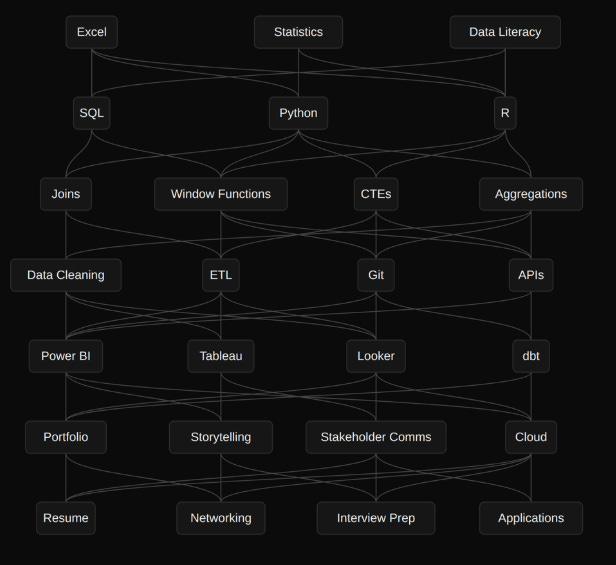
Typical roadmap the internet tells you to follow…
Most people run this order: learn everything, build a portfolio, fix the resume, start applying.
A recruiter spends about 6 seconds deciding whether the rest of you exists. If that document doesn’t clear, nobody finds out you can write a window function.
Fixing a resume takes a few focused days and has a clear finish line. Getting “good enough at SQL” takes months and has no finish line at all, which is why people pick it. You can’t fail a task that never ends. You can only keep doing it.
So the skill you spent 4 months on sits behind a document you spent 40 minutes on. It’s the cheapest thing on the whole list to fix.
“Fix the resume” means something specific. Rewrite your current job in the language of the job you want. Put numbers on things you already did, because “improved reporting” and “cut a weekly report from 4 hours to 20 minutes” describe the same work and only one of them gets read. Change the line at the top to say data analyst instead of whatever your last employer called you.
None of that needs a new technical skill. Most people could knock it out this weekend and never do, because it doesn’t feel like learning.
No course can tell you your portfolio project reads like a tutorial someone followed. A recruiter can, by not calling.
20 applications will expose your real gaps in 3 weeks. You find out your resume gets no responses, or that it gets responses but you freeze in the screening call, or that you clear the screen and fall apart on the SQL assessment.
Three different problems with three different fixes. You can’t tell which one you’ve got until you’re in the process.
Track it and the answer shows up fast. 30 applications and zero responses is a resume problem. 5 screening calls and no second rounds means you can’t explain your background in a way that connects to the role. Second rounds that die at the technical is the one case where the answer is more SQL.
Most people assume they’re in that third bucket. Almost nobody is.
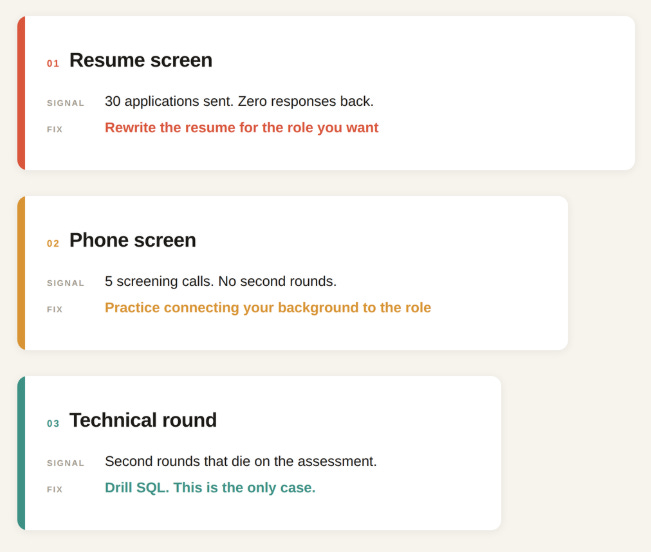
This is where resumes die and how to fix!
Any plan that depends on you waking up and deciding what to do that day falls apart on the first bad week. A kid gets sick. Work runs long. You skip two days, feel behind, and open a tutorial instead of the hard thing, because the hard thing got heavier while you were gone.
Delete the decision. You should be able to sit down, see one task, do it, and close the laptop without ever asking yourself what you should be working on.
That’s what Analyst Hive is. 90 days, one task per day, in the order that gets people hired: resume, then SQL, then portfolio, then applications, then interviews. You open it and do today.
Become a Data Analyst without a degree.
Free content stops at the roadmap for a reason. Telling you what to learn is easy and it gets shared. Telling you what to do on day 34 means somebody had to decide what day 34 is, and be wrong about it in public if they got it wrong.
So you get every skill listed and no order to run them in. Then when it doesn’t work, the story is that you lacked consistency.
You’ve had access to everything you need for the entire time you’ve been stuck.
What’s missing is a Tuesday. A specific one, with a specific task sitting on it, that you didn’t have to invent at 6am.
Analyst Hive is 90 days of daily tasks for breaking into data. Open it, do today’s task, close it. No lectures, no roadmap to interpret, no weekly decision about what matters most right now.
It’s $19 a month, less than most people reading this have already spent on courses they didn’t finish. Members have talked to multiple recruiters and landed foot-in-the-door gigs inside their first week, because week one is applications.
If you’ve been learning data analytics for more than 6 months and haven’t applied anywhere, this is the piece you’re missing.
Reply with the month and year you first decided you wanted to be a data analyst. Just the date. I want to see how far back this goes for people.
P.S. If you read all that and thought “yeah, but I actually do need to learn more SQL first,” that sentence is the problem. It’s been telling you that for months and it’ll keep telling you that for months more.
Talk soon,
Ian
No posts
Comments
Nothing yet. Say the first thing.
Sign in to join the conversation.