
Most people restart their data analyst journey the same way every January.
They buy another SQL course. They watch three hours of it. They tell themselves this is the year, then open a new tab and start the exact same thing they abandoned in March.
Ninety days later they’ve learned a little more SQL and applied to nothing.
I’ve watched this loop from the inside, and I ran it myself once. I broke into analytics with no degree and no permission, and the thing that finally worked wasn’t more learning. It was a sequence. So here’s the real question people should be asking: if I had to wipe my progress and start completely over in 2026, knowing what I know now, what would I actually do for 90 days?
Not what would I learn. What would I do, day by day, to be employable by the end of it.
Here’s the exact plan.
1. WEEK ONE IS RESUME AND LINKEDIN. NOT SQL.
Everyone gets the order backwards. They spend two months learning tools before anyone can find them, then wonder why the skills never turned into interviews.
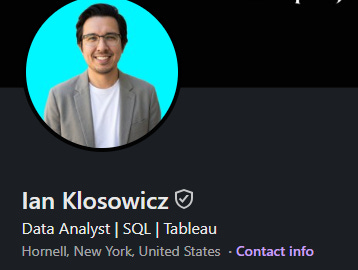
If I started over, day one is a resume that survives an ATS scan and a LinkedIn profile that reads like an analyst instead of “aspiring data enthusiast on a journey.” Because the moment I start building projects in week three, I want a place to put them that’s already set up to be seen.
This is boring and unglamorous and it’s why most people skip it. It’s also the part that decides whether any of the later work gets looked at. A perfect portfolio pointed at a dead profile is a tree falling in an empty forest.
2. I’D LEARN SQL BY BUILDING, NOT BY WATCHING.
I would not touch a 12-hour SQL course. I’d learn the joins, the aggregations, and the window functions I actually need, then immediately point them at a real messy dataset and answer a real question.
The difference between someone who “did the SQL course” and someone who can do the job is that the second person has queried data that didn’t come pre-cleaned in a tutorial. Nobody hands you a spotless table at work. You get duplicate rows, nulls where there shouldn’t be nulls, and a column called “date” that stores dates in four different formats. The whole skill is dealing with the mess.
So every concept I learned, I’d apply the same day to something ugly. Watch a 20-minute explanation of window functions, then go rank real customers by real spend in a real dataset before I close the laptop. Learning and doing collapse into one step. That’s the pace that gets you hired in months instead of years, because you’re not accumulating knowledge you can’t demonstrate. You’re accumulating things you’ve actually done.
3. ONE PORTFOLIO PROJECT THAT ISN’T THE TITANIC DATASET.
A hiring manager who’s screened 40 portfolios this month has seen the Titanic survival predictor at least 15 times. It signals one thing: this person followed the same free tutorial everyone else did. Same with the Iris flowers and the stock-price line chart. The moment they recognize the dataset, they stop reading.
If I started over, my portfolio would have one project built around a question someone would actually pay to answer. Pick an industry, find its real data, and answer something a manager in that industry would nod at. Why do customers churn after month three. Which store locations are quietly losing money. One strong project built around a real business question beats five copy-paste notebooks, every time.
And I’d write it up like I’m explaining it to a non-technical boss, because that’s the actual job. Lead with the answer, then show the work. The analysis is half of it. Communicating what it means to someone who doesn’t care about your code is the half that gets you promoted.
4. I’D APPLY BEFORE I FELT READY. ON PURPOSE.
The instinct is to wait until the portfolio is perfect and the skills feel complete. That day never arrives. The people who wait are still waiting a year later, more skilled and just as unemployed.
Applying early does two things. It tells you exactly which skills the market wants right now, from real job descriptions instead of a course syllabus from 2021. If every posting in your city asks for Power BI and your portfolio is all Tableau, you want to know that in week five, not week fifteen.
And it gets you reps at the part everyone’s worst at: the interview. Your first interview is going to be rough no matter when you take it. Better to spend that roughness on a job you’re lukewarm about than on the one you actually want three months from now.
This is exactly what the middle stretch of the 90 days walks through, day by day, so you’re not guessing when to pivot from building to applying. It tells you which day to start sending applications and what to send.
5. NETWORKING, BUT NOT THE CRINGE KIND.
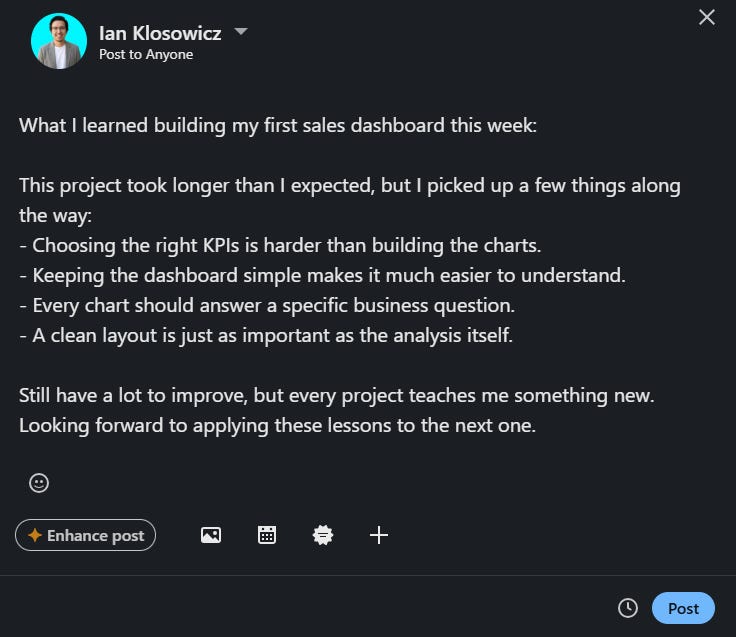
I would not send “I’d love to pick your brain” messages to strangers. Those get ignored, and they should. I’d post what I’m learning, publicly, consistently. That’s networking that scales while you sleep.
Every project, every thing that clicked, every ugly dataset I wrestled into shape becomes a short post. Do that for 90 days and you’ve built an audience of people in the field who now recognize your name. Some of them do the hiring. A few of them will message you about a role before you ever apply to it.
I built my entire path on this. The posts weren’t self-promotion and they weren’t polished. They were proof of work, in public, on a schedule. People don’t refer strangers. They refer the person whose learning they’ve been watching for two months.
6. MONTH THREE IS INTERVIEW REPS, NOT MORE TUTORIALS.
By the final stretch I wouldn’t learn a single new tool. I’d drill the interview: the SQL live-coding, the STAR stories, the “walk me through a project,” and the salary conversation people fumble and leave real money on the table over.
Most candidates prepare for interviews by doing more of the thing that’s comfortable, which is learning. Then they get in the room and can’t explain their own project out loud. They freeze on a query they’d have written easily at home, because they never practiced writing it while someone watched.
The reps that matter in month three are performance reps, not knowledge reps. Say your project story out loud until it’s smooth. Rehearse the number you’ll give when they ask about salary. The offer doesn’t go to the most skilled person. It goes to the person who was clearly the least risky hire in the room.
The point of all of this
Notice what’s missing from these 90 days: there’s no month spent “getting the fundamentals down” before anything real happens. Every single week produces something a hiring manager could see.
Learning isn’t the bottleneck. It never was. The bottleneck is turning what you learn into evidence, fast enough that you’re employable before you burn out and quit again in March.
You don’t need another course. You need a sequence that tells you what to do today.
That’s the entire reason Analyst Hive exists. It’s not a course and it’s not a community you scroll for motivation. It’s the exact 90-day sequence above, broken into a task for every single day, so you never open your laptop and wonder what you’re supposed to be doing. Stop buying information. Buy the sequence, and spend the next 90 days executing instead of guessing.
If you were starting over in 2026, what’s the one thing you’d refuse to waste time on this time around? Reply and tell me. I read every one.
P.S. The reason week one is resume and not SQL is that I did it in the wrong order myself the first time. Spent months getting “ready” for a stage nobody had invited me to yet.
Talk soon,
Ian
No posts
Comments
Nothing yet. Say the first thing.
Sign in to join the conversation.