
Type “is data analytics still worth it in 2026” into Google and you’ll get about forty answers.
Half say the field is saturated and AI is coming for it. Half say demand has never been higher and now is the perfect time to start. Almost every one of them is written by someone selling a course.
So you read all forty. Then the Reddit threads. Then two YouTube videos with opposite conclusions and the same thumbnail. Then you decide you’ll start once you have a better read on where things are heading.
That was six months ago.
Here is what “saturated” actually looks like from the other side of the desk.
A hiring manager posts an entry-level analyst role on a Monday. By Wednesday there are 400 applications. She opens the first forty. Thirty of them have the same certificate, the same three-dashboard portfolio, and the same summary line about being passionate about turning data into insights. Four analyzed the same Netflix dataset. Two used the same Tableau template, down to the color palette.
She is not rejecting those people because the field is dead. She is rejecting them because she cannot tell them apart and she has 360 more to get through.
That is the whole issue in one scene. The field is fine. The on-ramp broke. And it broke because it got easy, not because it got hard.
That distinction decides everything you do next. If demand collapsed, the correct move is to leave. If supply exploded, the correct move is to stop looking like the supply. Same headline, opposite responses.
Here is what actually changed.
1. THE DEMAND SIDE NEVER MOVED
Companies did not stop needing people who can answer questions with data. The Bureau of Labor Statistics projects 34% growth for data scientists and 7% for market research analysts between 2024 and 2034. The World Economic Forum’s 2025 Future of Jobs report put data roles at five of the fifteen fastest-growing jobs. Glassdoor puts the average US data analyst salary around $82,000 in 2026. 365 Data Science
Those are not the numbers of a dying field. Nobody writes “is welding still worth it” posts about a job paying $82,000 with a decade of projected growth ahead of it.
If you are waiting for demand to come back, it never left. Nothing in the last two years suggests a company somewhere decided it would prefer to run on vibes.
What people are actually noticing when they say the market is dead is that they applied to 60 jobs and heard nothing. That is real. It is also not a demand signal. It is a sorting signal.
2. WHAT EXPLODED WAS THE SUPPLY
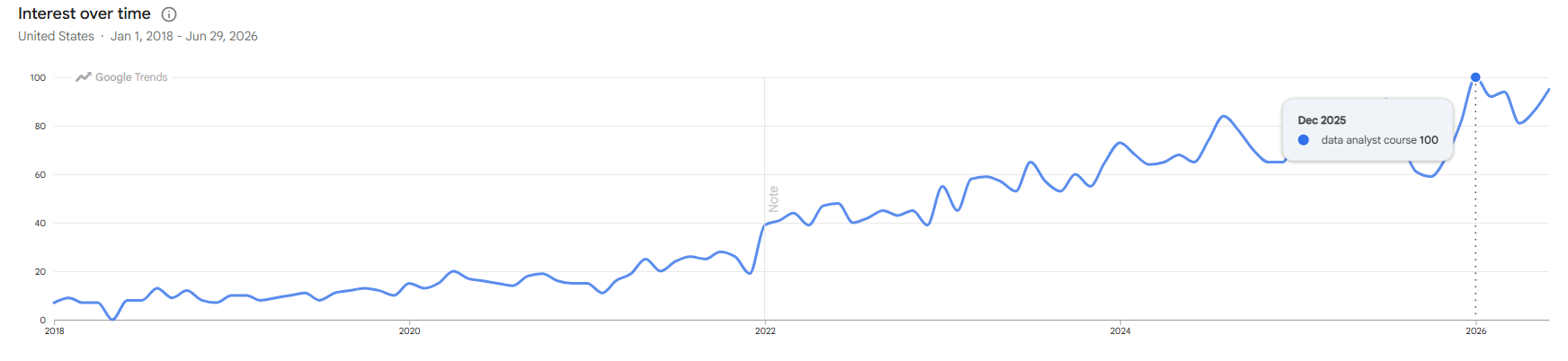
Search volume for data courses peaked in 2025. Bootcamps, certificates, university programs, and AI-generated learning paths all did exactly what they promised. They lowered the barrier to entry. Analythical
That worked. That is the problem. The result is that a hiring manager now opens hundreds of applications that look nearly identical, and a good chunk of them were tailored to the posting by the same AI tool. Analythical
You are not competing against a shrinking number of jobs. You are competing against a much larger number of people who took the same free path you took and produced the same artifacts you produced.
This is why the advice that worked in 2021 stopped working. It did not become wrong. It became universal. Advice that everyone follows is not advice anymore, it is a description of the pile.
3. AI DID NOT TAKE THE JOB. IT TOOK THE PROOF.
Around 70% of analysts report that AI automation makes them more effective at work. That is not the profile of a role being replaced. That is a role getting a power tool. 365 Data Science
But here is the part nobody says out loud. AI did not eliminate the analyst. It eliminated the evidence you used to rely on.
Writing a JOIN used to be proof you could do something most people could not. It is not anymore, because the laptop of the person interviewing you writes JOINs too. Every skill that a model performs on demand has stopped functioning as a credential. What is left is the part the model cannot do for you in a 45-minute conversation: knowing which question was worth asking, and being able to defend the answer to someone who disagrees.
This is good news if you are willing to hear it. The skills that got commoditized are the ones that took the longest to learn and proved the least. The skills that still count are the ones you can start practicing this week, on a project you already have, in a conversation you can rehearse.
4. THE BAR MOVED FROM CREDENTIALS TO EVIDENCE
Roughly 85% of data analyst job postings do not specify any required years of experience. 365 Data Science
Read that twice, because it sounds like the best news you have heard all year, and it is not charity. The filter did not get deleted. It moved. When a posting refuses to screen on experience, the screening happens later and less visibly: at the resume, at the referral, at the interview where you either explain a real decision you made or you do not.
The bar did not get lower. It got less legible. That is worse for people waiting to be told they qualify, and much better for people who can show something.
I broke into this field without a degree and without permission from anyone, and the mechanism was not that the requirements were soft. It was that a specific person became convinced I could do a specific job. That mechanism has not changed. It has just gotten harder to hit by accident, because there are more people in front of it.
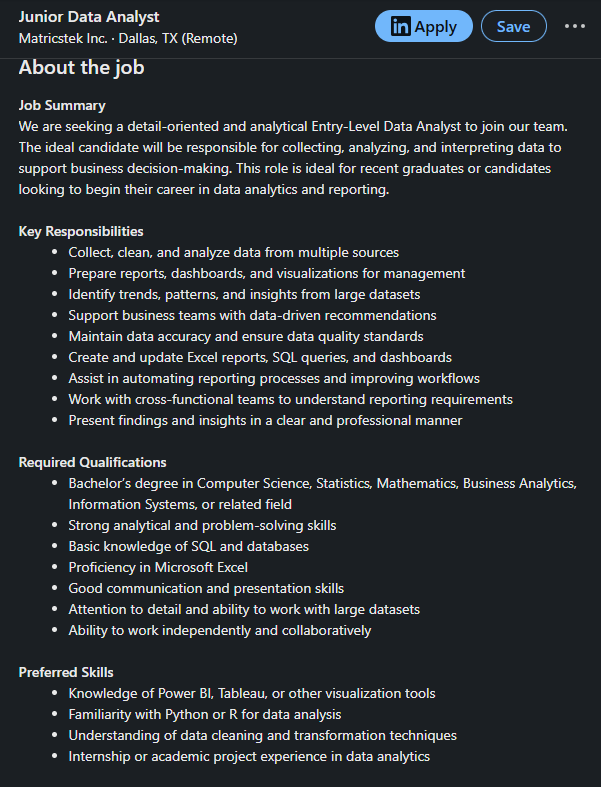
Actual job listing for an entry-level position with no years of experience required.
5. THE COST OF THE QUESTION IS THE CALENDAR
Every version of this question has the same hidden price. You are not weighing a career. You are buying time to not start.
Six months of research produces a person who knows more about the job market than most people employed in it, and who has not written a resume. Ninety days of unglamorous sequence produces a person interviewing. Both of those people asked the same question in January. Only one of them stopped asking it.
The first week of Analyst Hive is deliberately not exciting for this exact reason. Resume rewritten. LinkedIn fixed. Trackers built. Learning blocks on the calendar. SQL started. It is the boring version of the answer, in the order that works, so nobody spends month one deciding what month one should be.
So, is it worth it in 2026?
The field is worth it. It was worth it in 2024 and it will be worth it in 2028, because businesses will still be making expensive decisions with incomplete information and paying people to reduce the guessing.
The question is worth nothing. “Is it worth it” is a question about the market. “Am I going to do the work” is a question about you. Only one of those two is actually up for debate, and it is not the market.
Analyst Hive is a 90-day daily sequence for getting hired as a data analyst. Not a course, not a bootcamp, not a community with a Discord nobody opens. You get told what to do each day, in order, for 90 days, so the six months you would have spent reading conflicting takes gets spent building the thing that gets you interviews. If the market is crowded, the answer is not more information. It is a sequence, executed.
If you are on the fence right now, reply and tell me the specific thing you are waiting to see change before you start. Not “the market.” The actual thing. I want to know if it is something that can happen, or if it is a way of staying where you are.
P.S. Every article arguing about whether this field is dead is competing for the same search term you typed. Think about what that tells you about how many of your competitors are also reading instead of starting.
Talk soon,
Ian
No posts
Comments
Nothing yet. Say the first thing.
Sign in to join the conversation.