
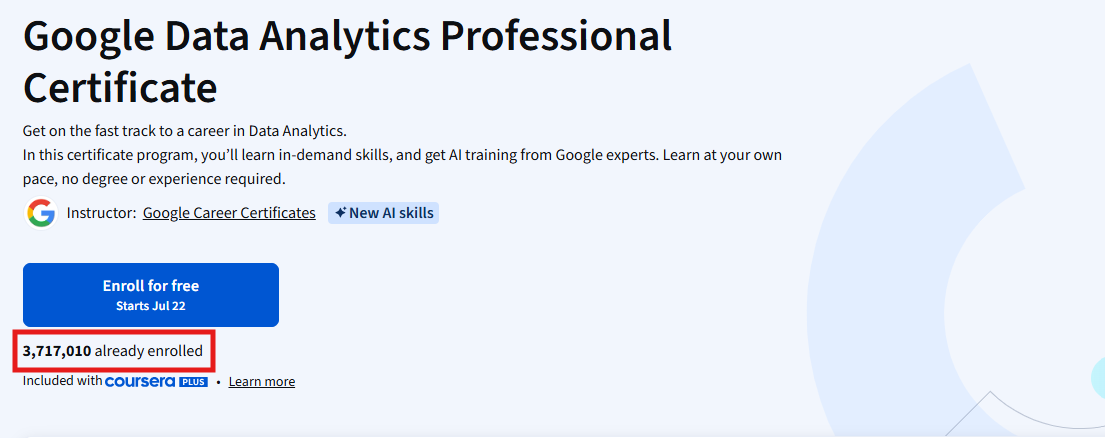
Someone asks in a comment thread whether the Google Data Analytics Certificate is worth it.
Forty people answer. Half say it changed their life. Half say it’s a scam. Almost none of them have ever screened a resume for an analyst role.
So here’s the version from the other side of the table.
The standard path looks like this. You enroll. You watch the videos at 1x. You take six months because life happens. You finish the Cyclistic case study, you add the badge to your LinkedIn banner, you flip on Open to Work, you apply to 200 jobs.
Then you wonder why nobody’s calling.
Picture the person on the other end of those applications. One open entry-level analyst req, 300 applicants in the ATS, and about seven seconds per resume before a decision gets made. In that stack, the Google certificate shows up again and again. So does the same bike-share case study, the same three charts, the same conclusion about casual riders versus annual members.
By resume 40 she isn’t reading the certificate line anymore. Her eye has learned to skip it the same way you skip a cookie banner.
That’s not a knock on the course. It’s arithmetic. Anything a few hundred thousand people can complete on the same schedule stops being a differentiator the moment it gets popular.
Here’s the actual gap. The certificate teaches you a curriculum. Hiring is a comparison.
Finishing a curriculum proves you can follow instructions for six months. It says nothing about whether you’d be useful on a Tuesday when two dashboards disagree and somebody has to figure out which one is lying.
That gap is the whole game.
1. IT’S A SYLLABUS, NOT A CREDENTIAL.
Treat it as a reading list and it’s genuinely useful. Treat it as a qualification and you’ve handed your job search to a line that four other people in the same stack already have.
The tell is where people put it. If the certificate sits at the top of your resume, above your projects and above your work history, you’ve told the reader it’s the strongest thing you own. She will take you at your word and rank you accordingly.
Move it to one line at the bottom. Nothing about your candidacy changes. What changes is what the first seven seconds land on.
The comparison she’s making isn’t “certificate versus no certificate.” It’s you versus everyone else who finished the same one, and that gets settled entirely by what sits above the certificate line.
2. IT WEIGHTS THE TOOLS WRONG FOR THE JOBS YOU’RE APPLYING TO.
The course spends heavy time on spreadsheets, heavy time on Tableau, and a full course on R. SQL gets a fraction of the runtime.
Go open 20 real entry-level postings and tally the tools yourself. Not the ones you wish existed. The 20 in your metro or remote that you would actually apply to today. SQL will be on nearly every one. R will show up on a handful, mostly in research and biotech. Excel and a BI tool will be everywhere.
The proportions inside the course and the proportions in the market do not match, and the market is the thing interviewing you. Nobody has ever been asked to open R or Python in an entry-level analyst interview. People get asked to write a join under time pressure constantly.
Look at the course list. Nine courses, and none of them are named after SQL.
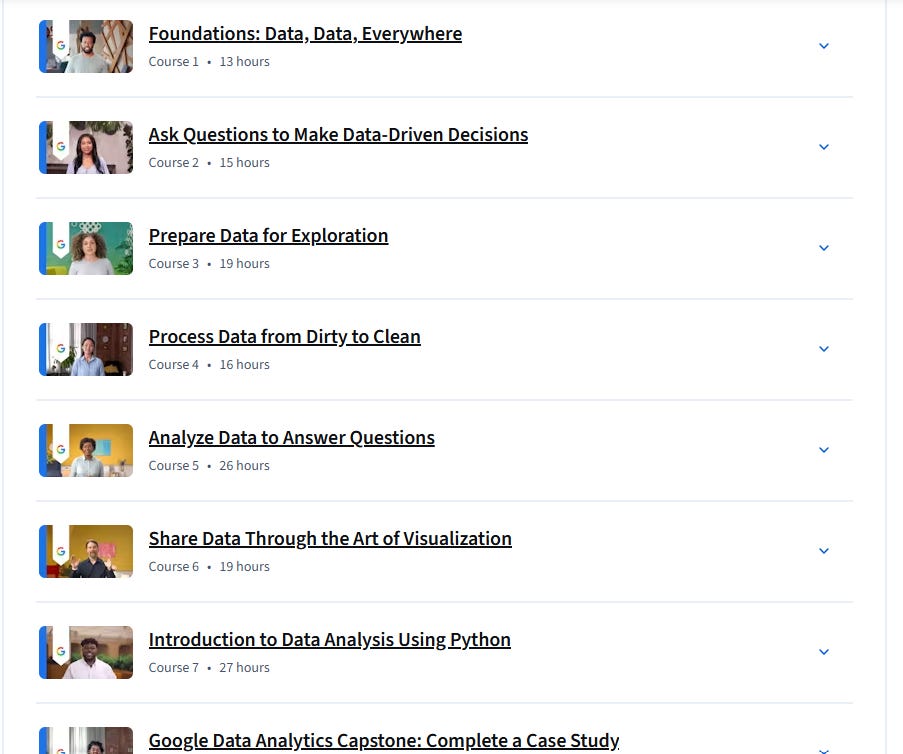
That doesn’t make the course bad. It makes it incomplete in a way that’s invisible while you’re inside it, because everything feels productive when a progress bar is moving. You can spend three weeks on R and finish further from a job than when you started, and nothing in the interface will tell you.
3. THE CAPSTONE IS THE PART THAT ACTUALLY HURTS YOU.
Most of the certificate is neutral at worst. The shared capstone is negative.
When you submit the same case study, on the same dataset, answering the same questions the course handed you, you’re submitting evidence that you can execute someone else’s assignment. The reviewer has already seen the answer. She knows which decisions were yours and which ones the course made for you, and the honest count is close to zero on the first list.
The fix isn’t a harder dataset. It’s owning the question. Pick a topic you can get genuinely messy data on, write the question yourself, and be ready to explain why you cut the rows you cut. A scrappy project on a boring subject you scoped yourself beats a polished one you were handed, because only one of the two shows judgment, and judgment is the entire thing being hired for.
If you keep the capstone anyway, don’t lead with it, and never present it as your best work. It’s a homework assignment with good branding.
The test for any portfolio project is simple. Can you name a decision you made that a reasonable person would have made differently, and defend it? If the answer is no, the project isn’t yours yet.
4. SIX MONTHS OF LEARNING WITH ZERO APPLYING IS THE REAL PRICE.
The tuition isn’t the money. It’s the six months you spent as a student while telling yourself you were preparing.
The people who get hired run both tracks at once. They’re sending outreach in week two, not after graduation. They rewrite the resume in month one, then again in month two once they’ve seen what the postings actually ask for. They’re getting rejected early enough that the rejections still have time to teach them something.
Waiting until you feel ready is the most expensive habit in this whole field, and a course with a completion certificate at the end is perfectly designed to feed it. There’s always one more module.
That’s the reason I built Analyst Hive as a daily sequence instead of another course. One task a day for 90 days, and outreach and applications start in the first week, not after some finish line.
5. WHEN IT IS ACTUALLY WORTH IT.
Here’s the fair version, because the certificate does have a real use.
If you’re starting from absolute zero, if you don’t know what a join is or what a dashboard is for or what an analyst does between 9 and 5, the course gives you vocabulary and a map. That’s worth something real. Vocabulary is what lets you read a job posting and understand what’s being asked of you, and you can’t fake your way past that step.
So use it that way. Four to six weeks, not six months. Watch at 1.5x. Skip the reflection prompts. Do the SQL sections twice and everything else once. Replace the capstone with your own project. Put it on one line at the bottom of the resume and don’t bring it up in an interview unless someone asks.
Used like that, it’s a month-long head start. Used the other way, it’s a six-month waiting room with a certificate at the exit.
Same course. Same content. The difference is entirely in what you do with the calendar around it.
The certificate is the syllabus. The interview is the exam. Nobody grades attendance.
Every entry-level analyst who gets hired had to prove one specific thing: that they can take an unclear question, get their hands into imperfect data, and come back with an answer somebody can act on. No course does that for you. The best one can do is put you in a position to demonstrate it, and then you have to go and actually demonstrate it.
Analyst Hive is a 90-day daily-task operating system for people trying to break into data analytics. Not a course, not a bootcamp, not another video library. One task a day, in order, covering SQL, portfolio, resume, LinkedIn, outreach, applications, and interviews, so you never open your laptop wondering what to work on. It exists because the certificate ends and leaves you standing in the parking lot holding a badge. This is the part after.
If you finished the certificate, hit reply with two numbers: how many months it took you, and how many interviews you’ve gotten since. I want to see the real spread, not the testimonials.
P.S. The people defending the certificate hardest in comment sections are almost always still in it. The ones who got hired talk about their projects.
Talk soon,
Ian
No posts
Comments
Nothing yet. Say the first thing.
Sign in to join the conversation.