
Note: I haven’t axed the mailbag. Working through it slowly as I’m on paternity leave after the birth of my second son. Life’s been busy, but here are some more timely thoughts.
To the surprise of no one, except perhaps the Canadian tournament directors. From 2025:
“I actually told them [Sinner and Alcaraz], because we were in talks when they withdrew, we talked to them for several days and then I said ‘Okay, we’re here… 2026 you’re gonna be in Montreal. Just make sure that happens.’ I’m very very confident that they’ll be in Montreal next year …”
— Toronto Director Karl Hale, via Nothing Major
This is becoming an entirely expected but nonetheless painful biennial kick in the teeth for someone who now lives in Montreal. The last time I attended the men’s event was 2022, which was great: 56-player draw, one week format, a grounds pass was like, what, $40?, Dan Evans made a run (hell of a match against Tommy). Some notable second-rounds I took in on a regular ol’ Wednesday:
Medvedev vs Kyrgios
Paul vs Alcaraz
Fritz vs Tiafoe
de Minaur vs Dimitrov
Draper vs Tsitsipas
Rublev vs Evans
Cilic vs Khachanov
It’s similar to what I tweeted at the start of the Rome Masters this year:
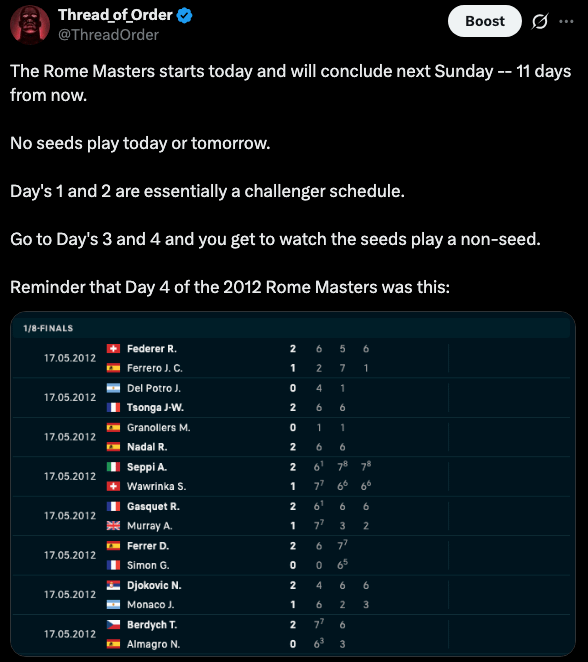
In an ironic choice of words, ATP chief Andrea Gaudenzi defended the expansions last year saying “we need patience”:
Give this model five or ten years and I believe the Masters 1000s will have grown exponentially across all metrics and we’ll look back at this move as the foundation of that shift.
— Gaudenzi, for atptour.com
Metrics seem to be revenue and attendance records, with the ‘foundational shift’ being a watered-down product with a 1000 label slapped on. But hey, Canadian vendors can now sell $15 Stella Artois for 12 days and after about five of them you won’t be able to tell if it’s Carlos Alcaraz or Carlos Taberner from the upper decks. But it will probably be Taberner, because Sincaraz can afford to skip mandatory 1000s and the bonus pool and plug that money hole (and more) with a quick little detour to the Saudi Kingdom for a hit-and-giggle; three days and $6 million later, all is well.
The whole thing reads like some caricature of private equity: cash flow is excellent and no one is happy.
Maybe 500s are the new 1000s:
I’m in DC for a few days to attend the Mubadala DC Open, the only joint WTA and ATP 500-level tournament. I’ve grown to love smaller tournaments—even with a stacked field, everything’s just a little more chill, easy to navigate, and, dare I say it, fun. Some of the best tennis players in the world breeze by fans on their way to the practice courts or gym, the media center has the vibe of a summer camp cafeteria, and the crowds are refreshingly manageable. It’s a nice palette cleanser after the epic that was Wimbledon.
— Jessica Schiffer for Hard Court
On-site commentators said as much during opening rounds on Monday:
“32-draw now… so high quality from the very beginning. Day 1.”
— during Tabilo vs Griekspoor
Comm 1: “A nice draw. Plenty of talent, and now that it’s been culled down from 48 to 32 players it makes early clashes that are of more intrigue, if you will.”
Comm 2: “So many good first-round matches. There’s some tough ones. No feeling your way in now. You got to be close to your best from round one, if you’re a seed certainly, to get through.”
— during Fritz vs Bergs
For now, one can only dream to be surprised in 2028.
Jack Draper was in D.C. with Andy Murray and a blacked-out stick:
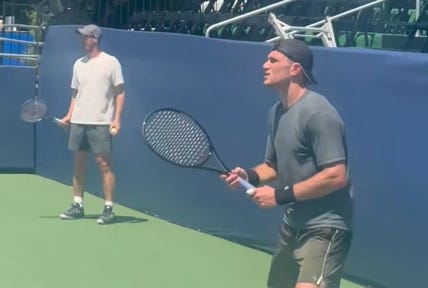
Reports are that it is a ‘Defyer’ (not a typo); Wilson’s candy-red Babolat Aero-98 impersonation that has been used in a (way cooler) black snakeskin prototype colour-way by Korda, Khachanov, Kouame, and a host of other Wilson-contracted players.
Draper is coming from a ‘Dunlop Revo CV 3.0 F’ (again, not a typo…), which is reportedly much stiffer (at least in stock form), so perhaps this is part-contractual/part-health related in a bid to soften the blows to his ever-bruised arm. This year Draper has also added natural gut strings to his mains, and tweaked his serve to platform (although he was back to pinpoint on his brief grass stint). All of that is proving moot, however. Draper pulled out of D.C, citing the left arm injury again. This is looking seriously bad for the Brit.
But I didn’t really want to talk about the specifics of Draper’s racquet switch as much as what the trend indicates if we zoom out. I touched on this recently in the last mailbag; how the sheer weight of information and resulting analytics industry is pressing everything — tactics, styles, court speeds, even racquet specs — into a smoothed and narrow ideal.1 Is it because the game rewards knowledge translation more than ever?
Aero 98’s, Vcore and Ezone 98’s, and now the Wilson Defyer 98. They’re all the same: 305 grams in weight, 315mm in balance, 16 main strings.2 The only defiant thing in Wilson’s latest iteration is in its spelling. Save yourself the cash and get something like a Prince Synergy 98 for half the price. I tell people all the time: most of the racquet “tech” is gimmicky BS. Weight and weight distribution are major determinants of how a racquet will play. And I’ll keep saying that until Wilson sends me at least three brand-spanking-new Defyers (with strings and racquet bag, of course).
Anyway, I don’t want this to be a tennis-doomer piece as much as a measuring stick to look back on when it’s 2035 and 9 of the top 10 are more similar than ever. Could be wrong though. After all, who could have predicted the rise of the drop shot when someone like an 18-year-old Alcaraz exploded in 2022? What will be the next trend?
What about a rising one-hander in the WTA?
Austrian. One-handed backhand. That’s right, Thie — I mean Tagger — has arrived.
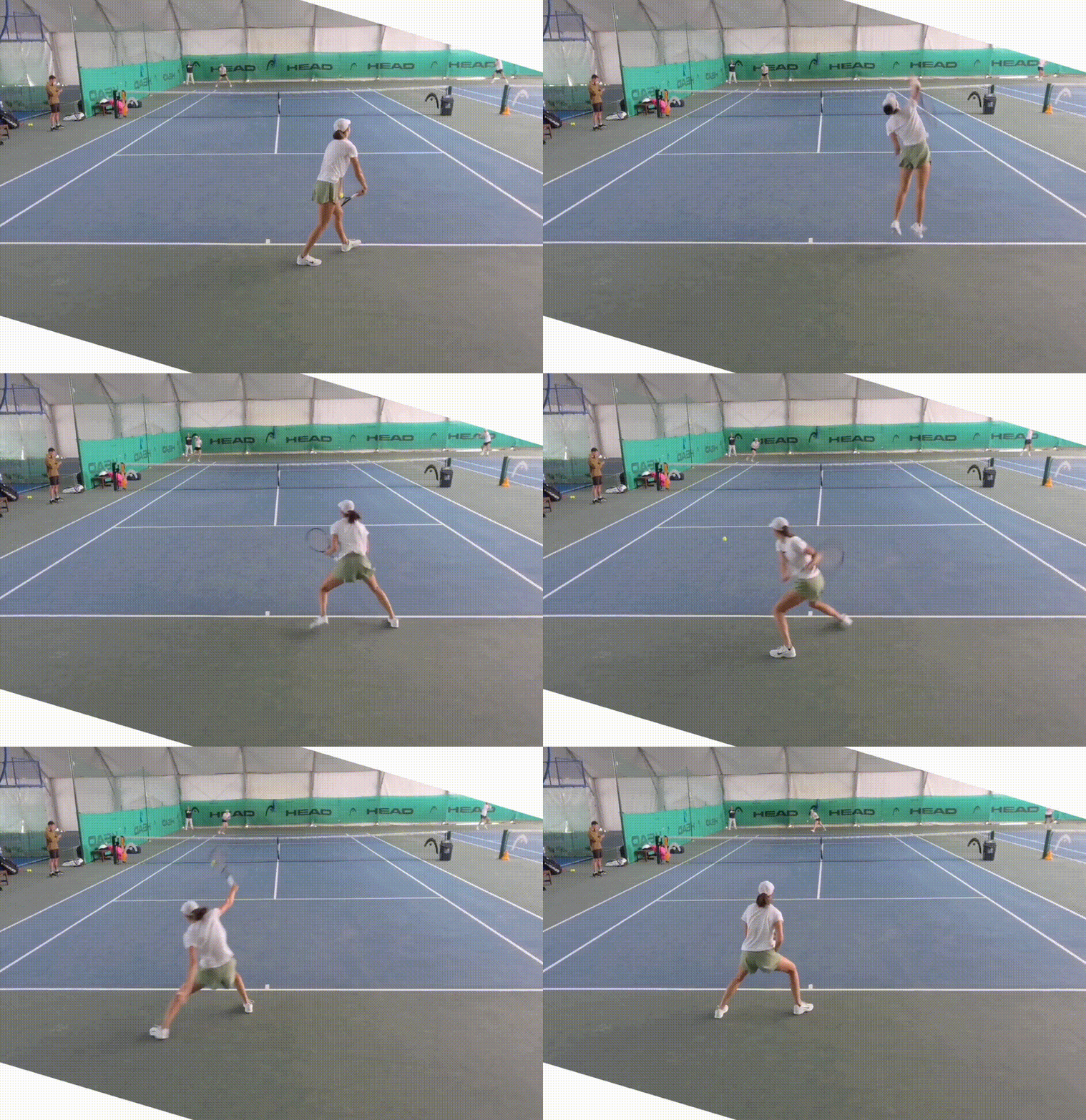
She was the French Open junior girls champion in 2025 when I first saw some of her highlights. This wasn’t that long after I had written a popular deep-dive on Tsitsipas’ backhand, so the stroke was front of mind for me at the time.
Far from being an ornamental weakness, Tagger’s one-hander mimics other greats: an early straightening of the hitting arm with a deep slot position:
I’m bullish the one-hander in the women’s game more than the men because I think the slice can be even more effective on the WTA, where strokes trend flatter and slice is less common. Plus, it’s a less serve-dominant game. Ash Barty was a world number 1 with a predominantly sliced backhand not too long ago. I don’t think that could happen in the men’s game anymore.
Already in the top 50 of the WTA rankings, it will be interesting to watch her progression down the back-half of the 2026 season.

Parsa@Parsa_Nemati
The ATP will trial more frequent ball changes at the Lexington Challenger next month: main draw singles get the first change after 5 games, then every 7 — down from the standard 7, then 9. Backed by the Player Advisory Council, it follows player feedback on hard-court ball wear.

11:44 PM · Jul 16, 2026 · 161K Views
3 Replies · 25 Reposts · 125 Likes
This is an interesting development that has been waiting for action.
Matt Willis crunched the numbers showing the impact that ball wear had on unreturned first serve percentages.
Old balls are returned around 10% more than new ones. As Matt wrote, “Tennis is already massively short point and serve dominant, and changes like this nudge it slightly further in that direction.”
But I think this move could give hard court tournaments the green light to stray from the “medium-fast everywhere” era we are currently in. If balls are changed more regularly, slow/gritty courts like a classic Indian Wells surface become more palatable, and that can help reverse the short point trend and encourage different play styles to excel. I also think there are certain strokes who will benefit from more regular ball changes. Fritz spoke about this issue against Sinner after the
“Something that got exposed today is when the balls got pretty worn out, I was struggling to generate any power with my backhand. It allowed him to take control of a lot of points. When the balls were newer, that wasn’t really an issue. I was able to stay in the points.”
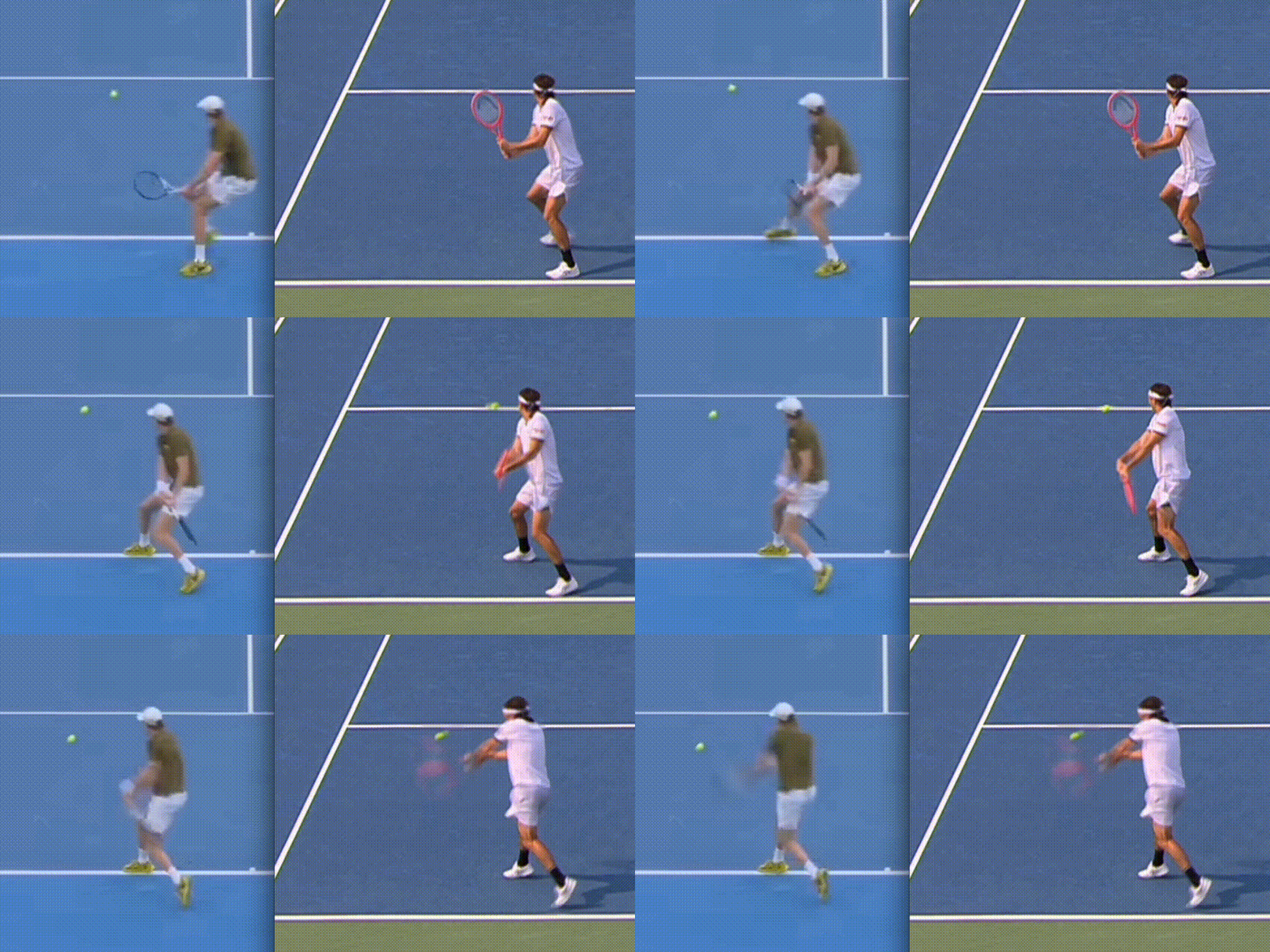
Look at that difference in runway length.
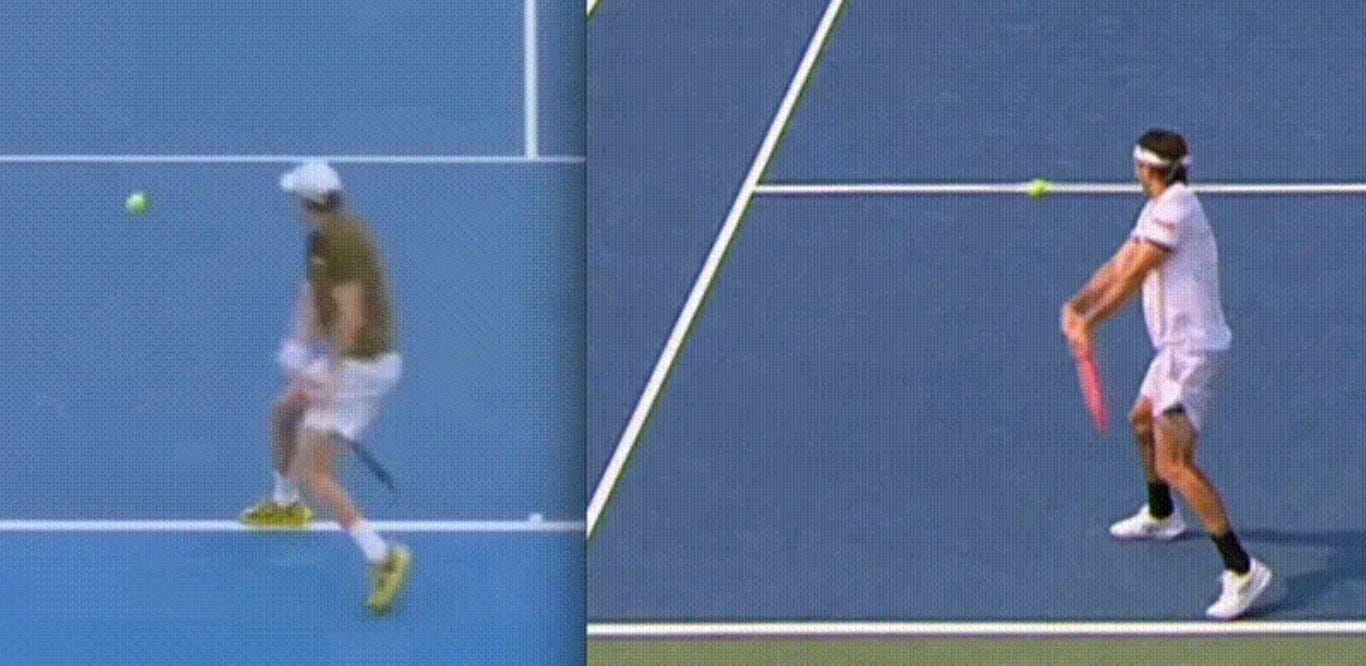
That extra swing length in the flip gives Sinner around 6 km/h more speed and 500 more RPM on average, and that has marginal gains more so with old balls/slower conditions than it does when balls are pinging and the simple timing/redirected mechanics of Fritz can be rewarded (Data courtesy of TennisViz and Courtside Advantage).
Medvedev can’t wait. Keeping tabs on this.
Was Nadal’s return of serve position a vulnerability?
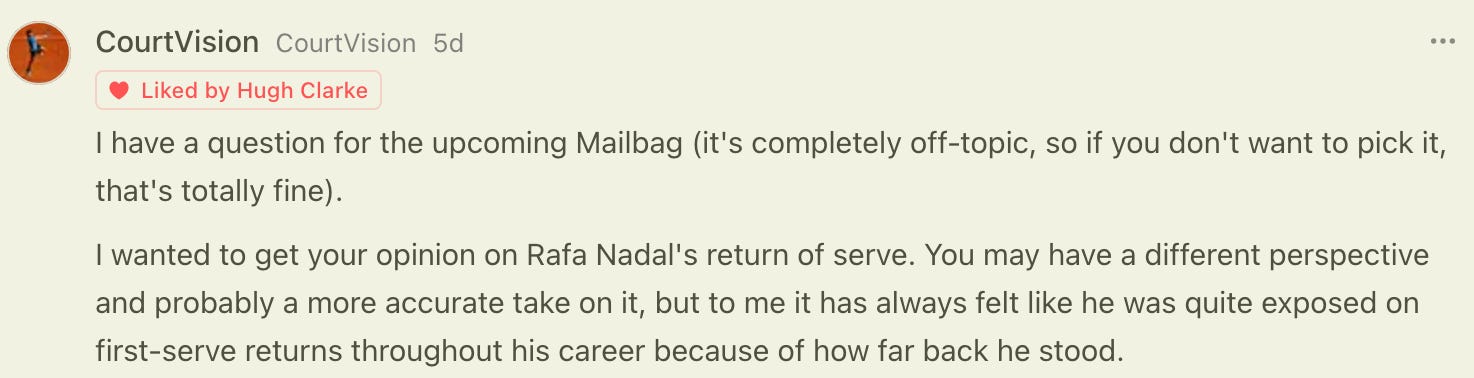
CourtVision has his own substack and answered this question himself if you want to check it out here. The comment further asks:
… Rafa was rarely in a position to truly neutralize a first serve and, by that, I mean that opponents with a great first serve often had a comfortable +1 to work with.
…So my question is: Do you think Nadal's deep return position was an actual structural weakness that elite servers could consistently exploit, or was it simply the trade-off that maximized the overall effectiveness of his return game over the course of his career?
This is an example of what CourtVision means by leaving his opponent with a perceived easy +1 ball:
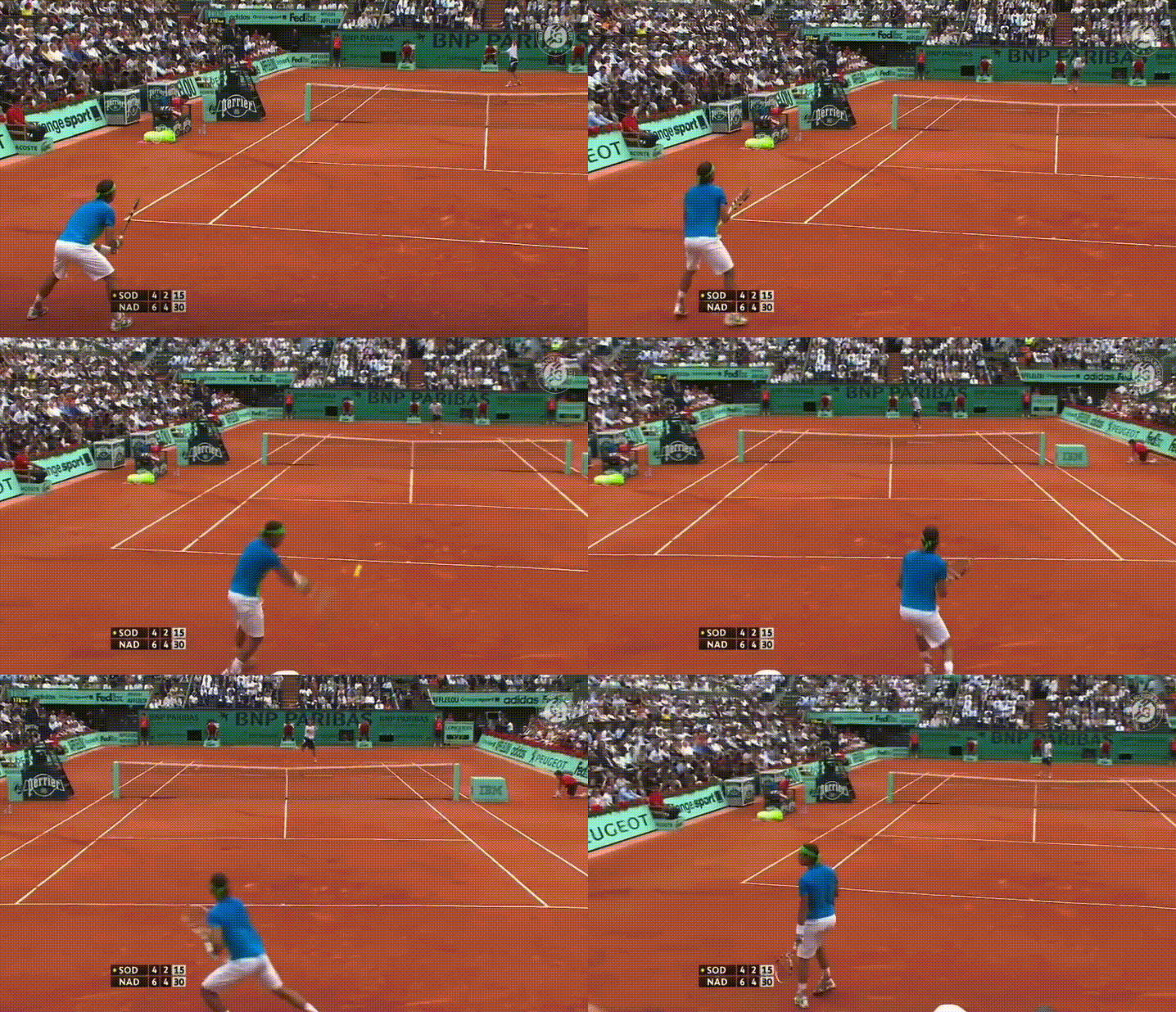
One way to start answering this question is to look at this graphic that Matt Willis posted during Wimbledon last year:
If we exclude the freaks, the “returns-in-play” specialists like Medvedev, Musetti, Ruud, Cerundolo etc. are often being more defensive to help boost that stat: Ruud and Musetti employ the block return on faster surfaces; Medvedev returns from six metres back. But we see that once the return is in play, they win less than aggressive returners like Rublev. Inherent in any strategy is a tradeoff.
So, should Nadal have stood further in on first-serve returns? Well, he often did on faster surfaces. Compare Fed (green) to Nadal (orange) on grass courts (left) and clay (right):
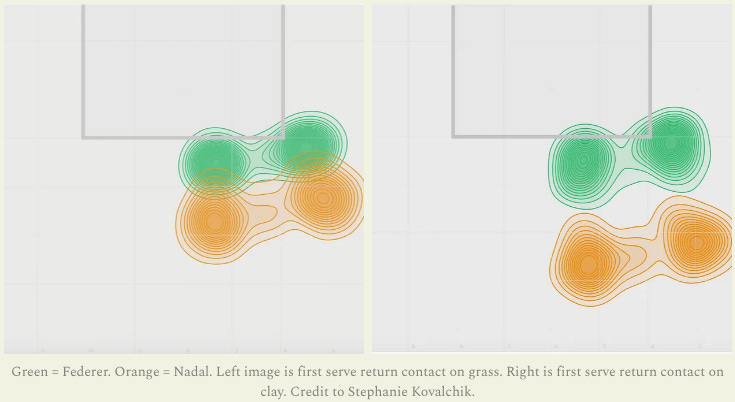
But Nadal’s hard and grass court adjustment was still noticeably farther back than Federer or even Djokovic. Sometimes your tactical adjustments are limited by your technique: Musetti has a huge five-bevel grip change to make between forehand and backhand that results in blocks/chips; Medvedev has long swings with a unique grip change that requires a deeper position for more time.

The tradeoff Nadal made was that he would put a higher percentage of returns in play, and this was probably the right tactic given he was the best end-range player we’ve ever seen. A couple of years ago I wrote a Big-3 movement series, and with Nadal I spoke about his defensive-V footwork; that he could attack while moving backwards.
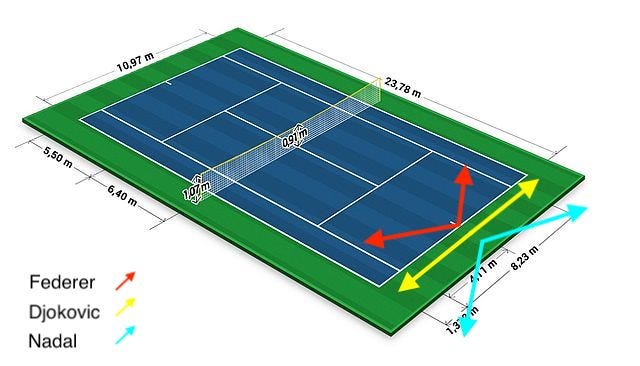
No one — not Alcaraz, not Djokovic, not Medvedev, not Sinner — had this combination of raw footspeed and racquet-speed off both wings from the ultra-deep:
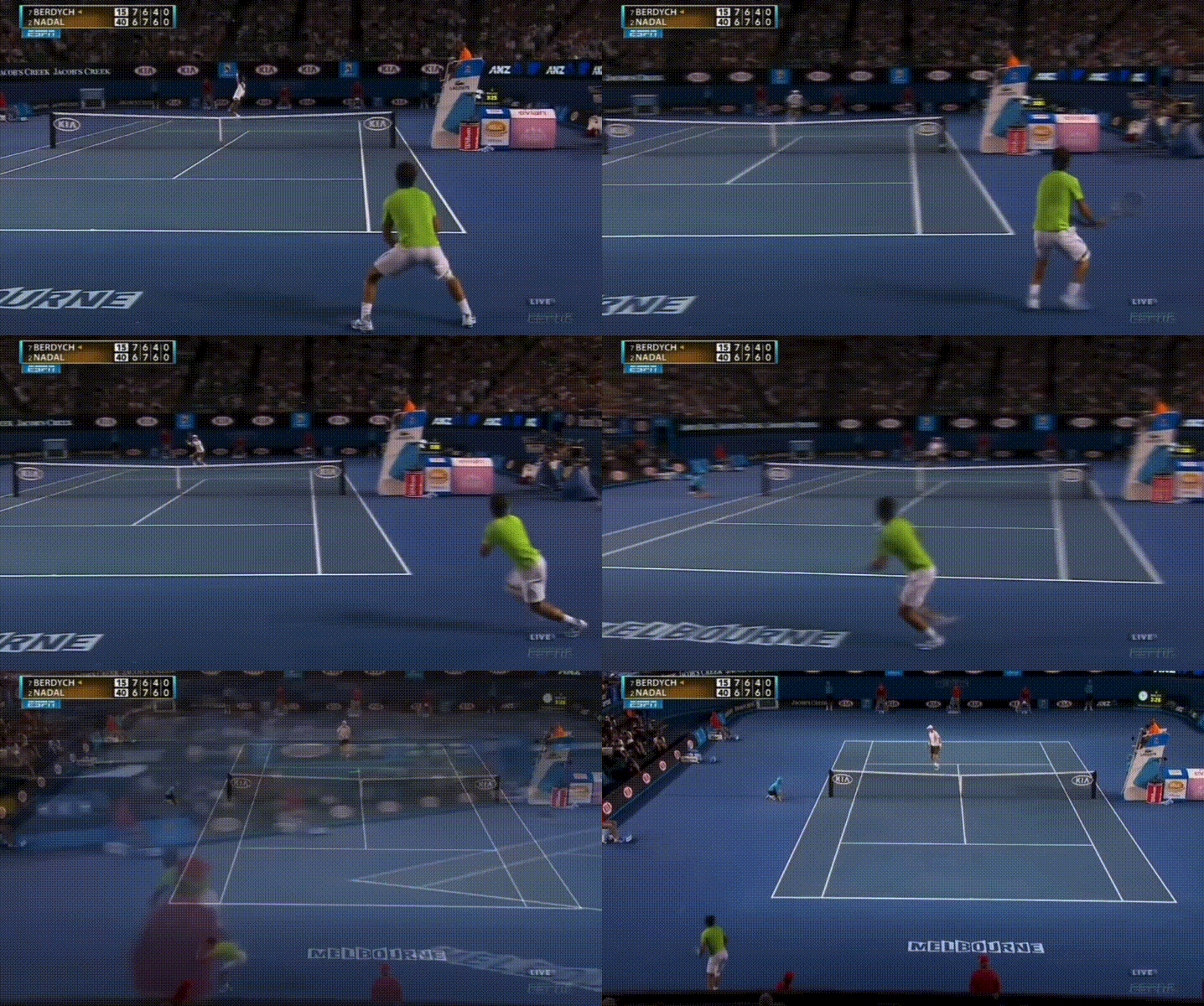
So when Nadal was being ‘exposed’ with deeper, looped returns like the one that opened this comment, his tactic was: good luck doing it for a whole match. He was betting that his defense and end-range abilities were going to trump whatever +1 forecourt aggression you could muster, because Nadal made that court look awfully small for his opponents, especially in big moments.3 And 14 RG’s suggest he was probably right. We’ll never know for sure, but standing closer in/getting more aggressive on first-returns would have meant fewer returns in play, and less opportunities to use his incredible defense.
Kind of fits with some themes from this piece anyway.
Substack made waves last week with the announcement that you could now scan texts for AI writing. I like the move, not because I’m against people using it, but because I do think there’s way too much slop out there and this will likely result in less of it, at least on Substack.
I’m more of the view that if the writing is enjoyable I’m not overly fussed if someone used AI. My hunch is that it must be used as a tool way more than a crutch if the writing is to have any hope of becoming interesting. I genuinely don’t think AI could write an interesting tennis article. I’ve read loads of them already and I’m super bullish A Thread of Order. I’ve noticed that whenever I feed a first draft into ChatGPT or Grok I get something flattering like: “this is an 8.4/10 right now, but if you *10 suggestions that completely eradicate my voice into generic slop* then it will be a 9.5.”
No thanks.
Grade inflation aside, the exercise is helpful for catching spelling and grammar mistakes and helping to smooth transitions between paragraphs; I’m quite a choppy writer in that sense and I’m happy to use it as a rough editor that cuts 10% of my waffling.
Well that’s all for now. I’ll see you in the comments. HC
Sure the pros modify them to personal tastes, but you can’t help but notice that even pro specs are converging into a far narrower range than prior generations, and that’s reflecting the convergence of game styles as well. Murray, Djokovic, and Nadal were all three very different baseliners (roughly: flat counterpuncher, flat offensive, spin-aggressive) with three very different frames.
Rally length data tends to skew longer on important points, which is probably a mix of conservative server play (ensuring they make the first serve/more spin on +1 balls/bigger targets), and a heightened effort level from returners to scrap/defend.
No posts
Comments
Nothing yet. Say the first thing.
Sign in to join the conversation.