
Dear friends,
How often have you heard the complaint that being environmentally friendly is expensive? It’s valid.
I was in my local shop the other day, looking for table salt and triple A batteries, when the pricing of toothbrushes caught my eye. A pack of three plastic Oral-B toothbrushes was £1.98—just 66p per toothbrush. A single Colgate toothbrush made of recycled plastic with plant-based bristles was £2, while one Colgate toothbrush made of FSC-grade bamboo with charcoal bristles was £3.85. Try to persuade a single, low-income parent of three kids to choose one of the latter two options, and it ain’t happening (unless, of course, they are a very particular, rare kind of person).
And toothbrushes are just one example. What about membership of conservation organisations, responsible for funding a large amount of conservation work? This is highly unlikely to be made up of those on low incomes.
This, obviously, is not a slight against those with less disposable income. This raises important questions about what the relationship is between income and money spent on the environment. If the more environmentally friendly choices are more expensive, is it true that as people get wealthier, they spend more of their money on greener options?

This isn’t just an abstract, theoretical question that’s interesting to ponder. We currently have an obsession with using GDP as a marker of progress. If it’s true that as GDP rises, people spend more on conservation, then is this obsession misplaced? (Spoiler: yes.)
Essentially, the dominant economic model is a capitalist one that has firmly linked growth with increasing incomes and higher consumption—does this mean environmental action is doomed to failure (in which case we need to adopt an alternative measure of progress, fast), or can we successfully protect the environment within this framework?
To answer this, we need to think about a graph. It’s not complicated—bear with me.
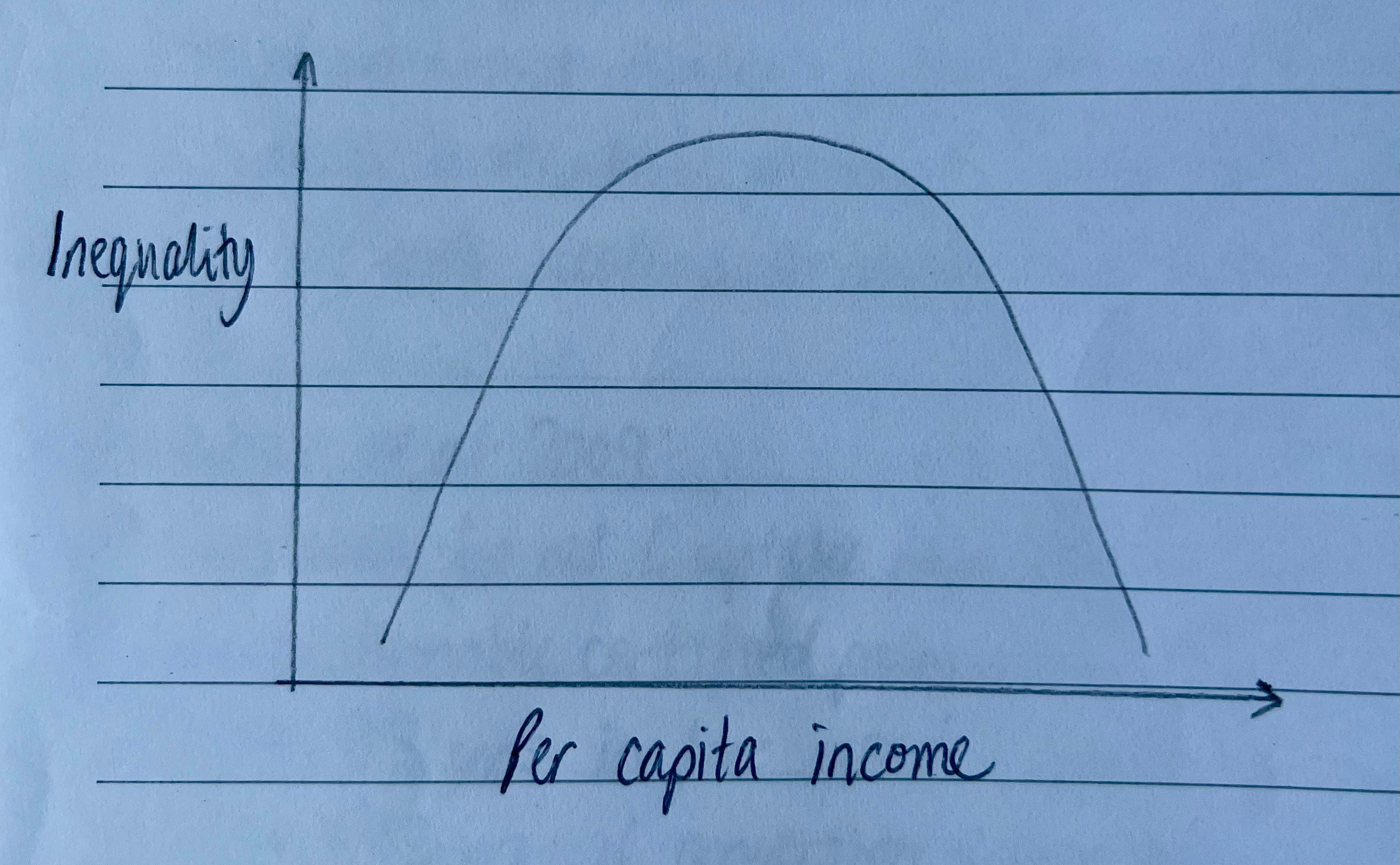
Have you heard of the Kuznets Curve? It’s an idea from economics that represents a hypothetical relationship between income and inequality.
The general idea is that, initially, as incomes increase, inequality increases too—think ‘money makes more money’, so those with higher incomes grow theirs, while those less well-off continue to stay less well-off. But then, the relationship reaches a tipping point beyond which, as incomes increase still further, inequality begins to decrease, as the benefits of rapid societal monetary growth start to be felt.
Existence of this curve is massively disputed, with most accepting that it applied only to a very brief period after the Second World War in Europe and the US.
But we’re not here to talk about economics. We’re here to talk about economics in the context of conservation.
Mirroring this idea is the Environmental Kuznets Curve. This proposes the same upside down ‘U’-shaped relationship between income and environmental degradation.
At first, its suggested, environmental degradation increases as incomes increase, since people tend to use more resources as their incomes rise (think more flights and travel, excess food, excess clothes and excess stuff). After a tipping point, as larger incomes allow people the luxury of being able to care about the environment and invest in it, environmental degradation decreases again.
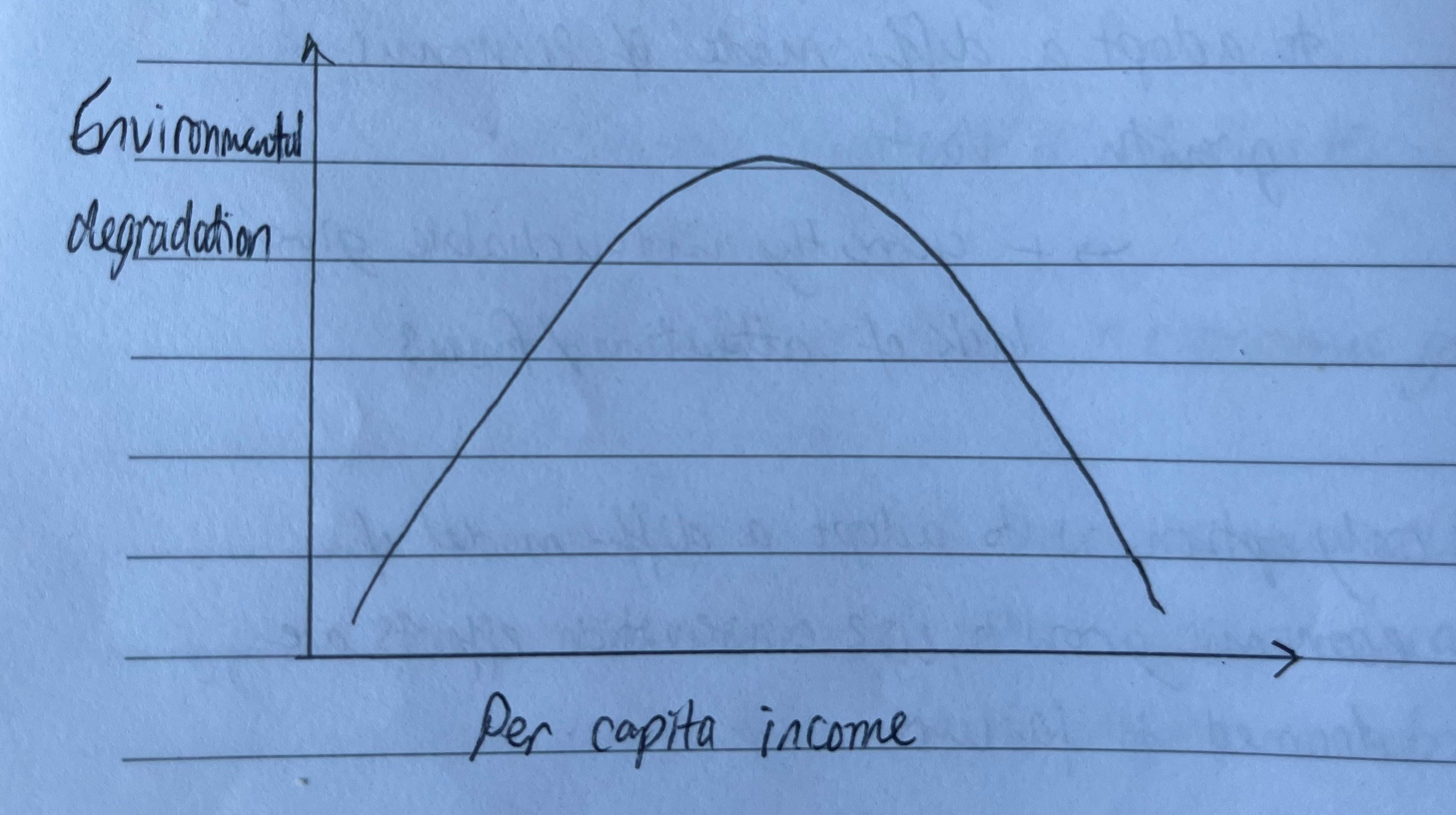
Essentially, the Environmental Kuznets Curve suggests that being environmentally friendly is expensive, so only once people’s basic needs are met by having enough money can they afford to spend money on the environment. That’s the idea.
If this were indeed the case, then prioritising growth in GDP should eventually lead to better environmental outcomes. Let me explain why this doesn’t work, in case you can’t see the holes in this argument already.
In reality, there is very little evidence for the existence of the Environmental Kuznets Curve. It’s likely that it represents more of an idealised hope that justifies our current economic model, in which resource use is firmly coupled with economic growth—i.e., the more we develop economically, the more resources we use and the worse-off the natural world becomes.
Firstly, let’s think about how biodiversity behaves. Biodiversity has a very slow recovery rate, and once a species is lost, it is lost forever. So clearly, the Environmental Kuznets Curve cannot apply here: once this type of environmental degradation has happened, it doesn’t matter if further down the line people invest in conservation more once they have higher incomes—the damage is already done and irreparable.
Then there’s the existence of historical, traditional practices that, despite being environmentally damaging, are entrenched and very hard indeed to overturn, even once people have higher incomes. Think of grouse shooting in the UK. This practice dates all the way back to the mid-19th century, and it means that about 8% of the land in England and Scotland is still managed to this day to provide the best habitat for red grouse, as opposed to other, more biodiverse habitats.
Another example is the use of rhino horns in traditional Chinese medicine. In fact, this is a good example of how wealthier people tend to be drawn more to expensive items—high-status symbols that often have a high environmental cost: shark fins, fur coats and snake-skin bags, rhino horns, meat-heavy diets, four-wheel drive cars or long-haul flights.
While it might be true, at least in principle, that people have greater capacity to prioritise the environment monetarily once they have more comfortable incomes, in reality, this doesn’t seem to be how people actually behave.
In fact, the evidence suggests that, as people’s wealth increases, so does their disconnect from nature. People become less aware of their natural environment as they become more surrounded by material goods, so they start to care less about the state of nature. This makes it easier for wealthier people to make lifestyle and consumer choices that cause environmental damage.
A survey conducted by National Geographic back in 2014 found that people from wealthier countries feel less guilty about their environmental impact than those from poorer countries do, despite having a much larger negative impact on the environment. Take a look at the average carbon footprint of someone living in the Philippines versus the US, for example. In the Philippines, the average amount of CO2 produced by one person in a single year is 1.5 tons. In the US, it’s 13.6 tons. And yet, it seems those who feel more guilty about their impact, and so more likely to make changes, are the very people doing less damage.
The final thing the Environmental Kuznets Curve fails to take account of is leakage of environmental damage. In other words, as a country’s internal environmental damage lessens, it is likely that part of the reason is they are exporting this damage to somewhere else.

At a country-scale, it might sometimes be true that environmental damage starts to decrease as income levels rise, but this is often only because a nation’s negative environmental impacts are being exported to other countries.
On the face of it, for example, it might appear that European countries’ agricultural practices are less damaging now than they used to be. In reality though, a large part of this is down to imports of beef and lamb from Brazil, rather than eating home-grown. The imported meat comes from livestock fed on soy, for which vast swathes of the Amazon are being cleared—the environmental degradation happens in Brazil, but it is caused by those in Europe.
In one study that looked at countries’ rates of deforestation and reforestation between 1961-2007, 22% of countries’ conservation investments were offset by being responsible for environmental degradation elsewhere. And this percentage increased as development increased—for the period 2002-2007, this percentage increased to 52%. So the evidence suggests that it just isn’t true that environmental degradation decreases as economic growth continues, despite what many would like to believe is feasible.
All of this points to the central idea that it isn’t possible for conservation efforts to succeed under our current capitalist model of economic growth—one that encourages increased consumption and greater exploitation of finite resources. Our choice of per capita GDP as our only measure of growth is inherently tying us to prioritising consumption and calling that progress. There just doesn’t seem to be any evidence that we will all start throwing our extra disposable income at environmentally friendly choices once we reach a certain income.
So what can we do about it?
The first thing we could absolutely do now, even under our current economic model centred on GDP, is to force the market to capture externalities—i.e., to regulate businesses and charge them for their true environmental footprints. Let me go back to our toothbrush example to explain what I mean.
The reason that the plastic toothbrushes are so much cheaper than the bamboo ones is not because they are actually cheaper to produce based on the resources used to make them; it’s because no one is forcing companies to pay for the environmental cost that is inherent in producing a plastic-based product. Plastic is ‘cheap’ according to the price tag we’ve given it because we haven’t built its environmental cost into our system—it’s a material made (mostly) from fossil fuels, so it has an inherently high cost in terms of greenhouse gas emissions, plus it is a huge source of damaging environmental pollution.
So the cost of a plastic toothbrush is, in reality, very high; it’s just that our monetary system hasn’t built this in, so we think it is cheap.
Forcing companies to truly bake environmental costs into the price of their products would go a long way to reducing that massive price difference we see in the shops between the more and less environmentally damaging goods. This may not be a sexy idea. It may not be popular because no one wants to pay more for things. But everything does ultimately have an actual cost in terms of resource use, and if our pricing doesn’t accurately reflect this, then all we are doing is shifting the cost onto future generations in the form of environmental degradation.
There are also ways of achieving an alternative kind of growth that isn’t based simply on increased consumption—‘green growth’.
We could shift to a focus on resource-use efficiency, so that we can continue having faster cars (or whatever it is we think we want) by using the same amount of resources, or even fewer if we can work out how. We could also choose to redirect investment towards helping the growth of service industries, like healthcare or teaching, as opposed to production. All of this is possible if we want it to be—if we stop swallowing the narrow, relentless focus on income and consumption as the benchmark for progress.
Ultimately though, the evidence suggests we need to adopt an alternative model of growth, one that is focused on a more meaningful measure of quality of life than GDP. At the end of the day, it’s an improvement in quality of life that we all want, isn’t it? This is what we really mean when we talk about progress. It’s simply that we’ve got stuck with the wrong ruler with which to measure it.
Other measures do exist. A particularly hopeful one is the Genuine Progress Indicator (or GPI), which tries to build a fuller picture of the wellbeing of a country. Only a part of the wellbeing of a country is made up of the size of its economy, so GPI also includes measurements of environmental and social factors to form a better assessment. These include things like carbon footprints, pollution, resource depletion, public health and rates of poverty.
This means that if a country improves financially, but this improvement is offset by increasing poverty and pollution, then the change in GPI will be zero, or even negative if GDP increases are more than offset by negative social or environmental costs. This makes a lot of intuitive sense. It seems entirely reasonable that economic growth isn’t synonymous with societal progress. It forms only a part.

Imagine countries having a genuine desire to improve GPI instead of GDP. Imagine if this were the measure always touted during election campaigns and used to compare countries’ progress. Until this happens, improvement will always be thought of as higher incomes and business profits, which are intrinsically linked to greater resource use, so foiling environmental efforts.
This is completely possible. Take Costa Rica, for example. They consistently top the charts on the Social Progress Index, which includes measures of human needs, wellbeing and opportunity. Costa Rica scores more highly than the US for health, life expectancy, democracy, personal rights and environmental quality, despite having an average income over three times smaller than the United States. The difference is simply that they decided to prioritise the right things, accepting this means they won’t top the GDP charts.
Sometimes, it takes seeing examples of what’s possible to let us dream about a future we actually want. Economics might have a reputation for being complex, packed with jargon, impossible to understand and graph-filled. But the principles behind it are really just decision-making, the type that you and I make every day.
Production and consumption of goods and services are driven by us—by the daily choices we all make—and understanding just a little bit more about how these can be linked and unlinked to environmental damage helps us make more informed, empowered decisions. This is how everything ever thought of as unchangeable got changed.
If you enjoy reading about nurturing a rich relationship with nature, would you consider upgrading to paid or buying me a coffee? It allows me to keep writing.
Comments
Nothing yet. Say the first thing.
Sign in to join the conversation.