
This is part of my Nature Deep Dive series in which I unpack the science behind nature connection.
Research is often inaccessible because of jargon and assumptions of prior knowledge. This shouldn’t be the case. Everyone has the right to know what we know. Knowledge is power, after all. AI can’t interpret and contextualise research for you, but I can.
That’s why I read science papers that won’t make it into the media but should, so you don’t have to.
Dear friends,
This month, I’m looking at research on pot plants in classrooms. Yes, it exists.
A month or so back, I wrote a piece about our tendency to bring nature inside our homes in the form of pot plants, cut flowers and Christmas trees. So many of us do this, and for so many of us, our house would not feel like a home without a good dose of green leaves.
Despite us decorating our homes in this way, school classrooms, where we send our children to spend a good portion of their time, do not get the same treatment. The only plant I remember at school was an underwater plant, Elodea, that we used in science experiments.
This month’s study wanted to work out if introducing plants into school classrooms affected students’ perceptions of these spaces. In other words, does introducing pot plants into schools make students feel the same way towards their classrooms as we do towards our homes—positive, comfortable and like we want to be there?
I love this study because of its simplicity: take two classrooms, put plants in one but not the other, see if the students feel or behave differently. Not all science need be multi-million-pound-grant levels of complex.
I also love its real-world applications. Much like the paper I unpacked back in January, which looked at how views of trees might influence recovery after surgery in hospital, this study experiments with ways in which we can integrate nature better into our existing systems and how this might help.
I first came across this paper through reading another. It was about outdoor learning in primary schools, and it specifically referenced the findings of this one: ‘In one study, children with plants in their classroom experienced stronger positive feelings about their environment and had lower absences from school…’ One thing led to another, and I think you can see the rabbit hole I ended up down.
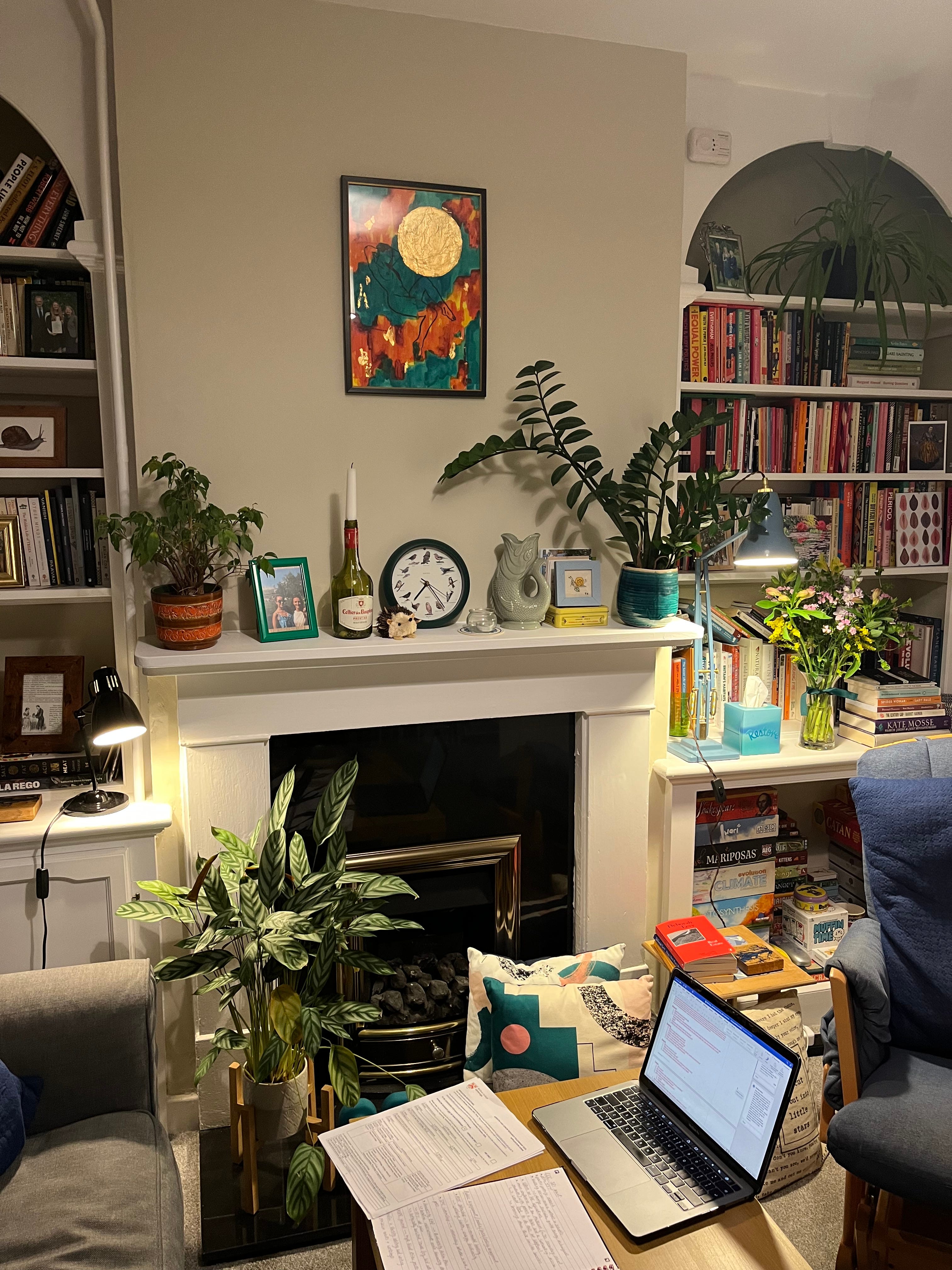
To collect their data, the researchers worked with two classes of eighth-grade students at a junior high school in Taiwan. There were about 40 children in each class, and they were all about 13 years old. Their classrooms were right next door to each other, making them ideal for this experiment since they were practically identical.
For a period of just over seven months, the students in both classrooms were surveyed every other week. They were asked the same questions each time about their perceptions of their classroom, in terms of preference, attraction, comfort and friendliness. The researchers also got hold of data on students’ sick leave and the punishment records for misbehaviour.
Each of preference, attraction, comfort and friendliness was gauged by asking students to rate how much they agreed with a statement: ‘I like this setting very much’ (preference), ‘I am attracted to this environment very much’ (attraction), ‘I am very comfortable in this setting’ (comfort) and ‘This environment makes me feel very friendly’ (friendliness). This allowed the researchers to see whether children’s feelings towards the classroom changed once the plants were added.
All students completed the questionnaire ten times, the first four times before there were any pot plants involved, and the last six times once plants had been added into one classroom (the experimental group) but not the other (the control group).
Now, when I was reading this paper the first time, I was imagining cute little pot plants—maybe some succulents, a fern, a classic monstera or devil’s ivy. However, see below.
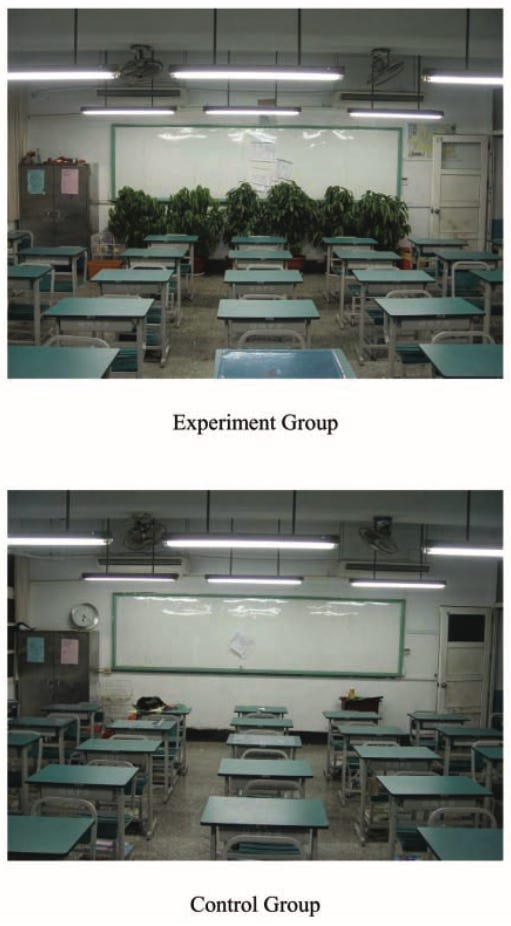
To the classroom of the experimental group, the researchers added six Botel Tobago cinnamon trees. I wouldn’t normally add such extraneous detail here, but these dimensions are worthy of mention: the six plants had an average height of 135cm, an average canopy size of 80cm, and they took up 6% of the classroom’s floor space. I think I literally said ‘Oh wow’ out loud when I saw the photo.
The plants were cared for by school staff, so the children weren’t responsible for this, although, as the author notes, tending to the plants might well have influenced how students felt towards them. Interestingly, despite not being part of the official data collection, several students were observed adding small decorations to the plants, which I think is just fascinating and heart-warming at the same time—I know what experiments I’d want to run next…
The point here was to see if simply having plants in classrooms affected how students felt towards these spaces, and I think you’ll agree, this was the perfect, simple set-up.
Firstly, students in the classroom with plants racked up significantly fewer hours of sick leave and significantly lower rates of punishment for misbehaviour over the test period in contrast to the children in the classroom without plants.
Secondly, the children in the group with plants showed significantly higher perceptions of preference, comfort and friendliness towards their classroom than those in the group without plants.
In summary then, plants in the classroom made these children prefer their environment more and feel more comfortable and friendly in it, which also meant they had less time off school and misbehaved less. As I said—simple, straightforward, not rocket science. But sometimes, we need to collect evidence for the stuff that isn’t rocket science.
Frankly, the fact that people dedicate time and whole careers to collecting these kinds of data and asking these kinds of questions restores my faith in humanity. I’m not being hyperbolic here. Research that works out how to design robotic ‘bees’ to pollinate flowers or how we can send people into space faster does the opposite.
I think it’s a question of how we decide to use human ingenuity and intellectualism. Sure, we can throw money, resources, time, brain power at walking across the surface of the moon, but there are still people who can’t see the point of putting plants in classrooms to help children have a better environment in which to learn and spend so much of their time. And yet, it’s often this kind of research that’s deemed pointless, not worth the money and frivolous.
I care about these results because I think they get to the heart of everything we misunderstand about how children learn and what they deserve from school. So many classrooms and school environments have been designed around the idea that, in order to learn, children need no distractions—fine, in principle, but in reality, this has come to look like removing anything remotely fun, interesting or real from the room. Aren’t these precisely the things that help us learn?
It feels like a double standard to decorate our own homes with art, pleasing objects and plants so that we enjoy being there, but then not question it when we send children off into sterlised, boring, drab classrooms all day, expecting them to return enthused with a love of learning about the world.
Yes, the findings of this paper seem simple, even obvious—that children feel better about their classrooms when they have plants in—but sometimes, we need to be reminded of the obvious. Who could ask for a simpler, cheaper way to improve children’s time at school? It is rare that solutions come along so capable of being acted upon and with such little paperwork.
Full credit to the author of this paper: Ke-Tsung Han. If you would like to read the full paper, click here.
If you want to learn more about the science behind how nature is good for us, would you consider upgrading to paid or buying me a coffee? It allows me to keep writing.
Comments
Nothing yet. Say the first thing.
Sign in to join the conversation.