
It’s early 2010, and there’s a busy lunch service at Eleven Madison Park in New York. The New York Times had given it four stars the year before. Four friends are finishing their meal, and the general manager, Will Guidara, overhears them. Having eaten their way across the best restaurants in the city all week, these out-of-towners are flying home in a few hours. One of them says something like, “The single thing we never got to do was eat a New York street hot dog.”
A hot dog, of all things.
Guidara walks out the front door, finds a cart on the corner, and buys a hot dog for $2. He carries it back to Daniel Humm’s kitchen, has it cut into four pieces, plates each one, and serves them himself.
The visitors lose it. Of everything they ate that week, the hot dog is what they’ll be talking about for the rest of their lives.
Guidara built a career on that instinct and wrote a book about it called Unreasonable Hospitality. “Service is black and white,” he wrote. “Hospitality is color.” He also explained it another way: “I wasn’t in the business of serving people dinner. I was in the business of serving them memories.”
That distinction will soon take on great significance for many companies, regardless of their business.
For as long as we can remember, professional service providers have sold their time. Law firms, consultancies, and accountants bill by the hour. Banks take a percentage of the assets that a banker manages on a person’s behalf. Each service puts a price on human effort.
AI is now removing the effort from the equation, and customers can feel it. They know that lawyers are using AI and that consultants are using LLMs. It’s obvious to them that banks are running agents behind the scenes. Worse still, customers now self-serve, allowing smart tools to compare services for them.
Somewhere in every client’s head, the same question is forming: Why, exactly, am I still paying for an hour of someone’s time? That’s why people are drifting away from being billed by the hour toward paying for outcomes instead. Pricing follows behavior. The Thomson Reuters Institute writes that the billable hour “may be long past its expiration date,” citing its 2025 State of the US Legal Market Report.
Yet somehow, the human element is in demand like never before. Take Vivino, the popular wine app based in Denmark, which had long run an experiment for the world to see. Point your phone at a wine label, and you’ll instantly have the producer’s name, the region, the vintage, the average price, and a rating.
The app has been downloaded more than 70 million times. Co-founder Heini Zachariassen said Vivino processes 100,000 ratings a day, while industry bibles such as Wine Spectator and Robert Parker might rate 20,000 wines a year. And crucially, according to a 2024 study, crowd ratings broadly align with those of professional critics.
So, theoretically and empirically, within a single digital invention, every piece of knowledge that a sommelier would accrue over a decade had literally become a free resource in your iPhone on demand.
Surely, this was the end of the sommelier, just like photography on film had ended.
The reality was far from it.
Ever since the digital app went live in 2010, the sommelier has become nothing less than a cultural phenomenon. Two years later, the documentary Somm turned the sommeliers’ own examination into a spectacle, and the profession has expanded into the only counterpart to the celebrity chef. The Court of Master Sommeliers Americas in July 2025 passed the largest class of advanced sommeliers in its history, even when every digital app and chatbot was capable of responding to any inquiry that a user might have.
How could it be? Come to think of it, when you go to a restaurant, you ask a human to help you reduce risk. You want someone who can read the room, or at least the table where you’re sitting, to understand without asking who’s the boss and who’s paying. Are people worried about looking cheap? What’s the purpose of their gathering? Are they a group of chums and friends, a business setting, or a nervous first date?
After all, it takes a human to curate the right selection of product and create a theatrical experience to enhance the dining night.[1]
When I talk to private bankers now, they all tell me the same thing: that the wealthiest customers do not want a chatbot. And customer expectations keep rising. When McKinsey surveyed the most affluent households in 2024, almost 80% of them preferred to pay a premium (50 basis points or more) for a human financial advisor over taking cheaper automated services.
But there’s a catch: The human advisor is expected to be part strategist and part life coach.
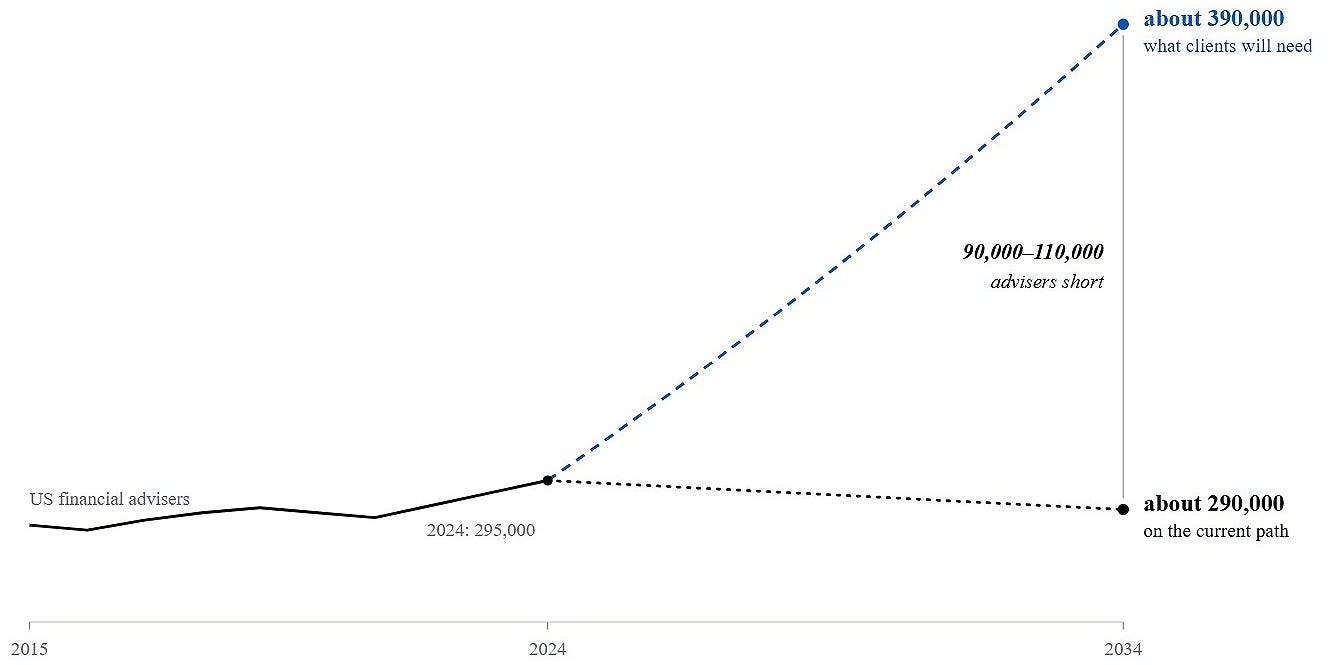
For the better part of the entire history of the banking industry, services of that kind were reserved only for the ultra-rich. Time and staffing had always been the constraint. AI removed that excuse because product knowledge is so easy to access and is very commonly available.
Matthew Fleissig, whose Pathstone firm manages $185 billion, told CNBC in July, “My personal opinion is that ChatGPT is the single largest investment advisor in the world right now.”
What remains scarce is the banker who walks in, already deep in the client’s life, who can tie the portfolio to the client’s kids, the private business, and whatever else keeps this one person up at night. During the face-to-face meeting, the customer gets to feel like the most important person on earth.
That is the Michelin-star standard of unreasonable hospitality.
Maya Angelou is often credited with saying, “People don’t remember what you say. They remember how you make them feel.” MIT economist David Autor has another favorite example.
When ATM arrived, everyone assumed that tellers were finished. Instead, the teller number increased over the next 30 years because the work itself has expanded beyond counting cash. The job now includes upselling an insurance product and signing up for a mutual fund. The technology freed up humans to make deeper connections and expand the work itself.
Every business plays two games at once. I call them captivate and convert. Convert is the transactional game: you know, the search, the comparison, the checkout, the follow-up. The chatbots and AI agents are taking over these duties.
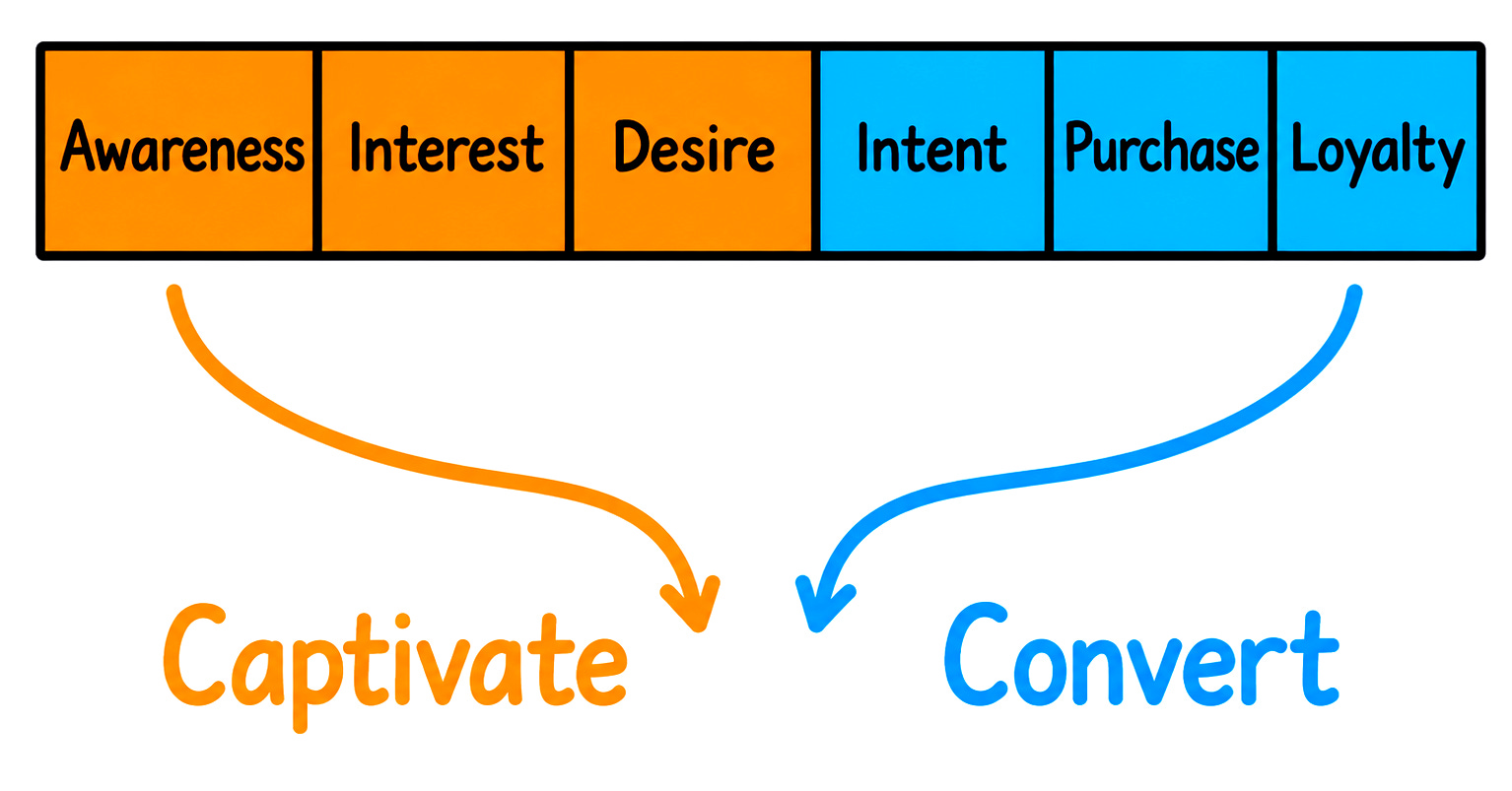
Captivate, on the other hand, is to create a particular desire, a deep meaning, or a strong reason to show up in person to experience the brand or to receive the human counsel.
So then, if the errands can run by themselves because of AI, how many people does a business really need?
In June 2025, 31-year-old developer Maor Shlomo from Tel Aviv successfully sold his startup that was built in the most extraordinary way. The first time he did it, he had built a company the ordinary way with 100 employees, backed by nine-figure venture funding. But the second time, by his own account, he wanted to see how far he could go as the only person in the building. (Quite far, as it turned out.)
Base44 was the product. It was a platform that turned plain-language descriptions into working software. Shlomo launched it as a side project in late 2024. There was no need for investors or employees, just Claude models under everything. He gained visibility through LinkedIn. He paid the token bills, automating everything else.
Astonishingly, 10,000 users arrived during the first three weeks, then a quarter of a million in the following six months. It had been profitable from day one, by Shlomo’s own account, clearing some $190,000 in May 2025 alone. In the past, he would have hired human hands; the second time, he automated.
That’s how, by June 18, 2025, six months after launch, Wix bought Base44 for some $80 million in cash. That day, there were about eight employees on the payroll. I myself couldn’t believe it and had to do the math twice. That’s $10 million per employee.
A year later, Stripe’s economists counted roughly 4 million Americans earning their primary income as solo operators or entrepreneurs, each grossing over $100,000. Solo operators clearing $1 million in gross revenue have since more than doubled from 2023.
The idea of a one-person company is quite simple. The solo founder is an orchestrator. One agent does the market research, another works on customer tickets and complaints, and still another controls the financial book. Only the solo entrepreneur, the human, decides what is worth doing at a strategic level and assigns agents to do it.
None of this was possible before the emergence of the autonomous agent, and I’ve traced that shift in another essay.
Now, of course, if a one-person company as a concept could be deployed only for a solo software founder, none of us would need to pay attention. Yet the very same idea can, in fact, move to big companies, with a twist.
Back in March 2023, Morgan Stanley had selected OpenAI as a strategic partner for wealth management. A digital assistant went live by September 2023, answering any question from their bankers against 100,000 research documents.
Before the assistant became available, an advisor searching that library found the right document around 20% of the time. Retrieval rose to 80% immediately after the launch, and adoption reached around 98% of the advisory teams.
None of this should be surprising. Jeff McMillan, who led the rollout, said the goal was to make every employee “as smart as the smartest person” on any topic.
That is the democratization of talent. Any organization always has the really great expert. AI is not going to be as good as these super-ultra-stars, but spreading that talent across the organization makes it good enough for the average to become great.
Then Morgan Stanley went after the client meetings themselves with Debrief, launched in June 2024 for roughly 15,000 human advisors. With the customer’s consent, the assistant switches on during the client conversation in order to take notes, draft a follow-up, and file the record.
This means the advisor can stop scribbling and attend to the person in front of them. Houston advisor Don Whitehead said, “You can really be invested in the meeting; you’re actually a lot more present.”
More than 18,500 of you are regularly reading my pieces. If you like mine, you’ll like the other colleagues of mine who write for my school’s magazine, I by IMD.
The new issue asks whether SpaceX is the beginning of the era of corporate dictatorship. It’s one of the many fun and insightful pieces in this volume.
Try the whole thing for free by clicking here!
Again, the errands go to the agent. The desire remains human, and a human can pour their heart and mind into feeling the emotion of the customer who’s sitting right across the desk.
It seems to work. AI-matched referrals doubled past 100,000 in nine months. Morgan Stanley’s revenues from wealth management set a record of $31.8 billion. Total client assets crossed $10 trillion by mid-2026. And the stock has set an all-time high.
Notice that in this scenario, each of those 15,000 advisors at Morgan Stanley runs a host of capabilities that, in the past, might have been reserved for the most senior executive of the company.
Now the average banker can act as the strategist of the investment portfolio, with the whole research floor behind every conversation, personalized each time. I think this is just an early expression of how a one-person company looks inside a large organization.
I described this discipline as “work atomization” in an earlier piece. You package a company’s own internal capability as an agent and put it on a shelf for any employee to pull from.
The test is fairly simple. Count the hours that your team loses each week waiting for a response from another department across an idle silo. But when capabilities are codified into an agent and put on the shelf, there’s no more waiting. Feedback is instantaneous, and each employee stops being caught in a big machine and becomes a captain commanding a fleet.
Just in case you think only the banking industry can do this, a furniture manufacturer and retailer has done it, too. IKEA discovered that its chatbots had absorbed about 47% of routine customer inquiries in just two years. The company sees no need to shrink the call center. In fact, it has retrained about 8,500 call center employees to become remote interior design advisors.
People will pay to have a human examine their living room over video and suggest how to make it look even better. The remote design brought in some €1.3 billion in fiscal year 2022, and by 2028, the company wants 10% of its overall revenue from offerings like this.
A person who works at a call center is no longer a helpless human reading from a standard script. They are commanding a fleet of capabilities at their fingertips, acting like an orchestrator giving customers the best advice with an emotional connection. Everyone is a captain in their own right.
If you’re leading a firm, a branch, or a sales floor, the sequence of change can be made very concrete. First, split the work into two buckets. List what customers experience as errands: the intake form, the status update, the meeting note. All of these are sent to an AI agent, freeing up your focus for the second part. During the moment when a person shows up, how do you make them feel about you?
Once you have the vision, start building the agent shelf. Say you own a family business with 50 people, five of them on customer support. It can be done in a way that costs you absolutely nothing.
Where are the operating manual, the warranty policy, the price list, and the folder of informal rules? Pull them into a tool like Google’s NotebookLM, giving every employee what Morgan Stanley gave its advisors. It’s essentially an assistant that answers from your own document library, which is more efficient than having your people hunt around the office.
Later, if you want, you could source an IT solution to put the agents on a more systematic footing. And there are services that help build an agent shelf for almost any back-end function. AI-native accounting platform Digits, for example, starts at $65. (To be sure, I am not an investor, nor a client of Digits. This is just for a quick illustration.)
But remember, you must spend time clearing out the existing workflow with your employees before you package it into an agent. The last thing you want is to automate complexity with even less explainability.
Now, because competition never stays the same, the goal will never be just a smaller team generating more return. With the same team size, everyone could upskill themselves like veterans and make your customer stickier. Lower average cost, higher customer satisfaction.
Again, Guidara ran 95% of his restaurant operation down to the penny so that he could spend the remaining 5% on gestures like buying a hot dog, plating it in the chef’s kitchen, and serving it to wow a guest. Ritz-Carlton authorizes every employee in advance to spend up to $2,000 per guest to make their stay absolutely flawless, and no managerial sign-off is required. You need cost efficiency everywhere in order to save enough to splurge on customers.
So there is a fork in the road. Down one path, you use AI obsessively to lay people off, and you become a smaller company doing the same work, cheaper. Down the other, you accept that AI is inevitable, take the efficiency it hands you, and spend it on lasting human advantage. The errands go to the agents. The desire stays human.
Then one afternoon, somebody on your team has time to walk out the front door, find the cart on the corner, and carry back a $2 hot dog.
[1] I’m grateful to Sangeet Paul Choudary for telling me this example as a counterfactual on job displacement. His perspective on job enrichment is outlined in his book, Reshuffle, which is a fabulous read.
Comments
Nothing yet. Say the first thing.
Sign in to join the conversation.