
By Howard Wolinsky, Editor, The Active Surveillor
The Veterans Affairs Healthcare System has done something extraordinary—and almost entirely under the radar.
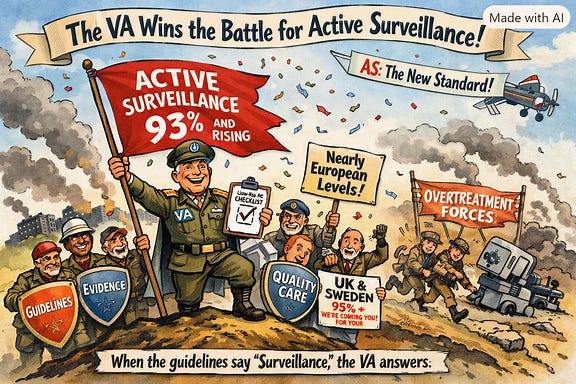
While some U.S. health systems still struggle to adopt Active Surveillance (AS), close monitoring for low‑risk prostate cancer, the VA has pushed AS rates to near‑European levels, approaching the 95‑plus percent seen in places like the United Kingdom and Sweden.
According to a new JAMA Research Letter, 93 percent of veterans with low‑risk prostate cancer now begin on AS. That’s not just improvement. That’s the sort of transformation we can and should see across America.
Among patients with Gleason 6 low-risk disease, rates of Active Surveillance use increased from 27% in 2005 to 93% in 2024.
Among patients with favorable intermediate risk, active surveillance rates increased from 14% in 2005 to 61% in 2024.
Wowser. Congrats, VA and salaried physicians.
The VA should be the model for the USA, but I fear that too many practitioners are lured by the sirens of the rich incentives for aggressive treatment
Matthew Cooperberg, MD, of UCSF, one of the authors of this study, reported, based on the AQUA database from the American Urological Association, in 2023 that AS nationally had reached 60% uptake—a remarkable public health achievement. When I started on AS, only 6-10% of us went on AS.
Do the math of how many patients still opt for definitive treatment.
The AQUA numbers have not been updated.
The VA study followed more than 73,000 veterans diagnosed with NCCN low‑ or favorable‑intermediate‑risk prostate cancer from 2005 through 2024, giving researchers a rare, nearly two‑decade view of how prostate cancer management evolves inside a massive, integrated health system.
In the early years, AS was a minority choice—barely a quarter of low‑risk patients were managed conservatively. But as guidelines shifted and evidence mounted, the VA shifted with them. By 2024, AS had become the default for low‑risk disease and a rapidly growing option for favorable‑intermediate‑risk cases.
The rise in AS wasn’t limited to the easiest cases. Even among intermediate‑risk subgroups—historically the gray zone where many U.S. clinicians reflexively treat—the VA showed dramatic movement. Veterans with Gleason Grade Group 2 disease involving fewer than half their biopsy cores and PSA under 10 increasingly landed on surveillance rather than the operating table. And men with Gleason 6 disease but PSA between 10 and 20 saw AS adoption soar. The VA didn’t tiptoe into guideline‑driven care; it embraced it.
Why did the VA succeed where so many community practices lag? The authors point to structural advantages baked into the system. There’s no fee‑for‑service pressure nudging clinicians toward surgery or radiation. Quality metrics are monitored and matter. Veterans tend to stay within the system rather than bouncing from doctor to doctor, reducing the “opinion shopping” that often leads to overtreatment. In short, the VA is designed—almost uniquely in the U.S.—to reward evidence‑based care rather than procedural volume.
But the story isn’t uniformly rosy. Even in a system built to level the playing field, disparities persist. Black veterans were slightly less likely to be placed on AS, as were Hispanic veterans and those living in areas of high socioeconomic deprivation. These gaps remained even after adjusting for clinical factors, suggesting that social and cultural dynamics still shape prostate cancer decisions, even when financial incentives do not. The authors call for “science‑driven interventions” to ensure that AS is offered equitably.
The study also sheds light on what drives AS decisions. Age mattered—older veterans were more likely to be managed conservatively. Time mattered—each passing year brought higher AS adoption, reflecting growing clinician comfort and guideline reinforcement. Grade mattered most—Gleason Grade Group 2 still sharply reduced the likelihood of AS. Interestingly, geography did not. Travel distance to VA facilities had no measurable effect on whether a veteran landed on surveillance, suggesting that barriers to AS are more social than logistical.
Across VA facilities, AS rates varied but generally trended high. Most centers achieved strong performance, especially for Gleason 6 patients diagnosed in the past decade. Only one facility stood out as a true outlier with markedly lower AS use. For a national system with enormous geographic and demographic diversity, the consistency is remarkable.
For patients, the implications are profound. The VA has shown what happens when a health system follows guidelines, removes incentives for overtreatment, and tracks quality. Veterans with favorable‑risk prostate cancer are overwhelmingly avoiding unnecessary treatment—something many men in community settings still struggle to access. The VA’s experience is the closest the United States has come to the European model, where conservative management is the norm rather than the exception.
The takeaway for The Active Surveillor community is clear: the VA has become a national leader in active surveillance, proving that guideline‑driven prostate cancer care is not only possible but scalable.
The system still has work to do—particularly in closing racial and socioeconomic gaps—but the headline is unmistakable. When prostate cancer is low‑risk, veterans overwhelmingly avoid overtreatment. And in doing so, the VA has quietly moved American prostate cancer care closer to the gold standard long set by Europe.
No posts
Comments
Nothing yet. Say the first thing.
Sign in to join the conversation.