
By Howard Wolinsky, Editor, The Active Surveillor
Edward Stourton spent more than four decades as one of the BBC’s most reliable narrators of British public life — calm in crises, sharp in interviews, and unmistakably authoritative behind the microphone.
His death on July 20 at age 68, after nearly a decade living with prostate cancer, landed with unusual force.
It wasn’t just the loss of a respected broadcaster. It was the latest chapter in a growing and troubling pattern, which is impacting UK broadcasters—a cluster of PCa diagnoses.
I’m not suggesting these diagnoses and deaths are a true cancer cluster. Rather, I think this just represents how common prostate cancer is and how open British society is about the most common solid cancer in men.

Stourton disclosed in his 2023 memoir Confessions that he had been diagnosed almost ten years earlier. He continued reporting even after doctors told him the cancer had spread and become incurable. He worked until he couldn’t — a hallmark of his career.
His death came just nine days after another prominent broadcaster, Dermot Murnaghan, died of stage IV prostate cancer at the same age.
Two respected journalists. Two deaths. Nine days apart.
For a disease often described as slow‑moving, this was a jolt.
Stourton’s death didn’t happen in isolation. It arrived amid a remarkable run of prostate‑cancer disclosures among BBC‑connected figures — a cluster that has grown steadily over the past three years and reached a crescendo this summer.
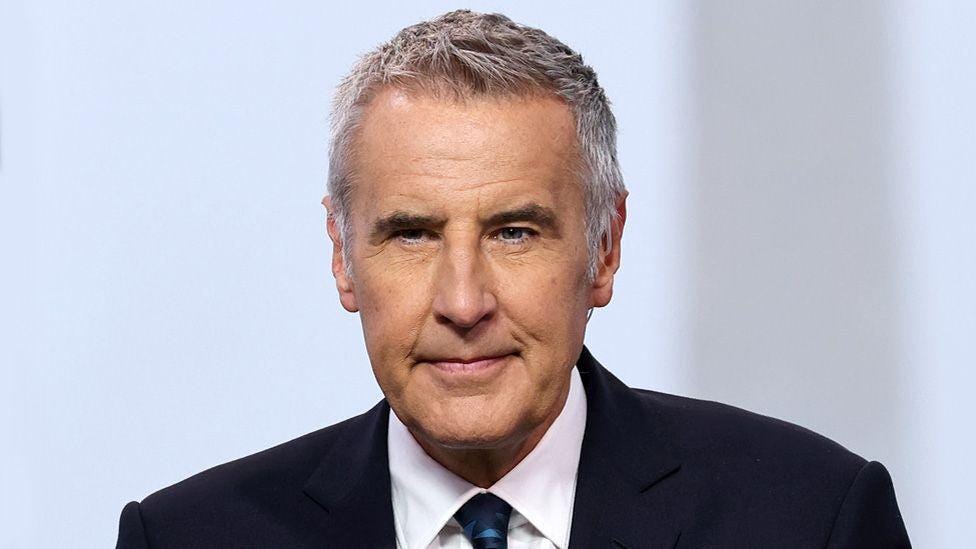
Dermot Murnaghan — former BBC Breakfast anchor; died July 11, 2026, after a year of public advocacy following his stage IV diagnosis.

Jeremy Clarkson — revealed in June 2026 that surgeons removed ~10% of his prostate using focal therapy for a “highly aggressive” early cancer.
Bob Harris (“Whispering Bob”) — announced in April 2026 that his long-managed cancer had metastasized to his spine.
Kenny Macintyre — BBC Scotland presenter; disclosed his diagnosis live on air in 2025, citing three uncles with the disease.
Jon Holmes — Radio 4 comedian; diagnosed in 2023 after a GP casually asked about family history.
Nick Owen — Midlands Today presenter; diagnosed in 2023, now in remission and hosting a prostate‑cancer awareness podcast.
Steve Rider — Grandstand/Sportsnight host; diagnosed in 2023, treated early and successfully.
Bill Turnbull — whose 2022 death at 66 triggered a documented spike in UK prostate‑cancer referrals.

A prostate cancer diagnosis seems to a rite of passage for UK male broadcasters.
Prostate cancer is the most common male cancer in the UK, with more than 60,000 diagnoses annually. But the concentration among broadcasters has amplified public attention in a way few awareness campaigns ever manage.
When trusted voices speak about prostate cancer, men listen.
When trusted voices die of prostate cancer, men act.
Stourton’s passing has poured fuel on a simmering policy debate: Who should be screened for prostate cancer — and when?
The UK does not have a national screening program. Instead, men must request a PSA test, and many don’t. The government’s advisory body recently proposed expanding screening only for:
Men with a BRCA2 mutation
Plus specific family history
That’s a tiny group — estimated at only a few thousand men.
The Telegraph, has been campaigning for a broader, targeted screening program: PSA testing for men over 50, Black men, and men with family history or high‑risk genes.
The cluster of broadcaster diagnoses has become Exhibit A in the argument that the current approach misses too many men — including men like Stourton, Murnaghan, and Turnbull.
Amid the grim headlines, one BBC figure has offered a different kind of story — one rooted in early detection and modern treatment.
BBC radio presenter Bill Buckley recently revealed he underwent High‑Intensity Focused Ultrasound (HIFU), a form of focal therapy that destroys only the cancerous portion of the prostate using high‑frequency sound waves.
(Clarkson and former UK PM Sir Davis Cameron also underwent focal therapy, which is not widely available to UK patients,)
Buckley’s diagnosis was accidental. He went to A&E with severe leg pain and was found to have one of the largest deep‑vein thromboses clinicians had ever seen. During follow‑up imaging, a nurse casually mentioned his prostate cancer diagnosis as he was leaving the room — assuming he already knew.
He didn’t.
Buckley, 67, enrolled in a clinical trial at Wexham Park Hospital and received HIFU. Researcher Tim Dudderidge, one of the trial’s leaders, told the BBC HIFU’s side‑effect profile is significantly lower because healthy prostate tissue and critical structures — including nerves for erections and continence — are largely spared.
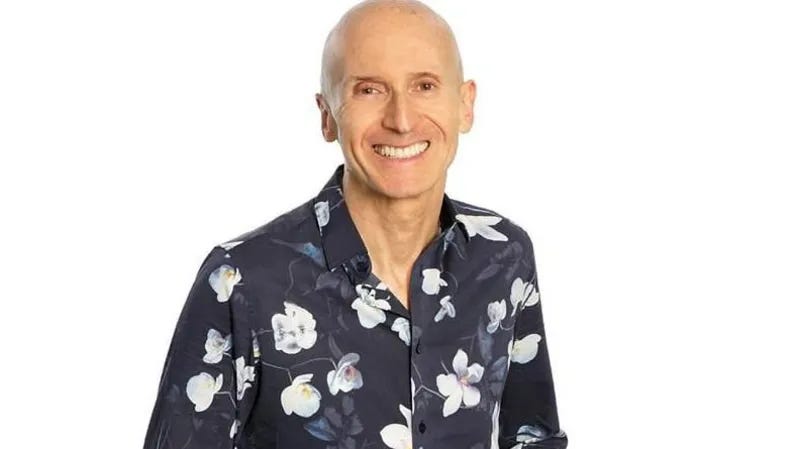
Buckley wore a catheter for a week, felt sore for a few days, and is now past the six‑month mark.
“I’m one of the very tiny number of people so far who have had this wonderful treatment… and I couldn’t have had it if I had been discovered to have cancer late.”
His story is a reminder: early detection preserves options — including focal therapy.
The broadcasters who’ve stepped forward represent a cross‑section of how prostate cancer behaves:
Slow and silent (Stourton lived nearly a decade with it).
Aggressive and unforgiving (Murnaghan’s stage IV diagnosis).
Caught early and treated successfully (Owen, Rider).
Found by accident (Buckley).
Found only because someone asked the right question (Holmes).
Their stories collectively highlight the central truth of prostate cancer:
Men don’t know they have it until they do. And when they do, the window for the least invasive treatments may already be closing.
Buckley puts it plainly: “The majority of men die with, rather than of, prostate cancer… You don’t even know you’ve got it.”
(Note: The trial Buckley was in has generated controversy:
The UK is at a crossroads. The deaths of Stourton and Murnaghan, the disclosures from Clarkson and Buckley, and the ongoing cases among other BBC figures have created a rare moment when public attention, policy debate, and personal stories are aligned.
The question now is whether health authorities will seize it.
Will the UK continue limiting PSA testing to a tiny BRCA2‑defined group?
Or will it adopt a broader, targeted screening strategy that reflects the real epidemiology — and the real stories of the men who’ve lived, worked, and died with this disease?
For now, the broadcasters’ voices — even in death — are doing what they always did best:
They’re informing the public.
They’re shaping the conversation.
And they’re reminding men everywhere that prostate cancer is common, often silent, and absolutely worth checking for.
Where are all the high-profile Americans with prostate cancer—especially those on Active Surveillance?
By Howard Wolinsky, Editor, The Active Surveillor
I swung by my friendly, neighborhood “urgent aid” hybrid — part ED, part revenue experiment, a step up from “urgent care” — because I had a burning sensation while urinating.
With a trip to Europe on the horizon, My Mission for ASPI, I’d prefer to spend my time not casing bathrooms like a bladder‑driven detective.
My caregiver, dressed in jeans and a T-shirt, introduced herself simply as “I’ll be your provider today,” which I gather meant she is a nurse practitioner. She looked at my urine sample, declaring it seemed to be bacteria-free.
She noticed I had been diagnosed with prostate cancer. And she shocked me when she told me she was shocked when I told her I had never treated the cancer.
I went on Active Surveillance on the advice of a University of Chicago urologist, who ran an AS clinic on the main campus in the Hyde Park neighborhood. It’s 16 years later and 25 miles away in my leafy suburb. This provider at UChicago’s Urgent Aid seemingly had never heard of Active Surveillance. Yikes.
I started to worry about whether I could trust her advice.
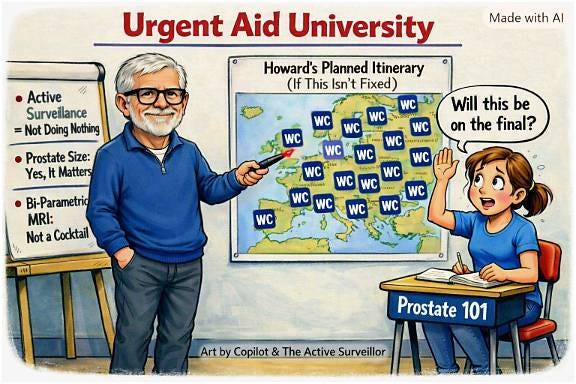
She suggested my oversized prostate might be acting like a dam in my urinary tract. Reasonable theory.
But when I mentioned the actual size — nearly 90 to nearly 100 grams, depending on which of my urologists (the prostate cancer one, or the kidney stone one) you asked— her face froze as if I’d just asked her to explain quantum computing. She said prostate sizes were meaningless to her.
Somehow, at UChicago’s own urgent‑care outpost, she’d unacquainted with AS.
My trust meter dipped.
Then, I mentioned my biparametric MRI. Another blank.
Suddenly, I was teaching Prostate Imaging for Beginners while sitting on an exam table.
She ordered the antibiotic Keflex and a urine culture. If it came back negative, she said she’d stop treatment,
But her unfamiliarity with prostate basics didn’t exactly scream “trust me.” I went in for urgent care, not to deliver a guest lecture.
Now I’m trying to get in with one of my urologists — the kidney‑stone guy — to determine whether this is an infection, a plumbing issue, or just another episode in the long-running sitcom that is my prostate.
Another Day in the Life of The Active Surveillor.
A fast‑moving area of prostate cancer research is gaining attention: the gut microbiome and its potential connection to prostate cancer. Early studies suggest gut bacteria may influence inflammation, metabolism, immune activity — even patterns seen in prostate cancer itself.
Join ASPI for a look at what researchers actually know — and what remains speculation — with urologic oncologist Dr. Michael Liss of UC San Diego, a leading voice in microbiome research and prostate cancer innovation.
Webinar: Saturday, August 22, 2026 • 12 PM Eastern
Where: Zoom — Register here: https://aspatients.org/event/gut-microbiome-prostate-cancer/
Thanks, Charlie!
No posts
Comments
Nothing yet. Say the first thing.
Sign in to join the conversation.