
Over the years, one of the more unfortunate things I’ve noticed in my office is that people rarely complain about their balance. They don’t often talk about their loss of ability… Instead, they tell me about the things they’ve stopped doing. This is part of the narrowing of people’s lives that I’ve often written about.
They no longer hike trails because ‘the ground feels uneven.’ They avoid ladders unless someone else is around. They instinctively reach for the handrail every time they walk downstairs. Some stop playing tennis or pickleball because they’re afraid of changing direction too quickly. Others tell me they look at every curb wearily before stepping off it. They are describing the narrowing of their lives… but they are blaming it on aging— not the loss of a critical ability. Balance.
As we have discussed often on these pages… We do experience some decline in our abilities due to aging, but we lose far more capacity due to our lack of practice or training.
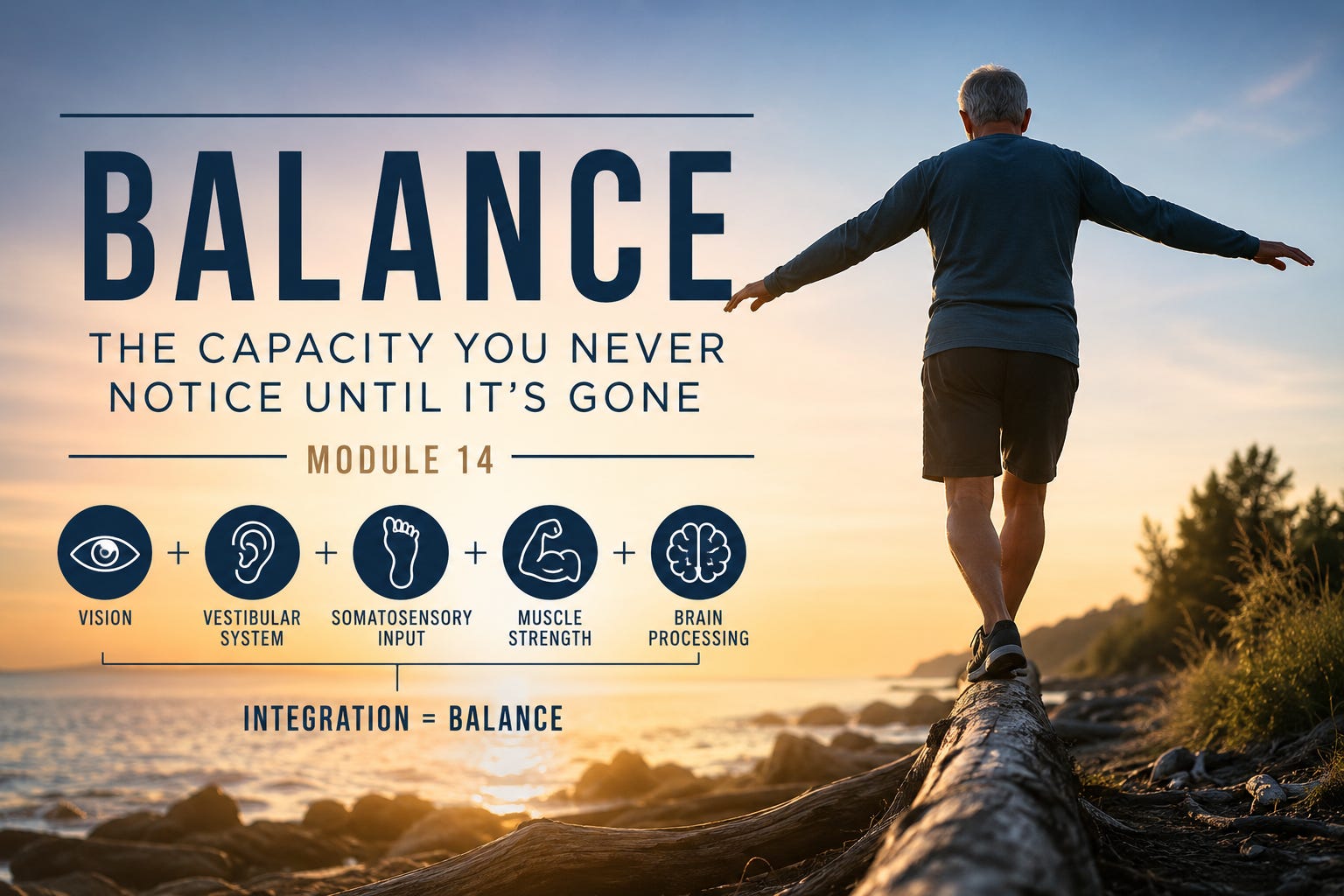
The longer I practice medicine, the more convinced I become that balance is one of the most misunderstood, ignored, yet vital physical capacities we possess. We tend to think of it as something our legs do. In reality, balance is something our nervous system creates. Every second you are standing upright, an extraordinarily complex conversation is taking place between your brain, your eyes, your inner ear, your muscles, your tendons, your joints, and even the soles of your feet. Balance isn’t a reflex. It’s the result of millions of pieces of information being gathered, interpreted, and acted upon almost instantaneously.
Every step begins with information. ‘Mechanoreceptors’ beneath the skin of your feet constantly measure pressure and tell your brain how your weight is distributed. Muscle spindles embedded within your muscles detect even tiny changes in muscle length and the speed at which those changes occur. Golgi tendon organs monitor force production, while receptors within your joints continuously report the position of your ankles, knees, hips, and spine. At the same time, your vestibular system in the inner ear detects acceleration and changes in head position, while your eyes provide a continuous stream of visual information about your environment.
It’s remarkable that your brain integrates all of this information within milliseconds, compares it with where it predicted your body would be, identifies any mismatch, and sends corrective signals back to the appropriate muscles before you are ever consciously aware that something has changed. By the time you realize you’ve stumbled, your nervous system is already trying to save you in a fraction of a second.
It’s an amazing system with remarkable abilities… but like everything else, it needs to be trained… otherwise, you will lose those protective capabilities.
For Members, there’s so much more to know! Balance training is mostly about rewiring the communication network between our brain and muscles.
We talk about developing an ability we’re losing, and an ability that could very well save your life one day. It’s that simple. Falls are a leading cause of death and disability. Once humans start falling, a very predictable storyline will start to unfold. And I have seen this story far too often to sit silently and ignore it. It’s not just facts that shape what I share with you. It’s the thousands of stories and clinical scenarios that I have seen develop in my small office over the last two decades.
If you’ve found value here, I’d welcome you as a member. It’s a very modest cost against the years of strength and independence this work is meant to protect.
I will repost two of our complete Saturday Action Plan posts on balance training below.
Comments
Nothing yet. Say the first thing.
Sign in to join the conversation.