
“It’s amazing… I’ve only lost three pounds, but my knees already feel better.”
I’ve heard and observed this countless times over the last few years. Since the use of GLP-1 medications has become more prevalent, my thinking about how much our metabolic health contributes to knee health has changed.
Most people assume it’s just the weight loss that improves their knee pain. Mechanistically, it makes sense: less weight means less force across the knee. Don’t get me wrong, weight plays a role… Every pound of body weight translates into 4-7 pounds of force across the knee with every step. But I have become far more convinced that the explanation is much deeper than simple weight and the forces that follow. Let’s remember, hand osteoarthritis is more common among people who carry extra weight. That alone should make you think that there’s something else going on other than just weight alone.

.
To understand why, we need to take a step back and ask a different question.
What actually determines whether a knee remains healthy over the course of a lifetime?
Most people assume there must be a single answer. There isn’t, and that’s why this is a multipart series on maintaining healthy knees.
I want you to understand that healthy knees are rarely the result of protecting them from life. More often, they are the product of building a healthier, stronger, and more metabolically resilient human being.
After more than thirty years of caring for knees, I’ve come to think of every patient as a unique combination of variables that have been interacting for decades. Some of those variables were determined before you were born. Genetics influences the quality of your cartilage, the shape of your bones, your alignment, your inflammatory response, and even your likelihood of developing arthritis. But many studies have shown that genetics doesn’t play as large a role as many suspect.
Other factors accumulate throughout life. An ACL tear changes the mechanics of the joint forever. A meniscus injury alters how load is distributed across the cartilage. Surgery to remove that tear makes it worse. Years spent kneeling for work, decades of recreational sports, prior fractures, muscle strength, body weight, and aging also factor into the equation.
Every one of those factors matters, but none of them alone tells the entire story.
If knee arthritis were simply the consequence of mechanical wear, everyone with the same alignment and the same X-rays would have similar symptoms. We know that isn’t true.
We also know that some people have severe pain and swelling with only mild osteoarthritis, but some people with advanced arthritis continue hiking, skiing, and traveling with surprisingly little discomfort. Others struggle to walk across a parking lot despite relatively modest changes in their imaging.
We now know that many lifelong runners maintain healthy knees, while some sedentary people develop severe arthritis despite placing far fewer miles on their joints.
Clearly, something more than mechanics is influencing what happens inside a joint.
Members get 50% off all my premium guides: the code is at the end
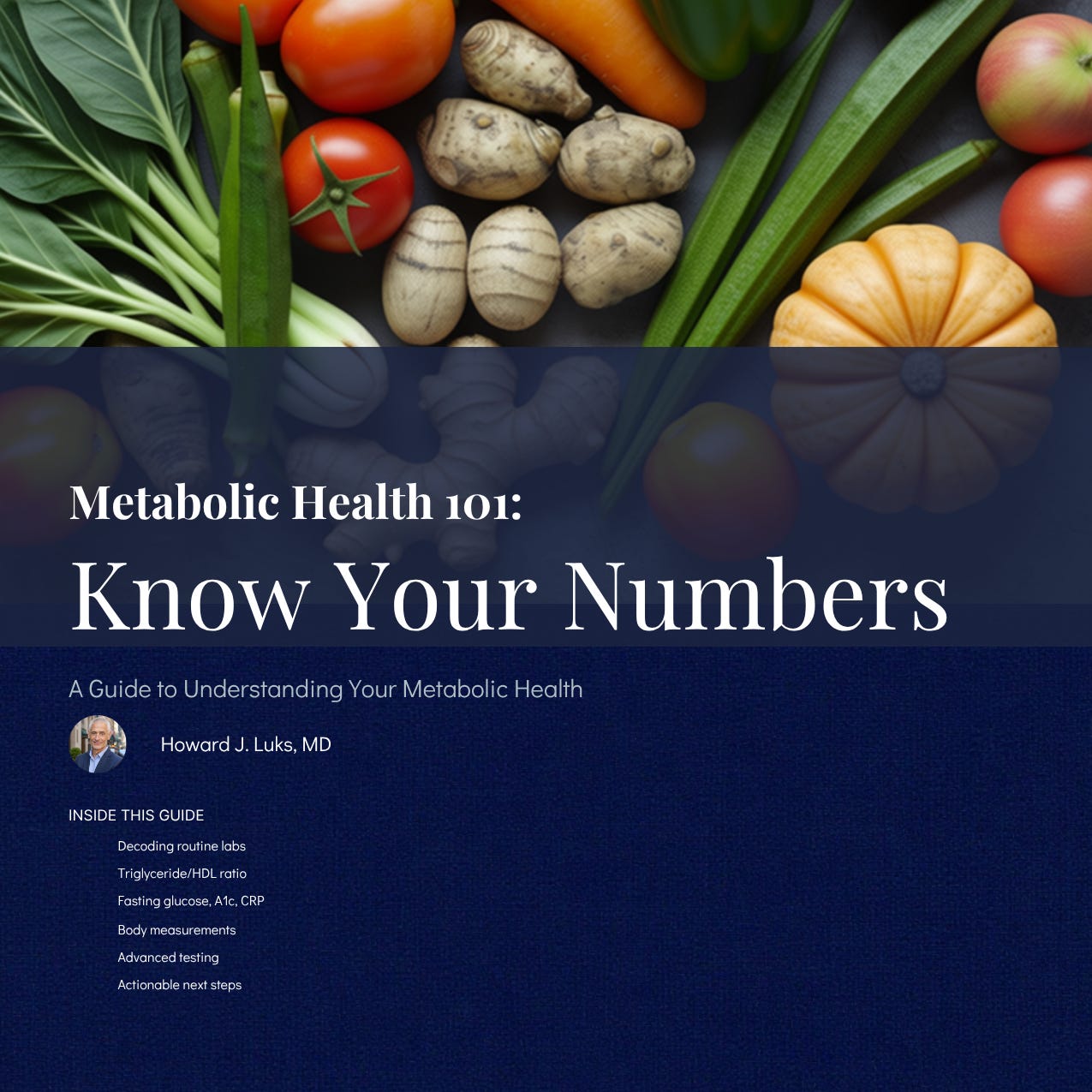
This guide explains what triglycerides, HDL, fasting glucose, A1c, hs-CRP, waist-to-height ratio, fasting insulin, HOMA-IR, and advanced testing can actually tell you when viewed together. It includes practical reference ranges, clear explanations, and actionable next steps so you know what to ask for, what to track, and which patterns to prioritize first.
For members, in part two of this multi-part series, I will continue to lay the groundwork for why the concept of wear and tear is outdated and often wrong. In this piece, we go into how your metabolic health and the presence of systemic inflammation play a role in not only the onset of osteoarthritis, but its progression and severity, too.
Instead of asking, “How do I keep my knees from wearing out?” we should be asking: How do I create the biological environment where my knees can continue to adapt, repair, and thrive?”
Let’s do this…
Comments
Nothing yet. Say the first thing.
Sign in to join the conversation.