
Last week, I attended a conference in San Francisco. On stage, the CEO of an AI lab shared a sentence someone had recently told him:
“Maybe atrophying people’s brains is the price we pay for curing Alzheimer’s with AI.”
Sentences like this sound brutal–this is a real tradeoff. If AI helps us make scientific breakthroughs, cure diseases, extend life, discover new mathematics, and accelerate knowledge itself, then perhaps individual cognitive decline is the cost of admission. Humanity grows more powerful while humans grow weaker.
The timing made the question urgent. That same week, OpenAI announced that one of its models had disproved a long-standing conjecture in combinatorial geometry: the planar unit-distance problem, first posed by Paul Erdős in 1946.
The question becomes unavoidable. Does AI helping humanity flourish have to mean shrinking the individual?
I reject the idea that the price of that future has to be the diminishment of the people living in it.
A more intelligent civilization should not require less capable individuals. Curing Alzheimer’s should not mean accepting that healthy people stop thinking for themselves.
The tradeoff is a design choice.
In Plato’s Phaedrus, Socrates tells a story about the invention of writing. The Egyptian god Theuth presents writing to King Thamus as a gift: a technology that will improve memory and make people wiser. The king is suspicious. Writing, he argues, will weaken memory rather than strengthen it, making people dependent on marks outside themselves. They will appear knowledgeable without having understood.
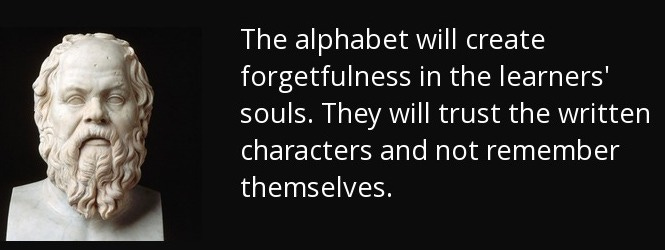
It is hard to read that passage today without smiling. Writing did weaken certain forms of memory. Most of us can no longer recite long epics, genealogies, laws, or sacred texts the way people in oral cultures had to.
And yet writing did not make humanity stupid, it gave permanence to ideas.
A person born centuries later could argue with Plato, learn from Euclid, read Dostoevsky, improve upon Newton, or fall in love with a sentence written by a stranger from another century. We lost some dependence on memory and gained an enormous new capacity: the ability for human thought to accumulate across time.
Every transformative technology changes which cognitive skills matter.
Books reduced the need to carry entire libraries in our heads, calculators retired long computation by hand, and GPS replaced the skills required for navigation. Technology has always replaced some forms of mental labor; there is a reason my mother who did not grow up with GPS in her hand can tell you every back road direction and I cannot. I am fine with that, I have Waze.
What matters is what AI makes possible in us, and what it forecloses without ever announcing it.
AI makes that question more urgent than any previous technology because it can explain, persuade, recommend, anticipate, generate, decide, and increasingly act for us.
Earlier technologies left the interior of your life alone: calculators don’t ask what kind of life you want, books don’t reshape themselves around your weaknesses, maps don’t decide where you might want to go.
AI can do all three. The real question is whether it leaves us more capable of authoring our own lives.
When people say they’re afraid AI will atrophy their brains, they are talking about more than raw intelligence.
They are afraid of becoming people who can no longer sit with a hard problem, can no longer tell which ideas are theirs, and eventually lose the desire to act unassisted at all.
Underneath that fear are two human capacities: autonomy and agency.
Autonomy is deciding what you want. It is the capacity to reflect on your values, your goals, your preferences, your commitments, and to feel that the direction of your life is yours.
Agency is making it real. It is the ability to act in the world, to turn an intention into a plan, a plan into a decision, and a decision into something that exists.
Autonomy asks: Is this what I want? Agency asks: Can I do something about it?
You can have one without the other.
A person may know what life they want but lack the money, information, confidence, or tools to pursue it. That is autonomy without agency.
A person may be effective at producing, achieving, responding, and executing while being guided by incentives, habits, algorithms, or pressures they never chose. That is agency without autonomy.
A good life requires both: I know what I choose, and I have the power to act on it.
The best AI helps people understand what they want and gives them new power to pursue it; while the worst does the opposite: it makes people capable of executing someone else’s agenda while leaving them less able to identify or defend their own.
I grew up in Morocco where some of the people I know from my village work on farms. For years, when they negotiated wages with landowners, the imbalance was informational as much as financial.
The landowner knew more: what similar work paid elsewhere, how much bargaining room existed, what language to use, what rights to invoke, what alternatives existed. The worker came to the negotiation with labor and not much leverage.
Now some of those same people pull up ChatGPT before they sit down. They ask what a fair wage looks like, how to make their case, what arguments to use, what questions to ask, and what they shouldn’t agree to too quickly.
Nothing about that makes them less intelligent. They are walking into a negotiation with access to the strategic thinking and contextual knowledge that used to live on the wealthier side of the table.
To me, that is autonomy made visible.
For most of history, expertise has been concentrated inside wealthy institutions, elite educations, expensive professional networks, and a short list of passports, accents, and zip codes.
We should not mistake that concentration for the natural order of things.
Giving ordinary people access to intelligence, strategic advice, and the ability to question authority is the correction of an old imbalance.
I see the same thing with agency.
My friend Sara always wanted to make perfumes. She has taste, ideas, and a clear sense of what she wanted to make. The distance between imagining a fragrance and selling one felt impossibly large. She did not know how to begin, which laboratory to contact, how ingredients were sourced, how a bottle was designed, how a label became real, or how to build a website.
Then she started using AI to understand the process: what kind of laboratory she needed, what questions to ask, how production worked. Once she had her first fragrance, she used image-generation tools to design the bottle and label. Instead of one expensive first attempt, she could iterate, testing and refining until the object in front of her resembled the one in her head.
She used Codex to build a website, even though she does not code.
Two weeks ago, she sold her first bottle.
Her story moves me. An idea that might have lived and died inside her head is now a real object on a shelf, and AI built the bridge between the two.
All along her creativity was intact as she gained an execution layer for it.
For decades, starting a company, designing a product, building a website, producing a brand, or testing an artistic idea required a small organization: designers, engineers, consultants, marketers, people with specialized skills and enough money to hire them.
A single person with an idea can now reach those capabilities themselves.
Human agency is exploding outward into hands that never held it before.
The child in a small town, the farmer in Morocco, the woman who wanted to make perfume, the person who never set foot inside the institutions where expertise lived: all of them can now move from ‘one day’ to ‘day one.’
That possibility is enormous.
There is a version of AI that makes people smaller, and it arrives when AI begins replacing the capacities we most need to protect: the ability to form an intention, endure uncertainty, develop judgment, arrive at a belief, cultivate taste, and decide what is worth wanting.
Dependency rarely announces itself as dependency. It arrives as convenience.
It starts small. The AI helps you write an email, and soon it is writing the opening line of every email you send. You ask it to help you think through a hard decision, and somewhere along the way you stop knowing what you think until you have asked. A song recommendation here, a restaurant there, and without anyone marking the moment, the system itself is the one deciding what enters your attention, which goals feel urgent, which relationships you nurture, and which possibilities you never encounter.
There is a difference between an AI that helps you pursue a goal you chose and one that becomes very good at choosing them for you; between an AI that teaches you to reason through a hard question and one that makes the question disappear before you can grow from it. Assistance and surrender are not the same thing, even when they look identical from the outside.
The familiar framing of the question isn’t precise enough. Asking whether AI will make us smarter or dumber misses what matters.
AI will make us more capable in many ways. The deeper question is whether the capacities that remain human are the ones that keep us self-directed.
Someone generating ten thousand outputs a day who no longer knows which ones matter isn’t flourishing. The same is true of a person whose life becomes frictionless while their desires are shaped by systems they don’t understand, or of someone who can accomplish anything while the machine is running but nothing the moment it stops.
The goal cannot be to maximize what people produce with AI. It must be to ensure that, over time, people become better at understanding themselves, making meaningful choices, developing skills they care about, and acting on their own values.
People sometimes treat agency, autonomy, and human flourishing as beautiful but vague ideas, appropriate for essays and philosophy departments but too abstract for scientists or engineers.
I disagree.
Autonomy and agency are human capacities, and human capacities can be studied.
We already measure whether models are accurate, persuasive, safe, useful, fast, engaging, and able to complete tasks. We can also measure whether the systems we build leave people more self-directed or less so.
After repeated use of an AI system, does a person feel clearer about their own goals, or more dependent on the system to tell them what matters?
Does the system help users build transferable skills, or does performance collapse the moment the tool is removed?
When the AI gives advice, does the user understand and endorse the decision, or just follow it because the system sounded confident?
When a system becomes proactive, interrupting and recommending and intervening, is it doing so in service of goals the person chose? And can the person still refuse it, revise it, or change direction?
These are empirical questions, and the companies building AI should take responsibility for answering them.
Human flourishing cannot be a slogan slapped onto the end of a product launch. It has to become a property we test for, design for, and refuse to sacrifice.
Builders are only half of the equation. The rest of us have to learn how to use these systems well.
Earlier this week, I was on a flight back from Paris. I began chatting with a flight attendant, and she asked me a question I hear more and more lately:
“Well, you’re one of the people building this technology. What’s your rule for making sure it doesn’t make us all dumber?”
I thought about it for a moment.
Never let AI be your first pass. And never let it be your last pass.
The first pass should be yours.
Before asking a model to write something, try to write it. Sit with the hard question yourself before asking what it thinks. Attempt to find your own idea before letting it search for one, and form an instinct about what you find beautiful before letting it design for you.
Your first attempt may be bad. It may be incomplete, clumsy, badly expressed, even embarrassing.
That is fine.
Trying to beat the AI misses what’s at stake. What matters is that your curiosity, your confusion, your taste, your intuitions, and your original angle on the world are still in the room.
Then let the AI help.
Let it generate variations, explain what you don’t understand, run calculations, write code, search possibilities, organize information, handle drudgery, test alternate approaches, and help bring your idea into form.
Use it ambitiously, joyfully, to attempt things that used to be out of reach.
Then take the pen back. The last pass must also be yours.
You decide what is true, what is beautiful, what fits your values, what carries your name, and what you want to put into the world.
This does not mean clinging to every old skill. People do not have to perform every tedious calculation by hand, format every document themselves, or refuse help with tasks that were never meaningful in the first place.
Technological progress rearranges the cognitive skills society rewards.
There was a time when a prodigious memory was essential, not just impressive. In oral cultures, a person who could remember law, genealogy, poetry, religious teaching, and practical knowledge was part archive, part institution. Writing changed that, printing changed it again, and search engines changed it once more.
AI will change it, too.
Some skills will matter less, others will matter far more.
The answer is to develop the capacities that let us stay human in a world of abundant intelligence: judgment, curiosity, self-knowledge, critical thinking, moral imagination, courage, taste, and the ability to act on what we value.
I keep returning to the sentence I heard in San Francisco: “Maybe atrophying people’s brains is the price we pay for curing Alzheimer’s with AI.”
I understand why it lands. It captures a fear many people feel but struggle to articulate: that AI may give humanity extraordinary power while leaving individual humans diminished inside the world it creates.
That isn’t the future we have to build.
We do not need an AI that cures disease while making healthy people passive.
The promise is that more people, from more places, with fewer inherited advantages, will understand the world, imagine alternatives, choose with less friction, and turn their intentions into reality.
That future is worth measuring and one that we should all refuse to compromise on.
From Houda,
With Love
No posts
Comments
Nothing yet. Say the first thing.
Sign in to join the conversation.