
If anything about the AI bubble these days, is the omnipresence of the word maxxing: token-maxxing, context-maxxing, Claude-maxxing, brain-maxxing, life-maxxing.
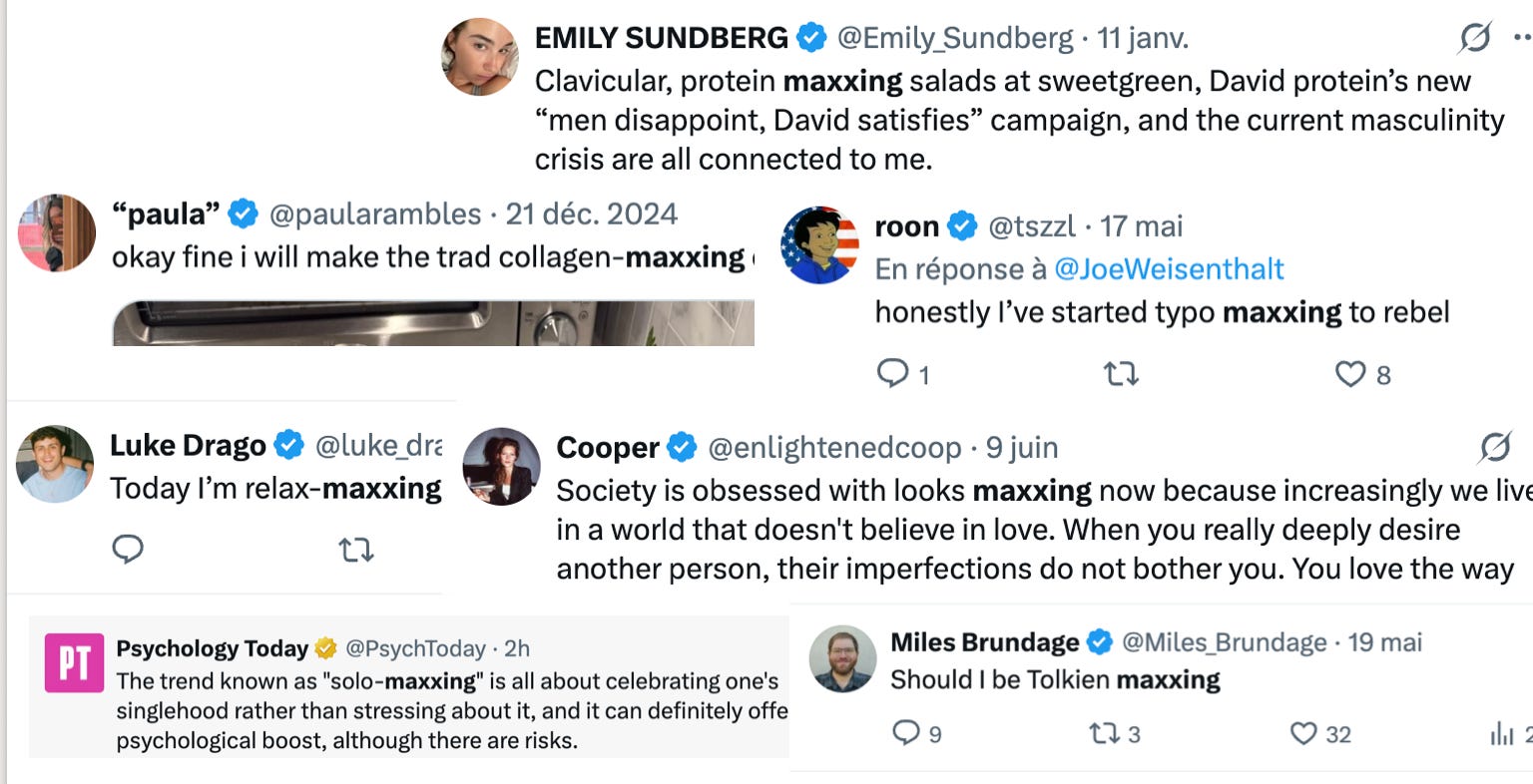
On one level it is just a meme suffix, and on another, it is a small piece of grammar that captures a historical mood: a world in which more and more of life appears improvable, measurable, and therefore, by definition, inadequately optimized.
AI intensifies this feeling. When intelligence stops being scarce and execution becomes practically free, the opportunity cost of an idle hour explodes. During the hour in which you did nothing, you could have written something, built something, learned something, or instructed a model to produce something that did not exist before.
Leisure is no longer simply leisure. It is haunted by a parallel, counterfactual life.
So it is unsurprising that human beings, outstanding adapters that we are, start to optimize around that haunt. Time has never felt this precious. Skills go obsolete in months. GPUs spin out infinite drafts on command. In an economy where the marginal cost of doing approaches zero, the scarce inputs are no longer tools and talent but access to the technology and the time we spend telling it what to do. Algorithms still need us to point them somewhere.
If that sounds exhausting, consider that we are now optimizing the escape from optimization itself. Open X, the social network we all despise yet refuse to quit, and you will find, alongside the prompts and the token hacks, talk of health-maxxing, longevity-maxxing, and, recently, fun-maxxing. Even my all-time favorite pop star Dua Lipa has gotten in on it.
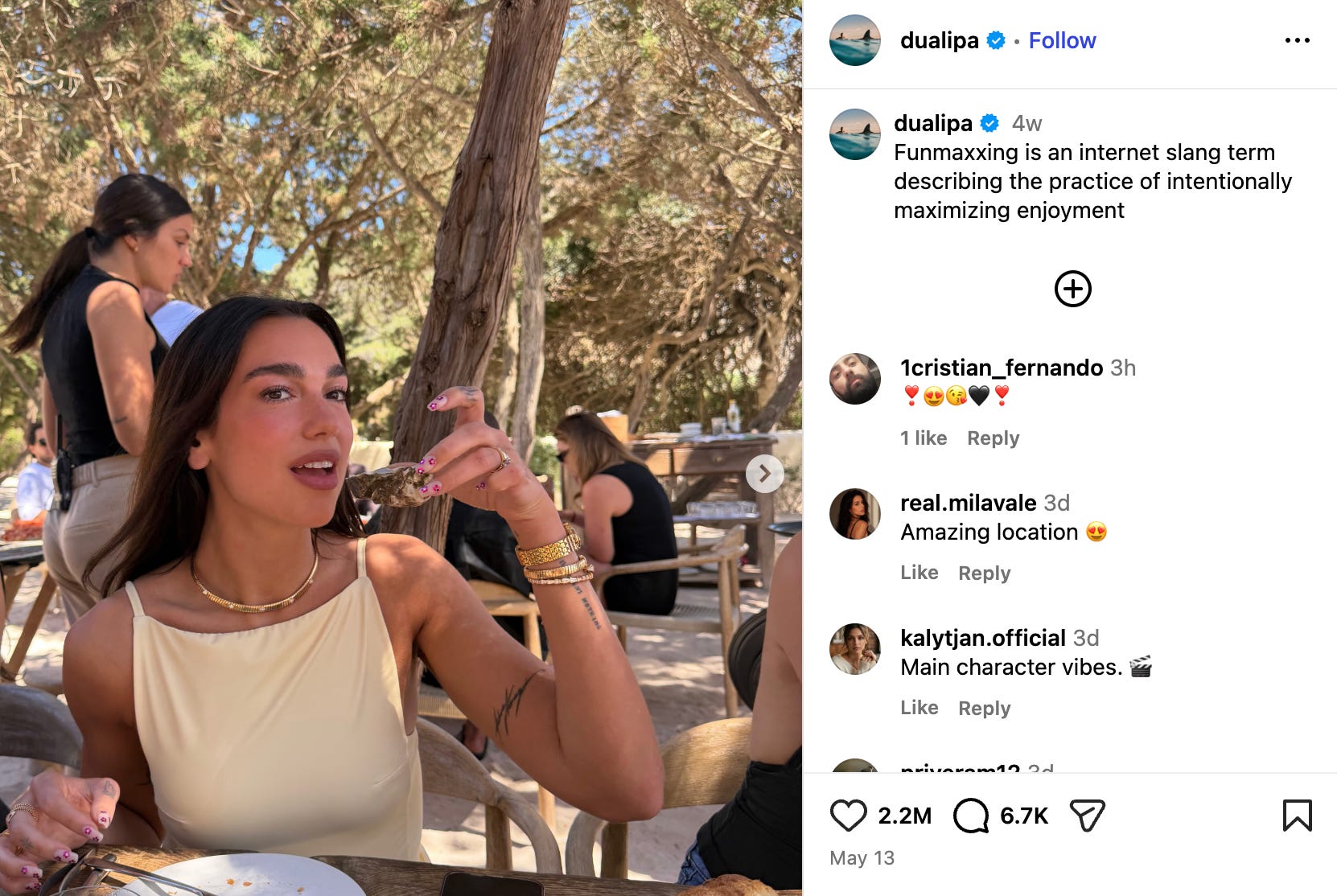
Fun-maxxing, at first reading, seems pretty harmless. Who would object to deliberately having fun? What is novel is exactly what Dua’s post makes explicit: intention. You do not simply have fun because you stumbled into a good night. You choose, in advance, to maximize fun per unit of time. You schedule enjoyment like a dentist appointment.
Alan Watts once remarked that the desire to improve yourself is often the very thing that prevents you from being yourself.
Happiness, joy, even relaxation obey a similar logic: the harder you pursue them as objectives, the more elusive they become. Traditionally, fun arrives sideways. It emerges from an unplanned conversation, a dinner that runs too long, a wrong turn, a missed train, a stranger. Fun-maxxing reverses that logic. Enjoyment is no longer a byproduct of being alive. It becomes a target, pursued intentionally, measured retrospectively, and inevitably optimized again next weekend.
This is a radical departure from serendipity, carelessness, and what the French call l’art de ne rien faire. In nineteenth-century Paris, the flâneur was almost a cultural hero. Baudelaire described him as “a kaleidoscope gifted with consciousness”: someone who wandered the city with no destination, absorbing life as it unfolded like Owen Wilson in Midnight in Paris. The destination was irrelevant, and the noticing was everything.
We have gone from bringing people soup when they feel sick to mailing letters to making phone calls to sending texts to sending ‘thumbs up’ reactions. Each compression felt like efficiency. Each one also closed off something that could not be recovered when you are sitting on someone’s couch with them. Hanging, wandering, or just simply being present without purpose has undergone the same compression: it increasingly feels like a failure of optimization, rather than a different relationship to time.
Economists might be satisfied. At last, the species is behaving like the rational agents of the textbook: carefully allocating scarce resources toward maximum utility. But some of the most meaningful parts of existence, friendship, art, falling in love, three-hour lunches, derive their value precisely from their inefficiency.
Part of this is practical as time really has become more valuable when technology obliterates the barriers to making things. Part of it is existential.
For a long time, human meaning came from qualities we believed set us apart: intelligence, creativity, language, judgment, empathy. Artificial intelligence has not merely given us another tool. It has made many of those qualities feel less exclusively ours. When the capabilities around which we organized our identity become abundant, what remains under our control?
One option is the optimization of the self. We may not be the most capable entity in every domain, but we can still optimize the body, the morning routine, the community stack. Eating salmon becomes salmon-maxxing. Sleeping becomes sleep-maxxing. Having friends becomes community-maxxing. Ordinary acts are renamed as deliberate projects of self-construction. The suffix gives us back a sense of agency. It transforms us from people to whom life happens into engineers of our own becoming.
Beneath that engineer’s confidence is, I think, terror at uncertainty. Milan Kundera wrote that “there is no means of testing which decision is better, because there is no basis for comparison.” We live only once and cannot compare the life we chose with all the lives we declined. Optimization culture denies this. It assumes that somewhere, hidden in the search space, there is a correct answer: the right career, the right partner, the right city, the right use of a Saturday afternoon. If we process hard enough, we will find it. Maxxing may therefore be less about efficiency than about avoiding one of the most uncomfortable truths of being human: we must commit without ever knowing what the optimal choice would have been.
The comedy reaches its apex when even anti-optimization gets optimized. Europe-maxxing and Mediterranean-maxxing promise long lunches, late mornings, cafés, cigarettes, and hours of doing apparently nothing, scheduled, of course, in your Google Calendar. More recently we have invented friction-maxxing: deliberately adding inconvenience to resist excessive convenience. So now we optimize inefficiency. We strategically plan spontaneity. We maximize our exposure to the unmaximized. Even rebellion arrives as another optimization protocol.
If this sounds like the voice of a critic, here is my confession: I am describing a trap I built for myself. I have long been the person who maxxes out every working hour and every holiday hour, surfing between calendars with all the grace of a retaliatory algorithm.
I find something intoxicating in living at the extremes, the fantasy that by intensifying every experience I might fit several lives inside one. AI has made it worse. It compressed our relationship to time, to productivity, and to our sense of what a day is worth.
The result is that rest begins to feel like performance. A holiday must be the best possible holiday. A dinner must justify the evening it consumed. Fun must earn the hours it stole from work.
It is possible to become so determined to live fully that you lose the ability simply to live.
In the not-so-distant future, our personal AIs will know our obligations, ambitions, relationships, sleep patterns, blood glucose, and calendar. They will life-maxx on our behalf. They will allocate every opening toward whatever activity appears most likely to improve us, recommend whom to call, what to read, when to exercise, where to travel, and which invitation to politely decline.
The calendar will become another recommendation feed; only this time, the content being recommended is you.
Perhaps these systems will make good choices. That may be the problem. In a life where every decision has been optimized, what space remains for experiences whose value could not have been predicted in advance? Serendipity will become a luxury good. People will literally pay to get lost, to meet strangers, to enter restaurants they have not researched, and to spend afternoons that produce no measurable benefit. We will design disturbances into our perfectly arranged lives because disturbance will be one of the few remaining ways to encounter something an algorithm did not already anticipate.
When intelligence is abundant, the scarce resource will not be knowledge or capability or even time.
It will be the unplanned.
And we will probably find a way to maxx that too.
– With Love,
Houda
No posts
Comments
Nothing yet. Say the first thing.
Sign in to join the conversation.