
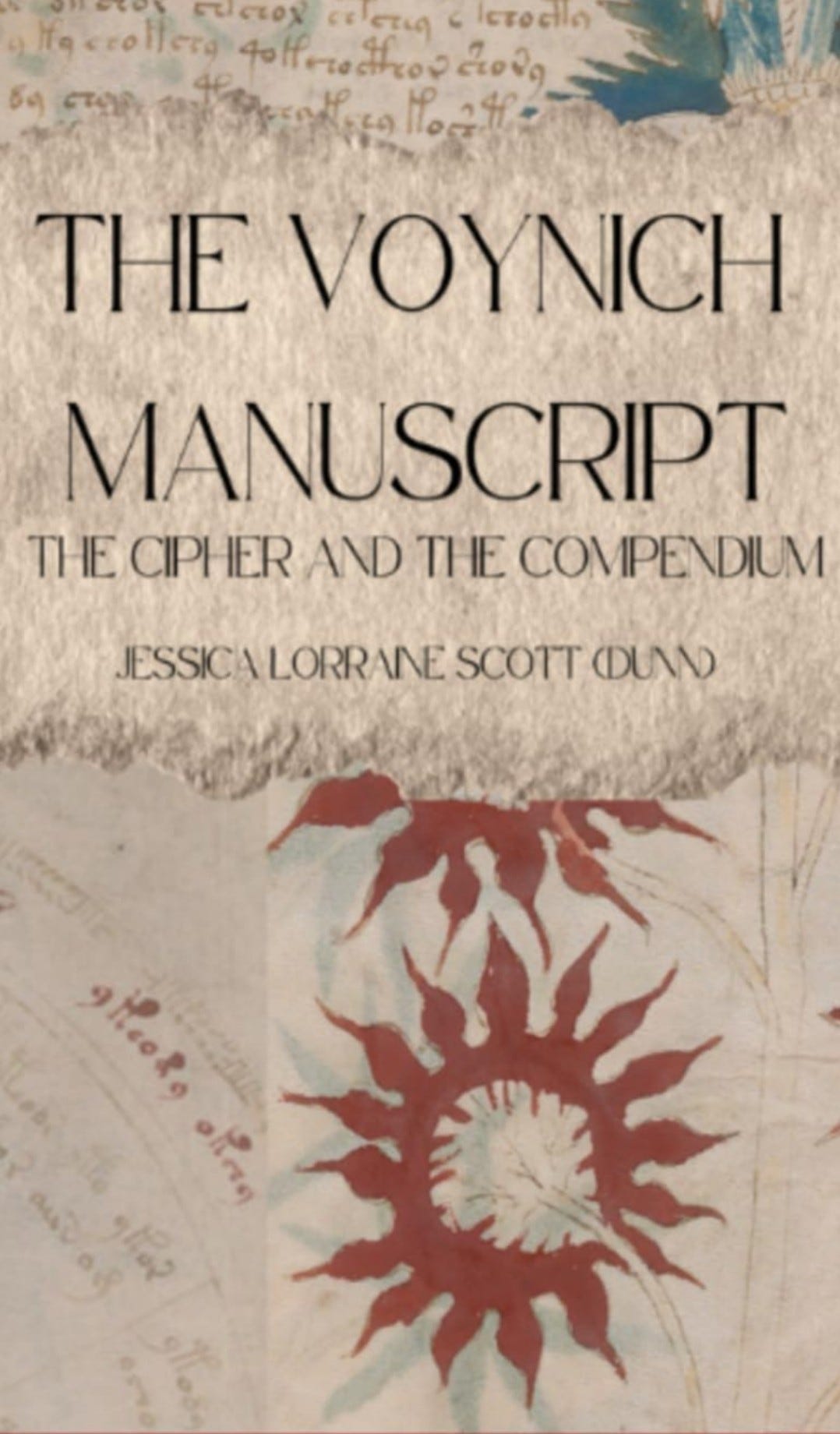
The Voynich Manuscript has attracted proposed solutions for more than a century. Yet recognising a plant, identifying a symbol or matching one illustration to a known tradition is not the same as explaining the manuscript as a whole.
That distinction lies at the centre of Jessica Scott Dunn’s The Voynich Manuscript: The Cipher and The Compendium.
Any convincing interpretation of the Voynich Manuscript must account for more than its mysterious script. It must also explain its plants, circular diagrams, human figures, vessels and physical organisation.
Jessica Scott’s book makes this comprehensive claim. Presented as the full study behind her paper on Folio 78v, it argues that the manuscript’s apparently disconnected features belong to a single intellectual system rather than several unrelated traditions.
This is an ambitious approach.
Many Voynich theories begin with a single resemblance: a plant that appears familiar, an alphabet that looks similar or an illustration that recalls European astrology or medicine. The danger is that resemblance can become identification, after which the rest of the manuscript is interpreted to support the original assumption.
Dunn instead asks readers to consider the manuscript as an integrated work. Its botanical images, cosmological diagrams, healing figures and abbreviated writing are interpreted through the same cultural framework.
That gives her argument an important strength. A successful explanation should connect different sections of the codex rather than solving one page while ignoring the rest.
But comprehensiveness also creates a greater burden of proof.
A unified theory must show that its comparisons are historically plausible, consistently applied and specific enough to exclude competing interpretations. Coherence matters, but an elegant system is not necessarily a proven one.
The key question is therefore not simply whether Dunn has “solved” the Voynich Manuscript. It is whether she has created a framework strong enough to change what a credible solution should look like.
The paid subscriber’s section examines why Folio 78v matters, where Dunn’s argument is most consequential and what evidence would be required for the wider field to accept such a sweeping reinterpretation.
Comments
Nothing yet. Say the first thing.
Sign in to join the conversation.